

Precalculus - Polynomial and Rational Functions
- Mathematics
- Texas A&M University
- 11 pages
- Shared March 2026
Preview 4 of 11 pages
See the first 4 pages exactly as they appear in the document.
Page 1 Read page 1 as text
Study Guide Precalculus – Polynomial and Rational Functions 1. Factoring Polynomials Factoring is like undoing multiplication . Instead of multiplying expressions together, you break a polynomial into simpler parts whose product gives you the original expression. Factoring is one of the most important skills in algebra. It helps you: • Solve higher - degree equations • Simplify expressions • Understand how polynomials are built You may already know some factoring, but this chapter reviews the key methods you should be comfortable with. 1. Greatest Common Factor (GCF) The greatest common factor is the largest factor that divides every term in a polynomial evenly. If all terms share one or more common factors, you can factor them out just like you would factor numbers. How to find the GCF: 1. Look at the numbers in each term. 2. Look at the variables and take the smallest power they all share. 3. Multiply those together. Example 1: Factor the expressions (a) Each term is divisible by 5 and x , so the GCF is 5x .
Page 2 Read page 2 as text
Study Guide Factor it out: (b) The largest factor shared by all terms is: Factor it out: 2. Factoring by Grouping Sometimes, the greatest common factor is not just a number or variable , but an entire expression in parentheses. In these cases, you: 1. Group terms together. 2. Factor each group. 3. Look for a common binomial factor. Example 2: Factor the expressions (a) Every term contains ((x - 5)). Factor it out:
Page 3 Read page 3 as text
Study Guide (b) There is no single GCF for all four terms, so group them: Factor each group: Now factor out ((x - 2)): 3. Factoring Quadratic Trinomials One of the most common factoring tasks is rewriting a quadratic trinomial as the product of two binomials. When the leading coefficient is 1 Use this method when the expression looks like: Find two numbers that: • Add up to the middle coefficient • Multiply to the constant term Example 3 (a)
Page 4 Read page 4 as text
Study Guide We need two numbers that: • Add to ( - 4) • Multiply to ( - 12) Those numbers are ( - 6) and (2). So the factorization is: (b) The numbers that add to ( - 10) and multiply to (24) are ( - 6) and ( - 4). So: When the leading coefficient is not 1 Now the expression looks like: You still look for two numbers that: • Add to the middle coefficient • Multiply to (a \ times c) Then rewrite the middle term and factor by grouping. (c) Multiply the leading coefficient and constant:
7 more pages in the full document
Unlock it once and it stays in your library, ready to chat with or turn into flashcards.
Unlock the full documentMore Mathematics study materials
See all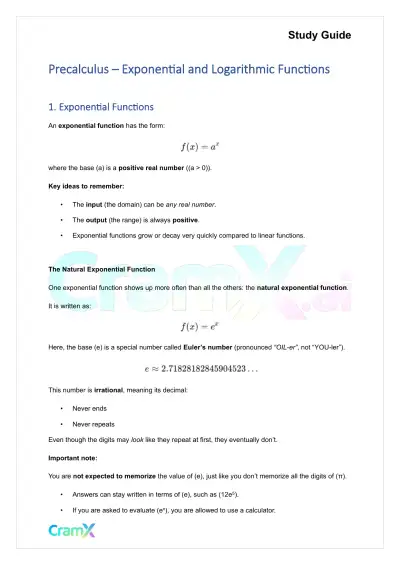 Quick Guides
Precalculus - Exponential and Logarithmic Functions
Mathematics
10 pagesMar 2026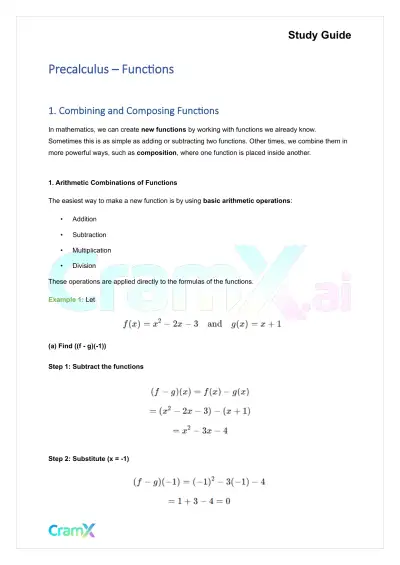 Quick Guides
Precalculus - Functions
Mathematics
14 pagesMar 2026 Exam Guides
Test Bank for Precalculus, 6th Edition
Mathematics
1051 pages175downloadsFeb 2025 Textbook Guides
Solution Manual For Introduction To Management Science, 11th Edition
Mathematics
437 pages167downloadsFeb 2025 Textbook Guides
Solution Manual For Derivatives Markets, 3rd Edition
Mathematics
358 pages143downloadsFeb 2025 Textbook Guides
Solution Manual for Geometry, 1st Edition
Mathematics
446 pages141downloadsFeb 2025 Textbook Guides
Solution Manual for Beginning Algebra, 7th Edition
Mathematics
479 pages139downloadsFeb 2025 Textbook Guides
Solution Manual for Developmental Mathematics, 1st Edition
Mathematics
1623 pages137downloadsFeb 2025
Study this document with CramX
Once it is in your library, every tool can work from it.