

Precalculus - Functions
- Mathematics
- Texas A&M University
- 14 pages
- Shared March 2026
Preview 5 of 14 pages
See the first 5 pages exactly as they appear in the document.
Page 1 Read page 1 as text
Study Guide Precalculus – Functions 1. Combining and Composing Functions In mathematics, we can create new functions by working with functions we already know. Sometimes this is as simple as adding or subtracting two functions. Other times, we combine them in more powerful ways, such as composition , where one function is placed inside another. 1. Arithmetic Combinations of Functions The easiest way to make a new function is by using basic arithmetic operations : • Addition • Subtraction • Multiplication • Division These operations are applied directly to the formulas of the functions. Example 1 : Let (a) Find ((f - g)( - 1)) Step 1: Subtract the functions Step 2: Substitute (x = - 1)
Page 2 Read page 2 as text
Study Guide Answer: ((f - g)( - 1) = 0) (b) Find ( f/g)(x) Step 1: Write the division Step 2: Factor the numerator Step 3: Simplify This simplification is valid only if (x ≠ - 1), because division by zero is not allowed. Answer: Important Note: The domain of this new function is all real numbers except (x = - 1) . This restriction comes from the denominator, even though both original functions are defined for all real numbers. 2. Composition of Functions Now let’s look at a different way to combine functions. What Is Function Composition?
Page 3 Read page 3 as text
Study Guide Function composition means plugging one function inside another. • Written as: • This means: 1. Start with (x) 2. Apply (g) 3. Take that result and apply (f) Composition can also be written as: Example 2 : Let (a) Find (f(g(x))) Step 1: Replace (x) in (f(x)) with (g(x)) Step 2: Substitute into the formula Step 3: Simplify
Page 4 Read page 4 as text
Study Guide Answer: (b) Find (g ∘ f)(4) This means find g(f(4)). Step 1: Find (f(4)) Step 2: Substitute into (g(x)) Answer: (c) Find ((f ∘ f)(x)) Step 1: Replace (x) in (f(x)) with (f(x)) Step 2: Substitute into the formula Step 3: Expand
Page 5 Read page 5 as text
Study Guide Step 4: Simplify Answer: 2. Inverse Functions You have actually been using inverse functions since your early algebra days — often without even realizing it! Anytime you “undo” an operation, such as subtracting after adding or dividing after multiplying, you are working with inverses. Now that your math skills have grown, let’s take a closer look at what inverse functions are , why they work , and how to find them . What Is an Inverse Function? An inverse function reverses the action of another function. If we start with a function ( f(x) ) , its inverse is written as: Key Idea • The domain of ( f(x) ) becomes the range of ( f - 1 (x) ) • The range of ( f(x) ) becomes the domain of ( f - 1 (x) ) In simple terms, inverse functions swap inputs and outputs . Ordered Pairs and Inverses If a point ((a, b)) belongs to ( f(x) ) , then the point ((b, a)) belongs to ( f - 1 (x) ) . Example
9 more pages in the full document
Unlock it once and it stays in your library, ready to chat with or turn into flashcards.
Unlock the full documentMore Mathematics study materials
See all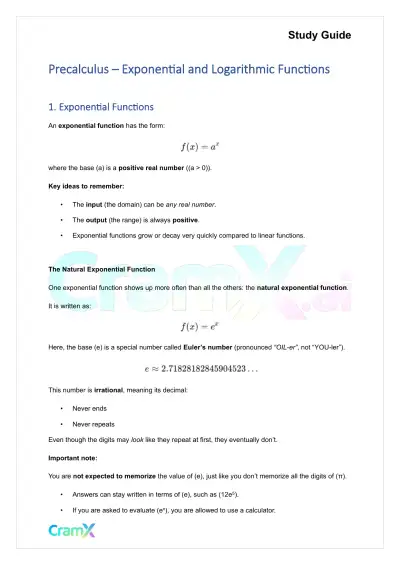 Quick Guides
Precalculus - Exponential and Logarithmic Functions
Mathematics
10 pagesMar 2026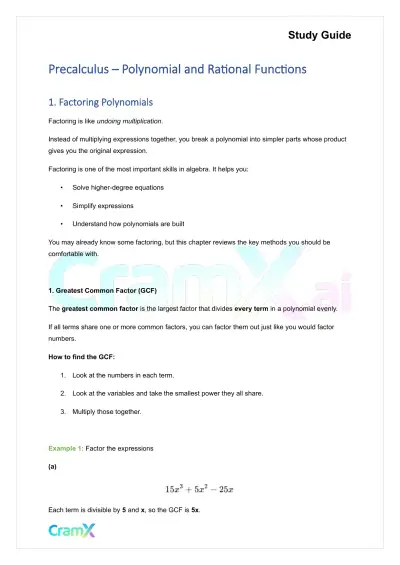 Quick Guides
Precalculus - Polynomial and Rational Functions
Mathematics
11 pagesMar 2026 Exam Guides
Test Bank for Precalculus, 6th Edition
Mathematics
1051 pages175downloadsFeb 2025 Textbook Guides
Solution Manual For Introduction To Management Science, 11th Edition
Mathematics
437 pages167downloadsFeb 2025 Textbook Guides
Solution Manual For Derivatives Markets, 3rd Edition
Mathematics
358 pages143downloadsFeb 2025 Textbook Guides
Solution Manual for Geometry, 1st Edition
Mathematics
446 pages141downloadsFeb 2025 Textbook Guides
Solution Manual for Beginning Algebra, 7th Edition
Mathematics
479 pages139downloadsFeb 2025 Textbook Guides
Solution Manual for Developmental Mathematics, 1st Edition
Mathematics
1623 pages137downloadsFeb 2025
Study this document with CramX
Once it is in your library, every tool can work from it.