

Algebra I – Equations Ratios and Proportions
- Mathematics
- Texas A&M University
- 50 pages
- Shared March 2026
Preview 10 of 50 pages
See the first 10 pages exactly as they appear in the document.
Page 1 Read page 1 as text
Study Guide Algebra I – Equa Ɵ ons Ra Ɵ os and Propor Ɵ ons 1. Equa Ɵ ons What Is an Equation? An equation is a mathematical statement that shows two expressions are equal. It always has an equal sign (=). The equal sign tells us that both sides have the same value. Think of an equation like a balance scale. If both sides are equal, the scale stays balanced. Rules of Equality (Axioms of Equality) To solve equations correctly, we follow some important rules. These rules work for all real numbers (a), (b), and (c). Let’s look at them one by one. 1. Re fl exive Property If a number is equal to itself. Rule: a = a Example: 4 = 4 This just means every number is equal to itself.
Page 2 Read page 2 as text
Study Guide 2. Symmetric Property If one value equals another, then you can switch them. Rule: If a = b, then b = a Example: If 2 + 3 = 5, then 5 = 2 + 3 The order does not matter when two things are equal. 3. Transi Ɵ ve Property If two things are equal to the same value, they are equal to each other. Rule: If a = b and b = c, then a = c Example: If 1 + 3 = 4 and 4 = 2 + 2, then 1 + 3 = 2 + 2 4. Addi Ɵ ve Property of Equality If two values are equal, you can add the same number to both sides and they will still be equal. Rule: If a = b and c = d, then a + c = b + d Example: If 1 + 1 = 2 and 3 + 3 = 6, then 1 + 1 + 3 + 3 = 2 + 6 5. Mul Ɵ plica Ɵ ve Property of Equality If two values are equal, you can multiply both sides by the same number. Rule: If a = b and c = d, then ac = bd Example: If 1 = 2/2 and 4 = 8/2, then 1(4) = (2/2)(8/2)
Page 3 Read page 3 as text
Study Guide Solving Equations Now let’s learn how to solve equations. Remember this important idea: An equation is like a balance scale. If you do something to one side, you must do the same thing to the other side. This keeps the equation balanced. Example 1 Solve for x: x − 5 = 23 Our goal is to get x alone on one side. To remove − 5, we do the opposite operation. The opposite of subtracting 5 is adding 5. So we add 5 to both sides: x − 5 + 5 = 23 + 5 This simplifies to: x = 28 Final Answer: x = 28 Important Reminder You can: • Add • Subtract
Page 4 Read page 4 as text
Study Guide • Multiply • Divide Both sides of an equation by the same nonzero number, and the solution will not change. Sometimes solving an equation takes more than one step. Example 2 Solve for x: 3x + 4 = 19 Step 1: Subtract 4 from both sides. 3x + 4 − 4 = 19 − 4 3x = 15 Step 2: Divide both sides by 3. 3x ÷ 3 = 15 ÷ 3 x = 5 Final Answer: x = 5 Checking Your Answer It’s always a good idea to check your solution. Substitute x = 5 back into the original equation: 3x + 4 = 19 Replace x with 5: 3(5) + 4 = 19 15 + 4 = 19
Page 5 Read page 5 as text
Study Guide 19 = 19 Since both sides are equal, our answer is correct! Example 3 Solve for x: Our goal is to get x by itself . Step 1: Remove − 4 To cancel − 4, we do the opposite operation — add 4 to both sides. This simplifies to: Step 2: Remove the division by 5 Right now, x is divided by 5. To undo division, we multiply. Multiply both sides by 5 : The 5s cancel on the left side:
Page 6 Read page 6 as text
Study Guide Final Answer: [x = 30] Example 4 Solve for x: Again, we want x alone. Step 1: Remove − 6 Add 6 to both sides: Step 2: Remove the fraction x is multiplied by 3/5 . To undo multiplying by 3/5, we multiply by its reciprocal. The reciprocal of 3/5 is 5/3 . Multiply both sides by 5/3: The fractions cancel nicely:
Page 7 Read page 7 as text
Study Guide Final Answer: [x = 30] Example 5 Solve for x: Now the variable appears on both sides. Don’t worry — we’ll bring all x terms to one side. Step 1: Move 2x to the left side Subtract 2x from both sides: Step 2: Divide by 3 Final Answer: [x = - 2] Example 6 Solve for x:
Page 8 Read page 8 as text
Study Guide Step 1: Subtract 4x from both sides Step 2: Subtract 3 from both sides Step 3: Divide by 2 Final Answer: [x = 1] Literal Equations A literal equation is an equation that uses letters instead of numbers. Instead of solving for x, we might solve for another variable like q or y. The steps are the same: • Move terms using opposite operations. • Isolate the variable you are solving for. Example 7 Solve for q:
Page 9 Read page 9 as text
Study Guide We want q alone. Step 1: Add x to both sides To remove − x, add x to both sides: Step 2: Divide by p Since q is multiplied by p, divide both sides by p: Final Answer: What Happened Here? We used opposite operations: • Added x to remove − x. • Divided by p to undo multiplication. The strategy is exactly the same as solving regular equations — just with letters!
Page 10 Read page 10 as text
Study Guide Example 8 Solve for y: We want y alone. Step 1: Multiply by x Since y is divided by x, multiply both sides by x: The x values cancel on the left: Final Answer: Example 9 Solve for x: This is a literal equation with variables on both sides. Step 1: Subtract cx from both sides Factor x:
40 more pages in the full document
Unlock it once and it stays in your library, ready to chat with or turn into flashcards.
Unlock the full documentMore Mathematics study materials
See all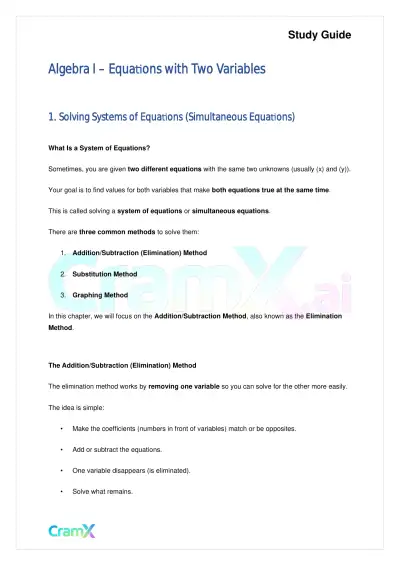 Quick Guides
Algebra I – Equations with Two Variables
Mathematics
45 pagesMar 2026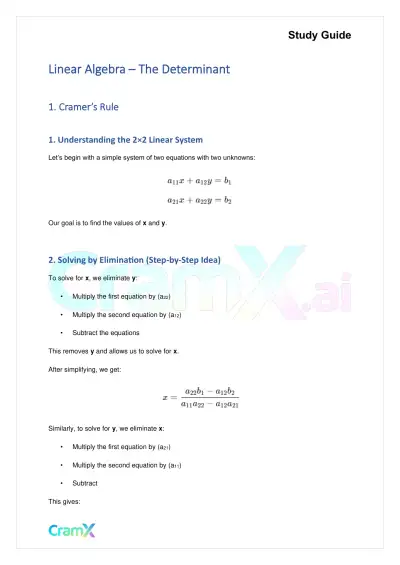 Quick Guides
Linear Algebra – The Determinant
Mathematics
56 pagesMar 2026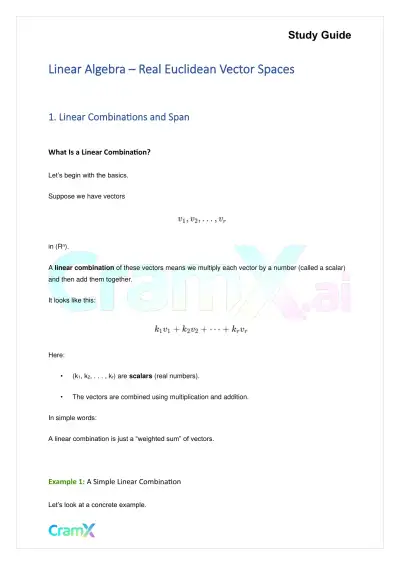 Quick Guides
Linear Algebra – Real Euclidean Vector Spaces
Mathematics
122 pagesMar 2026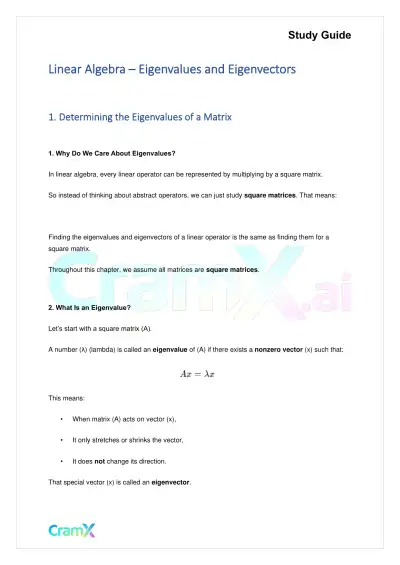 Quick Guides
Linear Algebra – Eigenvalues and Eigenvectors
Mathematics
41 pagesMar 2026 Quick Guides
Algebra I – Roots and Radicals
Mathematics
50 pagesMar 2026 Quick Guides
Linear Algebra – Linear Systems
Mathematics
59 pagesMar 2026 Quick Guides
Algebra I – Algebraic Fractions
Mathematics
40 pagesMar 2026 Quick Guides
Algebra I – Functions and Variations
Mathematics
62 pagesMar 2026
Study this document with CramX
Once it is in your library, every tool can work from it.