

Algebra I – Inequalities Graphing and Absolute Value
- Mathematics
- Texas A&M University
- 71 pages
- Shared March 2026
Preview 10 of 71 pages
See the first 10 pages exactly as they appear in the document.
Page 1 Read page 1 as text
Study Guide Algebra I – Inequali Ɵ es Graphing and Absolute Value 1. Inequali Ɵ es What Is an Inequality? An inequality is a mathematical statement that compares two values that are not necessarily equal . Instead of using an equals sign (=), inequalities use special symbols to show the relationship between numbers. Common inequality symbols include: • > : greater than • < : less than • ≥ : greater than or equal to • ≤ : less than or equal to These symbols help us describe whether one number is larger, smaller, or possibly equal to another number. Axioms and Proper Ɵ es of Inequali Ɵ es When working with inequalities, mathematicians follow certain basic rules (called axioms or properties) . These rules apply to all real numbers (a), (b), and (c). Understanding these properties will help you compare numbers and solve inequality problems correctly. 1. Trichotomy Axiom The Trichotomy Axiom states that for any two numbers, only one of the following can be true :
Page 2 Read page 2 as text
Study Guide • (a > b) • (a = b) • (a < b) In simple terms, when comparing two numbers, one number must be greater, equal, or smaller than the other . No other possibilities exist. 2. Transi Ɵ ve Property of Inequali Ɵ es The transitive property helps us compare numbers through a chain of relationships. If: [a > b and b > c] then: [a > c] Example If: [3 > 2 and 2 > 1] then: [3 > 1] The same idea works for less than relationships. Example: [4 < 5 and 5 < 6] Therefore: [4 < 6]
Page 3 Read page 3 as text
Study Guide 3. Addi Ɵ on and Subtrac Ɵ on Property You can add or subtract the same number on both sides of an inequality , and the inequality will remain true. If: [a > b] then: [a + c > b + c] and [a - c > b - c] Similarly: If: [a < b] then: [a + c < b + c] and [a - c < b - c] Key Idea Adding or subtracting the same value from both sides does not change the direction of the inequality. Examples If: [3 > 2] Add 1 to both sides:
Page 4 Read page 4 as text
Study Guide [3 + 1 > 2 + 1] [4 > 3] Another example: [12 < 15] Subtract 4 from both sides: [12 - 4 < 15 - 4] [8 < 11] 4. Mul Ɵ plica Ɵ on and Division by a Posi Ɵ ve Number When you multiply or divide both sides of an inequality by a positive number , the direction of the inequality stays the same . If: [a > b and c > 0] then: [ac > bc If: [a < b and c > 0] then: [ac < bc] Important Rule Multiplying or dividing by a positive number does NOT change the inequality sign . Example If:
Page 5 Read page 5 as text
Study Guide [5 > 2] Multiply both sides by 3 : [5(3) > 2(3)] [15 > 6] Another example: [3 < 12] Divide both sides by 4 : 5. Mul Ɵ plica Ɵ on and Division by a Nega Ɵ ve Number Multiplying or dividing by a negative number works differently . When you do this, the inequality sign must reverse direction . If: [a > b and c < 0] then: [ac < bc] If: [a < b and c < 0] then: [ac > bc]
Page 6 Read page 6 as text
Study Guide Important Rule Multiplying or dividing by a negative number flips the inequality sign . Example If: [5 > 2] Multiply both sides by − 3 : [5( - 3) < 2( - 3)] [ - 15 < - 6] Notice how the sign changed from > to < . Solving Inequalities Solving inequalities is very similar to solving equations . You can: • Add numbers • Subtract numbers • Multiply • Divide on both sides to isolate the variable. However, there is one very important difference : If you multiply or divide by a negative number, you must reverse the inequality sign. Keeping this rule in mind will help you solve inequalities correctly.
Page 7 Read page 7 as text
Study Guide Solving Inequalities: Worked Examples Now that we understand the rules of inequalities, let’s see how to solve them step by step . Solving inequalities is very similar to solving equations. We use basic operations such as: • Adding or subtracting numbers • Multiplying or dividing both sides However, remember one important rule: If you multiply or divide by a negative number, you must reverse the inequality sign. Let’s look at some examples to understand this better. Example 1 Solve for (x): [2x + 4 > 6] Step 1: Subtract 4 from both sides We remove the constant term from the left side. Step 2: Divide both sides by 2 Final Answer
Page 8 Read page 8 as text
Study Guide This means x can be any number greater than 1 . Writing the Answer in Set Builder Notation Sometimes solutions are written using set builder notation . For this example: This is read as: “The set of all x such that x is greater than 1.” Example 2 Solve for (x): Step 1: Divide both sides by − 7 Since we are dividing by a negative number , we must reverse the inequality sign . Step 2: Simplify Final Answer
Page 9 Read page 9 as text
Study Guide This means x can be any number less than − 2 . Example 3 Solve for (x): Step 1: Subtract 2 from both sides Step 2: Subtract (5x) from both sides Step 3: Divide both sides by − 2 Because we divide by a negative number , we must reverse the inequality sign . Final Answer This means x can be any number less than or equal to 6 .
Page 10 Read page 10 as text
Study Guide Set Builder Notation The solution can also be written as: 2. Quiz: Inequali Ɵ es 1. Question Which of the following symbols represents “is less than or equal to”? Answer Choices • ≥ • < • ≤ Correct Answer : ≤ Why This Is Correct The symbol ≤ means “less than or equal to.” It shows that a value can be smaller than another value or exactly equal to it . Example: If x ≤ 5 , then x can be 5, 4, 3, 2 , or any number less than 5. 2. Question Which of the following is a false statement?
61 more pages in the full document
Unlock it once and it stays in your library, ready to chat with or turn into flashcards.
Unlock the full documentMore Mathematics study materials
See all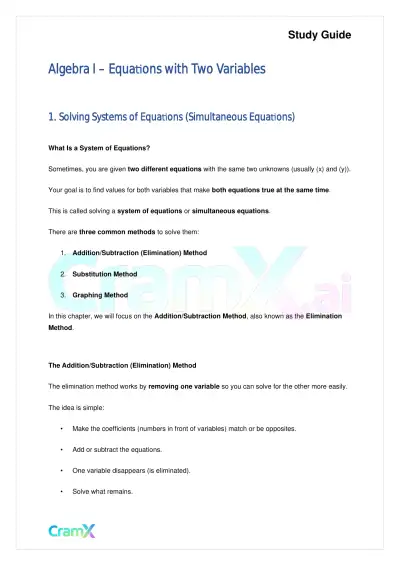 Quick Guides
Algebra I – Equations with Two Variables
Mathematics
45 pagesMar 2026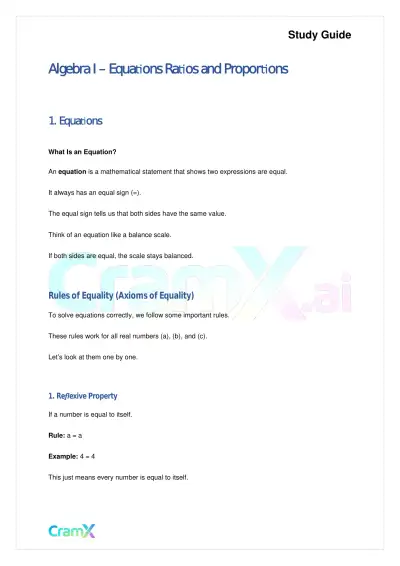 Quick Guides
Algebra I – Equations Ratios and Proportions
Mathematics
50 pagesMar 2026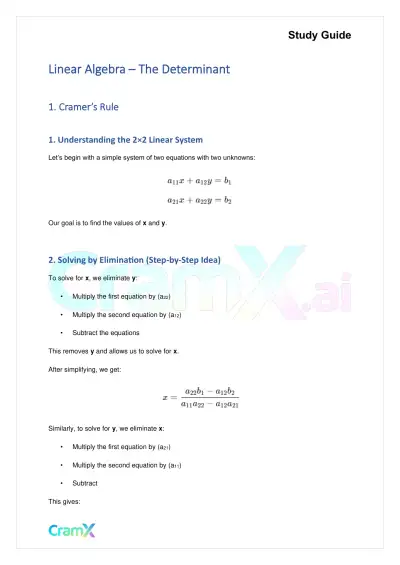 Quick Guides
Linear Algebra – The Determinant
Mathematics
56 pagesMar 2026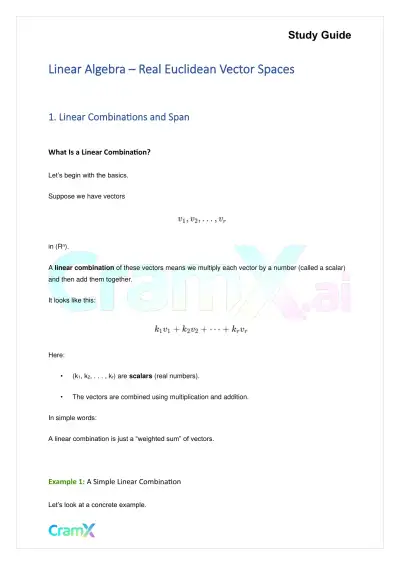 Quick Guides
Linear Algebra – Real Euclidean Vector Spaces
Mathematics
122 pagesMar 2026 Quick Guides
Linear Algebra – Eigenvalues and Eigenvectors
Mathematics
41 pagesMar 2026 Quick Guides
Algebra I – Roots and Radicals
Mathematics
50 pagesMar 2026 Quick Guides
Linear Algebra – Linear Systems
Mathematics
59 pagesMar 2026 Quick Guides
Algebra I – Functions and Variations
Mathematics
62 pagesMar 2026
Study this document with CramX
Once it is in your library, every tool can work from it.