

Algebra I – Roots and Radicals
- Mathematics
- Texas A&M University
- 50 pages
- Shared March 2026
Preview 10 of 50 pages
See the first 10 pages exactly as they appear in the document.
Page 1 Read page 1 as text
Study Guide Algebra I – Roots and Radicals 1. Introduc Ɵ on to Roots and Radicals Let’s begin with the basics. What Is a Radical? The symbol √ is called a radical sign . It is used to show a square root . For example: • √ 9 = 3 because 3 × 3 = 9 • √ 16 = 4 because 4 × 4 = 16 In simple terms, a square root asks: “What number multiplied by itself gives this result?” What About Cube Roots? If we want to find a cube root , we use a small 3 written above the radical sign: This tells us we are looking for a number that is multiplied by itself three times . For example: • ∛ 8 = 2 because 2 × 2 × 2 = 8 • ∛ 27 = 3 because 3 × 3 × 3 = 27 That small number above the radical sign is called the index . If there is no number written there, it automatically means square root (index 2) .
Page 2 Read page 2 as text
Study Guide What If Two Radicals Are Next to Each Other? If two radical expressions are written next to each other, they are multiplied . For example: The multiplication sign is usually not written , but it is understood. Square Roots of Negative Numbers Now here’s something important: In the real number system , you cannot take the square root of a negative number. For example: There is no real number that you can multiply by itself to get − 4. So we need a new system of numbers. Imaginary Numbers To handle square roots of negative numbers, mathematicians created a new system called imaginary numbers . The key idea is the imaginary unit: This means:
Page 3 Read page 3 as text
Study Guide • √− 1 = i • √− 4 = 2i • √− 9 = 3i Here’s why: Imaginary numbers are simply multiples of i . 2. Simplifying Square Roots Now that you understand what square roots are, let’s learn how to simplify them step by step. The goal of simplifying is to rewrite a radical in its simplest form — meaning no perfect square factors are left inside the radical. Example 1: Basic Square Roots Let’s start with some simple cases. 1. √ 9 Because 3 × 3 = 9. 2. −√ 9 Be careful here!
Page 4 Read page 4 as text
Study Guide The negative sign is outside the radical. So we first find √ 9 = 3, then apply the negative sign. This notation (writing −√ 9 instead of √− 9) is commonly used in textbooks, and we will follow that same style. 3. √ 18 Break 18 into a perfect square times another number: Now split the radical: We simplified it because 9 is a perfect square. Square Roots of Variables Now let’s look at expressions with variables. 4. √ x² If we are told that each variable is nonnegative , then: Why? Because x × x = x². What If the Variable Could Be Positive or Negative?
Page 5 Read page 5 as text
Study Guide If x might be positive or negative, we must use absolute value : Why absolute value? Because a square root is always nonnegative. Absolute value makes sure the answer is never negative. For example: • If x = 5 → √ x² = 5 • If x = − 5 → √ x² = 5 So we write |x| to cover both cases. More Variable Examples e. √ x ⁴ If x is nonnegative: Because: f. √ (x ⁶ y ⁸ ) If each variable is nonnegative:
Page 6 Read page 6 as text
Study Guide If the variables could be positive or negative, we must use absolute value for odd powers: Since y ⁴ is always nonnegative, this is often written simply as: g. √ (25a ⁴ b ⁶ ) If each variable is nonnegative: Break it apart: If the variables could be positive or negative, use absolute value for odd powers: Bigger Example h. √ x ⁷ If x is nonnegative:
Page 7 Read page 7 as text
Study Guide If x could be positive or negative: i. √ (x ⁹ y ⁸ ) If variables are nonnegative: Break into perfect squares: j. √ (16x ⁵ ) If variables are nonnegative:
Page 8 Read page 8 as text
Study Guide 3. Quiz: Simplifying Square Roots 1. Question Which of the following expressions results in an imaginary number? Answer Choices • √ ( - 3)² • √ ( - 3)³ • √ ( - 3) ⁴ Correct Answer : √ ( - 3)³ Why This Is Correct Let’s evaluate each expression: • ( - 3)² = 9 → √ 9 = 3 (real number) • ( - 3)³ = - 27 → √ ( - 27) is the square root of a negative number (imaginary) • ( - 3) ⁴ = 81 → √ 81 = 9 (real number) Only √ ( - 3)³ results in the square root of a negative number, which is imaginary. 2. Question Which of the following correctly states the value of √ 25? Answer Choices • ±5 • - 5
Page 9 Read page 9 as text
Study Guide • +5 Correct Answer : +5 Why This Is Correct The square root symbol ( √ ) represents the principal (positive) square root . Even though both 5 and - 5 squared equal 25, √ 25 is defined as the positive root only. So: √ 25 = 5 3. Question If x could be positive or negative, then which of the following is the best way to express √ (x¹ ⁰ )? Answer Choices • |x ⁵ | • x ⁵ • - x ⁵ Correct Answer : |x ⁵ | Why This Is Correct √ (x¹ ⁰ ) = √ (x ⁵ )² The square root of something squared equals its absolute value when the variable could be positive or negative. So: √ (x¹ ⁰ ) = |x ⁵ | Absolute value ensures the result is never negative.
Page 10 Read page 10 as text
Study Guide 4. Question √ 48 when completely simplified would be: Answer Choices • 2 √ 12 • 4 √ 3 • already simplified Correct Answer : 4 √ 3 Why This Is Correct Break 48 into a perfect square: 48 = 16 × 3 √ 48 = √ 16 × √ 3 = 4 √ 3 Since 3 has no perfect square factors, this is fully simplified. 5. Question Which of the following cannot be simplified? Answer Choices : √ 75 • √ 27 • √ 62 Correct Answer : √ 62
40 more pages in the full document
Unlock it once and it stays in your library, ready to chat with or turn into flashcards.
Unlock the full documentMore Mathematics study materials
See all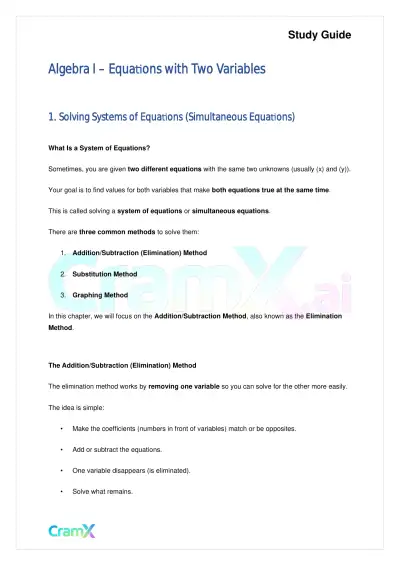 Quick Guides
Algebra I – Equations with Two Variables
Mathematics
45 pagesMar 2026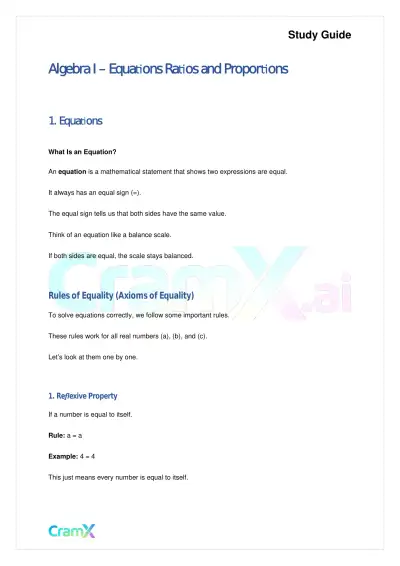 Quick Guides
Algebra I – Equations Ratios and Proportions
Mathematics
50 pagesMar 2026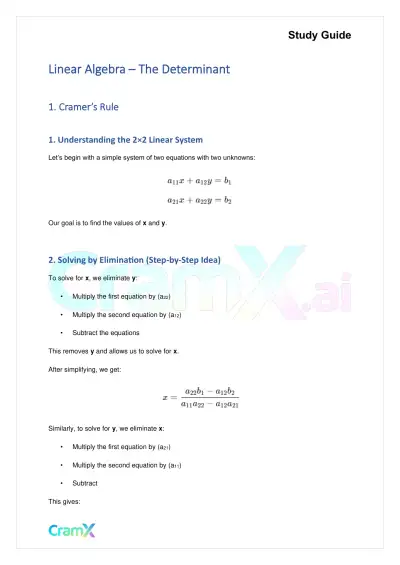 Quick Guides
Linear Algebra – The Determinant
Mathematics
56 pagesMar 2026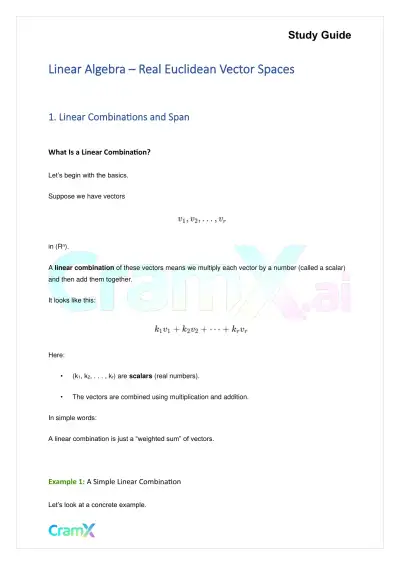 Quick Guides
Linear Algebra – Real Euclidean Vector Spaces
Mathematics
122 pagesMar 2026 Quick Guides
Linear Algebra – Eigenvalues and Eigenvectors
Mathematics
41 pagesMar 2026 Quick Guides
Linear Algebra – Linear Systems
Mathematics
59 pagesMar 2026 Quick Guides
Algebra I – Algebraic Fractions
Mathematics
40 pagesMar 2026 Quick Guides
Algebra I – Functions and Variations
Mathematics
62 pagesMar 2026
Study this document with CramX
Once it is in your library, every tool can work from it.