

Algebra II – Polynomial Function
- Mathematics
- Texas A&M University
- 52 pages
- Shared March 2026
Preview 10 of 52 pages
See the first 10 pages exactly as they appear in the document.
Page 1 Read page 1 as text
Study Guide Algebra II – Polynomial Function 1. Polynomial Function What Is a Polynomial Function? A polynomial function is a type of mathematical expression made up of variables and numbers combined using addition, subtraction, and multiplication . The general form of a polynomial function looks like this: Understanding the Parts • (x) is the variable. • (a 0 , a 1 , a 2 , … , a n ) are numbers called coefficients . • (n) is a whole number (0, 1, 2, 3, …). • The highest power of (x) determines the degree of the polynomial. Polynomial functions are evaluated by substituting a number for the variable (x) and then simplifying the expression. For example, if we replace (x) with 4 in (P(x)), we write it as: This means “find the value of the polynomial when (x = 4)” . Example 1: Evaluating a Polynomial Suppose we have the polynomial:
Page 2 Read page 2 as text
Study Guide We want to find (P( - 4)) . Step 1: Substitute (x = - 4) Step 2: Calculate the powers Step 3: Multiply Step 4: Add and subtract This means when (x = - 4), the value of the polynomial is - 241 . Example 2: Finding (f(x + h)) Now consider the function: We want to find (f(x + h)) . This means we replace every (x) with (x + h) . Step 1: Substitute (x + h)
Page 3 Read page 3 as text
Study Guide Step 2: Expand the square So, Step 3: Multiply Final Expression This is the expanded form of (f(x + h)) . 2. Quiz: Polynomial Function 1. Question If (P(y) = 2y 4 - 3y 3 + 4y 2 - 7), find (P(3)). Answer Choices • 110 • 81 • 29 Correct Answer : 110
Page 4 Read page 4 as text
Study Guide Why This Is Correct To find (P(3)), substitute (y = 3) into the polynomial. Now calculate each term: Therefore, the correct answer is 110 . 2. Question If (Q(z) = 3z 3 + 4z 2 - 7z + 8), find (Q( - 5)). Answer Choices • 232 • 518 • - 232 Correct Answer : - 232 Why This Is Correct Substitute (z = - 5) into the polynomial. Calculate each part:
Page 5 Read page 5 as text
Study Guide So the correct answer is - 232 . 3. Question If (f(x) = x 3 + 6x + 9), find (f(x - 2)). Answer Choices • (x 3 + 6x 2 + 8x + 9) • (x 3 - 6x 2 + 18x - 11) • (x 3 - 6x 2 - 8x + 9) Correct Answer : (x 3 - 6x 2 + 18x - 11) Why This Is Correct Substitute (x - 2) into the function. First expand the cube: Now substitute: Combine like terms:
Page 6 Read page 6 as text
Study Guide Thus the correct answer is (x 3 - 6x 2 + 18x - 11) . 4. Question If (f(x) = x 2 - 4x - 3), find (f(x + 3)). Answer Choices • (x 2 - 2x - 6) • (x 2 + 2x - 6) • (x 2 + 2x + 6) Correct Answer : (x 2 + 2x - 6) Why This Is Correct Substitute (x + 3) into the function. Expand: Combine like terms: So the correct answer is (x 2 + 2x - 6) .
Page 7 Read page 7 as text
Study Guide 5. Question If (g(x) = 2x 3 + 4x - 5), find (g(x - m)). Answer Choices • (2x 3 - m 2 x 2 + 4x - 4m - 2m 3 - 5) • (2x 3 + 12m 2 x 2 + 4x - 4m - 2m 3 - 5) • (2x 3 - 6mx 2 + 6m 2 x + 4x - 4m - 2m 3 - 5) Correct Answer : (2x 3 - 6mx 2 + 6m 2 x + 4x - 4m - 2m 3 - 5) Why This Is Correct Substitute (x - m) into the function. First expand the cube: Multiply by 2: Now include the remaining terms: Final expression: Thus the correct answer is (2x 3 - 6mx 2 + 6m 2 x + 4x - 4m - 2m 3 - 5) .
Page 8 Read page 8 as text
Study Guide 3. Remainder Theorem What Is the Remainder Theorem? The Remainder Theorem helps us quickly find the remainder when a polynomial is divided by a linear expression. It states: If a polynomial (P(x)) is divided by ((x - r)), then the remainder is equal to (P(r)) . In simple terms Instead of performing long division, you can: 1. Replace (x) with (r) in the polynomial. 2. Calculate the value. 3. That value is the remainder . So, This makes calculations much faster and easier . Example 1: Finding (P( - 3)) Given: We want to find:
Page 9 Read page 9 as text
Study Guide There are two possible methods to solve this. Method 1: Direct Substitution Simply replace (x) with − 3 . Step 1: Evaluate the powers Step 2: Substitute the values Step 3: Multiply Step 4: Simplify Final Answer: Method 2: Using Synthetic Division
Page 10 Read page 10 as text
Study Guide Another way to find the remainder is by synthetic division . Since we want (P( - 3)), we divide the polynomial by: which simplifies to: Using synthetic division with − 3 , we calculate the remainder. After completing the synthetic division steps, the remainder is −1610 . This confirms our result from Method 1 . Therefore, Example 2: Finding the Remainder Find the remainder when: is divided by: Method 1: Apply the Remainder Theorem According to the theorem, Step 1: Substitute (x = 4)
42 more pages in the full document
Unlock it once and it stays in your library, ready to chat with or turn into flashcards.
Unlock the full documentMore Mathematics study materials
See all Quick Guides
Algebra II - Polynomial Arithmetic
Mathematics
55 pagesMar 2026 Quick Guides
Algebra II – Conic Sections
Mathematics
92 pagesMar 2026 Quick Guides
Algebra II – Sequences and Series
Mathematics
60 pagesMar 2026 Quick Guides
Algebra II - Relations and Functions
Mathematics
56 pagesMar 2026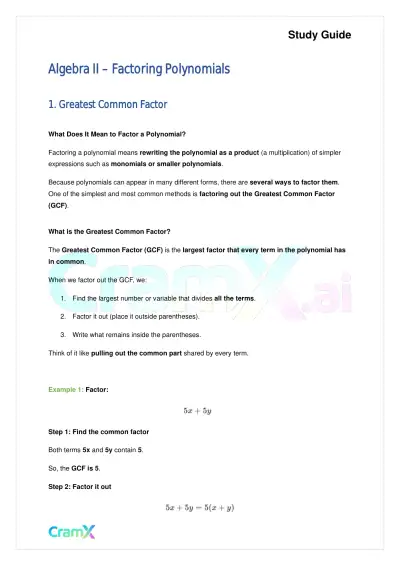 Quick Guides
Algebra II - Factoring Polynomials
Mathematics
70 pagesMar 2026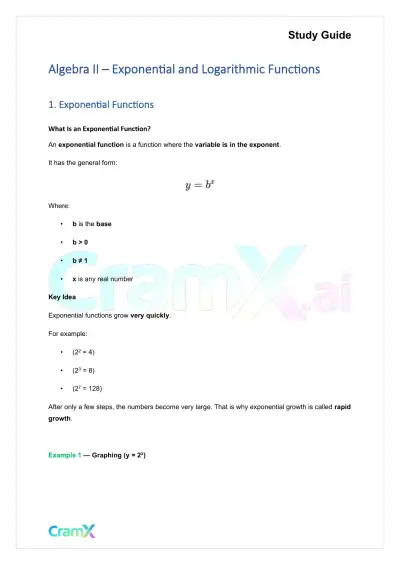 Quick Guides
Algebra II - Exponential and Logarithmic Functions
Mathematics
49 pagesMar 2026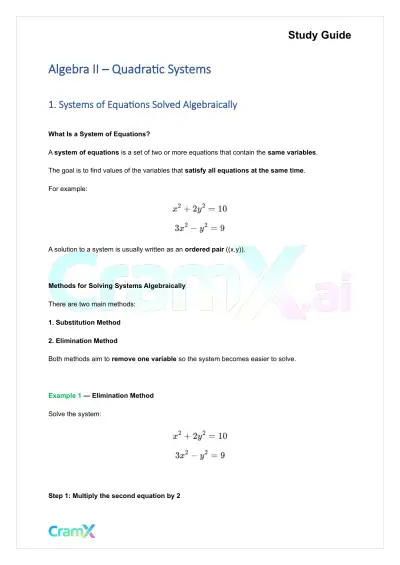 Quick Guides
Algebra II – Quadratic Systems
Mathematics
27 pagesMar 2026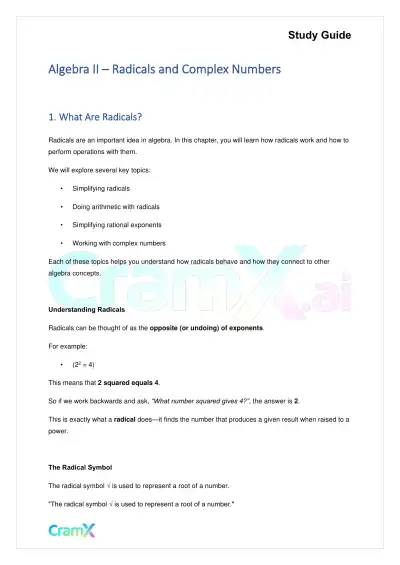 Quick Guides
Algebra II – Radicals and Complex Numbers
Mathematics
89 pagesMar 2026
Study this document with CramX
Once it is in your library, every tool can work from it.