

Algebra II - Rational Expressions
- Mathematics
- Texas A&M University
- 107 pages
- Shared March 2026
Preview 10 of 107 pages
See the first 10 pages exactly as they appear in the document.
Page 1 Read page 1 as text
Study Guide Algebra II – Ra Ɵ onal Expressions 1. Examples of Ra Ɵ onal Expressions A rational expression is simply another way of writing a fraction . Just like regular fractions, it represents division . In a fraction, the numerator (top part) is divided by the denominator (bottom part). For example: means a divided by b . Rational Expressions with Polynomials In algebra, rational expressions often contain polynomials in the numerator, the denominator, or both. This can make them look more complicated than regular fractions, but the main idea is still the same: one expression is being divided by another . Sometimes the numerator or denominator may contain more complex algebraic expressions , which requires extra steps to simplify. Definition of a Rational Expression A rational expression is the quotient (division) of two polynomials . It has the form: where: • (P(x)) is a polynomial (numerator) • (Q(x)) is a polynomial (denominator) • (Q(x) ≠ 0) The denominator cannot be zero , because division by zero is undefined.
Page 2 Read page 2 as text
Study Guide Examples of Rational Expressions Here are some examples: In each example, one expression is divided by another. Whole Numbers as Rational Expressions Even expressions that look like whole numbers or polynomials can be written as rational expressions. For example: can be written as: Since 1 is a polynomial , this expression still fits the definition of a rational expression. Complex Rational Expressions Sometimes rational expressions may contain fractions inside other fractions . These are called complex rational expressions .
Page 3 Read page 3 as text
Study Guide They may require extra steps to simplify, such as: • finding common denominators • simplifying fractions • factoring polynomials You will learn more about these techniques later. Summary • A rational expression is a fraction that contains polynomials . • It represents division of two polynomials . • The denominator cannot equal zero . • Rational expressions can look like: o regular fractions o algebraic fractions o polynomials written over 1 Examples: Even expressions like can be written as so they are also rational expressions.
Page 4 Read page 4 as text
Study Guide 2. Quiz: Examples of Ra Ɵ onal Expressions 1. Question Rewrite the expression as a fraction: (5a + 3b) ÷ 7c Answer Choices • ((8ab)/7c)) • (7c/(5a + 3b)) • ((5a + 3b)/7c)) Correct Answer ((5a + 3b)/7c)) Why This Is Correct Division can be written as a fraction. So the numerator is 5a + 3b and the denominator is 7c . 2. Question Rewrite the expression as a fraction: 19x ÷ (5x² − 3x + 2) Answer Choices • (19x/ ( 5x 2 - 3x + 2 ) ) • ( (5x 2 - 3x + 2 ) /19x)) • (19/ ( 5x – 1))
Page 5 Read page 5 as text
Study Guide Correct Answer (19x/5x 2 - 3x + 2) Why This Is Correct Division by an expression can be written as a fraction. The entire expression 5x² − 3x + 2 becomes the denominator. 3. Question Rewrite the expression as a fraction: 12r − 13 Answer Choices • ( (12r – 13 ) / 2) • ( (12r – 13 ) / 1) ) • (1/ ( 12r – 13)) Correct Answer (12r – 13/1) Why This Is Correct Any expression can be written as a fraction by placing 1 in the denominator . This does not change the value of the expression.
Page 6 Read page 6 as text
Study Guide 4. Question Rewrite the expression as a fraction: (5b 3 - 2b 2 + c 7 ) ÷ (8c + 7b 4 ) Answer Choices Correct Answer Why This Is Correct Division by a polynomial is written as a fraction. The numerator is the first expression and the denominator is the second. 5. Question Evaluate the expression: (24x²y² − 8xy + 4) ÷ (8b · 0) Answer Choices
Page 7 Read page 7 as text
Study Guide Correct Answer insoluble Why This Is Correct The denominator contains 8b · 0 . This means the expression becomes division by zero , which is undefined in mathematics . Since division by zero is not allowed, the expression has no valid solution and is considered insoluble (undefined) . 3. Simplifying Ra Ɵ onal Expressions Simplifying a rational expression works very much like simplifying a regular fraction. The goal is to factor the numerator and denominator and cancel any common factors . Steps to Simplify a Rational Expression To simplify a rational expression: 1. Completely factor the numerator and denominator. 2. Cancel any common factors that appear in both the numerator and denominator. Only factors can be canceled — not individual terms. Example 1: Simplify: Step 1: Factor both expressions
Page 8 Read page 8 as text
Study Guide So the expression becomes: Step 2: Cancel the common factor This leaves: Example 2: Simplify: Step 1: Factor each expression Difference of squares: Sum of cubes: So we get: Step 2: Cancel the common factor Result:
Page 9 Read page 9 as text
Study Guide Example 3: Simplify: Step 1: Factor the numerator Difference of squares: Step 2: Rewrite the denominator Step 3: Cancel the common factor So we get: Final result: Example 4: Simplify: Step 1: Factor the numerator
Page 10 Read page 10 as text
Study Guide Step 2: Factor the denominator Rewrite the denominator: Now factor: So the denominator becomes: Step 3: Cancel common factors Cancel: The expression becomes: This can also be written as: or All forms represent the same simplified expression.
97 more pages in the full document
Unlock it once and it stays in your library, ready to chat with or turn into flashcards.
Unlock the full documentMore Mathematics study materials
See all Quick Guides
Algebra II - Polynomial Arithmetic
Mathematics
55 pagesMar 2026 Quick Guides
Algebra II – Conic Sections
Mathematics
92 pagesMar 2026 Quick Guides
Algebra II – Sequences and Series
Mathematics
60 pagesMar 2026 Quick Guides
Algebra II - Relations and Functions
Mathematics
56 pagesMar 2026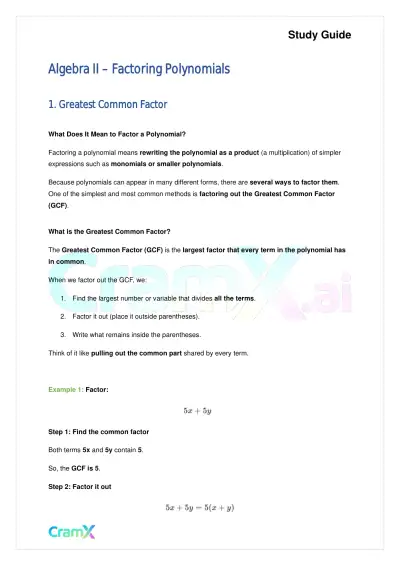 Quick Guides
Algebra II - Factoring Polynomials
Mathematics
70 pagesMar 2026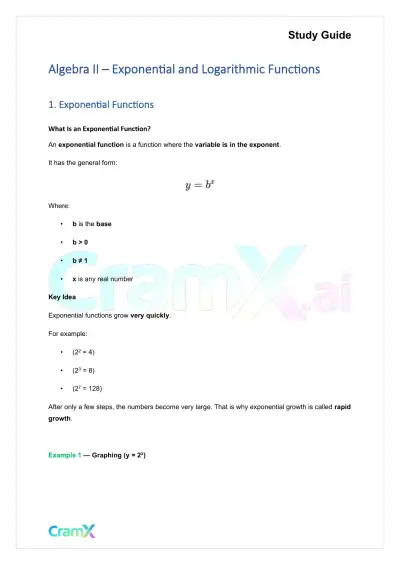 Quick Guides
Algebra II - Exponential and Logarithmic Functions
Mathematics
49 pagesMar 2026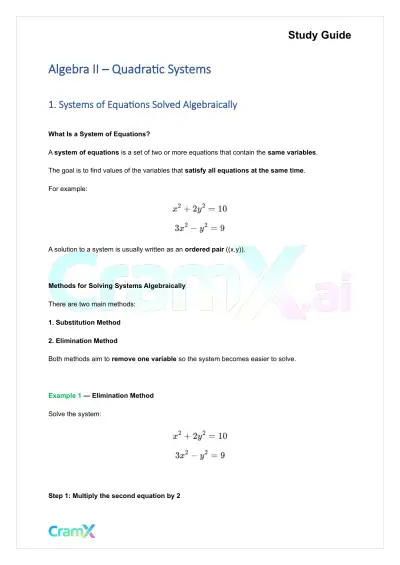 Quick Guides
Algebra II – Quadratic Systems
Mathematics
27 pagesMar 2026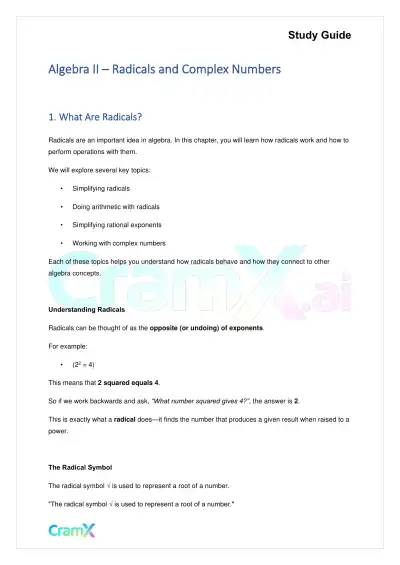 Quick Guides
Algebra II – Radicals and Complex Numbers
Mathematics
89 pagesMar 2026
Study this document with CramX
Once it is in your library, every tool can work from it.