

Algebra II – Radicals and Complex Numbers
- Mathematics
- Texas A&M University
- 89 pages
- Shared March 2026
Preview 10 of 89 pages
See the first 10 pages exactly as they appear in the document.
Page 1 Read page 1 as text
Study Guide Algebra II – Radicals and Complex Numbers 1. What Are Radicals? Radicals are an important idea in algebra. In this chapter, you will learn how radicals work and how to perform operations with them. We will explore several key topics: • Simplifying radicals • Doing arithmetic with radicals • Simplifying rational exponents • Working with complex numbers Each of these topics helps you understand how radicals behave and how they connect to other algebra concepts. Understanding Radicals Radicals can be thought of as the opposite (or undoing) of exponents . For example: • (2 2 = 4) This means that 2 squared equals 4 . So if we work backwards and ask, “What number squared gives 4?” , the answer is 2 . This is exactly what a radical does — it finds the number that produces a given result when raised to a power. The Radical Symbol The radical symbol √ is used to represent a root of a number. "The radical symbol √ is used to represent a root of a number."
Page 2 Read page 2 as text
Study Guide When there is no number written in the small corner of the radical sign , it means we are finding the square root of the number inside. For example: • √4 = 2 This means the square root of 4 is 2 , because (2 2 = 4). Other Types of Roots Sometimes you will see a small number written in the corner of the radical symbol. This number tells us which root we are finding . For example, a 3 in the corner means we are finding the cube root . "Sometimes you will see a small number written in the corner of the radical symbol." For example: • ³√8 = 2 This means the cube root of 8 is 2 , because (2 3 = 8). In general: • No number in the radical → square root • Small number (n) in the radical → nth root Working With Radical Expressions In this chapter, you will learn the terms and rules used when working with radicals . Radical expressions can be treated similarly to algebraic expressions. When doing calculations, the radical part often behaves like a variable . This allows us to: • Add radicals • Subtract radicals • Multiply radicals
Page 3 Read page 3 as text
Study Guide • Simplify radical expressions Learning these operations will help you solve more complex algebra problems. Radicals and Complex Numbers Radicals are closely connected to complex numbers . Sometimes, we try to take the square root of a negative number . In ordinary numbers, this is not possible. However, mathematics introduces a special number to handle this situation. This number is called the imaginary unit , written as i . The imaginary unit is defined as: This means i represents the square root of −1 . Example with Negative Radicals Let’s look at an example: This can be rewritten as: Since: • √9 = 3 • √−1 = i The simplified result is:
Page 4 Read page 4 as text
Study Guide "Let’s look at an example: √−9." 2. Radicals A radical expression is written using the radical symbol. It represents a root of a number. The general form of a radical expression is: “The general form of a radical expression is √ⁿa.” Parts of a Radical Expression A radical expression has several important parts: • Radical sign (√) – the symbol used to indicate a root. • Radicand – the number or expression inside the radical. • Index (n) – the small number that tells which root we are finding. If no index is written , it is understood to be 2 , which means we are finding the square root . So, is read as “the nth root of a.” Important Property of Radicals Radicals and exponents are closely connected. If then
Page 5 Read page 5 as text
Study Guide This means that raising the root to the power of its index gives back the original number. Example 1 Simplify Each Expression Let’s practice simplifying some radical expressions. 1. Square Root Example Since (5 2 = 25), “1. Square Root Example” 2. Cube Root Example Because (4 3 = 64), 3. Fifth Root Example Since
Page 6 Read page 6 as text
Study Guide the answer is 4. Cube Root of a Negative Number Since the simplified answer is 5. Square Root of a Negative Number If we let then
Page 7 Read page 7 as text
Study Guide But no real number squared equals −4 . Therefore: is not a real number . Understanding Positive and Negative Roots When solving equations involving square roots, a number may have two possible values . For example: If then However, when we write the radical symbol by itself: we always take the positive value . This is called the principal root . So: but Additional Examples Cube Root
Page 8 Read page 8 as text
Study Guide If then and Fifth Root Example If then and Cube Root with Negative Value If
Page 9 Read page 9 as text
Study Guide then so True Statements About Radical Expressions Some general rules help us understand radicals. Even Index Roots When the index is even (like square root or fourth root): • Positive numbers → real answers • Negative numbers → not real numbers Example: but is not a real number . Odd Index Roots When the index is odd (like cube root): • Positive numbers → positive answers • Negative numbers → negative answers
Page 10 Read page 10 as text
Study Guide • Zero → zero Examples: Example 2 Simplifying ( √x 2 ) Let’s simplify the expression: At first glance, it might seem that: However, this is not always correct . The reason is that we do not know whether (x) is positive or negative . For example: This shows that the square root always gives a nonnegative result . Because of this rule, we write: The absolute value ensures that the answer is always nonnegative. “Let’s simplify the expression √x².”
79 more pages in the full document
Unlock it once and it stays in your library, ready to chat with or turn into flashcards.
Unlock the full documentMore Mathematics study materials
See all Quick Guides
Algebra II - Polynomial Arithmetic
Mathematics
55 pagesMar 2026 Quick Guides
Algebra II – Conic Sections
Mathematics
92 pagesMar 2026 Quick Guides
Algebra II – Sequences and Series
Mathematics
60 pagesMar 2026 Quick Guides
Algebra II - Relations and Functions
Mathematics
56 pagesMar 2026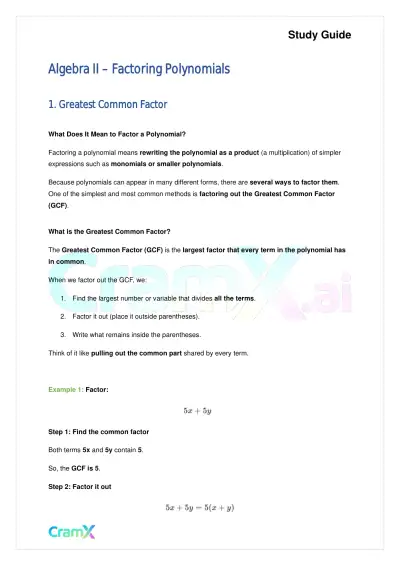 Quick Guides
Algebra II - Factoring Polynomials
Mathematics
70 pagesMar 2026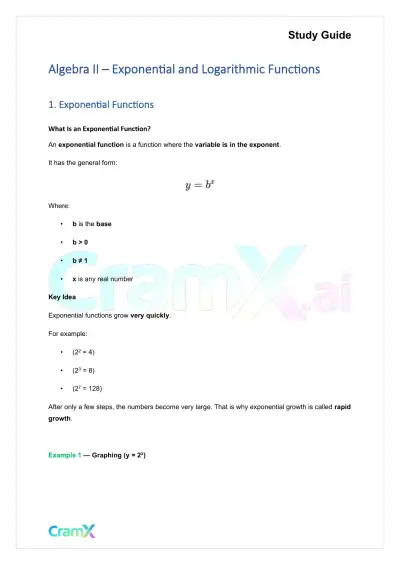 Quick Guides
Algebra II - Exponential and Logarithmic Functions
Mathematics
49 pagesMar 2026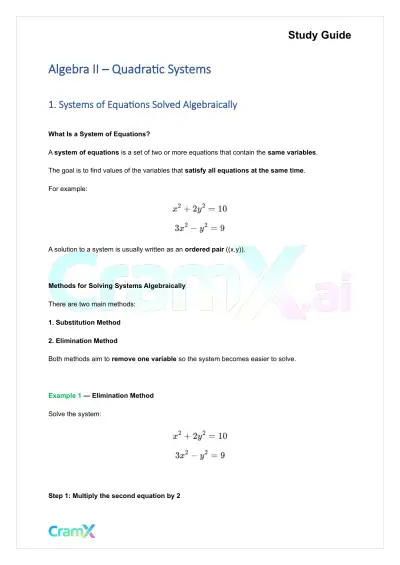 Quick Guides
Algebra II – Quadratic Systems
Mathematics
27 pagesMar 2026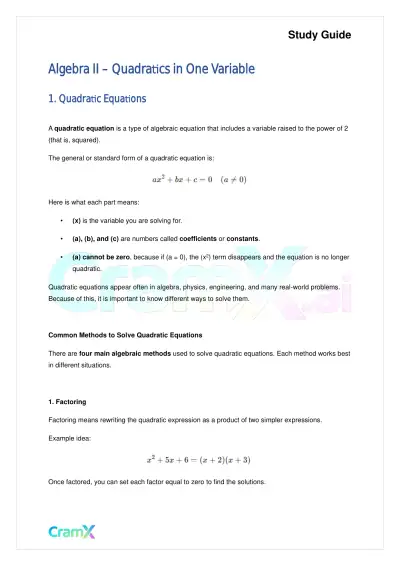 Quick Guides
Algebra II - Quadratics in One Variable
Mathematics
65 pagesMar 2026
Study this document with CramX
Once it is in your library, every tool can work from it.