

Linear Algebra – Eigenvalues and Eigenvectors
- Mathematics
- Texas A&M University
- 41 pages
- Shared March 2026
Preview 10 of 41 pages
See the first 10 pages exactly as they appear in the document.
Page 1 Read page 1 as text
Study Guide Linear Algebra – Eigenvalues and Eigenvectors 1. Determining the Eigenvalues of a Matrix 1. Why Do We Care About Eigenvalues? In linear algebra, every linear operator can be represented by multiplying by a square matrix. So instead of thinking about abstract operators, we can just study square matrices . That means: Finding the eigenvalues and eigenvectors of a linear operator is the same as finding them for a square matrix. Throughout this chapter, we assume all matrices are square matrices . 2. What Is an Eigenvalue? Let’s start with a square matrix (A). A number ( λ ) (lambda) is called an eigenvalue of (A) if there exists a nonzero vector (x) such that: This means: • When matrix (A) acts on vector (x), • It only stretches or shrinks the vector, • It does not change its direction. That special vector (x) is called an eigenvector .
Page 2 Read page 2 as text
Study Guide 3. Turning the Equation Into a Useful Form We start with: Now rewrite it step by step: Factor out (x): Here: • (I) is the identity matrix. • (A − λI ) means subtract ( λ ) from every diagonal entry of (A). 4. When Does a Nonzero Solution Exist? We want a nonzero vector (x). For the system to have a nonzero solution, the determinant must be zero: This equation is called the characteristic equation . The expression:
Page 3 Read page 3 as text
Study Guide is called the characteristic polynomial . Important facts: • It is a polynomial in ( λ ). • It has degree (n) if (A) is an ( n × n ) matrix. • The roots of this polynomial are the eigenvalues . Example 1: Finding Eigenvalues of a 2×2 Matrix We are given: Step 1: Form (A − λ I ) Subtract ( λ ) from each diagonal entry: Step 2: Take the Determinant Now simplify: This is the characteristic polynomial . Step 3: Solve the Characteristic Equation
Page 4 Read page 4 as text
Study Guide Set it equal to zero: Factor: So the eigenvalues are: A Small Note About Notation Sometimes books write: instead of For: • Even - sized matrices → they are exactly the same. • Odd - sized matrices → they differ by a negative sign. But this does not affect the eigenvalues , because both expressions become zero at the same values of ( λ ). Example 2: 3 × 3 Checkerboard Matrix We are given:
Page 5 Read page 5 as text
Study Guide Step 1 : Form (C − λ I ) Subtract ( λ ) from the diagonal: Step 2: Compute the Determinant To simplify the determinant: • Add the second row to the third row. • Then expand along the first column (Laplace expansion). After simplifying carefully, we get: Step 3: Solve the Characteristic Equation Set equal to zero: This gives:
Page 6 Read page 6 as text
Study Guide So the eigenvalues are: • ( λ ) (with multiplicity 2) • ( λ = 3) 2. Determining the Eigenvectors of a Matrix 1. Big Idea: How Do We Find Eigenvectors? Before finding eigenvectors, we must first know the eigenvalues . Why? Because eigenvectors are found by plugging each eigenvalue into the equation: This can also be written as: Now we solve this system for x . Important: • We are looking for nonzero solutions . • Those nonzero solutions form the eigenvectors corresponding to that eigenvalue . • We repeat the process for each eigenvalue. Example 1: Finding Eigenvectors of a 2×2 Matrix We use the matrix:
Page 7 Read page 7 as text
Study Guide From the previous section, we already found the eigenvalues: Now let’s find the eigenvectors for each one. Eigenvectors for λ = −1 We substitute λ = −1 into: So we solve: This gives a system of equations. After simplifying, we obtain: Notice something important: These two equations are not independent . They are actually the same equation written twice. That means we have infinitely many solutions. From: So every solution looks like:
Page 8 Read page 8 as text
Study Guide which can be written as: where t is any nonzero scalar . Therefore, the eigenvectors corresponding to λ = −1 are all multiples of: Eigenvectors for λ = −2 Now substitute λ = −2 into: After simplifying, we get the system: Again, the equations are not independent. Solving: This gives vectors of the form:
Page 9 Read page 9 as text
Study Guide where t ≠ 0 . Therefore, the eigenvectors corresponding to λ = −2 are all multiples of: Understanding What Happened For each eigenvalue: 1. Substitute λ into (A − λI ) ( x = 0) 2. Solve the resulting system. 3. If calculations are correct, there must be nonzero solutions . 4. The solutions form a line (or subspace) of eigenvectors. If you ever find that only the zero vector works, it means something went wrong — because eigenvalues must produce nonzero eigenvectors. Example 2: The General 2×2 Matrix Now consider a general matrix: Let’s explore what we can learn about its eigenvalues. Step 1: Find the Characteristic Equation We compute:
Page 10 Read page 10 as text
Study Guide This gives: This is a quadratic equation in λ. Using the quadratic formula: Step 2: Understanding the Discriminant The expression under the square root is: This can be rewritten as: Now suppose the matrix is symmetric , meaning: Then the expression becomes: This is the sum of two squares. And a sum of squares is always nonnegative . Therefore: If a matrix is real and symmetric, its eigenvalues are always real numbers.
31 more pages in the full document
Unlock it once and it stays in your library, ready to chat with or turn into flashcards.
Unlock the full documentMore Mathematics study materials
See all Quick Guides
Algebra I – Equations with Two Variables
Mathematics
45 pagesMar 2026 Quick Guides
Algebra I – Equations Ratios and Proportions
Mathematics
50 pagesMar 2026 Quick Guides
Linear Algebra – The Determinant
Mathematics
56 pagesMar 2026 Quick Guides
Linear Algebra – Real Euclidean Vector Spaces
Mathematics
122 pagesMar 2026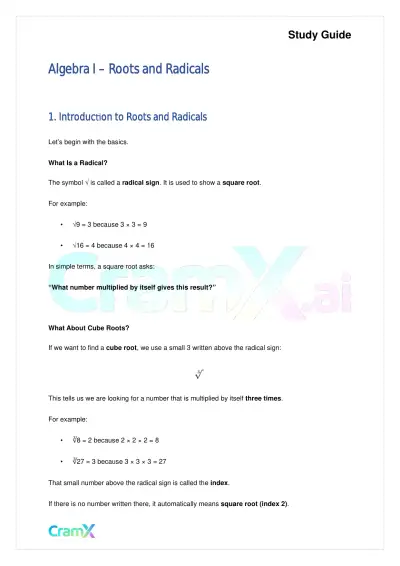 Quick Guides
Algebra I – Roots and Radicals
Mathematics
50 pagesMar 2026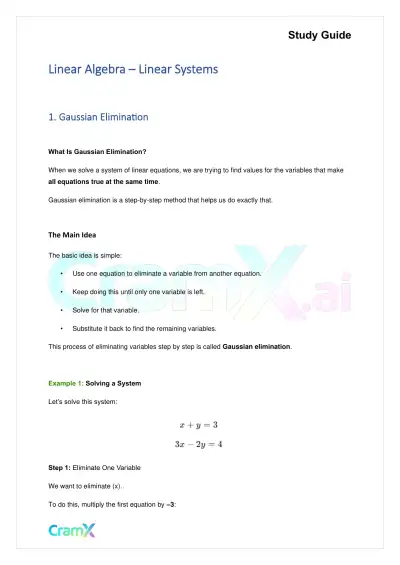 Quick Guides
Linear Algebra – Linear Systems
Mathematics
59 pagesMar 2026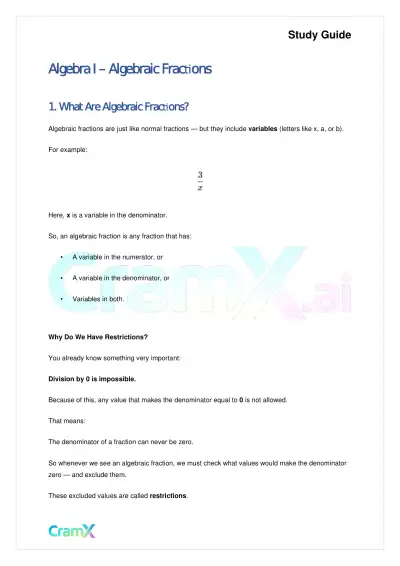 Quick Guides
Algebra I – Algebraic Fractions
Mathematics
40 pagesMar 2026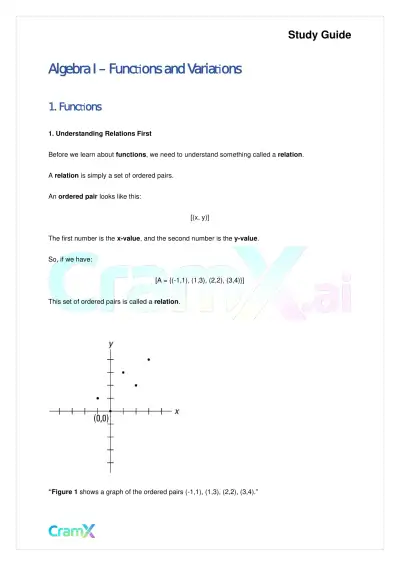 Quick Guides
Algebra I – Functions and Variations
Mathematics
62 pagesMar 2026
Study this document with CramX
Once it is in your library, every tool can work from it.