

Linear Algebra – Linear Systems
- Mathematics
- Texas A&M University
- 59 pages
- Shared March 2026
Preview 10 of 59 pages
See the first 10 pages exactly as they appear in the document.
Page 1 Read page 1 as text
Study Guide Linear Algebra – Linear Systems 1. Gaussian Elimination What Is Gaussian Elimination? When we solve a system of linear equations, we are trying to find values for the variables that make all equations true at the same time . Gaussian elimination is a step - by - step method that helps us do exactly that. The Main Idea The basic idea is simple: • Use one equation to eliminate a variable from another equation. • Keep doing this until only one variable is left. • Solve for that variable. • Substitute it back to find the remaining variables. This process of eliminating variables step by step is called Gaussian elimination . Example 1: Solving a System Let’s solve this system: Step 1: Eliminate One Variable We want to eliminate (x). To do this, multiply the first equation by – 3 :
Page 2 Read page 2 as text
Study Guide Now add this to the second equation: When we add them: Great! The (x) - terms cancel out. Step 2: Solve for One Variable Divide both sides by – 5: Step 3: Back - Substitution Now substitute (y = 1) into the first equation: So, Final Answer That’s it!
Page 3 Read page 3 as text
Study Guide Example 2: Solving Using Matrices We start with the same system: Step 1: Write the Coefficient Matrix We first write just the coefficients of the variables: This is called the coefficient matrix . Step 2: Create the Augmented Matrix Now we include the constants on the right side: This is called the augmented matrix . Each row represents one equation: • First row → (x + y = 3) • Second row → (3x - 2y = 4) Sometimes a vertical line is drawn to separate coefficients from constants. Step 3: Perform Row Operations Instead of changing equations, we now change rows. To eliminate (x) from the second row:
Page 4 Read page 4 as text
Study Guide Add – 3 times the first row to the second row. This gives: Now the second row represents: So, Substitute back into the first row: Final solution: Same answer — but much more organized! Summary of Gaussian Elimination Let’s summarize the full method. If a system is written as: We form the augmented matrix : Then we perform elementary row operations .
Page 5 Read page 5 as text
Study Guide Elementary Row Operations There are only three types: 1. Interchange Two Rows Swap any two rows. 2. Multiply a Row by a Nonzero Number Multiply every entry in a row by the same nonzero constant. 3. Add a Multiple of One Row to Another Row This is the most common operation. It helps eliminate variables. Goal of Row Operations We want to transform the matrix into a simpler form called echelon form . A matrix is in echelon form if: • All zero rows are at the bottom. • The first nonzero number in each row (called a pivot) is to the right of the pivot above it. • Entries below each pivot are zero. In this form, the system becomes much easier to solve using back - substitution . Important Concept Row operations do not change the solution of the system. That means: If the simpler matrix represents Then its solutions are exactly the same as the original system:
Page 6 Read page 6 as text
Study Guide Final Thoughts Gaussian elimination is powerful because: • It works for small and large systems. • It reduces messy algebra. • It provides a systematic, reliable method. Once you understand the logic — eliminate, simplify, back - substitute — solving systems becomes much easier and more structured. Example 3: Solving a 3 - Variable System Using Gaussian Elimination The System of Equations We are given: Our goal is to find the values of x, y, and z that make all three equations true at the same time. Step 1: Write the Augmented Matrix To organize the system, we write the augmented matrix: Each row represents one equation. The last column contains the constants on the right side.
Page 7 Read page 7 as text
Study Guide Forward Elimination Our goal now is to create zeros below each pivot (the first nonzero number in a row). Step 2: Eliminate the First Variable (x) We want zeros below the first entry in the first column. To eliminate (x) from the second and third rows: • Add – 2 times row 1 to row 2 • Add – 4 times row 1 to row 3 After doing this, the matrix becomes: Great! Now the first column has zeros below the pivot. Step 3: Eliminate the Second Variable (y) Now we focus on the second column. We want a zero below the pivot in row 2. One way would be to add a fraction of row 2 to row 3. But to avoid fractions, we first swap row 2 and row 3 . After switching rows 2 and 3: Swapping rows does not change the solution of the system. Step 4: Eliminate y from Row 3
Page 8 Read page 8 as text
Study Guide Now subtract 5 times row 2 from row 3: This gives: Now the matrix is in echelon form . All entries below each pivot are zero. The forward elimination part is complete! Back Substitution Now we solve from the bottom up. Step 5: Solve for z The third row represents: So, Step 6: Solve for y Substitute (z = 1) into the second row:
Page 9 Read page 9 as text
Study Guide Step 7: Solve for x Substitute (y = 2) and (z = 1) into the first row: Final Answer Example 4: Solving a System Using Gaussian Elimination The System of Equations We are given:
Page 10 Read page 10 as text
Study Guide Our goal is to find the values of x, y, and z . Step 1: Write the Augmented Matrix To organize the system, we write: Each row represents one equation. The last column contains the constants. Forward Elimination Our goal is to create zeros below each pivot. Step 2: Simplify the First Row To make calculations easier, multiply Row 1 by 1/2 : This gives: Now the first pivot is 1. Much cleaner!
49 more pages in the full document
Unlock it once and it stays in your library, ready to chat with or turn into flashcards.
Unlock the full documentMore Mathematics study materials
See all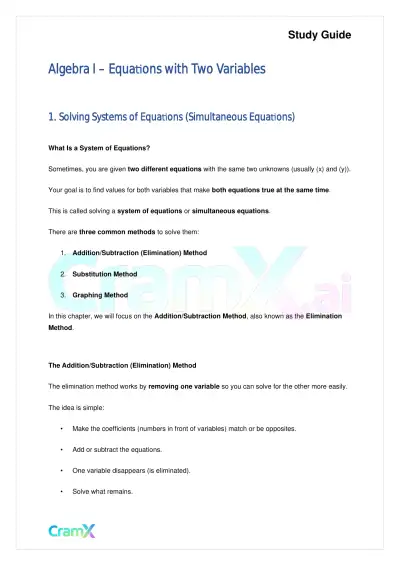 Quick Guides
Algebra I – Equations with Two Variables
Mathematics
45 pagesMar 2026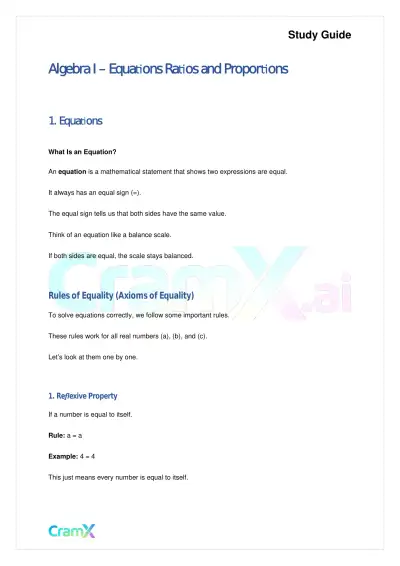 Quick Guides
Algebra I – Equations Ratios and Proportions
Mathematics
50 pagesMar 2026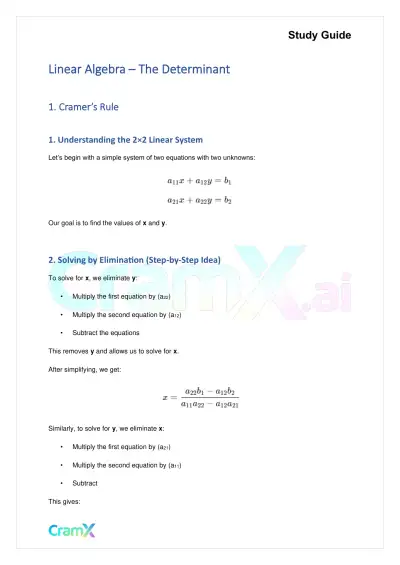 Quick Guides
Linear Algebra – The Determinant
Mathematics
56 pagesMar 2026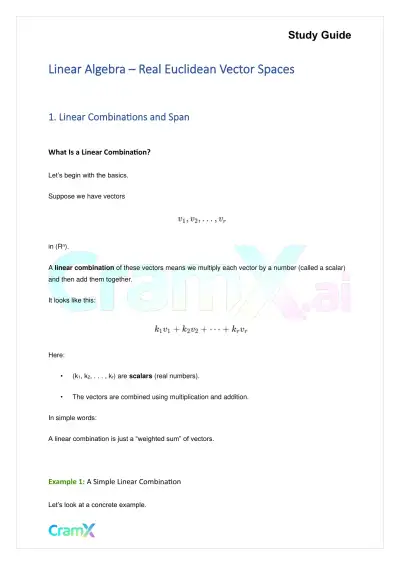 Quick Guides
Linear Algebra – Real Euclidean Vector Spaces
Mathematics
122 pagesMar 2026 Quick Guides
Linear Algebra – Eigenvalues and Eigenvectors
Mathematics
41 pagesMar 2026 Quick Guides
Algebra I – Roots and Radicals
Mathematics
50 pagesMar 2026 Quick Guides
Algebra I – Algebraic Fractions
Mathematics
40 pagesMar 2026 Quick Guides
Algebra I – Functions and Variations
Mathematics
62 pagesMar 2026
Study this document with CramX
Once it is in your library, every tool can work from it.