

Solution Manual For Heat and Mass Transfer: Fundamentals and Applications, 6th Edition
- Mechanical Engineering
- 6912 pages
- Shared May 2025
Solution Manual For Heat and Mass Transfer: Fundamentals and Applications, 6th Edition condenses textbook information into an easy-to-follow study resource.
Preview 16 of 6912 pages
See the first 16 pages exactly as they appear in the document.
Page 1 Read page 1 as text
Problem 1 - 1 C How does the science of heat transfer differ from the science of thermodynamics?
Page 2 Page 3 Read page 3 as text
Problem 1 - 2 C What is the driving force for ( a ) heat transfer, ( b ) electric current flow, and ( c ) fluid flow?
Page 4 Read page 4 as text
Problem 1 - 3 C How do rating problems in heat transfer differ from the sizing problems?
Page 5 Read page 5 as text
Problem 1 - 4 C What is the difference between the analytical and experimental approaches to heat transfer? Discuss the advantages and disadvantages of each approach.
Page 6 Read page 6 as text
Problem 1 - 5 C What is the importance of modeling in engineering? How are the mathematical models for engineering pr o cesses prepared?
Page 7 Read page 7 as text
Problem 1 - 6 C When modeling an engineering process, how is the right choice made between a simple but crude and a complex but accurate model? Is the complex model necessarily a better choice since it is more accurate?
Page 8 Read page 8 as text
Problem 1 - 7 C On a hot summer day, a student turns his fan on when he leaves his room in the morning. When he returns in the evening, will his room be warmer or cooler than the neighboring rooms? Why? Assume all the doors and windows are kept closed.
Page 9 Read page 9 as text
Problem 1 - 8 C Consider two identical rooms, one with a refrigerator in it and the other without one. If all the doors and windows are closed, will the room that contains the refrigerator be cooler or warmer than the other room? Why?
Page 10 Read page 10 as text
Problem 1 - 9 C It is often claimed that you should leave the heating system in your house on all the time rather than turning it off when yo u are not home because it takes more energy to heat the house back to its normal temperature. What do you think?
Page 11 Read page 11 as text
Problem 1 - 10 C Someone claims that turning the thermostat of the central air conditioning of a warm house to the lowest level will cool the house a lot faster. Is there any truth to this claim?
Page 12 Read page 12 as text
Problem 1 - 11 C Consider a perfectly insulated (no heat loss from the skin) 80 - L electric water heater set at 60 ° C . Observing that one tank of hot water is sufficient to meet the hot water needs of a family for an entire day, someone suggests using a timer to heat the water once a day to the set temperature and then turning it off to save energy and money. Do you think the family should take this advice and invest in a timer? Assume there is a single tariff for electricity for all hours of the day.
Page 13 Read page 13 as text
Problem 1 - 1 2 C An ideal gas is heated from 5 0 ° C to 8 0 ° C ( a ) at constant volume and ( b ) at constant pressure. For which case do you think the energy required will be greater? Why?
Page 14 Read page 14 as text
Problem 1 - 1 3 C What is heat flux? How is it related to the heat transfer rate?
Page 15 Read page 15 as text
Problem 1 - 1 4 C What are the mechanisms of energy transfer to a closed system? How is heat transfer distinguished from the other forms of energy transfer?
Page 16 Read page 16 as text
Problem 1 - 1 5 E A logic chip used in a computer dissipates 3 W of power in an environment at 120 ° F and has a heat transfer surface area of 0.08 in 2 . Assuming the heat transfer from the surface to be uniform, determine ( a ) the amount of heat this chip dissipates during an eight - hour workday in kWh and ( b ) the heat flux on the surface of the chip in W/in 2 .
6896 more pages in the full document
Unlock it once and it stays in your library, ready to chat with or turn into flashcards.
Unlock the full documentMore Mechanical Engineering study materials
See all Textbook Guides
Solution Manual For Heat And Mass Transfer: Fundamentals And Applications, 5th Edition
Mechanical Engineering
1843 pagesMay 2025 Textbook Guides
Solution Manual for Engineering Mechanics Dynamics, 13th Edition
Mechanical Engineering
1360 pages123downloadsFeb 2025 Textbook Guides
Solution Manual For Introduction To Engineering Experimentation, 3rd Edition
Mechanical Engineering
298 pages99downloadsFeb 2025 Textbook Guides
Solution Manual for Mechanics of Materials SI, 9th Edition
Mechanical Engineering
1598 pages91downloadsFeb 2025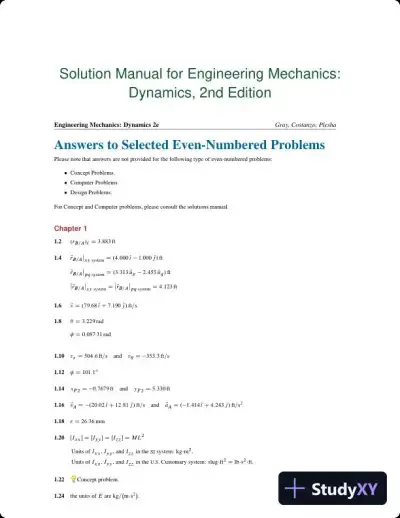 Textbook Guides
Solution Manual for Engineering Mechanics: Dynamics, 2nd Edition
Mechanical Engineering
41 pages82downloadsFeb 2025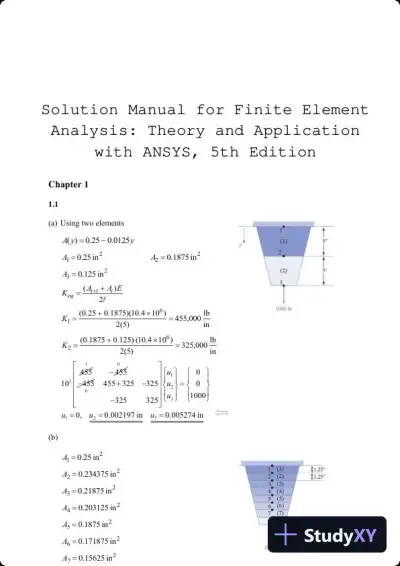 Textbook Guides
Solution Manual for Finite Element Analysis: Theory and Application with ANSYS, 5th Edition
Mechanical Engineering
426 pages53downloadsFeb 2025 Textbook Guides
Solution Manual For Modern Compressible Flow: With Historical Perspective, 3rd Edition
Mechanical Engineering
362 pages52downloadsFeb 2025 Certification Guides
Biofluid Mechanics: An Introduction to Fluid Mechanics, Macrocirculation, and Microcirculation, 3rd Edition (2021)
Mechanical Engineering
172 pages48downloadsFeb 2025
Study this document with CramX
Once it is in your library, every tool can work from it.