

ACLS Final Test Questions
- Medicine
- 4 pages
- Shared June 2025
Review key emergency cardiac care concepts: AV block types, CPR quality monitoring, appropriate EMS destinations, signs of cardiac arrest, ventilation timing, tube placement, and stroke treatment protocols.
Preview 2 of 4 pages
See the first 2 pages exactly as they appear in the document.
Page 1 Read page 1 as text
ACLS FINAL TEST QUESTIONS AND ANSWERS 2024/2025 GRADED A + BEST STUDY GUIDE. I .Which type of atrioventricular block best describes this rhythm?: Ci Second-degree type II 2. Your patient is in cardiac arrest and has been intuhate<LTo assess CPRquality, which should you do?: Ai Monitor the patient's PETCO2 3. Which facility is the most appropriate EMS destination for a patient with sudden cardiac who achieved return of spontaneous circulation in thefield?: Di Coronary reperfusion-capable medical center 4. Which of the following signs is a likely indicator of cardiac arrest in anun responsive patient?: C7i Agonal gasps 5. Which ly pe of atrioventricular block best describes this rhythm?: B Second-degree atrios emricular block type I 6. To properly ventilate a patient with a perfusing rhythm, how often dir yousqueeze the bag?: B j Once every 5 to 6 seconds. 7. In addition to clinical assessment, which is the most reliable method to confirm and monitor correct placement of an endotracheal tube?: C?i Continu-nus wav eform capnography K. You are caring for a patient with a suspected stroke whose symptoms started 2 hours ago. I he Cl scan was normal, with no signs of hemorrhage. The patient does not liave any contraindications to fibrinolytic therapy. Whichtreatment is the best for this patient?: B) Stan fibrinolytic therapy as soon as possible. 9. Which best describes this rhythm?: DjThiid-degree atrioventricular block. 10. V3hat is the- recommended range from which a temperature should heselected and maintained constantly to achieve targeted temperature matiagc-ment alter cardiac arrest?: C J 32 to 36 Degrees Celsius
Page 2 Read page 2 as text
1 1. Which is the recommended first intravenous dose of amiodarone for apatient with refractory ventricular fibrillation?: D) 3CK) mg 12. What is the primary of a medical emergency team or rapid responseteam?: B) Improving patient outcomes by identifying and treating early clinical deterioration. 13. What is the recommended next step afiera defibrillation attempt?: DiResume CPR. starting with chest compressions 14. EMS providers are treating a patient with suspected stroke. Accord ingto the Adult Suspected Stroke Algorithm, which critical action performed by the EMS team will expedite this patient's care on arrival and reduce the time to treatment?: Ai Alert the hospital. 15. A responder is caring for a patient with a history of cot estive heartfailure, rhe patient is experiencing shortness of breath, a blood pressure of 6K/50 mmHg, and a heart rate of IWmin. The patient's lead II ECU is displayed here. Which best characterizes this patient's rhythm?: D) Unstaldesupraventricular tachj cardia 16. Your rescue team arrives to find a 59-year-old man lying on the kitchenfloor. You determine that lie is unresponsive. Which is the next step in your assessment and management of tills patient?: Bi Check die patient's breaihiiigand pulse. 17. Which best describes the length of time it should take to perform apulse check during the BLS assessment?: B i 5 io 1 0 seconds IK. You instruct a team member to give 1 mg Atropine JV. Which is the bestexample of closed-loop comtnunicat ion?: C) HI draw up I mg of Atropine. 19. What is an effect of excessive ventilation?: A) Decreased cardiac output. 20. If a team member is about to make a mistake during a resuscitation attempt, w hich best describes the action that the team leader or other teanunemhers should take?: C i Address the team members immediately. 2 1. Which best describes this rhythm?: A) Monomorphic ventricular tachy car-dia. 22. ForSTEMI patient, which best describes the recommended maximumgoal time for emergency department door-to-balloon inflation time for percu-taiieous coronary intervention?: D) 91) minutes. 23. Which is the maximum interval you should allow for an Interruption inchest compressions?: A) 1() seconds. 24. Which is the one way to minimize interruptions in chest compressionsduring CPR?: D)
2 more pages in the full document
Unlock it once and it stays in your library, ready to chat with or turn into flashcards.
Unlock the full documentMore Medicine study materials
See all Exam Guides
Test Bank for The Human Body in Health and Illness, 7th Edition (Chapters 1-27)
Medicine
370 pages162downloadsFeb 2025 Textbook Guides
Solution Manual for Pearson's Comprehensive Medical Coding, 2nd Edition
Medicine
462 pages153downloadsFeb 2025 Certification Guides
Mosbys Exam Review for Computed Tomography 3rd Edition (2019)
Medicine
624 pages150downloadsFeb 2025 Exam Guides
Test Bank for CURRENT Medical Diagnosis and Treatment 2020, 59th Edition
Medicine
461 pages149downloadsFeb 2025 Exam Guides
Test Bank for Henke's Med-Math: Dosage Calculation, Preparation, and Administration, 9th Edition (Chapters 1-10)
Medicine
58 pages139downloadsFeb 2025 Exam Guides
Pathophysiology of Disease: An Introduction to Clinical Medicine 8th Edition Test Bank
Medicine
284 pages138downloadsFeb 2025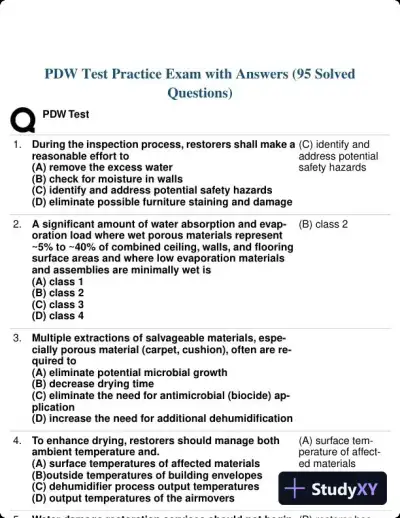 Past Exams
PDW Test Practice Exam with Answers (95 Solved Questions)
Medicine
19 pages136downloadsFeb 2025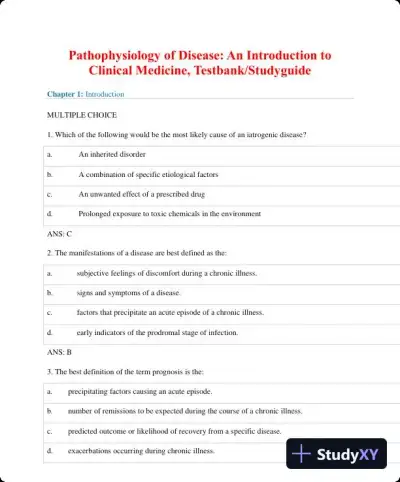 Exam Guides
Test Bank For Pathophysiology of Disease: An Introduction to Clinical Medicine, 8th Edition
Medicine
284 pages135downloadsFeb 2025
Study this document with CramX
Once it is in your library, every tool can work from it.