

Test Bank For Emergency Care, 12th Edition
- Medicine
- 528 pages
- Shared May 2025
Unlock the secrets to mastering your exam with Test Bank For Emergency Care, 12th Edition, filled with practice questions and detailed solutions.
Preview 16 of 528 pages
See the first 16 pages exactly as they appear in the document.
Page 1 Read page 1 as text
1 Test Questions for Appendix B, Emergency Care , 12 th Edition Correlation (Note: all references are to pages in Appendix B, Emergency Care , 12 th Edition) 1. To determine whether or not a child has a pulse, you would assess the __________ artery. a. Carotid (p . 1130) b. Femoral c. Radial d. Brachial 2. As you attempt to ventilate your patient , the first breath is unsuccessful. Your next step would be to: a. Reposition the head . (p . 1128, Table B - 2) b. Assess the brachial pulse . c. Assess the carotid pulse . d. Begin chest compressions . 3. When performing CPR, what is the rate of chest compressions per minute for an adult patient? a. At least 80 b. At least 90 c. At least 100 (p . 1135, Table B - 3) d. 120 4. The compression - to - ventilation ratio for a newborn is: a. 3 : 1 . (p . 1135, Table B - 3) b. 30 : 2 . c. 15 : 2 . d. 5 : 1 . 5. When performing two - person CPR on an infant, the correct compression - to - ventilation ratio is: a. 30:2 . b. 5:1 . c. 3:1 . d. 15:2 . (p . 1135, Table B - 3)
Page 2 Page 3 Read page 3 as text
2 6. Do not perform finger sweeps on unresponsive victims with a foreign body airway obstruction: a. Because the patient may bite . b. Unless your gloves are sterile . c. Unless the object is visible . (p . 1138, Table B - 4) d. Because the patient may cough . 7. The rate of compressions for a newborn in cardiac arrest is: a. 100 per minute . b. 60 per minute . c. 80 per minute . d. 120 per minute . (p . 1135, Table B - 3) 8. To prevent fatigue while performing CPR , you should switch positions with your partner: a. Every five cycles of CPR . (p . 113, Scan B - 3) b. Every minute . c. Each time you deliver a shock . d. Each time you ventilate . 9. Which of the following is considered a sign of life? a. Gasping breaths b. Wheezing (p . 1124, Table B - 1) c. Pulselessness d. Breathlessness 10. The depth of compressions when performing CPR on an adult is: a. 1 to 1 ½ inches . b. ½ – ¾ inch . c. At least 2 inches . (p. 1135, Table B - 3) d. ¾ – 1 inch . 11. Which of the following d escribes the first action you would take when encountering a person who has collapsed? a. Determine if the patient has an airway b. Determine if the patient has a pulse c. Determine if the patient is unresponsive (p . 1124) d. Determine if the patient is breathing
Page 4 Read page 4 as text
3 12. Wh at is the compression - to - ventilation ratio when performing two - person CPR on a child? a. 15:2 (p . 1135, Table B - 3) b. 30:2 c. 15:1 d. 30:1 13. The ratio of compressions to ventilations for single - rescuer CPR for adult, child, and infant patients is: a. 1 compression : 6 venti lations b. 2 compressions : 15 ventilations c. 15 compressions : 2 ventilations d. 30 compressions : 2 ventilations (p . 1135, Table B - 3) 14. Most common airway obstructions are caused by: a. Dentures . b. Vomitus . c. Broken teeth . d. T he t ongue . (p . 1126) 15. For an unresponsive patient l ess than 1 year of age , you would check for a pulse at the: a. Carotid artery . b. Femoral artery . c. Brachial artery . (p . 1125) d. Radial artery . 16. When performing CPR on a child , you should use the : a. Tips of the middle and ring fingers . b. Heel of one or two hands . (p . 11 33) c. Thumbs of both hands . d. Index finger . 17. What is the preferred method of performing CPR on an infant when two rescuers are present? a. Heel of one hand b. Heel of both hands c. Two - thumb – encircling hands technique (p . 1134, Scan B - 4) d. Index fingers 18. When ventilati ng a patient , it is important to avoid gastric distention. The best way to avoid gastric distention or mak e it worse if it develops is to : a. Deliver breaths that are enough to cause the chest to rise . (p . 1130) b. Deliver forceful breaths . c. Deliver quick breaths . d. Deliver deep breaths .
Page 5 Read page 5 as text
4 19. As you are performing rescue breathing on a patient with no spinal injury , you notice that the person is resuming adequate breathing. I n which position would you place this person? a. Recovery position (p . 1130) b. Supine position c. Prone position d. Shock position 20. In order to minimize a delay in beginning compressions for a person in suspected cardiac arrest , you should: a. Open the airway while determining unresponsiveness . b. Look, listen, and feel for breathing . c. Look for signs of breathing whi le checking for a pulse . (p . 1125) d. Immediately begin chest compressions . 21. You are on location with an adult patient with a known cardiac history. You have already determined that the patient is unresponsive. What would your next step be? a. Open the airway b. Pl ace the patient in the recovery position c. Check for a carotid pulse (p . 1125) d. Look, listen , and feel for breathing 22. What is the ventilation rate when performing rescue breathing for a child? a. 10 – 12 breaths per minute b. 12 – 20 breaths per minute (p . 1128, Table B - 2) c. 15 – 30 breaths per minute d. 25 – 50 breaths per minute 23. For the purposes of CPR, a child is defined as a person who is: a. Less than 1 year of age . b. Age 1 to puberty . (p . 1132) c. Age 1 to age 8. d. Age 1 to age 17. 24. Despite your best efforts to help, a child with a known airway obstruction has become unresponsive. You should next: a. Perform abdominal thrusts . b. Open the airway and attempt to ventilate . (p . 1138, Table B - 4) c. Perform back blows . d. Ventilate the patient .
Page 6 Read page 6 as text
5 25. You have assessed a patient who is unresponsive in hi s bed and have determined that he is in cardiac arrest. In order to perform CPR , you should: a. Place the patient in a supine position on a hard surface . (p . 1133) b. Leave him on the bed . c. Place the patient in the recovery position . d. Elevate his legs .
Page 7 Read page 7 as text
Chapter 1 — Introduction to Emergency Medical Care Select the BEST answer to the following multiple -‐ choice questions. 1. You and another new EMT are studying your local protocols. The other EMT notices that you may give oral glucose without utilizing on - line medical control, but you must get an on - line order from a physic ian before assisting a patient in taking his nitroglycerin for chest pain. The EMT asks you why some drugs require on - line medical control while others do not. What is the best answer to give him? A. Glucose is only sugar so it cannot hurt the patient. B. The physician does not trust EMTs. C. The patient’s nitroglycerin might be expired. D. The physician wants to be sure it is appropriate for the patient. Answer: D Rationale: Glucose is sugar and relatively safe; however , it can be harmful if given to an unrespo nsive patient. This answer does not explain why not to give nitroglycerin without a physician’s order. The reason p rotocols are written is not because physicians do not trust EMTs; they are written because EMTs do not have the advanced training that physic ians have. Although medications may be expired , this does not require contacting medical control to confirm. Nitroglycerin, although indicated for most chest pain patients, is not appropriate for all cardiac patients. The physician, with his advanced train ing, is better suited to make that determination. 2. You have just come on duty. The EMT on the previous shift complains to you that the QI manager was giving him grief because he did not document three sets of vital signs on the patient record. The EMT is angry and does not understand why documenting three sets of vital signs is so important. What is the best answer you could give him? A. Vital signs are something you have to fill out because the state requires it. B. The recording of three sets of vital signs d emonstrates that you were trending the patient ’ s condition. C. It is important you show the QI manager that you are a team player. D. The report looks better when all the boxes are filled out. Answer: B Rationale: The local or state governmental authority may or may not require three sets of vital signs ; regardless , this should not be the primary reason to document them. Teamwork is an
Page 8 Read page 8 as text
important trait in an EMT , but is not the driving factor for recording vital sign s. QI is not concerned with how the report looks , but rather that the information in the report is complete and accurate. Recording three sets of vital signs demonstrates to the QI manager that the EMT is appropriately reassessing the patient at the approp riate periodic intervals . This demonstrates to the QI manager that the EMT is providing quality patient care. 3. You and your EMT partner are assigned to spend a day at the senior center where you are to provide free blood pressure screenings for the commun ity. Your partner is upset that he is not in the ambulance where the “ action is. ” He complains that taking blood pressures is a waste of his time. What would be the best response to his complaints? A. It is good practice for the next emergency call. B. It makes the taxpayers happy . C. Illness prevention is an important component of EMS . D. It minimizes the number of 911 calls late at night . Answer: C Rationale: EMTs should already have competency in b lood p ressure techniques prior to hosting any screen ing clinics. Although community relations are important, it is not the primary reason for checking blood pressures. Blood pressure screening clinics do not impact the number of late night 911 calls. Illness prevention is a n important component of EMS as EM Ts are always in the field , and the role of EMS in public health is expected to only increase in the future. 4. During the new employee orientation, the training officer meets with the new EMTs and explains to them the monthly training schedule and the cla sses they must attend for EMT recertification. One of the new EMTs asks the training officer why they have to keep taking EMT courses if they already passed the EMT examination. What is the best answer? A. The state requires the training. B. EMTs forget everything once they pass the EMT exam. C. It looks good to a jury should the service be sued. D. EMS is constantly evolving in response to evidence - based research. Answer: D Rationale: Although continuing education is mandated by most states, it i s not the reason continuing education is performed. Continuing education does provide EMTs with a good review of
Page 9 Read page 9 as text
rarely used material; however, it is not accurate that EMTs forget everything once they pass the EMT exam. Although continuing education can de monstrate to a jury that the service is providing adequate training, one of the goals of continuing education is to prevent lawsuits from happening in the first place, rather than to look good once a lawsuit has been filed. Evidence - based scientific resear ch is what drives changes in EMS. New and improved treatment techniques are derived from this research and the EMT needs to keep abreast of these dynamic changes to his profession. 5. A fellow EMT is talking with the Medical Director at a staff meeting. The EMT states that the neighboring ambulance service is carrying special clotting bandages for serious bleeding wounds. The special bandages cost five times as much as the regular bandages, but the EMT claims they work ten times better. The EMT wants the Medi cal Director to approve the bandages for use in their ambulances. The Medical Director responds to the EMT by saying he will not approve the bandages until he can prove they are worth the additional cost. How can the EMT best do this? A. Have a member of the other ambulance service call the Medical Director to provide firsthand information on how the special bandages are much better. B. Call the manufacturer of the special bandage and request literature to give to the Medical Director. C. Perform a literature searc h to see what studies have been done on the special bandages and report the findings to the Medical Director. D. Order a small number of the special bandages and compare them side by side to the regular bandages. Answer: C Rationale: Firsthand accounts or an ecdotal information do not provide any actual scientific proof that the special bandages are superior. Literature from the manufacturer is designed to sell the bandages and will only present the positives of the bandages without any negative information. P roduct testing of the bandages is a good idea to determine how the bandages will work for that particular service, but does not provide proof that they are actually better. Finding objective, unbiased, evidence - based research that validates the claims of t he special bandage is the only way to actually prove that the special bandages are superior.
Page 10 Read page 10 as text
1. Which of the following BEST describes the purpose of the modern emergency medical services (EMS) system? A) To have trained personnel respond quickly and provide emergency care on the scene, during transport, and at the hospital B) To have trained per sonnel capable of assessing and caring for injured and ill patients on the scene C) To have trained personnel understand the limitations of their training and "do no harm," while providing prompt transport to the hospital D) To have trained personnel kno wledgeable in all aspects of prehospital care Answer: A Page Ref: 7 – 18 Objective: 1.4 2. Which of the following groups is credited with developing the earliest documented emergency medical service? A) The Spanish B) The Egyptians C) The Mayans D) T he French Answer: D Page Ref: 5 – 7 Objective: 1. 2 3. In 1966 the National Highway Safety Act charged which of the following agencies with the development of emergency medical service standards? A) The U.S. Department of Transportation B) The U.S. Dep artment of the Interior C) The U.S. Department of Health Services D) The U.S. Department of Homeland Security Answer: A Page Ref: 6 – 7
Page 11 Read page 11 as text
Objective: 1.3 4. The National Registry of Emergency Medical Technicians was founded to establish which of the foll owing? A) An education curriculum for EMT courses B) Quality oversight of emergency medical services practices C) Professional standards for emergency medical services personnel D) Quality improvement and quality assurance programs for emergency medica l services Answer: C Page Ref: 13 Objective: 1. 9 5. What is the minimum level of certification required of ambulance personnel in most areas? A) Emergency Medical Technician B) Emergency Medical Responder C) Advanced EMT D) Emergency Ambulance Dri ver Answer: A Page Ref: 8 – 9 Objective: 1. 5 6. Which of the following is the primary responsibility of the EMT? A) Protect and stabilize the patient B) Communicate with other responders on the scene C) Maintain personal health and safety D) Provide em ergency care Answer: C Page Ref: 6 Objective: 1. 6 7. Upon arrival at the hospital, the EMT advises hospital personnel of the patient's condition,
Page 12 Read page 12 as text
observations from the scene, treatment rendered, and other pertinent data to assure continuity of care. Th is process is known as which of the following? A) Transfer of care B) Breach of duty C) Definitive care D) End of tour Answer: A Page Ref: 10 Objective: 1. 6 8. Which of the following BEST describes a person who speaks up on behalf of the patient a nd supports his cause? A) Guardian B) Assistant C) Advocate D) Representative Answer: C Page Ref: 11 – 12 Objective: 1.7 9. Which of the following is an example of patient advocacy? A) Immobilizing the neck of a patient with a possible spinal injury B) Granting patient wishes and not reporting spousal abuse to the authorities C) Building rapport with the patient during transport to the hospital D) Providing oxygen to a patient that is short of breath Answer: C Page Ref: 10 Objective: 1.6 10. Why is it important for EMTs to participate in quality improvement programs? A) To ensure that individuals making false calls for EMS are prosecuted
Page 13 Read page 13 as text
B) To identify problem employees and create a corrective action plan C) To identify problems and develop a plan to prevent their recurrence D) To ensure adequate personnel are available for emergencies Answer: C Page Ref: 13 – 16 Objective: 1. 10 1 1 . Which of the following is a role of the EMT in the quality improvement process? A) Taking responsibility for the actions of one's partner B) Writing complete patient care reports C) Critiquing performance of one’s partner D) Assuring personal safety Answer: B Page Ref: 14 – 15 Objective: 1.11 12. Who assumes the ultimate responsibility for patient care re ndered by the EMT? A) EMS supervisor B) EMT C) Director of quality assurance D) Medical D irector Answer: D Page Ref: 15 – 16 Objective: 1. 1, 1. 12 13. Which of the following BEST describes a list of steps the EMT should perform while assessing and ma naging emergency medical situations? A) Standing orders B) On - line medical direction C) Protocols D) Standard operating procedures
Page 14 Read page 14 as text
Answer: C Page Ref: 15 – 16 Objective: 1. 1, 1. 12 14. A written authorization for an EMS provider to perform a particul ar skill in a specific situation is a(n): A) on - line protocol. B) standard of care. C) direct medical order. D) standing order. Answer: D Page Ref: 15 – 16 Objective: 1. 1, 1. 12 15. Which of the following is a physical trait necessary for performing the duties of an EMT? A) Nonjudgmental and fair B) Ability to lift and carry 200 pounds C) Giving and receiving written instructions D) Ability to remain calm in stressful situations Answer: C Page Ref: 11 – 12 Objective: 1.7 16. Which of the follo wing is a personal trait an EMT should demonstrate? A) A self - starter B) A strong student C) Strong communicat ion D) Good eyesight Answer: A Page Ref: 12 Objective: 1. 8
Page 15 Read page 15 as text
17. Centralized coordination of emergency medical access, transportation, and care most refers to which of the following? A) An emergency preparedness plan B) A trauma system C) Resource management D) Central deployment Answer: C Page Ref: 6 – 7 Objective: 1. 3 18. Which of the following is professionally equivalent to the EMT ? A) Ambulance technician B) Physician assistant C) Ambulance driver D) None of the above Answer: D Page Ref: 8 – 9 Objective: 1. 5 19. All of the following are EMS system components as defined by the National Highway Traffic Safety Administration (N HTSA) EXCEPT: A) s afety and security of EMS personnel . B) f acilities . C) r egulation and policy . D) p ublic information and education . Answer: A Page Ref: 6 – 7 Objective: 1. 3 20. Which of the following agencies is responsible for establishing EMS system a ssessment
Page 16 Read page 16 as text
programs? A) Department of Health and Human Services (DHHS) B) National Transportation Safety Board (NTSB) C) National Highway Traffic Safety Administration (NHTSA) D) United States Health Services Agency (HSA) Answer: C Page Ref: 6 – 7 Objec tive: 1. 3 2 1. Which of the following refers to a program or process for evaluating and improving the effectiveness of an EMS system? A) Quality improvement B) System effectiveness management C) Quality assurance D) Total quality management Answer: A Page Ref: 13 – 15 Objective: 1. 10 22. Which of the following best describes training that supplements the EMT's original training and that is usually taken in regular intervals? A) Distance education B) EMT training program C) Recertification D) Co ntinuing education Answer: D Page Ref: 14 – 15 Objective: 1. 11 23. Which of the following is the most common gateway for hospital services for patients who need emergency medical assistance?
512 more pages in the full document
Unlock it once and it stays in your library, ready to chat with or turn into flashcards.
Unlock the full documentMore Medicine study materials
See all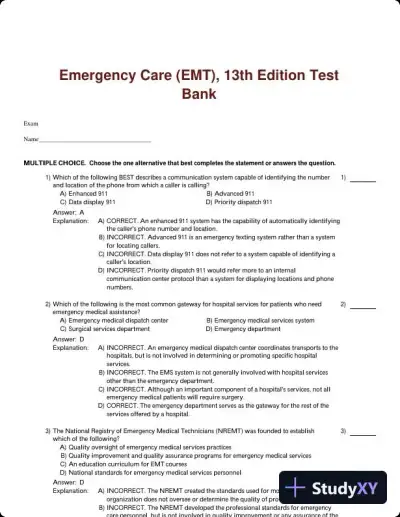 Exam Guides
Emergency Care (EMT), 13th Edition Test Bank
Medicine
725 pages38downloadsFeb 2025 Exam Guides
Test Bank for The Human Body in Health and Illness, 7th Edition (Chapters 1-27)
Medicine
370 pages162downloadsFeb 2025 Textbook Guides
Solution Manual for Pearson's Comprehensive Medical Coding, 2nd Edition
Medicine
462 pages153downloadsFeb 2025 Certification Guides
Mosbys Exam Review for Computed Tomography 3rd Edition (2019)
Medicine
624 pages150downloadsFeb 2025 Exam Guides
Test Bank for CURRENT Medical Diagnosis and Treatment 2020, 59th Edition
Medicine
461 pages149downloadsFeb 2025 Exam Guides
Test Bank for Henke's Med-Math: Dosage Calculation, Preparation, and Administration, 9th Edition (Chapters 1-10)
Medicine
58 pages139downloadsFeb 2025 Exam Guides
Pathophysiology of Disease: An Introduction to Clinical Medicine 8th Edition Test Bank
Medicine
284 pages138downloadsFeb 2025 Past Exams
PDW Test Practice Exam with Answers (95 Solved Questions)
Medicine
19 pages136downloadsFeb 2025
Study this document with CramX
Once it is in your library, every tool can work from it.