

NCLEX RN Exam With Completed Solution
- National Council Licensure Examination
- 41 pages
- Shared June 2025
NCLEX topics: blood transfusion protocols, preeclampsia, diabetes care, thyroid disorders, meds like Verapamil, and emergency antidotes.
Preview 13 of 41 pages
See the first 13 pages exactly as they appear in the document.
Page 1 Read page 1 as text
NCLEX RN EXAM WITH COMPLETE SOLUTION when fusing packed red blood cells, which solution is hung with the Y tubing? - answerO.9% sodium in water (NS) Severe Preeclampsia, what are expected findings? - answerproteinuria, facial edema, blurred vision DM and glucose monitoring, what will increase blood flow and decrease risk of infection, before taking the sample? - answerwashing clients hands with soap and warm water What is an expecting finding of Hyperthyroidism? - answerTremors What is an expected finding of Hypothyroidism? - answerPeriorbital Edema Coping Strategies - answer Verapamil - answerCCB, treats hypertension, angina, arrhythmia. Do not take with Grapefruit (may cause hypotension). what should be administered for a Benzodiazepine overdose? - answerFlumazenil Which side does a cane go on? Weak side or Strong side? - answerStrong side Na+ - answerElectrohd.es, Sodium 136-145 K+ - answerElect rolytes, Potassium 3.5-5
Page 2 Read page 2 as text
Ca+4 - answerElectrolxt.es, Calcium 9-10.5 pH - answerABG, 7.35-7.45 PaCO2 - answerABG, 35-45 HCO3 - answerABG, bicarbonate, 21-28 PaO2 - answerABG, oxygen, 80-100 SaO2 - answerABG, Oxygen Saturation, 95%-100% Hgb- answerCBC, Hemoglobin, 12-16 (F) 14rl8 (M) Het - answerCBC, Hematocrit, 42-52% (M) 37-47% (F) RBC - answer4.7 (M) 6.1 (F) WBC - answerCBC, White Blood Cell, 5000-10,000 ESR - answererythrocyte sedimentation rate, < 20 mm/hr Cholesterol, Total - answer< 200 (risk for cardiac or stroke > 150} Platelets - ans we rl 50,000-400,000
Page 3 Read page 3 as text
PT - answer!! -12.5 seconds therapeutic range is 1.5 - 2 times the normal aPTT - answerpartial thromboplastin time, 30-40 seconds therapeutic range is 1 . 5 - 2 times the normal INR- answerO.7-1.8 (unless on drug, therapeutic range 2-3) Glucose, Fasting - answerEndocrine, 70-105 HbAlc, glycosylated hemoglobin - answerEndocrine, Hemoglobin Ale, 4r6% under 6% for normal under 7% for Diabetes Control BUN - answerGU, 10-20 Creatinine - answerGU, 0.6-1.2 (M) 0.5-1.1 (F) Creatinine Clearance Test - answerOO - 139 (M) 80-125 (F) calculation of GFR best indicator of overall renal function
Page 4 Read page 4 as text
What type of solution is TPN? - answerhypertonic How can TPN be given and when is it prepared? - answerThrough a PICC line or tunneled catheter and prepared daily Which lab value is checked and how often, when TPN is initiated? - answerblood glucose, every 4r6 hours Every 24 hours a new TPN bag is hung with a new filter. True or False? - answerTrue No n-Pharmoco logical Interventions: HOT - answenon for 15min, off for 20min acts as an analgesia (pain relief) increase blood flow relaxes muscles diminishes muscles spasms eases muscles & joint stiffness No n-Pharmacc logical Interventions: COLD - answeron for 15min, off for 20min acts as an analgesia (pain relief) dec re as es/preve nts swelling diminishes muscles spasms Diseases that need Private rooms? - answeivaricella (chicken pox) herpes zoster (shingles) rubeola virus (measles) meningococcal disease
Page 5 Read page 5 as text
pneumonia respiratory syncytial virus (RSV) rubella tuberculosis (TB) HIV/AIDS - answerstandard duration of illness blood & body fluids, including breast milk hand hygiene P PE if in contact with potential contaminated materials Varicella (chicken pox) - answerstandard, Airborne, Contact Private Room until lesions crust over leasions & respiratory secretions ppi who are pregnant or not had chicken pox of vaccine, should not care for client Clostridium difficile (C-diff) - answerstandard, Contact duration of illness feces hand hygiene PPE {enteric} if contact with potentially contaminated materials Hepatitis A (HepA) - answerstandard, Contact (if fecal incontinence) until 7 days after onset of jaundice Contact precautions used with clients wearing diapers or incontinent, min of 1 week depending on
Page 6 Read page 6 as text
age Hepatitis B (HepB) - answerstandard duration of illness blood & body fluids hand hygiene contact for blood & body fluids Hepatitis C (HepC) - answerstandard (unless hemodialysis) duration of illness blood & body fluids hand hygiene contact for blood & body fluids Herpes Simplex Virus (HSV) - answerstandard, Contact recurrent oral, skin, genital until lesions crust over fluid from lesions horizontal transmission: skin & secretions vertical transmission: mother to child utero or birth Carbape nam-resistant entero bacteriacease (CRE) - answerstandard, Contact high mortality rate blood & body fluids, feces hand hygiene contact precautions
Page 7 Read page 7 as text
Herpes Zoster (shingles) - answerstandard. Airborne, Contact Private Room disseminated or localized in immunocompromised duration of illness or visible lesions lesions ppi who never had chicken pox or vaccine should not care for client Rubeola virus (measles) - answerstandard, Airborne Private Room duration of illness respiratory secretions virus can live on infected surfaces upto 2 hours Meningococcal disease - answerstandard, Droplet Private Room until continuous 2 4 h therapy respiratory secretions postexposure prophylaxis to control outbreaks What is the antidote for Magnesium Sulfate? - answerCalcium Gluconate What is the number one complication after insertion of an epidural catheter and what should the nurse do? - answerHTX and nurse should infuse isotonic IV solution Specific Gravity I urine) - answerUrinalysis, 1.005 - 1.02o
Page 8 Read page 8 as text
Protein (urine) - aiiswerUnnaiysis, 0.8 Glucose (urine) - answerless than 0.5 g/day Ketones (urine) - answerUrinalysis, none pH (urine) - answer4.6 - 8 WBC (urine) - answerO-3 (M) and 0-5 (F) What type of fluid am I? treatment of vascular system fluid deficit concentration equal to plasma prevent fluid shift, between compartments 0.9% NS LR D5W - answerlsotonic Stays where "I" put it! What type of fluid am I? treatment of intracellular dehydration
Page 9 Read page 9 as text
lower osmolality than ECF shifts fluid from ECF to ICF 0.45% NS 2.5% D in 45% NS - answerHypOtonic Go "O"ut of the vessel! and into cells What type of fluid am I? used only when serum osmolality’ is critically low osmolality higher than ECF shifts fluid from ICF to ECF D10W (10% dextrose in water) D50W (50% dextrose in water) D5NS (5% dextrose in NS) D5W in 0.45% NaCl (5% dextrose in 1/2 NS) D5LR (5% dextrose in LR) - answerHypE rto nic ■ E 1 'enter the vesse1! nasal cannula - answer!-6 LVmin 24-44% simple face mask - answers-8 L/min 40-60%
Page 10 Read page 10 as text
partial rebreather mask - answers-11 L/min 50-75% no n-re breather mask - answer12 L/min 80-100% venturi mask - answers8 L/min 24-40% aerosol mask / face tent - answers-10 L/min 30-100% T- piece - answers-10 L/min 30-100% Hypokalemia - answerlow K+ (potassium) give K+ **NEVER give IV push **"No P = No K+" risk factors: -adverse affects of medications (steroids, diuretics, digitalis, laxative abuse) -body fluid loss (vomit, diarrhea, wound drain, NG suction) -excessive diaphoresis -kidney disease -dietary 7 deficiency -alkalosis Manifestations: -muscle weakness, cramping
Page 11 Read page 11 as text
-fatigue -n/v -dysrhythmias -flat or inverted T waves confusion, irritable decreased bowel mobility paresthesia interventions: -monitor: respiratory, ECG, I&Os, HCO3 and pH, -initiate and monitor K4- replacement (oral, IV) -fall precautions -dietary -client education Hyperkalemia - answerhigh K+ {potassium) risk factors: -renal failure -adrenal insufficiency -acidosis -excessive K+ intake -medications (K+ sparing diuretics, ACE inhibitors) manifestations: -peaked T waves
Page 12 Read page 12 as text
-ventricular dysrhythmias -increased bowl motility -muscle twitching (early} -muscle weakness (late} interventions: -monitor: ECG, bowel sounds -initiate dialysis -administer (kayexalate, 50% glucose with insulin,calcium gluconate, bicarbonate, loop diuretics) Hyponatremia - answerlow Na+ (sodium} **risk of cerebral edema with hypertonic solutions risk factors-: -GI loss -SIADH -adrenal insufficiency -water intoxication -excessive diaphoresis -medications (diuretics, anti convulsants, SSRIs, lithium) manifestations: -muscle cramps, twitching -weakness -confusion
Page 13 Read page 13 as text
-lethargy -seizures -headache -n/v -anorexia -hypotension -tachycardia -weight gain, edema interventions: -Na+ replacement (oral, GI tube, IV) -restrict oral fluid intake -daily weight -I&Os -medication (conivaptan hydrochloride: Vaprisol) Hypernatremia - answerhigh Na+ (sodium) risk factors: -water deficit -GI loss -hypertonic tube feedings -DI -burns -heatstroke
28 more pages in the full document
Unlock it once and it stays in your library, ready to chat with or turn into flashcards.
Unlock the full documentMore National Council Licensure Examination study materials
See all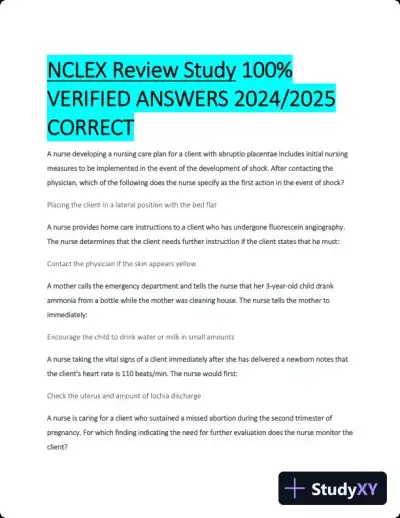 Past Exams
2024-2025 NCLEX Review Study Guide with Answers (50 Solved Questions)
National Council Licensure Examination
9 pages169downloadsFeb 2025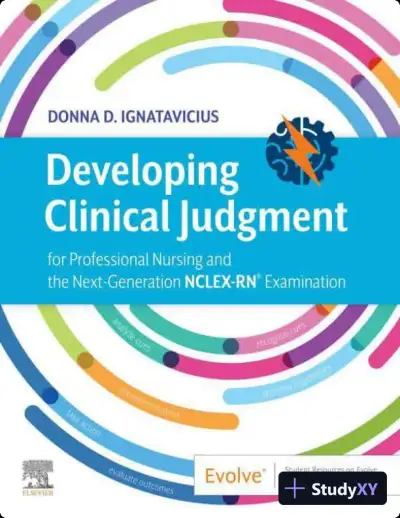 Certification Guides
Developing Clinical Judgment for Professional Nursing and the Next-Generation NCLEX-RN® Examination (2020)
National Council Licensure Examination
713 pages162downloadsFeb 2025 Certification Guides
NCLEX-RN Notes: Core Review and Exam Prep (2007)
National Council Licensure Examination
281 pages156downloadsFeb 2025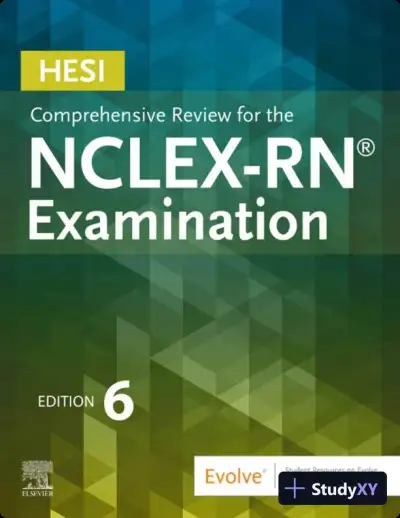 Certification Guides
HESI Comprehensive Review for the NCLEX-RN Examination 6th Edition (2019)
National Council Licensure Examination
842 pages150downloadsFeb 2025 Certification Guides
2020 NCLEX-PN Test Prep. Questions and Answers with Explanations (2020)
National Council Licensure Examination
943 pages147downloadsFeb 2025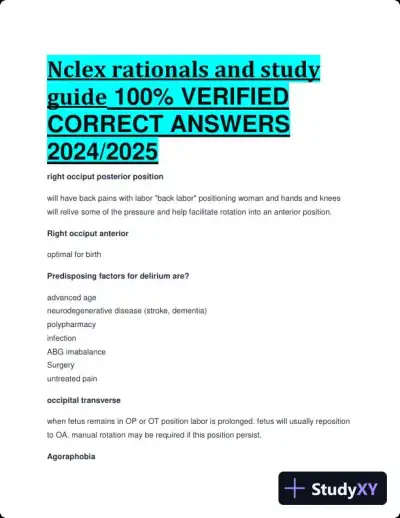 Past Exams
2024-2025 NCLEX Rationals and Study Guide with Answers (168 Solved Questions)
National Council Licensure Examination
41 pages130downloadsFeb 2025 Certification Guides
CliffsTestPrep NCLEX-RN (2011)
National Council Licensure Examination
510 pages130downloadsFeb 2025 Certification Guides
Saunders QandA Review for the NCLEX-RN Examination (2021)
National Council Licensure Examination
1761 pages125downloadsFeb 2025
Study this document with CramX
Once it is in your library, every tool can work from it.