

FES Nursing Diagnosis Written Exam With Answers (178 Solved Questions)
- Nursing
- 22 pages
- Shared May 2025
Develop exam familiarity with FES Nursing Diagnosis Written Exam With Answers, covering a wide range of past questions.
Preview 7 of 22 pages
See the first 7 pages exactly as they appear in the document.
Page 1 Read page 1 as text
FES written Exam With Questions And Answers 100% Verified (blank) are designed to view the lumen either in a front or side viewing manner -- correct answer -- Flexible scopes (blank) allow for optimal access to certain areas of the stomach and duodenum and are most commonly utilized during ERCP -- correct answer -- side - viewing Wh at is a charge coupled device or complementary metal oxide semioconducter chip based camera? -- correct answer -- sends digital message to a digital processor the suction button and the biopsy cap share a **** -- correct answer -- common channel The suction/biopsy channel is usually betw een what position on a clock face -- correct answer -- 5 and 7 oclock The (blank) cable connects to the video processing unit either wirelessly or via a separate cable. -- correct answer -- umbilical Can you use saline in your water channel? -- correct answer -- NO it can crystalize Do not activate (bla nk) until the functioning end of the device is fully exited from the endoscope channel. -- correct answer -- energy sources What scope is a side viewing scope? -- correct answer -- A duodenoscope What are external sources of endoscopic illumination? -- correct answer -- Xenon Arc, halogen filled tungste n filament lamp, LED What happens when the blue button of the scope handle is depressed? -- correct answer -- Provides water to clear the lens If the endoscope does not have a dedicated auxillary channel for irrigation, what channel can be used? -- correct answer -- The suction/biopsy ch annel
Page 2 Page 3 Read page 3 as text
Informed consent is based on what 2 ethical principles? -- correct answer -- Autonomy and self - determination Is routine testing recommended prior to endoscopy? -- correct answer -- No When should you do a pregnancy test? -- correct answer -- All females of child bearing age Who should get coag tes ts? -- c orrect answer -- active bleeding, history of bleeding, acquired coagulopathy Who should get a CXR? -- correct answer -- Patients with a suspected pulmonary or cardiac decompensation Who should get a chem panel? -- correct answer -- pts with impaired renal, hepatic or endocrine function Is there a perfect bowel prep? -- correct answer -- nope What would be an ideal prep? -- correct answer -- Reliable empties colon No effect on mucosa Short time for ingestion and evacuation No discomfort or signif SE No fluid or electrolyte shifts What is a split dose bowel regiment? -- correct answer -- half fluid given in the evening and then half in the morning of the colonoscopy completing at least 3 hours prior to procedure. If you are doing rectum and sigmoid colon endoscopy what can be the prep? -- correct answer -- 1 or 2 enemas morning of procedure If your pati ent is older than 65, what type of bowel prep should you use? -- correct answer -- PEG solutions to avoid electrolyte and fluid shifts (blank) are osmotically balanced, non - absorbable electrolyte solutions that effect bowel cleansing by washing out the ingested fluid with out producing significant fluid or electrolyte shifts -- correct answer -- Isosmotic preparations
Page 4 Read page 4 as text
What fragile patient populations can use isosmotic preps? -- correct answer -- Liver and renal failures, CHF, and electrolyte imbalances (Blank) draw plasma water into the bowel lumen to pro mote the evacuation of colonic contents. They are better tolerated due to lower volume, resulting in better patient compliance. -- correct answer -- Hyperosmotic preparations. What is the downside to hyperosomotic solutions? -- correct answer -- cause fluid loss, dehydration and are cost ly. Cant give it to people with any type of failure, ileus, malabsorption or ascites Antibiotics (are vs Are not?) generally recommended before most endoscopic procedures. -- correct answer -- Are NOT Who should you give antibiotic prophylaxis to? -- correct answer -- All patients before PEJ or PG People undergoing peritoneal dialysis Cirrhotic patients with Gi bleed High risk cardiac conditions like endocarditis or prosthetic valves In patients with liver transplant or suspected biliary obstructions Many endoscopic procedures may be perf ormed safely in the setting of antithrombotics. Cold forceps mucosal biopsies may be obtained while patient is on anticoagulation. T or F? -- corre ct answer -- True T or F When anticoagulation is temporary (e.g. warfarin for VTE), elective endoscopic procedures should be delayed when possible until anticoagulation is no longer necessary. -- correct answer -- True Procedures with a high risk of significant bleeding include: -- correct answer - - Polypectomy • Biliary sphincterotomy • Pneumatic or bougie dilation • Percutaneous endoscopic gastrostomy (PEG) placement • Endoscopic mucosal resection / endoscopic submucosal dissection (EMD/ESD) • Endosonographic - guided fine needle aspiration and pseudocyst drainage • Laser ablation and coagulation • Treatment of varices
Page 5 Read page 5 as text
Low - risk conditions for embolic event -- correct answer -- Deep vein thrombosis • Uncomplicated or paroxysmal nonvalvular atrial fibrillation • Bioprosthetic valve • Mechanical valve in the aortic position High - risk conditions for embolic event -- correct answer -- • Atrial fibrillation associated with valvular heart disease • M echanical valve in the mitral position • Mechanical valve and prior thromboembolic event The risk of major embolism in patients with mechanical heart valves without anticoagulation is(Blank) per 100 person - years, and is reduced to (blank) per 100 person - ye ars in patients with antiplatelet therapy, and to (blank) per 100 person - years in patients with warfarin. -- correct answer -- 4 2.2 1 Patients with atrial fibrillation but without valvular disease have a risk of thromboembolism of (blank) per year in the absence of anticoagulation. The risk is higher in the presence of dilated cardiomyopathy, valvular heart disease, or recent thromboembo lic events -- correct answer -- 5% to 7% The absolute risk of any embolic event in a patient with a low - risk condition in whom anticoagulation is stopped for 4 to 7 days is (blanK) per 1000 patients. -- correct answer -- 1 to 2 Pre - procedural management of antithrombotic therapy for proc edures with low risk of significant bleed are as follows: •Endoscopic procedures may be performed in patients taking antithrombotic therapy (WITH OR WITHOUT***)any alterations. -- correct answer -- Without Pre - procedural management of antithrombotic therapy for procedures with high - risk of significant bleed are as follows: • (blank) does not need to be stopped. • Patients on a single antiplatelet drug, should be switched to (blank) 5 - 7 days before. • Patients on dual antiplatelet drugs, (blank) should be continued and the second drug should be stopped 5 - 7 days before. •
Page 6 Read page 6 as text
Patients at high - risk for a thromboembolic event on long - acting anticoagulants should be given (blank). -- correct answer -- Aspirin Aspirin Aspirin Bridge Therapy When should you resume antithrombotic therapy? -- correct answer -- No cons ensus In patients with (CIED) Cardiovascular Implantable Electronic Device, what type of device are preferred? -- correct answer -- Bipolar and ultrasonic devices How do you know if a patient has a pacemaer? -- correct answer -- there should be pacing spikes on EKG in front of P waves Wh en do you place a magnet? -- correct answer -- - In non pacing patients to prevent arrythmia detection - In non pacing depending but has pacing ability patients, do need but should be available - in pacing dependent without ICD, place a magnet if procedure above umbilicus - in pacing dependent with an ICD If patients have an CIED, what else should you do besides have a magnet handy? -- correct a nswer -- monitored with either plethysmography or an arterial line and should have transcutaneous patches for emergent defibrillation and/or emergent transcutaneous pacing. Make sure CIED is working before they leave NPO guidelines: CLD? Breast milk? Infant formula? Non human Milk?
Page 7 Read page 7 as text
Light meal? Fried food, fatty foods, meat? -- correct answer -- 2 hours 4 hr 6 hr 6 hr 6 hr 8 hr Which are isomostic bowel preps? Hyperosomolar? -- correct answer -- polyethylene base and triLyte (movi prep, golytelY) Mag citrate, sodium phosphate Which of the following is considered a high - risk procedure for bleeing? a. EUS assessment of vessel encasement for pancreatic cancer B. Colonoscopy with c old forceps biopsy C. Push enteroscopy D. Balloon dilation of esophageal stricture -- correct answer -- D. balloon dilation of esophageal stricture What characterizes moderate sedation? -- correct answer -- Mildly depressed level of consciousness Patient response to verbal commands maint enance of patients own airway Intact airway reflexes hemodynamic equilibrium Deep sedation is characterized by: -- correct answer -- • Significant depression of level of consciousness • Painful stimulus is necessary to evoke a withdrawal response • Airway protective refle xes cannot be relied upon • Hemodynamics are usually preserved although instability can occur Updated Practice Guidelines for Sedation and Analgesia for Non - Anesthesiologists set forth by the American Society of Anesthesiology Task
15 more pages in the full document
Unlock it once and it stays in your library, ready to chat with or turn into flashcards.
Unlock the full documentMore Nursing study materials
See all Exam Guides
Test Bank for Critical Care Nursing: Diagnosis and Management, 9th Edition (Chapters 1-27)
Nursing
299 pages167downloadsFeb 2025 Class Notes
An Invitation To Health, Third Canadian Edition Lecture Notes
Nursing
439 pages163downloadsFeb 2025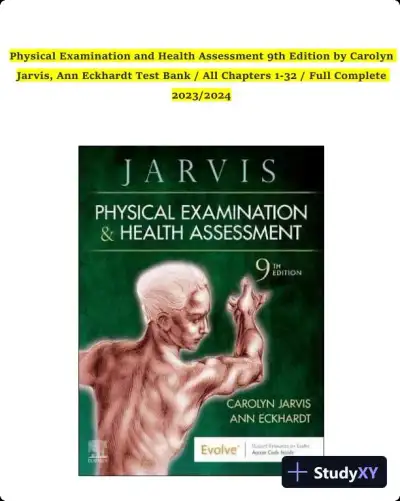 Exam Guides
Test Bank for Physical Examination and Health Assessment, 9th Edition (Chapters 1-15)
Nursing
200 pages161downloadsFeb 2025 Exam Guides
Focus on Nursing Pharmacology Seventh, North American Edition Test Bank
Nursing
1144 pages160downloadsFeb 2025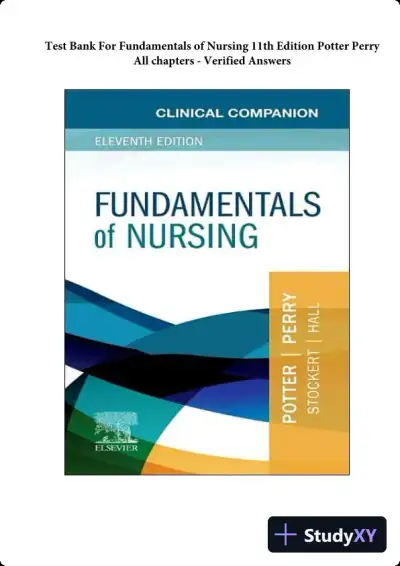 Exam Guides
Test Bank for Fundamentals of Nursing, 11th edition (Chapters 1-24)
Nursing
200 pages160downloadsFeb 2025 Class Notes
Class Notes for Child Health Nursing, 3rd Edition
Nursing
861 pages154downloadsFeb 2025 Class Notes
Class Notes for Clinical Nursing Skills: Basic to Advanced Skills, 9th Edition
Nursing
150 pages154downloadsFeb 2025 Class Notes
Class Notes for Principles of Pediatric Nursing Caring for Children, 6th Edition
Nursing
191 pages152downloadsFeb 2025
Study this document with CramX
Once it is in your library, every tool can work from it.