

Medical-Surgical Nursing: Concepts & Practice 3rd Edition Test Bank
- Nursing
- 695 pages
- Shared February 2025
- 93 downloads
Simplify your revision with Medical-Surgical Nursing: Concepts & Practice 3rd Edition Test Bank, packed with helpful practice questions.
Preview 31 of 695 pages
See the first 31 pages exactly as they appear in the document.
Page 1 Read page 1 as text
Chapter 01: Caring for Medical - Surgical Patients MULTIPLE CHOICE 1. The new nurse demonstrates an understanding of the primary purpose of the state nurse practice act (NPA) by explaining that it acts to: a. test and license LPN/LVNs. b. define the scope of LPN/LVN practice. c. improve the quality of care provided by the LPN/LVN. d. limit the LPN/LVN employment placement. ANS: B While improving quality of care provided by the LPN/LVN may be a result of the NPA, the primary purpose of the NPA of each stat e defines the scope of nursing practice in that state. DIF: Cognitive Level: Comprehension REF: 1 - 2 OBJ: 1 (theory) TOP: NPA KEY: Nursing Process Step: Implementation MSC: NCLEX: Safe, Effective Care Environment: Coordinated Care 2. The charge nurse asks t he new vocational nurse to start an intravenous infusion. Because the vocational nurse has not been taught this skill during her educational program, the vocational nurse should: a. ask a more experienced nurse to demonstrate the procedure. b. look up the procedure in the procedure manual. c. attempt to perform the procedure with supervision. d. inform the charge nurse of her lack of training in this procedure. ANS: D The charge nurse should be informed of the lack of training to perform the procedure, and the vocational nurse should seek further training to gain proficiency. Although the other options might be helpful, they are not safe. DIF: Cognitive Level: Application REF: 2 OBJ: 1 (theory) TOP: Providing Safe Care KEY: Nursing Process Step: NA
Page 2 Page 3 Read page 3 as text
MSC: NCLEX: Safe, Effective Care Environment: Coordinated Care 3. The nurse recognizes the need for further discharge education when the patient says: a. “ I have no idea of how this drug will affect me.” b. “ Do you know if my physician is coming back today?” c. “ Will my insurance pay for my stay?” d. “ Am I going to have to go to a nursing home?” ANS: A Lack of knowledge at discharge about medication effects and side effects is a concern that should be addressed by the vocational nurse. The other concerns in the options are the responsibility of other departments to which the nurse might refer the patient. DIF: Cognitive Level: Analysis REF: 2 OBJ: 1 (theory) TOP: Teaching KEY: Nursing Process Step: Implementation MSC: NCLEX: Safe, Effective Care Environment: Coordinated Care 4. According to most state NPAs, the vocational nurse acting as charge nurse in a long - term care facility is acting in which capacity? a. Under direct supervision of an RN on the unit b. With the RN in the building c. Under general supervision by the RN available on site or by phone d. As an independent vocational nurse ANS: C The vocational nurse in the capacity of the charge nurse in a long - term care facility acts with the general supervision of an RN available on site or by phone. DI F: Cognitive Level: Comprehension REF: 3 OBJ: 1 (theory) TOP: Charge Nurse/Manager KEY: Nursing Process Step: NA MSC: NCLEX: Safe, Effective Care Environment: Coordinated Care 5. The nurse reminds the patient who is a member of a health maintenance organiz ation that prior to treatment he will need to:
Page 4 Read page 4 as text
a. seek the opinion of another physician. b. have medical services approved by his insurance. c. provide documentation of all care received for his condition. d. wait 6 months to see a specialist. ANS: B M ost HMOs require preprocedure authorization for treatment. Patients are not required to seek a second opinion, provide documentation of care, or wait a specific time period before visiting a specialist. DIF: Cognitive Level: Application REF: 5 OBJ: 3 (theo ry) TOP: Charge Nurse/Manager KEY: Nursing Process Step: Implementation MSC: NCLEX: Safe, Effective Care Environment: Coordinated Care 6. The patient complains to the nurse that he is confused about his “deductible” that he owes the hospital. The nurse exp lains that the deductible is a(n): a. amount of money put aside for the payment of future medical bills. b. one-time fee for service. c. amount of money deducted from the bill by the insurance company. d. annual amount of money the patient must pay out-of-pocket for medical care. ANS: D The deductible is the annual amount the insured must pay out - of - pocket prior to the insurance company assuming the cost. This practice improves the profit of the insurance company. DIF: Cognitive Level: Application REF: 4 OBJ: 5 (theory) TOP: Health Care Financing KEY: Nursing Process Step: Implementation MSC: NCLEX: Safe, Effective Care Environment: Coordinated Care 7. The nurse compares the characteristics of a health maintenance organization (HMO) and a preferred provi der organization (PPO), pointing out that an HMO: a. requires a set fee of each member monthly. b. allows the member to select his health care provider.
Page 5 Read page 5 as text
c. permits admission to any facility the member prefers. d. offers unlimited diagnostics tests and treatments. ANS: A HMOs require a set fee from each member monthly (capitation). The patient will be treated by the HMO staff in HMO - approved facilities. Excessive use of diagnostic tests and treatments is discouraged by the HMO. DIF: Cognitive Level: Appl ication REF: 5 OBJ: 3 (theory) TOP: Managed Care KEY: Nursing Process Step: Implementation MSC: NCLEX: Safe, Effective Care Environment: Coordinated Care 8. When the patient asks the nurse what his Medicare Part A covers, the nurse responds that it covers: a. inpatient hospital costs. b. reimbursement to the physician. c. outpatient hospital services. d. ambulance transportation. ANS: A Medicare Part A covers inpatient hospital expenses, drugs, x - rays, lab work, and intensive care. Medicare Part B pays the physician, ambulance transport, and outpatient services. DIF: Cognitive Level: Comprehension REF: 5 | Box 1 - 3 OBJ: 4 (theory) TOP: Government - Sponsored Health Insurance KEY: Nursing Process Step: Implementation MSC: NCLEX: Safe, Effective Care Environm ent: Coordinated Care 9. The nurse explains that the main cost containment component of diagnosis - related groups (DRGs) is that: a. hospitals focus only on the specific diagnosis. b. hospitals treat and discharge patients quickly.
Page 6 Read page 6 as text
c. reduced-cost drugs are ordered for the specific diagnosis. d. diagnostic group classification streamlines care. ANS: B DRGs are a prospective payment plan in which hospitals receive a flat fee for each patient’s diagnostic category regardless of the length of time in the ho spital. If hospitals can treat and discharge patients before the allotted time, hospitals get to keep the excess payment; cost is contained, and the patient is discharged sooner. DIF: Cognitive Level: Comprehension REF: 6 OBJ: 5 (theory) TOP: Government - Sp onsored Health Insurance KEY: Nursing Process Step: Implementation MSC: NCLEX: Safe, Effective Care Environment: Coordinated Care 10. While assessing a group of patients, the nurse recognizes the patient who could qualify for Medicaid benefits is the: a. 35-year-old unemployed single mother with diabetes. b. 70-year-old Medicare recipient with retirement income who needs to be in a long-term care facility. c. 80-year-old blind woman living in her own home who has inadequate private insurance. d. 67-year-old stroke victim with Medicare Part A and an income from investments. ANS: A Medicaid is a joint effort of federal and state governments geared primarily for low - income people with no insurance. DIF: Cognitive Level: Comprehension REF: 6 | Box 1 - 5 OBJ: 4 (theory) TOP: Government - Sponsored Health Insurance – Medicaid KEY: Nursing Process Step: Assessment MSC: NCLEX: Safe, Effective Care Environment: Coordinated Care 11. The nurse explains that the major focus of Healthy People 2020 is to improve the health o f Americans in the second decade of the century by:
Page 7 Read page 7 as text
a. funding research. b. distributing health information. c. encouraging healthy lifestyles. d. designing programs for health improvement. ANS: C Healthy People focuses on helping ongoing programs to i ncorporate support and information to reduce infant mortality, cancer, cardiovascular disease, and HIV/AIDS and to increase effective immunizations, healthy eating habits, and healthy weight. DIF: Cognitive Level: Comprehension REF: 6 - 7 OBJ: 7 (theory) TOP : Healthy People 2020 KEY: Nursing Process Step: Implementation MSC: NCLEX: Safe, Effective Care Environment: Coordinated Care 12. The nurse who plans interventions for all dimensions of the patient’s life is practicing _____ care. a. focused b. general c. directed d. holistic ANS: D Holistic care addresses the physiologic, psychological, social, cultural, and spiritual needs of the patient. DIF: Cognitive Level: Comprehension REF: 7 OBJ: 8 (theory) TOP: Holistic Care KEY: Nursing Process Step: Planning MSC: NCLEX: Psychosocial Integrity: Coping and Adaptation 13. The patient furiously says, “My doctor was so busy giving me instructions that he didn’t hear what I was trying to ask him.” The most empathetic response would be: a. “ Boy! When people do that to me, I really get mad.” b. “ I’m sure the doctor was rushed and unaware of your needs.”
Page 8 Read page 8 as text
c. “ I’ll bet that made you feel very frustrated.” d. “ Take a deep breath and plan what you will say to him tomorrow.” ANS: C Empathy demonstrates that the nurse pe rceives the patient’s feelings but does not share the emotion. Belittling the patient’s feelings, showing sympathy, or defending the doctor makes the patient feel devalued. DIF: Cognitive Level: Analysis REF: 8 OBJ: 9 (theory) TOP: Nurse – Patient Relationsh ip KEY: Nursing Process Step: Implementation MSC: NCLEX: Psychosocial Integrity 14. The nurse explains that a therapeutic relationship differs from a social relationship in that the therapeutic relationship: a. has no boundaries. b. is goal directed. c. meets the needs of each person in the relationship. d. extends past the hospitalization period. ANS: B The therapeutic relationship is focused on the patient and is goal directed and designed to meet only the needs of the patient and does not extend past the period of hospitalization. DIF: Cognitive Level: Application REF: 8 OBJ: 9 (theory) TOP: Therapeutic Relationship KEY: Nursing Process Step: Implementation MSC: NCLEX: Psychosocial Integrity 15. The most effective nursing approach in caring for a depr essed 80 - year - old newly admitted resident to a long - term care facility would be to: a. encourage the resident to engage in an activity. b. remind the resident of reasons to be positive. c. point out episodes of negative behavior. d. present a bright and cheerful behavior.
Page 9 Read page 9 as text
ANS: A Activity and social interaction are helpful to depressed patients. Presenting a cheery approach and pointing out negative behavior and reasons to be positive are not therapeutic at this stage of the relationship. DIF: Cognitive Level: Application REF: 8 OBJ: 11 (theory) TOP: Depressed Behavior KEY: Nursing Process Step: Implementation MSC: NCLEX: Psychosocial Integrity 16. The patient who has been on antidepressants for 3 days tearfully says, “I still feel rotten. I don’t think a nything can help how I feel.” Which is the best response by the nurse? a. “ I will tell the charge nurse how you are feeling.” b. “ You will need to be patient and give your medicine some time to work.” c. “ Look how much you have improved since you were admitted to the facility.” d. “ It must be frustrating to be going through this difficult time.” ANS: D This response is an empathetic response which allows for further exploration of the patient’s feelings. The other responses will block communication with this patient. DIF: Cognitive Level: Application REF: 8 - 9 OBJ: 11 (theory) TOP: Therapeutic Communication KEY: Nursing Process Step: Implementation MSC: NCLEX: Psychosocial Integrity 17. An overweight male patient rips off his hospital gown, throws it out the door, and shouts, “I’m not wearing this stupid gown. It is too small, too short, and exposes my backside to the world.” The nurse’s best approach would be to: a. remind patient of the need to wear the gown for convenience in care. b. confer with the patient for methods to acquire a larger gown. c. replace the torn gown with another. d. inform the charge nurse of the hostile behavior. ANS: B
Page 10 Read page 10 as text
Allowing hostile patients to make reasonable requests defuses the anger and allows patients to vent their feel ings. DIF: Cognitive Level: Application REF: 9 OBJ: 11 (theory) TOP: Hostile Behavior KEY: Nursing Process Step: Implementation MSC: NCLEX: Psychosocial Integrity: Coping and Adaptation 18. A manipulative patient states, “You are the only nurse who underst ands about my pain. Can’t you give me an extra dose of pain medication?” The nurse should: a. be matter-of-fact and explain that dosage schedules are by physician’s orders. b. ignore the request. c. point out that such manipulative behavior is ineffective. d. give the extra dose. ANS: A A matter - of - fact response to a manipulative request limits the effect of the manipulation, thereby helping the nurse to avoid becoming defensive or being swayed by flattery. DIF: Cognitive Level: Application REF: 9 OBJ: 11 (theory) TOP: Manipulative Behavior KEY: Nursing Process Step: Implementation MSC: NCLEX: Psychosocial Integrity 19. A female patient who has recently been diagnosed with an inoperable brain tumor asks the nurse, “Do you think God punishes us?” The nurs e’s most helpful approach would be to: a. sit down with the patient and ask, “What do you think?” b. touch the patient’s shoulder and say, “God loves you.” c. ask the patient if she would like to speak with the chaplain. d. say, “God will not give you more than you can bear.” ANS: A Sitting with the patient and offering oneself to listen to the patient’s concerns and encouraging reflection is the best approach rather than responding with a cliché or suggesting speaking with the chaplain.
Page 11 Read page 11 as text
DIF: Cognitive Level: Analysis REF: 8 - 9 OBJ: 11 (theory) TOP: Spiritual Care KEY: Nursing Process Step: Implementation MSC: NCLEX: Psychosocial Integrity 20. The nurse is communicating with a patient who has voiced concern regarding an upcoming high - risk procedure. The n urse demonstrates empathy by stating: a. “ Would you like to talk about your feelings regarding the procedure?” b. “ My mother had the same procedure and did very well.” c. “ I can’t imagine how you feel.” d. “ It must be difficult preparing for the procedure; how are you feeling?” ANS: D This statement by the nurse displays empathy by trying to place oneself in the patient’s circumstance and validating the patient’s feelings. Simply asking patients if they would like to talk about their feelings does not s how empathy and may elicit a “yes” or “no” response. Telling the patient one’s mother had the procedure or stating “I can’t imagine how you feel” does not show empathy toward the patient. DIF: Cognitive Level: Application REF: 7 - 8 OBJ: 9 (theory) TOP: Nurs e – Patient Relationship KEY: Nursing Process Step: Implementation MSC: NCLEX: Psychosocial Integrity MULTIPLE RESPONSE 21. The new LPN/LVN reminds a coworker that clear guidelines for upholding clinical standards for safe and competent care can be found in information from: ( Select all that apply. ) a. the state’s nurse practice act (NPA). b. the State Board of Nurse Examiners (BNE). c. the National Association for Practical Nurse Education and Service (NAPNES). d. institutional policies. e. the National Federation of Licensed Practical Nurses, Inc. (NFLPN). ANS: C, E
Page 12 Read page 12 as text
NAPNES and the NFLPN give clear guidelines for clinical standards that can be used as a basis for court decisions. The NPA has broad guidelines, and institutional policies may not be complet e. The BNE enforces the NPA. DIF: Cognitive Level: Comprehension REF: 2 OBJ: 1 (theory) TOP: Upholding Clinical Standards KEY: Nursing Process Step: NA MSC: NCLEX: Safe, Effective Care Environment: Coordinated Care 22. The LPN/LVN clarifies that the role o f the LPN/LVN, regardless of employment placement, is to: ( Select all that apply. ) a. uphold clinical standards. b. educate patients. c. communicate effectively. d. collaborate with the health care team. e. initiate a care plan immediately after admission. ANS: A, B, C, D The LPN/LVN has the accountability to uphold clinical standards, educate patients, communicate effectively, and collaborate with the health care team. Depending on the type of facility, initiation of a care plan is often the role of t he registered nurse. DIF: Cognitive Level: Comprehension REF: 2 - 3 OBJ: 2 (theory) TOP: Roles of LPN/LVNs KEY: Nursing Process Step: Implementation MSC: NCLEX: Safe, Effective Care Environment: Coordinated Care 23. The newly licensed LPN/LVN demonstrates an understanding of employment opportunities when applying to a position in which of the following areas? ( Select all that apply. ) a. An outpatient clinic b. A home health care agency c. An intravenous therapy team d. A long-term care facility e. An ambulatory care unit ANS: A, B, D, E
Page 13 Read page 13 as text
With the exception of an intravenous therapy team, which requires postgraduate education and/or certification, the other options are open to newly graduated vocational nurses. DIF: Cognitive Level: Application REF: 3 | Box 1 - 1 OBJ: 2 (theory) TOP: Employment Opportunities for LPN/LVNs KEY: Nursing Process Step: NA MSC: NCLEX: Safe, Effective Care Environment: Coordinated Care 24. When an LPN/LVN delegates a task to unlicensed assistive personnel (UAP), there is: ( Select all that apply. ) a. a need for the UAP to voluntarily accept the task delegated. b. continued accountability for the task by the LPN/LVN. c. no further need for supervision of the UAP. d. the understanding that the task is in the job description of the UAP. e. a transfer of authority to the UAP. ANS: A, B, D, E Delegation is a considered act involving the condition of the patient and the competency of the UAP. Delegation requires that the UAP voluntarily accept the task, which is in the job description of the UAP. The vocational nurse has transferred authority for the completion of the task but is still accountable and should supervise. DIF: Cognitive Level: Application REF: 3 - 4 OBJ: 2 (theory) TOP: Delegation KEY: Nursing Process Step: NA MSC: NCLEX: Safe , Effective Care Environment: Coordinated Care 25. Following an in - service regarding cost containment within the health care facility, the LPN/LVN demonstrates understanding by: ( Select all that apply. ) a. telling patients that they must limit the amount of supplies they use. b. asking the UAP to be sure to correctly charge for patient care items. c. using only necessary items for patient care. d. using and charging for extra patient care items that the patient may take home upon discharge. e. documenting supplies used for patients in their patient care record.
Page 14 Read page 14 as text
ANS: B, C, E The UAP must correctly charge patients utilizing the facility’s charging system, only necessary supplies should be used for patient care, and documenting supplies used assists in rei mbursement. It is inappropriate and not the patient’s responsibility to monitor their supply use, and excess charges would be incurred if items were given to the patient upon discharge. DIF: Cognitive Level: Application REF: 6 OBJ: 6 (theory) TOP: Cost Con tainment KEY: Nursing Process Step: Implementation MSC: NCLEX: Safe, Effective Care Environment: Management of Care COMPLETION 26. When an insurance company directly reimburses a licensed health care provider for services, the form of financing is called _ _____________. ANS: fee for service Fee for service is the direct reimbursement by an insurance company to a health care provider. DIF: Cognitive Level: Comprehension REF: 4 - 5 OBJ: 6 (theory) TOP: Health Care Financing KEY: Nursing Process Step: NA MSC: NC LEX: NA 27. The nurse explains that the term _____________ refers to the severity of illness. ANS: acuity Acuity is the term referring to the severity of illness or condition of a patient. DIF: Cognitive Level: Knowledge REF: 3 OBJ: 6 (theory) TOP: Acuity KEY: Nursing Process Step: Implementation MSC: NCLEX: Safe, Effective Care Environment: Coordinated Care Chapter 02: Critical Thinking and Nursing Process MULTIPLE CHOICE
Page 15 Read page 15 as text
1. Basic to the ability to apply critical thinking, the nurse must have: a. unshakable beliefs and values. b. an open attitude. c. the ability to disregard evidence inconsistent with set goals. d. the ability to recognize the perfect solution. ANS: B An open attitude not clouded by unshakable beliefs and values or preset goals allows t he application of critical thinking. Acceptance that there may not be a perfect solution leaves the field open to new ideas. DIF: Cognitive Level: Comprehension REF: 14 - 15 OBJ: 2 (theory) TOP: Factors Influencing Critical Thinking KEY: Nursing Process Step : NA MSC: NCLEX: Health Promotion and Maintenance 2. The nurse explains that a fundamental basis for the nursing process is: a. that basic needs must be met by the individual without assistance. b. that patients and families appreciate an efficient health care system that functions without their input. c. a focus on disease control. d. that all persons have worth and dignity. ANS: D The nursing process is based on the belief that all people have worth and dignity. Patient - centered care that is applied t o all aspects of the patient’s health, and is not just disease oriented, is appreciated by the family and patient. Holistic care approach can support the patient to meet basic needs. DIF: Cognitive Level: Application REF: 16 OBJ: 5 (theory) TOP: Basic Beli efs Pertinent to the Nursing Process KEY: Nursing Process Step: Implementation MSC: NCLEX: Safe, Effective Care Environment: Coordinated Care
Page 16 Read page 16 as text
3. Upon a patient’s admission to the facility, the nurse collects the following data: patient’s temperature is 100 ° F, oxygen saturation is 89%, frothy mucus is expectorated, and the patient’s chest feels tight. The nurse correctly identifies tightness in the chest as: a. judgmental. b. objective data. c. subjective data. d. drawing a conclusion. ANS: C Subjective data is information given by the patient that cannot be measured otherwise. The other data are considered objective data. Objective data are pieces of information that can be measured by the examiner. The nurse should avoid making judgments or conclusions when obtaining data. DIF: Cognitive Level: Application REF: 18 OBJ: 2 (clinical) TOP: Assessment Data KEY: Nursing Process Step: Planning MSC: NCLEX: Safe, Effective Care Environment: Coordinated Care 4. The newly admitted patient is describing his recent symptoms to the nurse. The nurse is aware that the source of this information is considered: a. primary. b. objective. c. secondary. d. complete. ANS: A The patient is the primary source of information. Objective refers to a type of data obtained by t he nurse that is measured or can be verified through assessment techniques, secondary information is obtained from relatives or significant others, and information is not necessarily complete when the patient is the source. DIF: Cognitive Level: Applicatio n REF: 19 OBJ: 2 (clinical) TOP: Sources of Information KEY: Nursing Process Step: Assessment MSC: NCLEX: Safe, Effective Care Environment: Coordinated Care
Page 17 Read page 17 as text
5. The nurse performing an intake interview on a new resident to the long - term care facility detect s the odor of acetone from the patient’s breath. The assessment is done by: a. inspection. b. observation. c. auscultation. d. olfaction. ANS: D Olfaction is an assessment method of smells. Inspection and observation use the sense of vision. Auscultati on refers to use of the sense of hearing. DIF: Cognitive Level: Comprehension REF: 20 OBJ: 3 (clinical) TOP: Olfaction KEY: Nursing Process Step: Assessment MSC: NCLEX: Health Promotion and Maintenance 6. The nurse’s assessment reveals edema of both feet a nd ankles. The best documentation of these findings is: a. pitting edema present in both feet and ankles. b. edema in both feet and ankles approximately 4 mm deep. c. 4 mm pitting edema quickly resolving. d. bilateral pitting edema in feet and ankles: 4 mm deep resolving in 3 seconds. ANS: D Edema should be recorded as to location, depth of pitting, and time for resolution. DIF: Cognitive Level: Application REF: 20 OBJ: 3 (theory) TOP: Palpation KEY: Nursing Process Step: Assessment MSC: NCLEX: Physiolo gical Integrity: Basic Care and Comfort 7. To assess skin turgor, the nurse would: a. examine mucous membranes of the mouth. b. compare limbs for similar color.
Page 18 Read page 18 as text
c. pinch skinfold on chest for tenting. d. palpate ankles for evidence of pitting edema. AN S: C Skin turgor can be assessed by tenting the skin on the chest and recording the speed at which the “tent” subsides. DIF: Cognitive Level: Comprehension REF: 21 OBJ: 3 (clinical) TOP: Practical Assessment KEY: Nursing Process Step: Assessment MSC: NCLEX : Health Promotion and Maintenance: Prevention and Early Detection of Disease 8. The nursing student demonstrates an understanding of the Health Insurance Portability and Accountability Act (HIPAA) by: a. using the patient’s full name only on clinical assignments submitted to the instructor. b. using the facility printer to copy lab reports on an assigned patient. c. shredding any documents that the student has been using that contain identifying patient information before leaving the clinical facility. d. asking the patient for permission to copy lab and diagnostic reports for educational purposes. ANS: C HIPAA forbids any information used for educational purposes to have any identifying information; therefore, shredding documents would be appropriate. Full names on documents, printing copies of chart forms, and asking the patient for permission to copy forms would be violations of HIPAA regulations. DIF: Cognitive Level: Application REF: 22 OBJ: 1 (clinical) TOP: HIPAA KEY: Nursing Process Step: Impleme ntation MSC: NCLEX: Safe, Effective Care Environment: Coordinated Care 9. The diabetic patient who had blood drawn for an HbA1c level says, “I don’t know why they want to look at my hemoglobin.” The most helpful reply by the nurse would be: a. “ The test is to evaluate your present level of blood sugar.”
Page 19 Read page 19 as text
b. “ The HbA1c provides information relative to blood sugar levels from the past 2 to 3 months.” c. “ Hemoglobin levels and blood sugar levels are closely related.” d. “ The HbA1c tells if you have type 1 or type 2 diabetes.” ANS: B HbA1c evaluates the average blood glucose level for the last 2 to 3 months. DIF: Cognitive Level: Comprehension REF: 24 OBJ: 2 (clinical) TOP: Diagnostic Studies KEY: Nursing Process Step: Implementation MSC: NCLEX: Health Promot ion and Maintenance 10. The RN has chosen the nursing diagnosis of Risk for impaired skin integrity related to immobility. The correct goal/outcome statement for the diagnosis would be: a. patient will sit in chair at bedside for 15 minutes after each meal. b. nurse will assist patient to chair every shift. c. nurse will assess skin and record condition every shift. d. patient will change position frequently. ANS: A The goal/outcome statement is directed at the etiology and should be patient oriented. T he statement should be realistic and measurable and reflect what the patient will do. DIF: Cognitive Level: Application REF: 26 OBJ: 5 (clinical) TOP: Goals KEY: Nursing Process Step: Planning MSC: NCLEX: Physiological Integrity: Basic Care and Comfort 11. The nurse who has recently moved from Louisiana to Texas is uncertain about the LPN/LVN’s role in applying the nursing process. The most appropriate source for the nurse to consult is: a. hospital policies. b. the Texas State Board of Nursing. c. rules and regulations of the Louisiana Nurse Practice Act.
Page 20 Read page 20 as text
d. the National Association of Practical Nurse Education and Service. ANS: B Each state has different guidelines for areas of care planning, intravenous therapy, teaching, and delegation. The Texas Sta te Board of Nursing is the most reliable source. DIF: Cognitive Level: Application REF: 16 OBJ: 6 (theory) TOP: Nursing Process KEY: Nursing Process Step: NA MSC: NCLEX: Safe, Effective Care Environment: Coordinated Care 12. The nurse adds a nursing order to the care plan related to a patient with a nursing diagnosis of Nutrition: less than body requirement related to nausea and vomiting. The statement that is a nursing order is: a. medicate with an antiemetic before each meal. b. offer crackers and iced drink before each meal. c. change diet to clear liquids. d. give nothing by mouth until nausea subsides. ANS: B Offering crackers and iced drinks are within the scope of nursing; the other options would require a medical order to complete. DIF: Cognitive Level: Analysis REF: 26 OBJ: 6 (clinical) TOP: Nursing Orders KEY: Nursing Process Step: Planning MSC: NCLEX: Physiological Integrity: Basic Care and Comfort 13. Because the evaluation of the nursing care plan reflects lack of progress toward the goal, th e nurse will confer with the patient to plan a: a. more accessible goal. b. revision of interventions. c. different nursing diagnosis. d. new evaluation.
Page 21 Read page 21 as text
ANS: B When lack of progress to reach the goal is seen on evaluation, the interventions are review ed and/or revised. DIF: Cognitive Level: Application REF: 27 OBJ: 2 (clinical) TOP: Evaluation KEY: Nursing Process Step: Planning MSC: NCLEX: Safe, Effective Care Environment: Coordinated Care 14. During the intake interview, the nurse notices that, altho ugh the patient denies pain, he is grimacing and holding his hand over his stomach. The nurse’s best approach would be to: a. examine the history closely for etiology of pain. b. question the patient about having feelings of pain. c. record that patient denies pain but seems to be having abdominal discomfort. d. physically examine the patient’s abdomen. ANS: B The nurse should try to resolve any incongruence between body language and verbal responses. DIF: Cognitive Level: Application REF: 17 - 20 OBJ: 1 (clinical) TOP: Patient Interview KEY: Nursing Process Step: Assessment MSC: NCLEX: Health Promotion and Maintenance 15. During the admission interview, when asked about pain, the patient responds, “No. I’m pretty wobbly.” Which action by the nurse would b e most appropriate? a. Ask, “Did you hear me? I asked you about pain.” b. Say, “What do you mean ‘wobbly’?” c. Record the patient denied pain. d. Record the patient stated he was wobbly. ANS: B The nurse should ask for clarification if unsure of what i s meant by one of the patient’s responses.
Page 22 Read page 22 as text
DIF: Cognitive Level: Application REF: 17 - 20 OBJ: 1 (clinical) TOP: Patient Interview KEY: Nursing Process Step: Assessment MSC: NCLEX: Health Promotion and Maintenance 16. The nurse writes an intervention for the goal: Patient will sleep for 5 hours uninterrupted each night. The best nursing intervention is: a. medicate with sedative each night. b. offer warm fluids frequently. c. arrange for a large meal at supper. d. discourage daytime napping. ANS: D Discou raging daytime napping increases the probability of sleep. Giving medication is a collaborative intervention as it requires an order. Large meal and large fluid intakes may interrupt sleep. DIF: Cognitive Level: Analysis REF: 26 - 27 OBJ: 2 (clinical) TOP: N ursing Intervention KEY: Nursing Process Step: Planning MSC: NCLEX: Physiological Integrity: Basic Care and Comfort 17. The nursing team prioritizing the nursing diagnoses of an overweight hospital patient will select as the highest priority the nursing di agnosis of: a. Risk for dehydration related to vomiting. b. Activity intolerance related to shortness of breath. c. Knowledge deficit related to weight reduction diet. d. Altered self-image related to excessive weight. ANS: B Activity intolerance is th e highest priority as it has to do with activities that are essential to life. The second is Knowledge deficit related to weight reduction diet, followed by Altered self - image related to excessive weight, and the last is Risk for dehydration related to vom iting. DIF: Cognitive Level: Analysis REF: 24 - 27 OBJ: 2 (clinical)
Page 23 Read page 23 as text
TOP: Setting Priorities KEY: Nursing Process Step: Planning MSC: NCLEX: Physiological Integrity: Basic Care and Comfort 18. The nurse explains that, in addition to the NANDA stem and etiolo gy, the complete nursing diagnosis should include: a. a time reference for meeting the need. b. a designation of what the patient should do. c. signs and symptoms of the problem assessed. d. a specifically worded medical diagnosis. ANS: C A complete nu rsing diagnosis must have a NANDA stem, etiology, and signs and symptoms (etiology) of the problem. DIF: Cognitive Level: Comprehension REF: 24 - 25 OBJ: 7 (clinical) TOP: Nursing Diagnosis KEY: Nursing Process Step: Planning MSC: NCLEX: Health Promotion and Maintenance 19. The nurse explains to a patient that inclusion of potential problems in the nursing care plan: a. alerts nursing staff to prevent potential complications. b. reminds the family of potential problems. c. broadens the assessment of the caregiver. d. educates the patient to aspects of her health. ANS: A Addressing potential problems prevents complications by early action rather than waiting for a problem to materialize. DIF: Cognitive Level: Application REF: 24 - 25 OBJ: 7 (clinical) TOP: Po tential Health Problems KEY: Nursing Process Step: Planning MSC: NCLEX: Health Promotion and Maintenance
Page 24 Read page 24 as text
20. During the admission process, the nurse receives orders for the patient to have arterial blood gases (ABGs) drawn. Which finding from the patient’s history may cause concern? a. Taking ginkgo biloba for the last 6 months b. Having an increased hematocrit (Hct) level during the last physical exam c. Being diabetic for 10 years d. Having a decreased white blood cell (WBC) count ANS: A Ginkgo biloba may lower the platelet count and cause bleeding. Therefore, the nurse would be concerned about arterial bleeding occurring following ABGs being drawn. Increased Hct, a history of diabetes, and a decreased WBC count would not pose any problems with drawing a sample for ABGs. DIF: Cognitive Level: Application REF: 23 OBJ: 2 (clinical) TOP: Alternative Medicine KEY: Nursing Process Step: Assessment MSC: NCLEX: Physiological Integrity: Reduction of Risk Potential 21. The LPN/LVN adheres to facility policy rega rding core measures by performing which interventions during patient care? a. Administering the ordered amount of insulin to a patient with type 1 diabetes b. Performing a thorough patient assessment upon admission to the health care facility c. Documenting accurately and at appropriate intervals in the patient’s record d. Providing patient teaching regarding proper diet for the patient diagnosed with renal failure ANS: A Core measures are interventions that are based on scientifically researched, evide nced - based standards of care and are used to treat the majority of patients with a specific illness which often develops complications. Insulin administration for diabetics is evidence - based researched practice. The remaining options are good practice but are not considered core measures. DIF: Cognitive Level: Analysis REF: 17 OBJ: 10 (clinical) TOP: Core Measures KEY: Nursing Process Step: Implementation MSC: NCLEX: Safe, Effective Care Environment: Management of Care
Page 25 Read page 25 as text
22. The nurse is caring for a patient diagnosed with pneumonia. The patient has a BP 160/94, P 102, R 28, crackles in posterior lower lobes bilaterally, oxygen saturation 89%, and complains of shortness of breath upon exertion. The highest priority nursing diagnosis for this patient is: a. Activity intolerance b. Impaired gas exchange c. Ineffective cardiopulmonary tissue perfusion d. Self-care deficit: Bathing and hygiene ANS: B While all nursing diagnoses may apply to this patient, Impaired gas exchange is the highest priority because thi s is the underlying problem for the other nursing diagnoses, as well as physiologically the highest priority. DIF: Cognitive Level: Application REF: 24 - 27 OBJ: 2 (clinical) TOP: Nursing Diagnosis KEY: Nursing Process Step: Planning MSC: NCLEX: Safe, Effect ive Care Environment: Management of Care MULTIPLE RESPONSE 23. The nurse explains to the nursing student that the application of critical thinking to patient care involves: ( Select all that apply. ) a. identification of a patient problem. b. setting priorities. c. concentrating on the patient rather than family needs. d. use of logic and intuition. e. expansion of thought beyond the obvious. ANS: A, B, D, E Critical thinking as applied to nursing care requires setting priorities of patient problems and needs by using logic and intuition. Inclusion of the family in the care makes the approach family oriented. Critical thinking should go beyond the obvious. DIF: Cognitive Level: Comprehension REF: 14 - 16 OBJ: 2 (theory) TOP: Critical Thinking KEY: Nursing P rocess Step: Implementation
Page 26 Read page 26 as text
MSC: NCLEX: Safe, Effective Care Environment: Coordinated Care 24. The nurse demonstrates application of the nursing process by: ( Select all that apply.) a. performing a head-to-toe assessment. b. updating the patient care plan on a weekly basis. c. evaluating if patient goals have been met. d. determining if nursing interventions need to be changed based on lack of patient progress toward meeting goals. e. ensuring that all personnel caring for the patient are implementing the care plan and working toward the same goals. ANS: A, C, D, E The nursing care plan should be updated as necessary, not just on a weekly basis. Concepts of the nursing process are demonstrated by performing orderly, logical head - to - toe assessments, as w ell as ongoing evaluation of patient goals and interventions to meet those goals. DIF: Cognitive Level: Comprehension REF: 16 OBJ: 1 (clinical) TOP: Nursing Process KEY: Nursing Process Step: Implementation MSC: NCLEX: Safe, Effective Care Environment: Coo rdinated Care 25. The nurse demonstrates knowledge of the National Patient Safety Goals by performing patient care that includes: ( Select all that apply.) a. identifying the patient prior to medication administration by asking the patient to state his or her name. b. reporting any sentinel event to the facility’s quality assurance team. c. assessing the patient’s heart rate prior to administration of digoxin. d. performing hand hygiene prior to performing a patient assessment. e. documenting the appropriate time of medication administration. ANS: C, D, E Assessing the patient’s heart rate prior to administration of digoxin demonstrates knowledge of medication actions and prevention of adverse effects; hand hygiene is required before any patient care, in cluding assessment; and documentation of the time of medication administration is necessary to prevent medication errors. To meet National Patient Safety Goals, the nurse must
Page 27 Read page 27 as text
use at least two methods of patient identification prior to medication administr ation. Reporting a sentinel event is required but demonstrates that National Patient Safety Goals were not met. DIF: Cognitive Level: Application REF: 17 | Box 2 - 3 OBJ: 9 (clinical) TOP: National Patient Safety Goals KEY: Nursing Process Step: Implementati on MSC: NCLEX: Safe, Effective Care Environment: Safety and Infection Control COMPLETION 26. The nursing student demonstrates knowledge of the proper use of the ___________ when determining that it is safe to administer meperidine (Demerol) and promethazin e (Phenergan) together. ANS: Medication Reconciliation Form The Medication Reconciliation Form tracks all medications the patient is taking as prescribed by different physicians and can identify overdoses or drugs that are not compatible. DIF: Cognitive Le vel: Application REF: 19 - 20 OBJ: 2 (clinical) TOP: Medication Reconciliation Form KEY: Nursing Process Step: Implementation MSC: NCLEX: Safe, Effective Care Environment: Coordinated Care 27. Shortness of breath due to emphysema would be a major component o f the _________ care plan. ANS: interdisciplinary An interdisciplinary care plan involves all members of the health care team and is based on the medical diagnosis rather than a nursing diagnosis. DIF: Cognitive Level: Application REF: 27 OBJ: 2 (clinical) TOP: Interdisciplinary Care Plan KEY: Nursing Process Step: Planning MSC: NCLEX: Health Promotion and Maintenance MATCHING Place the steps of the nursing process in their proper sequence.
Page 28 Read page 28 as text
a. Evaluation b. Assessment c. Implementation d. Planning e. Nursing diagnosis 28. Step 1 29. Step 2 30. Step 3 31. Step 4 32. Step 5 28. ANS: B DIF: Cognitive Level: Comprehension REF: 17 OBJ: 7 (clinical) TOP: Applying the Nursing Process KEY: Nursing Process Step: Planning MSC: NCLEX: Health Promotion and Maintena nce 29. ANS: E DIF: Cognitive Level: Comprehension REF: 17 OBJ: 7 (clinical) TOP: Applying the Nursing Process KEY: Nursing Process Step: Planning MSC: NCLEX: Health Promotion and Maintenance 30. ANS: D DIF: Cognitive Level: Comprehension REF: 17 OBJ: 7 (c linical) TOP: Applying the Nursing Process KEY: Nursing Process Step: Planning MSC: NCLEX: Health Promotion and Maintenance 31. ANS: C DIF: Cognitive Level: Comprehension REF: 17 OBJ: 7 (clinical) TOP: Applying the Nursing Process KEY: Nursing Process Step : Planning MSC: NCLEX: Health Promotion and Maintenance 32. ANS: A DIF: Cognitive Level: Comprehension REF: 17 OBJ: 7 (clinical) TOP: Applying the Nursing Process KEY: Nursing Process Step: Planning MSC: NCLEX: Health Promotion and Maintenance
Page 29 Read page 29 as text
Chapter 03: Fluid, Electrolytes, Acid - Base Balance, and Intravenous Therapy MULTIPLE CHOICE 1. The nurse uses a diagram to demonstrate how in dehydration the water is drawn into the plasma from the cells by the process of: a. distillation. b. diffusion. c. filtration. d. osmosis. ANS: D The process of osmosis accomplishes the movement of water from the cells into the plasma, causing dehydration. DIF: Cognitive Level: Comprehension REF: 32 - 33 OBJ: 3 (theory) TOP: Dehydration KEY: Nursing Process Step: Implementation MSC: NCLEX: Physiological Integrity: Physiological Adaptation 2. The nurse assessing a patient with vomiting and diarrhea observes that the urine is scant and concentrated. The nurse explains that the compensatory reabsorption of water is controlled by: a. osmoreceptors in the hypothalamus. b. antidiuretic hormone in the posterior pituitary. c. baroreceptors in the carotid sinus. d. insulin from the pancreas. ANS: B The antidiuretic hormone controls how much water leaves the body by reabsorbing water i n the renal tubules. DIF: Cognitive Level: Knowledge REF: 31 - 32 OBJ: 2 (theory) TOP: Regulation of Body Fluids KEY: Nursing Process Step: Implementation MSC: NCLEX: Physiological Integrity: Physiological Adaptation
Page 30 Read page 30 as text
3. The nurse uses a picture to show how i ons equalize their concentration by the passive transport process of: a. osmosis. b. filtration. c. titration. d. diffusion. ANS: D Diffusion is the process by which substances move back and forth across compartment membranes until they are equally div ided. DIF: Cognitive Level: Comprehension REF: 32 OBJ: 3 (theory) TOP: Diffusion KEY: Nursing Process Step: Implementation MSC: NCLEX: Physiological Integrity: Physiological Adaptation 4. The nurse explains that the active transport process that is able to move sodium and potassium into or out of cells is: a. filtration. b. sodium pump. c. diffusion. d. osmosis. ANS: B The sodium pump is the mechanism by which sodium and potassium are moved into or out of cells regardless of the concentration. DIF: Cogn itive Level: Comprehension REF: 33 OBJ: 3 (theory) TOP: Active Transport KEY: Nursing Process Step: Implementation MSC: NCLEX: Physiological Integrity: Physiological Adaptation 5. The patient taking furosemide (Lasix) to correct excess edema shows a weight loss of 5.5 pounds in 24 hours. The nurse calculates this weight loss to be the excretion of approximately _____ liters of fluid.
Page 31 Read page 31 as text
a. 1.0 b. 1.5 c. 2.0 d. 2.5 ANS: D Each kilogram (2.2 pounds) of weight loss is equivalent to 1 liter of fluid. Therefore , 5.5 pounds ÷ 2.2 pounds = 2.5 liters. DIF: Cognitive Level: Application REF: 35 OBJ: 1 (clinical) TOP: Fluid Loss KEY: Nursing Process Step: Assessment MSC: NCLEX: Physiological Integrity: Physiological Adaptation 6. When the nurse assesses a potassium l evel of 2.9 mEq/L in the patient with vomiting and diarrhea, the nurse will be alert for: a. excessive urinary output. b. abdominal distention. c. increased reflexes. d. hyperactive bowel sounds. ANS: B A potassium level lower than 3.5 mEq/L results in reduced urine output, cardiac dysrhythmia, muscle weakness, abdominal pain and distention, paralytic ileus, lethargy, and confusion. DIF: Cognitive Level: Application REF: 42 | Table 3 - 4 OBJ: 4 (theory) TOP: Hypokalemia KEY: Nursing Process Step: Assessme nt MSC: NCLEX: Physiological Integrity: Basic Care and Comfort 7. While the nurse is washing the face of a patient in renal failure, the patient demonstrates a spasm of the lips and face. The nurse examines the recent electrolyte levels to assess the level of: a. potassium.
664 more pages in the full document
Unlock it once and it stays in your library, ready to chat with or turn into flashcards.
Unlock the full documentMore Nursing study materials
See all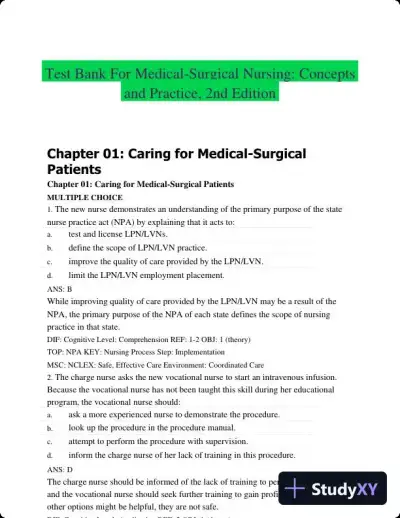 Exam Guides
Test Bank For Medical-Surgical Nursing: Concepts and Practice, 2nd Edition
Nursing
614 pages121downloadsFeb 2025 Exam Guides
Test Bank for Critical Care Nursing: Diagnosis and Management, 9th Edition (Chapters 1-27)
Nursing
299 pages167downloadsFeb 2025 Class Notes
An Invitation To Health, Third Canadian Edition Lecture Notes
Nursing
439 pages163downloadsFeb 2025 Exam Guides
Test Bank for Physical Examination and Health Assessment, 9th Edition (Chapters 1-15)
Nursing
200 pages161downloadsFeb 2025 Exam Guides
Focus on Nursing Pharmacology Seventh, North American Edition Test Bank
Nursing
1144 pages160downloadsFeb 2025 Exam Guides
Test Bank for Fundamentals of Nursing, 11th edition (Chapters 1-24)
Nursing
200 pages160downloadsFeb 2025 Class Notes
Class Notes for Clinical Nursing Skills: Basic to Advanced Skills, 9th Edition
Nursing
150 pages154downloadsFeb 2025 Class Notes
Class Notes for Child Health Nursing, 3rd Edition
Nursing
861 pages154downloadsFeb 2025
Study this document with CramX
Once it is in your library, every tool can work from it.