

NURS480 Comprehensive Practice Exam With Answers (189 Solved Questions)
- Nursing
- Chamberlain College of Nursing
- 81 pages
- Shared May 2025
Improve your answering techniques with NURS480 Comprehensive Practice Exam With Answers, featuring past papers and model solutions.
Preview 16 of 81 pages
See the first 16 pages exactly as they appear in the document.
Page 1 Read page 1 as text
EXAM 3 In planning for discharge planning for a client with bacterial meningitis, the nurse will be sure to include which instruction? 1. Keep all family and visitors from visiting your room for protective isolation. 2. Make sure you eat high protein diet with plenty of fluids 3. Take all of the antibiotics until gone. NURS 480 EXAM 1–3 WITH SATISFIED SOLUTIONS
Page 2 Page 3 Read page 3 as text
4. Incorporate regular exercise with an active range of motion. - 3. Take all of the antibiotics until gone. The client should be instructed to complete all antibiotics until they are completely gone. Failure to complete antibiotics may lead to re-infection and may spread causing endocarditis and other infections in the body, especially if the bacteria were from streptococci. While the client may be in isolation while in the hospital, family may not need to quarantine the client when at home. Some family members receive prophylactic antibiotics, but will be ordered according to the bacterial strain and health care provider (HCP) recommendations. It is important to eat a good diet, but the most important will be taking prescribed antibiotics. While returning to exercise is important, gradual increase should be performed, and the answer selection for exercise was not as important as prescribed antibiotics. The nurse is assessing the central stimulus function of an unconscious client in the intensive care unit. The nurse should plan to use which technique to test the client's central response to stimuli? 1. Supraorbital ridge pressure. 2. Sternal rub. 3. Pressure on the nail bed. 4. Calling out loudly close to the client's ear. - 1. Supraorbital ridge pressure. Central stimulus is applied to cranial nerves not peripheral nerves. Supraorbital ridge pressure by applying pressure on the orbital rim is indicated for central stimulus assessment. Sternal rub is usually not indicated via best practices. Pressure on the nail bed represents testing painful stimuli for motor testing on peripheral nerves. Calling out loudly is not an assessment technique for central stimulus function. There are two anatomic locations for pain stimulus: centrally and peripherally. Central involves trapezious pinch or supraorbital pressure
Page 4 Read page 4 as text
whereas peripheral stimuli are applied to extremities. Responses may infer damage to the brain or specific brain areas. A client is admitted for observation following a motor vehicle accident that occurred on the way to the client's daughter's wedding. The next morning, instead of asking about the wedding, the client tells the nurse "I have to leave now since the wedding is in a few minutes." The client then becomes agitated when the nurse re-orients and states the actual date (which is the day following the wedding). What should the nurse do next? 1. Change the date on the hospital room whiteboard to yesterday's date. 2. Perform neurological assessment and assess pupillary response. 3. Administer Valium 40 mg IV since the client is about to have a seizure. 4. Call the family to see if the wedding can be repeated - 2. Perform neurological assessment and assess pupillary response. The nurse needs to perform a neuro assessment to determine pupillary response, ask if a headache is present, take vital signs, and contact the health care provider. The client may be exhibiting subtle signs of increased intracranial pressure which includes restlessness, agitation, headache, and pupil changes. A client is taking felbamate (Felbatol) for seizures and displays symptoms of pancytopenia based on which assessment findings? (Select all that apply) 1. Sore throat 2. Epistaxis 3. Skin rash 4. Gingival hyperplasia - 1. Sore throat 2. Epistaxis
Page 5 Read page 5 as text
Pancytopenia symptoms while taking felbamate include fever, sore throat, flu-like feeling, and may exhibit increased bleeding with reduced platelet count (epitaxis). Skin rash may not indicate pancytopenia. Gingival hyperplasia is an adverse affect of anticonvulsants like phenytoin, but is not a symptom of pancytopenia. Pancytopenia affects red cells, white cells, and platelets and represents bone marrow's response to on-hematologic conditions such as drugs. A client is being discharged with a new prescription of phenytoin sodium (dilantin). Which instruction by the nurse is most important to include? 1. If stopped abruptly, status epilepticus may occur. 2. Sulfonamides like Bactrim will decrease phenytoin levels in the blood. 3. Take the medication with antacids to reduce gastric upset. 4. Dilantin will not affect contraceptive effectiveness. - 1. If stopped abruptly, status epilepticus may occur. It is important to instruct not to suddenly stop taking phenytoin sodium (Dilantin) as doing so may present a risk for return of life-threatening seizure activity. Sulfonamides will increase phenytoin levels. The drug should not be taken with antacids and will lower phenytoin absorption. Clients on contraceptive hormone therapy may need to use alternative forms of non-hormonal contraceptives while on phenytoin sodium (Dilantin). The nurse is caring for a client who is unconscious who requires enteral feedings through a nasogastric tube. Which action takes priority when managing enteral feedings? 1. Weigh the client daily at the same time. 2. Make sure sterile water and sterile gavage system is changed every 24 hours. 3. Keep the client in semi-fowlers position.
Page 6 Read page 6 as text
4. Keep the formula warm by setting in hot water 30 minutes prior to administration. - 3. Keep the client in semi-fowlers position. It is most important to maintain a semi-flowlers position with nasogastric feedings to prevent aspiration. While daily weights may be important, protecting the airway and lungs from aspiration is more important. Having sterile water and supplies are not necessary since the management is with clean not sterile procedure. The formula should be room temperature and should never be heated prior to administration. The nurse will collaborate with the interdisciplinary team on communication assist with a client with expressive aphasia. The team decided on which intervention to help with communication? 1. Make sure all staff know to speak slowly and in short sentences. 2. Make sure all staff speak loudly for the client to hear. 3. Make sure all staff write on a clipboard for the client to read communication. 4. Make sure all staff assist the client with use of a picture board which is client driven. - 4. Make sure all staff assist the client with use of a picture board which is client driven. Expressive aphasia clients may understand what is heard or written, but they may not be able to verbally communicate their needs. A picture or communication board helps the client as the client can point to or direct others towards objects on the board for wants and needs. Speaking loudly or slowly is not therapeutic for communication and may diminish the client's dignity. Having staff to be the only ones to write implies one-way communication that is staff-driven and not client- need driven. The focus is client-centered care and the client should be encouraged to express needs and wants through therapeutic means.
Page 7 Read page 7 as text
The nurse is caring for a client with increased intracranial pressure. Which respiratory pattern changes will signal increased intracranial pressure? 1. Rapid, shallow respirations. 2. Nasal flaring. 3. Slow, irregular respirations. 4. Sudden increase in respiratory secretions - 3. Slow, irregular respirations. Respiratory changes associated with increased intracranial pressure are the result of deterioration of neural control of respirations, which is controlled by the brain stem. Deterioration and pressure produce irregular respiratory patterns. Nasal flaring and rapid shallow respirations are a sign of respiratory distress which may not have root causes because of neurological changes. The emergency department nurse receives a client with an ischemic stroke, and prepares to administer tissue plasminogen activator (t-PA). What question should the nurse ask first before administering the t-PA? 1. Ask the client which arm or leg is affected. 2. Ask the client if speech was slurred. 3. The nurse will ask time of onset of stroke. 4. Ask what home medications the client takes. - 3. The nurse will ask time of onset of stroke. Timing of onset of stroke is important when receiving t-PA. Studies indicate that clients should receive the thrombolytic medication within 3 - 4.5 hours after the onset of a stroke for best outcomes. While asking about speech changes is important, it is more important to establish time frame of stroke onset. Other questions are not important as the emergent need is to determine if the client is a candidate for t-PA administration.
Page 8 Read page 8 as text
A client with trigeminal neuroalgia returns to the clinic for follow-up. Which assessment is most important for the nurse to perform for the client with trigeminal neuroalgia? 1. Skin temperature 2. Determining areas of pain through palpation 3. Examination of dentition 4. Perform cranial nerve IX and X assessment - 3. Examination of dentition Assessment of teeth and gums are important because dental care is often not performed for fear of pain associated with the oral care. Skin temperature and determining pain on palpation are not useful, and palpation for pain may trigger more intense pain and should be avoided. Cranial nerve IX and X are not affected by trigeminal neuralgia (trigeminal nerve is V). Trigeminal nerves control sensations in the face. Most pain is experienced in the upper or lower jaw and runs in cycles A nurse caring for a client with Guillain-Barré syndrome notifies the health care provider of deteriorating condition. Which of the following assessment findings indicate a worsening of Guillain-Barré syndrome? 1. Weakness 2. Paresthesia 3. Thick green respiratory sputum 4. Lower extremity pain - 3. Thick green respiratory sputum Guillain-Barré is characterized by paralysis which ascends through the body affecting the peripheral nervous system. Serious complications may occur as a result of respiratory infection since respiratory center is affected and failure may
Page 9 Read page 9 as text
ensue. Weakness, paresthesia, and lower extremity pain may be early signs; however, they do not indicate worsening. A client with a diagnosis of muscular sclerosis (MS) is prescribed baclofen (Lioresal). During instruction to the client, the nurse explains which of the following describes the preferred outcome of the drug? 1. It will reduce the chance of getting viral infections. 2. It will help relieve muscular spasticity. 3. It will decrease depression. 4. It will help with insomnia. - 2. It will help relieve muscular spasticity. Baclofen is a centrally acting muscle relaxant with a main outcome of relieving muscle spasms that frequently occur with MS. Baclofen does not reduce chances of getting infections, it does not decrease depression, and sedation is an adverse effect. The nurse is caring for an 8 year-old client who is diagnosed with epilepsy following an abnormal electroencephalogram (EEG). The parents are voicing disbelief in the diagnosis and indicate they never witnessed a seizure. Which of the following type of seizure will the nurse provide instruction for the parents? 1. Jacksonian seizure 2. Petit mal seizure 3. Grand mal seizure 4. Myoclonic seizure - 2. Petit mal seizure Petit mall seizures are also called absent seizures since they may be observed only as a brief staring occurrence. They may last only 10 seconds or less; however, they are likely to develop into tonic-clonic later, so medical management
Page 10 Read page 10 as text
is necessary. They usually are found between 3 and 15 years of age. Jacksonian seizure involves focal abnormal movements that usually begin in distal muscles and progress to other adjacent muscles (Motor Seizure). They last around 20-30 seconds and would be noticeable by the parents. Grand mal seizures are noticeable and the body may stiffen, jerk, shake, and loss of consciousness occurs. Myoclonic seizures occur with sudden muscle jerking as if shocked by electrical current, so the parents would have observed this type. The nurse is preparing an instructional discharge plan for a client with damage to cranial nerve II. Which item will be included in the discharge instruction? 1. Make sure the environment is clutter free and clear of obstacles. 2. Make sure all family and caretakers speak loudly. 3. Have the client to open the mouth for inspection of the tongue daily. 4. Have the client to drink only thickened liquids. - 1. Make sure the environment is clutter free and clear of obstacles. Cranial nerve II is the optic nerve and visual center, so the nurse needs to ensure that instruction on safe environment is provided. Speaking loudly may be instruction for hearing (Cranial nerve VII). Cranial nerve X, XI, & XII are more appropriate for answers C and D. The nurse is caring for an unconscious client and performs passive range of motion to which main reason? 1. To ensure that joints remain mobile. 2. To ensure that muscle tone is increased. 3. To prevent demineralization of bone. 4. To maintain muscle mass. - 1. To ensure that joints remain mobile.
Page 11 Read page 11 as text
Passive range of motion maintains joint mobility and reduces the chances of freezing joints. Muscle strength relies on maintaining muscle strength and tone. Weight bearing exercises provide for bone strengthening. A client injured in a motor vehicle accident is transferred to the intensive care unit with a diagnosis of head trauma. The emergency room nurse reports the client has increased intracranial pressure. Which assessment findings are the most important for the nurse to monitor? (Select all that apply) 1. Urine output 2. Rate of respirations 3. Cerebral perfusion pressure 4. Systolic blood pressure - 3. Cerebral perfusion pressure 4. Systolic blood pressure The systolic plus diastolic blood pressures are important and necessary in order to monitor mean arterial pressure (MAP). The MAP is necessary to assess since it reflects pressure required for brain perfusion with each cardiac cycle.The intracranial pressure (ICP) and MAP will provide analysis of cerebral perfusion pressure. While urine output, respiratory rate are important, the question is focused on critical indicators associated with head trauma. The nurse is instructing a client on the causes of Bell's palsy. What is the nurse's best explanation for Bell's Palsy? 1. It may be triggered following exposure to herbicide or poison. 2. It's cause may be unknown. 3. It may be triggered from malnutrition 4. It may be triggered from drug and alcohol addiction - 2. It's cause may be unknown.
Page 12 Read page 12 as text
The exact cause of Bell's Palsy is unknown, but some studies suggest it may include viral exposures like herpes, autoimmune diseases, or other conditions. There is no solid evidence to suggest it has a correlation with herbicides, toxins, or drug or alcohol addictions. There is no evidence linking Bell's Palsy with malnutrition. The evening nursing is caring for a client with new onset of myasthenia gravis. The nurse expects to find which of the following assessment observations? 1. Hand tremors when lifting a gallon of milk. 2. Stronger hand grips and steadier gait 3. Pain and tingling to extremities 4. Blurred vision and unclear speech patterns - 4. Blurred vision and unclear speech patterns Myasthenia gravis is a chronic autoimmune neuromuscular disease that causes weakness in skeletal muscles including those that control breathing and eye movement. Antibodies block, alter, or destroy receptors for acetylcholine at the neuromuscular junction which prevents muscular contraction. Vision changes, difficulty swallowing, breathing, ptosis, speech, and peripheral weakness are symptoms, and may worsen as the day progresses, so symptoms may be worse in later times of the day. While tremors when lifting the weight of a gallon of liquid may not be a cardinal sign, even though tremors may occur with profound weakness that may occur while using muscles for small low weight tasks. Vision and speech impairments are some of the first noticeable symptoms. The nurse is caring for a client with spinal cord injury and is preparing instructional plan for the client and family on autonomic dysreflexia. Which
Page 13 Read page 13 as text
teaching promotes the best measure to minimize occurrence of autonomic dysreflexia? 1. Perform bladder catheterization to once each 12 hours. 2. Use nitroglycerin ointment for low blood pressure. 3. Perform range of motion at least 4 times per day. 4. Perform bladder catheterization at least every 4 hours. - 4. Perform bladder catheterization at least every 4 hours. The nurse should instruct the client and family to make sure the bladder is not full since a full bladder may trigger an autonomic dysreflexia response, which may lead to increased blood pressure and possible stroke. Nitroglycerin may be used at the onset of autonomic dysreflexia for increased blood pressure. Some signs are headache, flushed skin, or sweating above the spinal cord injury occurs. The nitro past helps to bring blood pressure down quickly. Performing range of motion does not lessen chances of autonomic reflexia. Which cranial motor nerve controls the movement of the trapezius and sternocleidomastoid muscles of the shoulder? 1. Abducens 2. Trigeminal 3. Spinal accessory 4. Glossopharyngeal - 3. Spinal accessory A client with a diagnosis of epileptic seizures is on anticonvulsant therapy, phenytoin and is at the clinic for follow-up. The client reveals signs of central nervous system (CNS) depression with complaints of increased lethargy and confusion. The nurse provides further instruction on CNS depression after the client discloses use of which of the following?
Page 14 Read page 14 as text
1. Alcohol 2. Furosemide 3. Metformin 4. Calcium - 1. Alcohol Use of alcohol with phenytoin can increase CNS depression. The nurse should provide further education if a client discloses the use of alcohol while taking phenytoin. The nurse is assessing a client who has been on phenytoin for 10 years. Which characteristic finding is observed in clients with a long-term history of taking phenytoin sodium? 1. Excessive growth of gum tissue. 2. Enlarged tonsils. 3. Dry scaly skin. 4. Mania - 1. Excessive growth of gum tissue. Phenytoin is used to prevent and treat seizures. Long-term use of phenytoin can cause gingival hyperplasia (excessive growth of gum tissue). The nurse is caring for a client who was admitted 8 hours ago for a traumatic brain injury. The client's Glasgow Coma Scale score was 15 upon arrival, but now the client's GCS score is 6. What is the priority intervention? 1. Reposition the client and lower the head of the bed. 2. Call the Medical Response Team to code the client. 3. Increase the client's oxygen to 4 Liters/minute.
Page 15 Read page 15 as text
4. Notify the healthcare provider immediately. - 4. Notify the healthcare provider immediately. The total Glasgow coma scale (GCS) highest score is 15, which is considered normal brain activity. If the client's GCS is less than 8, the client is considered neurologically unstable, a medical emergency, and will be placed in the intensive care unit. A client with Guillain-Barre syndrome will be receiving immunoglobulin therapy (IVIG) and questions the nurse about the purpose of the treatment. Which statement by the nurse is correct? 1. "The liquid portion of part of your blood called plasma, is removed and replaced with healthy plasma to remove the antibodies that are harming your immune system." 2. "Donated blood plasma that contains certain antibodies is given to provide your body with the antibodies needed to fight infection." 3. "Intravenous corticosteroid treatment is administered to reduce nerve inflammation associated with Guillain-Barre syndrome." 4. "Intravenous injection of synthetically made proteins that perform like human antibodies to fight off harmful antigens." - 2. "Donated blood plasma that contains certain antibodies is given to provide your body with the antibodies needed to fight infection." Immunoglobulin therapy is blood plasma donated by healthy donors given intravenously to provide the body with the antibodies needed to fight infection. High doses of immunoglobulin can impede the injurious antibodies that present with GBS.
Page 16 Read page 16 as text
The nurse is caring for a client with a Glasgow coma scale of 5. What finding would the nurse expect with a coma scale of 5? 1. The client is alert & oriented X 4 2. The client is alert but confused 3. The client is severely confused 4. The client is in a coma - 4. The client is in a coma The total Glasgow coma scale (GCS) highest score is 15, which is considered normal brain activity. If the client's GCS is less than 8, the client is considered neurologically unstable, a medical emergency, and will be placed in the intensive care unit. The GCS assesses best eye opening response, best verbal response, and best motor response. When a client's GCS is 13-15, the client has mild brain injury; a GCS of 9-12 indicates moderate brain injury; and a GCS of 3-8 is severe brain injury. If the client has a GCS of 5, the client would be found comatose. The nurse caring for a client with a brain injury administered mannitol for increased intracranial pressure. Which is the most important for the nurse to monitor following administration of mannitol? 1. Intake and output. 2. Pupillary response. 3. Changes in pulse pressure 4. Respiratory rate. - 1. Intake and output. Which nursing diagnosis is appropriate for the client with Guillain-Barre syndrome? 1. Impaired skin integrity 2. Risk for ineffective breathing pattern
65 more pages in the full document
Unlock it once and it stays in your library, ready to chat with or turn into flashcards.
Unlock the full documentMore Nursing study materials
See all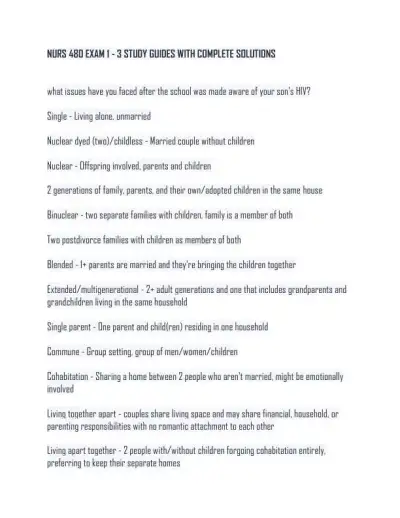 Past Exams
NURS480 Nursing Diagnosis Study Guide Practice Exam With Answers (250 Solved Questions)
Nursing
54 pagesMay 2025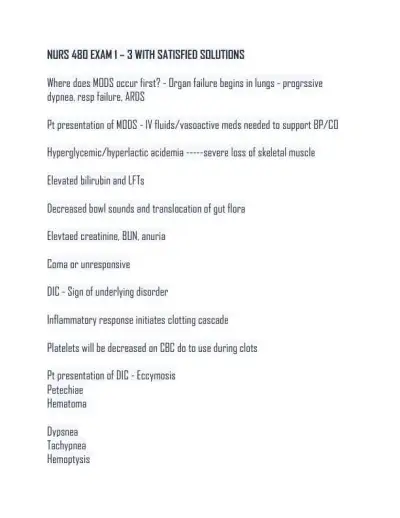 Past Exams
NURS480 Comprehensive Practice Exam With Answers (55 Solved Questions)
Nursing
41 pagesMay 2025 Exam Guides
Test Bank for Critical Care Nursing: Diagnosis and Management, 9th Edition (Chapters 1-27)
Nursing
299 pages167downloadsFeb 2025 Class Notes
An Invitation To Health, Third Canadian Edition Lecture Notes
Nursing
439 pages163downloadsFeb 2025 Exam Guides
Test Bank for Physical Examination and Health Assessment, 9th Edition (Chapters 1-15)
Nursing
200 pages161downloadsFeb 2025 Exam Guides
Focus on Nursing Pharmacology Seventh, North American Edition Test Bank
Nursing
1144 pages160downloadsFeb 2025 Exam Guides
Test Bank for Fundamentals of Nursing, 11th edition (Chapters 1-24)
Nursing
200 pages160downloadsFeb 2025 Class Notes
Class Notes for Child Health Nursing, 3rd Edition
Nursing
861 pages154downloadsFeb 2025
Study this document with CramX
Once it is in your library, every tool can work from it.