

Nursing Diagnosis Final Exam With Answers (30 Solved Questions)
- Nursing
- 14 pages
- Shared May 2025
Nursing Diagnosis Final Exam With Answers improves your retention and problem-solving skills with past exams.
Preview 5 of 14 pages
See the first 5 pages exactly as they appear in the document.
Page 1 Read page 1 as text
* Some questions not yet graded Final Exam - Requires Respondus LockDown Browser + Webcam Due No due date Points 120 Questions 30 Time Limit 90 Minutes Requires Respondus LockDown Browser Instructions Attempt History Attempt Time Score LATEST Attempt 1 30 minutes 60 out of 120 * Score for this quiz: 60 out of 120 * Submitted Jul 27 at 8:57am This attempt took 30 minutes. The Final Exam is composed of questions based upon material presented in the entire course. It will assess your level of mastery of the course content and goals. The format of the exam is similar to past module exams. You are about to begin a timed exam. Please make sure you are in a suitable, quiet place, free from distraction. 4 / 4 pts Question 1 Match each of the following organelles with the correct description. Nucleus Contains genomic content in Correct! Correct! Endoplasmic reticulum Series of membrane-enclose Correct! Correct! Lysosomes Contain hydrolytic enzymes Correct! Correct! Chloroplasts Site of photosynthesis Correct! Correct! Not yet graded / 4 pts Question 2 Your Answer: Briefly explain how a Scanning Transmission Electron Holography Microscope (STEHM) works and what it is specifically used to see.
Page 2 Page 3 Read page 3 as text
It emmits electrons instead of beams of light. The electrons will pass through the sample and allow for viewing. SEM and TEM are used differently, one looks at the outside shell of sample or cell and the other looks at the inside of the cell. One is a 3-D image and the other is 2D. Answer: An image is formed using an electron beam but coupled with a holography technique to study surfaces of proteins and subcellular structures. A STEHM has the capacity to magnify subatomic structures up to 20 million times larger than what can be viewed with the naked eye. 4 / 4 pts Question 3 Match each of the following diseases to the correct bacterial family. Legionnaires Legionella Correct! Correct! Wound botulism Clostridium botulism Correct! Correct! Impetigo Staph aureus Correct! Correct! Septicemic plague Yersina pestis Correct! Correct! 3 / 4 pts Question 4 Answer 1: Identify each of the following microorganisms as either a Prokaryote or a Eukaryote. 1 . E. Coli [ Select ] 2 . Archaeons [ Select ] 3 . Yeast Prokaryote 4 . Amoeba [ Select ] Prokaryote Correct! Correct!
Page 4 Read page 4 as text
Answer 2: Answer 3: Answer 4: Prokaryote Correct! Correct! Prokaryote You Answered You Answered Eukaryote Correct Answer Correct Answer Eukaryote Correct! Correct! 1 / 4 pts Question 5 Match each of the following terms with the correct description. Phototroph Utilize photons to generate A Correct! Correct! Lithotroph Acquire energy from preform You Answered You Answered Remove electrons from inorganic molecules Correct Answer Correct Answer Autotroph Remove electrons from inor You Answered You Answered Obtain their source of carbon from inorganic molecules Correct Answer Correct Answer Chemotroph Obtain their source of carbo You Answered You Answered Acquire energy from preformed chemicals in the environment Correct Answer Correct Answer 4 / 4 pts Question 6 A researcher is looking to solidify an agent for growth media. What polysaccharide substance would he or she use?
Page 5 Read page 5 as text
Peptone Agar Correct! Correct! Beef Abstract Yeast Not yet graded / 4 pts Question 7 Your Answer: Place the following viral life cycle steps in order beginning with viral attachment (3points) and provide a description of “RELEASE” (1 point). Uncoating: Release: Replication: Attachment: Entry: New infection: 1. Attachment 2. Entry 3. Uncoating 4. Replication 5. Release - newly replicated virions are released from host cell into organism 6. New Infection Answer: 1-Attachment: 2-Entry: 3- Uncoating: 4-Replication: 5-Release: New virus particles are produced and leave the cell 6-New infection:
9 more pages in the full document
Unlock it once and it stays in your library, ready to chat with or turn into flashcards.
Unlock the full documentMore Nursing study materials
See all Exam Guides
Test Bank for Critical Care Nursing: Diagnosis and Management, 9th Edition (Chapters 1-27)
Nursing
299 pages167downloadsFeb 2025 Class Notes
An Invitation To Health, Third Canadian Edition Lecture Notes
Nursing
439 pages163downloadsFeb 2025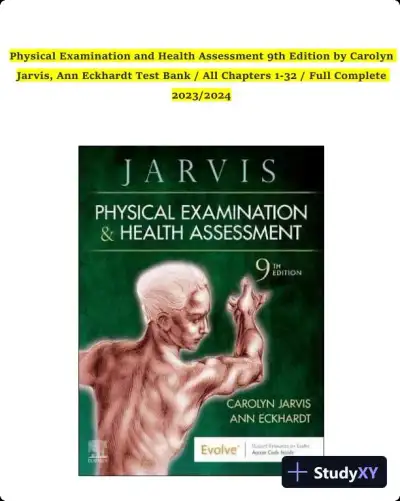 Exam Guides
Test Bank for Physical Examination and Health Assessment, 9th Edition (Chapters 1-15)
Nursing
200 pages161downloadsFeb 2025 Exam Guides
Focus on Nursing Pharmacology Seventh, North American Edition Test Bank
Nursing
1144 pages160downloadsFeb 2025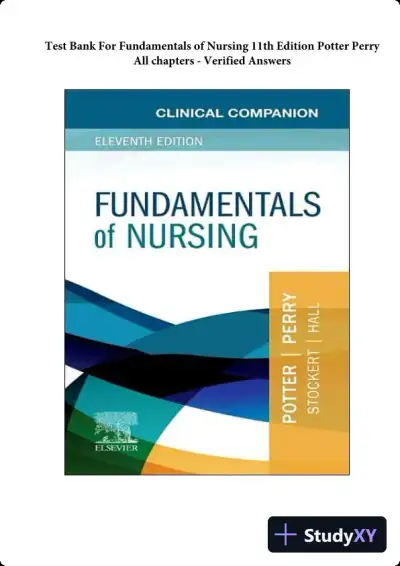 Exam Guides
Test Bank for Fundamentals of Nursing, 11th edition (Chapters 1-24)
Nursing
200 pages160downloadsFeb 2025 Class Notes
Class Notes for Child Health Nursing, 3rd Edition
Nursing
861 pages154downloadsFeb 2025 Class Notes
Class Notes for Clinical Nursing Skills: Basic to Advanced Skills, 9th Edition
Nursing
150 pages154downloadsFeb 2025 Class Notes
Class Notes for Principles of Pediatric Nursing Caring for Children, 6th Edition
Nursing
191 pages152downloadsFeb 2025
Study this document with CramX
Once it is in your library, every tool can work from it.