

Professional Nursing: Concepts and Challenges 8th Edition Test Bank
- Nursing
- 183 pages
- Shared May 2025
Professional Nursing: Concepts and Challenges 8th Edition Test Bank makes studying simple and effective with structured explanations and a clear study plan.
Preview 16 of 183 pages
See the first 16 pages exactly as they appear in the document.
Page 1 Read page 1 as text
Chapter 01: Nursing in Today’s Evolving Health Care Environment Black: Professional Nursing: Concepts & Challenges, 8th Edition MULTIPLE CHOICE 1. Which of the following could even tually change the historical status of nursing as a female - dominated profession? a. More men graduating from baccalaureate and higher degree programs b. The proportion of men in nursing beginning to increase c. More male graduates of basic nursing programs entering the workplace d. Salary compensation increasing to attract more men ANS: C Feedback A “ More men graduating from baccalaureate and higher degree programs” is not the best answer because associate degree programs produce the most new graduates. B The percentage of men in nursing has increased 50% since 2000. C The more men who enter the workplace as nurses, the less nursing will be seen as a female - dominated profession. D Salary rates do not appear to relate to the recruitment of men into nursing. DIF: Cognitive Level: Comprehension REF: Page 2 2. The racial and ethnic composition of the nursing profession will change to more accurately reflect the population as a whole when a. the increased numbers of racial and ethnic minorities enrolled in educational programs graduate and begin to practice. b. the number of Asians or Native Hawaiian - Pacific Islanders begins to increase. c. the percentage of African - American and Hispanic nurses decreases more than the percentage of white nurses. d. the nonwhite portion of the general population decreases. ANS: A Feedback A A larger percentage of minorities are enrolled in nursing educational programs than previously. B Asians and Native Hawaiian - Pacific Islanders are over represented in nursing compared to their percentage of the general population. C Not only would the percentage of African - American and Hispanic nurses need to increase, the percentage of white nurses would have to decrease in order to more accurately reflect the population as a whole. D The nonwhite portion of the general population is not likely to decrease. DIF: Cognitive Level: Comprehension REF: Page 3 3. Which of the following is a correct statement about the registered nurse (RN) population?
Page 2 Page 3 Read page 3 as text
a. The racial/ethnic composition of RNs closely resembles that of the general population. b. The number of men entering nursing has decreased steadily over the last decade. c. The rate of aging of RNs has slowed for the first time in the past 30 years. d. The majority of employed RNs working full time must work a second position. ANS: C Feedback A The racial/ethnic composition of RNs is increasing, but does not approximate their percentage of the overall population. B The number of men entering nursing is increasing. C The average age of RNs in both 2004 and 2008 was 46. This is a result of the numbers of RNs under 30 in the workforce. D According to 2008 data, only 12% of nurses working full time hold second positions. DIF: Cognitive Level: Knowledge REF: Page 3 4. Which of the following best describes trends in nursing education? a. Numbers of RNs with bachelor’s and higher degrees are increasing. b. Numbers of RNs with associate degrees are decreasing. c. Foreign - born nurses practicing in the United States are seen as less knowledgeable because of their lesser educational preparation. d. Numbers of RNs with diploma educations are increasing. ANS: A Feedback A Slightly over 50% of RNs eventually obtain their bachelor’s of science in nursing (BSN) or a higher nursing degree. B The majority of nurses in this country get their initial nursing education in associate degree in nursing (ADN) programs. C Foreign - born nurses practicing in the United States may be viewed as less knowledgeable by their peers because of language and cultural differences. D The numbers of diploma - educated nurses are declining. DIF: Cognitiv e Level: Knowledge REF: Page 4 5. Despite the variety of work settings available to the RN, data indicate that the primary work site for RNs is a. ambulatory care settings. b. community health settings. c. long - term care facilities. d. acute care hospitals. ANS: D Feedback A Ambulatory care settings account for about 10.5% of RNs’ places of
Page 4 Read page 4 as text
employment. B Public health and community health settings account for 7.8% of employed RNs. C Long - term care facilities account for 5.3% of RNs’ places of employment. D Statistics show that 62.2% of RNs work in acute care hospitals. DIF: Cognitive Level: Knowledge REF: Page 5 6. One important advantage of clinical ladder programs for hospital - based RNs is that they a. allow career advancement for nurses who choose to remain at the bedside. b. encourage nurses to move into management positions in which they can influence patient care on a broader scale. c. encourage RNs to become politically active and guide the profession of nursing. d. provide training to staff nurses so they can move seamlessly across departments. ANS: A Feedback A Clinical ladder programs allow nurses to advance professionally while remaining at the bedside. B Clinical ladder programs are designed to keep proficient nurses at the bedside. C Encouraging RNs to become politically active and guide the profession of nursing is not the goal of clinical ladder programs. D Clinical ladder programs are not designed to facilitate transfer between departments. DIF: Cognitive Level: Comprehension REF: Page 6 7. Which of the following statements is correct about community health nursing (CHN)? a. Prevention and community education are the cornerstones of CHN. b. Nursing care is rapidly moving from the home setting to the institutional setting. c. High - tech care such as ventilators and total parenteral nutrition cannot be handled in the home. d. Assessment skills are less important in CHN because patients are not acutely ill. ANS: A Feedback A The community health nurse provides educational programs in health maintenance, disease prevention, nutrition, and child care. B Care is moving into the home setting. C Home care is increasing in complexity. D Community health nurses must have excellent assessment skills as they do not have the immediate backup that an acute care facility offers. DIF: Cognitive Level: Comprehension REF: Page 9 8. Which of the following is most essential for the nurse entrepreneur to be successful? a. Ability to take direction well b. Excellent time - management skills c. Avoidance of risks
Page 5 Read page 5 as text
d. A college degree in business ANS: B Feedback A Nurse entrepreneurs must function autonomously. B Nurse entrepreneurs must be well organized and efficient. C Starting a business involves risk. D A degree in business is not required to be a nurse entrepreneur. DIF: Cognitive Level: Analysis REF: Page 16 9. The major benefit of serving as a military nurse is a. broader responsibilities and scope of practice than civilian nurses. b. working with entirely baccalaureate - prepared peers on active duty. c. serving as an officer on active duty or in the reserves. d. the financial support to seek advanced degrees. ANS: D Feedback A Although military nurses do have broader responsibilities and scopes of practice than civilian nurses do, this is not the major benefit. B Although military nurses do work with entirely baccalaureate - prepared peers on active duty, this is not the major benefit. C Although military nurses serve as officers on active duty or in the reserves, this is not the major benefit. D Advanced education is supported by the military financially and also allows for promotion in rank at an accelerated pace. DIF: Cognitive Level: Comprehension REF: Page 11 10. Which of the following statements explains why the school nurse of today is truly a community health nurse? a. The school nurse may be called on to care for a student’s family members in underserved areas. b. The school nurse’s primary responsibility is centered on the well child. c. The school nurse’s primary responsibility is to maintain immunization records. d. The school nurse must be certified in CHN. ANS: A Feedback A In me dically underserved areas a school nurse may be called on to care for members of a child’s immediate family. B Chronically ill, disabled, and physically challenged students are in regular classrooms. C School nurses detect developmental problems; counsel and educate children, parents, and teachers; and maintain immunization records. D Although school nurses are considered community health nurses, certification in
Page 6 Read page 6 as text
community health is not required. DIF: Cognitive Level: Comprehension REF: Page 12 11. What has been found about the outcomes of patients cared for in hospitals with a higher percentage of BSN - prepared nurses as compared to patients in hospitals with a lower percentage of BSN - prepared nurses? a. Patient outcomes are more dependent on nurse - patient ratios. b. Outcomes were better in hospitals with more BSN - prepared nurses. c. Outcomes were similar in both types of hospitals. d. Medical patients had better outcomes, but surgical patients fared the same. ANS: B Feedback A Nurse - patient ratio is an important determinant of patient care outcomes but has not been shown to be more or less important that the percentage of BSN - prepared nurses providing direct patient care. B Research by Aiken, et al. (2003) showed that patient outcomes were better in hospitals where higher percentages of BSN - prepared nurses were employed. C Research by Aiken, et al. (2003) showed that patient outcomes were better in hospitals where higher percentages of BSN - prepared nurses were employed. D Aiken, et al. (2003) studied orthopedic, general surgical, and vascular surgery patients and found the outcomes were improved for these patients in hospitals with a higher percentage of BSN - prepared nurses. DIF: Cognitive Level: Knowledge REF: Page 7 12. Faith community nursing (FCN) was founded on which of the following premises? a. Nurses’ faith beliefs do not play a part in healing. b. The spiritual aspect takes precedence over the physical body in healing. c. Spiritual health is central to a person’s well - being. d. Faith community nurses must receive formal training as a minister or clergy. ANS: C Feedback A The nurse’ s spiritual journey is believed to be an essential aspect of this nursing role. B Patients are treated holistically under FCN. C FCN is based on the belief that spiritual health is central to well - being. D Faith community nurses do not need to have formal training as ministers. DIF: Cognitive Level: Comprehension REF: Page 15 13. One important advantage of the evolution of nursing informatics is that a. it allows any RN to become a certified informatics nurse. b. informatics nurses are best able to design systems with the needs and skills of nurses who use them in mind. c. informatics nurses will reduce the need for direct caregivers to document care.
Page 7 Read page 7 as text
d. benefits of informatics advancements include improved patient safety and increased variability of care. ANS: B Feedback A Although all nurses may use informatics, a nurse specializing in informatics should have a BSN and additional knowledge and experience in the field of informatics. B Informatics nurses understand how the information needs to be used and how to make the systems work for the nurses. C Direct caregivers will still need to document the care provided. D Benefits do include improved patient safety, but decreased variability of care is expected with informatics systems. DIF: Cognitive Level: Comprehension REF: Page 16 14. Which of the following nursing roles is not considered an advanced practice role? a. Certified nurse - midwife (CNM) b. Community health nurse c. Certified nurse practitioner (CNP) d. Clinical nurse specialist (CNS) ANS: B Feedback A A CNM is an advanced practice role. B The community health nurse is not an advanced practice role. C CNP is an advanced practice role. D CNS is an advanced practice role. DIF: Cognitive Level: Comprehension REF: Page 18 15. NPs are advanced practice nurses who a. are required to have physician collaboration or supervision. b. function under a set of universal advanced practitioner laws. c. cannot receive direct reimbursement for their services. d. can diagnose and treat common and chronic conditions. ANS: D Feedback A The laws governing the practice of NPs vary from state to state, including the d egree of supervision required and how they may be reimbursed for their services. B The laws governing the practice of NPs vary from state to state, including the degree of supervisio n required and how they may be reimbursed for their services. C The laws governing the practice of NPs vary from state to state, including the degree of supervision required and how they may be reimbursed for their
Page 8 Read page 8 as text
services. D NPs are prepared to handle a wide range of basic health problems. DIF: Cognitive Level: Comprehension REF: Page 19 16. The clinical nurse leader (CNL) is a recently proposed role. The responsibilities of the person in this role include which of the following? a. Oversee and manage care delivery in specific settings. b. Manage and streamline operations in multiple nursing units. c. Replace the outdated CNS role. d. Provide daily care to a specific subset of patients with similar needs. ANS: A Feedback A The CNL role is intended to provide the highest quality of nursing care by having master’s - prepared nurses involved in the care of a distinct group of patients. B The CNL role was not intended as a managerial or administrative role. C The CNS role is not outdated, and some controversy exists because some CNSs view this new role as possibly disenfranchising them. D CNLs may on occasion provide direct patient care, but not on a daily basis. DIF: Cognitive Level: Knowledge REF: Page 18 MULTIPLE RESPONSE 1. Hospice and palliative care nursing is a rapidly developing specialty in nursing. Which facts have contributed to this growth? ( Select all that apply. ) a. End - of - life care is largely the responsibility of nurses. b. End - of - life needs are expected to increase with the aging population. c. Nursing curricula have prepared nurses to deal effectively with dying patients and their families. d. Palliative care is a new focus of advanced practice nurses. e. Hospice and palliative care nurses work in a variety of settings. ANS: A, B, E Feedback Correct “End - of - life care is largely the responsibility of nurses” is correct because pa lliative care reflects the holistic philosophy of nursing, and comfort and relief have always been nursing responsibilities. “End - of - life needs are expected to increase with the aging population” is correct because as the population ages there will be a greater demand for end - of - life care as the number of individuals needing care increases. “Hospice and palliative care nurses work in a variety of settings” is correct because palliative care takes place in hospitals, homes, hospices, skilled nursing homes, e tc. Incorrect “Nursing curricula have prepared nurses to deal effectively with dying patients and their families” is incorrect because nursing educational programs have not prepared nurses well as the content related to
Page 9 Read page 9 as text
end - of - life issues and palliative care has been limited. “Palliative care is a new focus of advanced practice nurses” is incorrect because palliative care has been a focus of many nurses, not just advanced practice nurses. DIF: Cognitive Level: Comprehension REF: Page 14 2. CNSs may ( Select all that apply. ) a. manage an inpatient nursing unit. b. develop educational programs for nursing staff. c. conduct practice outcomes research. d. prescribe medications for common illnesses. e. attend or assist in the delivery of low - risk newborns. ANS: A, B, C Feedback Correct CNSs are prepared with an advanced nursing degree and the skills to function in a variety of settings and functional roles. Incorrect CNSs do not have prescribing authority. CNMs attend or assist at the delivery of low - risk newborns. DIF: Cognitive Level: Comprehension REF: Page 19
Page 10 Read page 10 as text
Chapter 02: The History and Social Contexts of Nursing Black: Professional Nursing: Concepts & Challenges, 8th Edition MULTIPLE CHOICE 1. Which early nursing leader founded the first training school for nurses that wou ld later become a model for early nursing education? a. Dorothea Dix b. Florence Nightingale c. Clara Barton d. Mary Ann Bickerdyke ANS: B Feedback A Dorothea Dix is best known as an advocate for the mentally ill, and she created a brief training program at two New York hospitals for women who wished to serve as nurses in the Civil War. B Florence Nightingale founded the first training school for nurses at St. Thomas’s Hospital in London in 1806. This became the model for nursing education in the United States. C Clara Barton is known for founding the American Red Cross. D Mary Ann Bickerdyke is best known for nursing services during the Civil War. DIF: Cognitive Level: Knowledge REF: Page 26 2. Who was the first educated African - American professional nurse? a. Linda Richards b. Phoebe Pember c. Sojourner Truth d. Mary Eliza Mahoney ANS: D Feedback A Linda Richards was the first trained nurse in the United States. B Phoebe Pember was one of the first women placed in charge of a hospital. C Sojourner Truth was a famous abolitionist who served as a nurse for the Union forces in the Civil War. D Mary Eliza Mahoney was the first African - American professional nurse; she was educated at the New England Hospital for Women and Children. DIF: Cognitive Level: Knowledge REF: Page 28 3. To which early nursing leader is attributed the founding of the American Red Cross? a. Clara Barton b. Dorothea Dix c. Florence Nightingale d. Lavinia Lloyd Dock
Page 11 Read page 11 as text
ANS: A Feedback A Founding the American Red Cross is attributed to Clara Barton. B Dorothea Dix was superintendent of women nurses of the Union Army. C Florence Nightingale was an English pioneer in nursing. D Lavinia Lloyd Dock was influential in forming the National League for Nursing (NLN). DIF: Cognitive Level: Knowledge REF: Page 28 4. What were some of the application requirements of nursing education programs in the 1900s? a. Male, intelligent, strong b. Female, sensitive, subservient c. Female, docile, from poor background d. Male, high breeding, independent ANS: B Feedback A Men were not thought to be sensitive enough for nursing. B Sensitivity, breeding, intelligence, ladylike behavior, and submission to authority were highly desired personal traits for nursing students. C High breeding was desirable for nursing education program applicants. D Men were not desired nursing education program applicants. DIF: Cognitive Level: Knowledge REF: Page 28 5. Which of the following statements best describes how the Chicago World’s Fair of 1893 became a pivotal point in the history of nursing education in the United States? a. Florence Nightingale’ s work on sanitation and its relationship to mortality rates was finally recognized. b. The organization today known as the NLN was formed to address issues in nursing education. c. The American Nurses Association (ANA) was formed to oversee nursing education in the United States. d. The International Council of Nurses (ICN) was formed to enhance collaboration between practicing nurses and educators. ANS: B Feedback A Florence Nightingale’ s paper was on scientific training of nurses. B Several influential nursing leaders met at the Chicago World’s Fair and started the National League for Nursing Education — the precursor to the NLN. C The NLN, not the ANA, was formed to oversee nursing education in the United States. D The ICN was not founded until 1899 and is not involved in U.S. education of nurses.
Page 12 Read page 12 as text
DIF: Cognitive Level: Comprehension REF: Page 29 6. Which early nursing organization is credited with first recommending state registration for nurses? a. ICN b. NLN c. ANA d. National Association of Colored Graduate Nurses ANS: A Feedback A The ICN was formed to unite all nursing organizations. The topic of the first meeting was registration for nurses by each country and state. B The NLN was formed to oversee nursing education in the United States. C The ANA was formed to enhance collaboration between practicing nurses and educators. D The National Association of Colored Graduate Nurses was formed to develop leadership among African - American nurses. DIF: Cognitive Level: Knowledge REF: Page 32 7. Which of the following nursing leaders, because of her work in the Henry Street Settlement, is considered the founder of public health nursing? a. Margaret Sanger b. Clara Barton c. Lillian Wald d. Lavinia Lloyd Dock ANS: C Feedback A Margaret Sanger is known for her work on birth control with immigrant women from the Lower East Side of New York City. B Clara Barton founded the American Red Cross. C Lillian Wald founded the Henry Street Settlement, the first formalized public health nursing project. D Lavinia Lloyd Dock was instrumental in the formation of the NLN. DIF: Cognitive Level: Knowledge REF: Page 30 8. Despite the caring efforts of early public health nurses in the Henry Street Settlement, racial disparity left many people underserved. Which of the following African - American public health nurses was instrumental in providing excellent nursing care to underserved families despite these social challenges? a. Jessie Sleet Scales b. Margaret Sanger c. Lavinia Lloyd Dock d. Anita M. McGee
Page 13 Read page 13 as text
ANS: A Feedback A Jessie Sleet Scales established the Stillman House, a part of the Henry Street Settlement that provided care to African Americans. B Margaret Sanger worked to provide immigrant women on the Lower East Side of New York City with birth control information. C Lavinia Lloyd Dock founded the NLN. D Anita M. McGee was a physician appointed as head of the Hospital Corps, who recruited nurses for the Spanish - American War of 1898. DIF: Cognitive Level: Comprehension REF: Page 31 9. Which one of the following events occurring during the first decade of the 20th century brought sweeping changes to nursing? a. It was required that all practicing nurses be licensed. b. Permissive licensing laws allowed registered nurses (RNs) to practice without a license if they registered with the state. c. All states required a standardized licensing examination. d. Nurses had to pass a licensing examination to use the title RN. ANS: D Feedback A Practicing nurses did not have to be licensed but could not use the title RN. B Permissive licensing laws required all nurses using the title RN to be licensed. C Licensing examinations were not standardized until 1950. D Licensure laws were passed that required all people using the title of RN to be licensed. DIF: Cognitive Level: Comprehension REF: Page 32 10. What was the most significant impact on the profession of nursing made by Mary Breckenridge in her role as a frontier nurse? a. She demonstrated that nurses could provide primary care in rural settings. b. She demonstrated that female nurses could protect themselves in unsettled rural environments. c. She demonstrated that nurses were capable of teaching new mothers to care for babies. d. She demonstrated that nurses could provide care to many clients despite geographic boundaries. ANS: A Feedback A Mary Breckenridge established frontier nursing services. She provided primary care to women and babies and demonstrated that nurses could provide primary care. B Safety was not the primary impact of the success of frontier nursing. C Although she was a nurse - midwife, this was not the most significant impact.
Page 14 Read page 14 as text
D Demonstrating that nurses could provide care to many clients despite geographic boundaries was not the most significant impact made by Mary Breckenridge. DIF: Cognitive Level: Comprehension REF: Page 33 11. Which of the following trends in health care delivery that began in the second half of the 20th century continues today? a. Widespread use of team nursing to address the nursing shortage b. Massive movement of nurses out of acute care and into home care c. Advent of primary care to replace specialized care d. Provision of care to the poor, elderly, and disabled through Medicare and Medicaid ANS: D Feedback A Team nursing is rarely used today. B More nurses work in acute care today than in home care. C After World War II, specialization became popular. D Two amendments to the Social Security Act in 1965 designed to ensure access to health care for elderly, poor, and disabled Americans were the establishment of Medicare and Medicaid. DIF: Cognitive Level: Comprehension REF: Page 34 12. A recent trend in nursing has been an increase in the number of men and women with degrees in other fields or other careers applying to nursing programs. What is the single most important reason for this trend? a. Nursing as a career has gained increased status and prestige. b. Nursing salaries have outpaced many other fields. c. A nursing career provides both job security and meaningful employment. d. Working conditions in nursing have improved. ANS: C Feedback A While true, nursing’s increased status and prestige is not a significant factor in the trend of people choosing it as a second career. B Salary is not a major factor. C The current appeal to men and women with degrees in other fields is that nursing can provide job opportunities, economic security, and the opportunity to help others. D Working conditions are not identified as a reason for choosing a second career in nursing. DIF: Cognitive Level: Knowledge REF: Page 40 13. What specialty of nursing was considered well suited for men at a time when other areas were excluding men from practicing? a. Obstetric nursing b. Pediatric nursing
Page 15 Read page 15 as text
c. Psychiatric nursing d. Nurse educator ANS: C Feedback A Obstetric nursing was not considered an appropriate area for men in nursing. B Pediatric nursing was not considered an appropriate area for men in nursing. C Psychiatric nursing was considered well suited for men because it required physical stamina and strength. D Education was not a specialty considered well suited for men in nursing. DIF: Cognitive Level: Knowledge REF: Page 38 14. When surveyed, what is the primary reason given by men for entering nursing? a. To make a difference b. High salaries c. Flexible schedules d. Opportunity for travel ANS: A Feedback A Men who want to make a difference in peoples’ lives find nursing an appealing career choice B Economic and job security are important factors for men entering nursing, but more significant is the opportunity to make a difference in peoples’ lives. C Flexible schedules, where provided, are an attractive incentive for employment, but that is not as significant as being able to make a difference in peoples’ lives. D Opportunity for travel is available for travel and military nurses, otherwise it is not an important aspect of nursing as a career. DIF: Cognitive Level: Knowledge REF: Page 39 15. What was the purpose of the Hill - Burton Act? a. It established funding for the construction of hospitals. b. It provided women in the service with military rank. c. It established and funded the Frontier Nursing Service. d. It created the Cadet Nurse Corps. ANS: A Feedback A The 1946 Hill - Burton Act provided funding for the construction of hospitals. B Congress passed a bill in 1920 that allowed women to hold military rank. C The Frontier Nursing Service, originally known as the Kentucky Committee for Mothers and Babies, was established by Mary Breckinridge. D The Cadet Nurse Corps was an alliance between military and collegiate nursing programs to train nurses and was funded by Congress.
Page 16 Read page 16 as text
DIF: Cognitive Level: Knowledge REF: Page 34 16. When surveyed, which profession was chosen by the general public as highest in honesty and ethics? a. Physician b. Pharmacist c. Nurse d. Attorney ANS: C Feedback A Physicians were not ranked over nurses. B Pharmacists were not ranked over nurses. C Gallup polls from 1999 to 2010 rated nursing as the top profession in honesty and ethics. D Attorneys were not ranked over nurses in honesty and ethics. DIF: Cognitive Level: Knowledge REF: Page 41 17. In 2002 which major American corporation partnered with nursing to design a media campaign to promote the image of nursing? a. Johnson & Johnson b. Baxter c. Microsoft d. Wal - Mart ANS: A Feedback A In 2003 Johnson & Johnson began a $20 million campaign — Campaign for Nursing’s Future — to enhance the image of nursing, to recruit new nurses and educators, and to retain nurses. B Baxter did not launch a media campaign to promote the image of nursing. C Microsoft did not launch a media campaign to promote the image of nursing. D Wal - Mart did not launch a media campaign to promote the image of nursing. DIF: Cognitive Level: Knowledge REF: Page 41 18. A shift in population growth is expected to place stress on nursing resources. Which age - group is expected to experience the greatest population growth in the next decade? a. Older than 85 years of age b. 75 to 85 years of age c. 35 to 65 years of age d. 18 to 35 years of age ANS: A Feedback A People older than 85 years, known as the “very old,” represent the
167 more pages in the full document
Unlock it once and it stays in your library, ready to chat with or turn into flashcards.
Unlock the full documentMore Nursing study materials
See all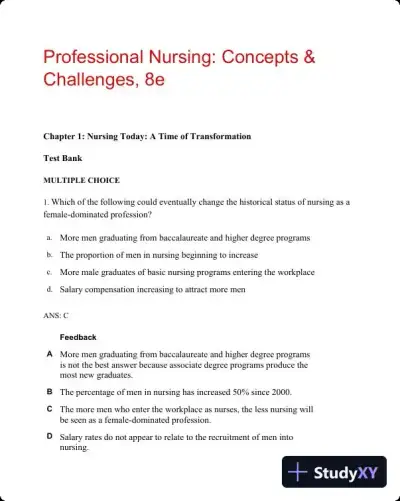 Exam Guides
Professional Nursing: Concepts & Challenges 8th Edition Test Bank
Nursing
304 pages93downloadsFeb 2025 Exam Guides
Test Bank for Critical Care Nursing: Diagnosis and Management, 9th Edition (Chapters 1-27)
Nursing
299 pages167downloadsFeb 2025 Class Notes
An Invitation To Health, Third Canadian Edition Lecture Notes
Nursing
439 pages163downloadsFeb 2025 Exam Guides
Test Bank for Physical Examination and Health Assessment, 9th Edition (Chapters 1-15)
Nursing
200 pages161downloadsFeb 2025 Exam Guides
Focus on Nursing Pharmacology Seventh, North American Edition Test Bank
Nursing
1144 pages160downloadsFeb 2025 Exam Guides
Test Bank for Fundamentals of Nursing, 11th edition (Chapters 1-24)
Nursing
200 pages160downloadsFeb 2025 Class Notes
Class Notes for Clinical Nursing Skills: Basic to Advanced Skills, 9th Edition
Nursing
150 pages154downloadsFeb 2025 Class Notes
Class Notes for Child Health Nursing, 3rd Edition
Nursing
861 pages154downloadsFeb 2025
Study this document with CramX
Once it is in your library, every tool can work from it.