

Test Bank For Fundamentals Of Nursing: The Art And Science Of Nursing Care Seventh, North American Edition Edition
- Nursing
- 320 pages
- Shared February 2025
- 114 downloads
Strengthen your understanding with Test Bank For Fundamentals Of Nursing: The Art And Science Of Nursing Care Seventh, North American Edition Edition, packed with challenging questions and expert solutions.
Preview 31 of 320 pages
See the first 31 pages exactly as they appear in the document.
Page 1 Read page 1 as text
Chapter 01- Introduction to Nursing 1. Which of the following statements accurately describe an element of nursing? Select all that A) The skills involved in nursing are primarily technical in nature. B) The primary focus of nursing is to assist individuals to recover from illness. C) The science of nursing is the knowledge base for the care that is given. D) The art of nursing is the collection of knowledge through research. E) Nursing is considered to be both an art and a science. F) Nursing is a profession that used specialized knowledge and skills. 2. Which of the following set of terms best describes nursing at the end of the Middle Ages? A) continuity, caring, critical thinking B) purpose, direction, leadership C) assessment, interventions, outcomes D) advocacy, research, education 3. Which of the following is a characteristic of nursing practiced from early civilization to the century? A) Most early civilizations believed that illness had supernatural causes. B) The physician was the priest who treated disease with prayer. C) The nurse was a nun committed to caring for the needy and homeless. D) Nursing changed from a spiritual focus to an emphasis on knowledge expansion. 4. In what time period did nursing care as we now know it begin? A) pre - civilization B) early civilization to 16th century C) 16th to 17th century D) 18th to 19th century 5. Who is considered to be the founder of professional nursing? A) Dorothea Dix B) Lillian Wald C) Florence Nightingale D) Clara Barton
Page 2 Page 3 Read page 3 as text
6. Which of the following nursing pioneers established the Red Cross in the United States in 1 A) Florence Nightingale B) Clara Barton C) Dorothea Dix D) Jane Addams 7. What was one barrier to the development of the nursing profession in the United States after Civil War? A) lack of educational standards B) hospital - based schools of nursing C) lack of influence from nursing leaders D) independence of nursing orders 8. Which of the following individuals provided community - based care and founded public hea nursing? A) Adelaide Nutting B) Lillian Wald C) Sojourner Truth D) Clara Barton 9. Which of the following nursing groups provides a definition and scope of practice for nursin A) ICN B) AAN C) ANA D) The Joint Commission 10. Teaching a woman about breast self - examination is an example of what broad aim of nurs A) promoting health B) preventing illness C) restoring health D) facilitating coping with disability and death 11. What nursing activity would meet the broad nursing aim of facilitating coping with disabil death? Select all that apply. A) conducting a blood pressure screening program B) teaching testicular self - examination
Page 4 Read page 4 as text
C) referring to a community diabetic support group D) administering intravenous fluids E) admitting a patient to a hospice program F) performing a physical assessment on a patient 12. A nurse caring for a patient with diabetes chooses an appropriate plan of care and devises interventions to accomplish the desired outcomes. This is an example of using which of th following type of nursing skills? A) Technical B) Cognitive C) Interpersonal D) Ethical/Legal 13. Which one of the following examples of nursing actions would be considered an ethical/le skill? A) A nurse helps a patient prepare a living will. B) A nurse obtains a urine sample for a urinalysis. C) A nurse explains the rationale for a patient’s plan of care. D) A nurse holds the hand of a woman whose baby died in childbirth. 14. A nurse practitioner is caring for a couple who are the parents of an infant diagnosed with Down’s Syndrome. The nurse makes referrals for a parent support group for the family. Th example of which nursing role? A) Teacher/Educator B) Leader C) Counselor D) Collaborator 15. A nurse is providing nursing care in a neighborhood clinic to single pregnant teens. Which following actions is the best example of using the collaborator role as a nurse? A) Discussing the legal aspects of adoption for teens wishing to place their infants with family B) Searching the Internet for information on child care for the teens who wish to return school C) Conducting a patient interview and documenting the information on the patient’s cha D) Referring a teen who admits having suicidal thoughts to a mental healthcare speciali
Page 5 Read page 5 as text
16. A nurse instructor explains the concept of health to her students. Which of the following statements accurately describes this state of being? A) Health is a state of optimal functioning. B) Health is an absence of illness. C) Health is always an objective state. D) Health is not determined by the patient. 17. A nurse incorporates the health promotion guidelines established by the U.S. Department o Health document: Healthy People 2010 . Which of the following is a health indicator discu this document? A) cancer B) obesity C) diabetes D) hypertension 18. A nurse conducts a smoking - cessation program for patients of a neighborhood clinic. This example of which of the following aims of nursing? A) promoting health B) preventing illness C) restoring health D) facilitating coping with disability or death 19. Which of the following is a criteria that defines nursing as profession? A) an undefined body of knowledge B) a dependence on the medical profession C) an ability to diagnose medical problems D) a strong service orientation 20. Although all of the following are nursing responsibilities, which one would be expected of nurse with a baccalaureate degree? A) providing direct physical care B) using research findings to improve practice C) administering medications as prescribed D) collaborating with other healthcare providers 21. Amy Jones, a high school senior, wants to become a geriatric nurse practitioner. What nur degree will she need to attain this goal?
Page 6 Read page 6 as text
A) licensed practical nurse B) associate degree C) baccalaureate degree D) master’s degree 22. Why are nursing organizations important for the continued development and improvement nursing as a whole? A) to provide socialization and networking for members B) to regulate work activities for members C) to set standards for nursing education and practice D) to provide information to nurses about legal requirements 23. Which of the following organizations has established standards for clinical nursing practic A) American Nurses Association B) National League for Nursing C) International Council of Nurses D) State Board of Nursing 24. What is the primary purpose of standards of nursing practice? A) to provide a method by which nurses perform skills safely B) to ensure knowledgeable, safe, comprehensive nursing care C) to establish nursing as a profession and a discipline D) to enable nurses to have a voice in healthcare policy 25. After graduation from an accredited program in nursing and successfully passing the NCL what gives the nurse a legal right to practice? A) enrolling in an advanced degree program B) filing NCLEX results in the county of residence C) being licensed by the State Board of Nursing D) having a signed letter confirming graduation 26. A nurse has been tried and found guilty of the felony crime of forgery. How might this aff nurse’s license to practice nursing? A) It will have no effect on the ability to practice nursing. B) The nurse can practice nursing at a less - skilled level. C) The license may be revoked or suspended.
Page 7 Read page 7 as text
D) The license will permanently carry the felony conviction. 27. Nurses use the nursing process to focus care on human responses to what? A) interactions with the environment B) physical effects of disease C) outcomes of medical or surgical treatment D) actual or potential health problems 28. Which age group in the population is expanding most rapidly, resulting in changes in the d of healthcare? A) older adults B) young adults C) school - aged children D) newborns 29. Which of the following is a current trend affecting nursing education and practice? A) over abundance of graduating nurses B) office - based care delivery systems C) increase in length of hospital stay D) increase in chronic health conditions Answer Key 1. C, E, F 2. B 3. A 4. D 5. C 6. B 7. A 8. B 9. B 10. B 11. C, E 12. B 13. A
Page 8 Read page 8 as text
14. C 15. D 16. A 17. B 18. B 19. D 20. B 21. D 22. C 23. A 24. B 25. C 26. C 27. D 28. A 29. D Page 1
Page 9 Read page 9 as text
Chapter 02- Cultural Diversity 1. How is culture learned by each new generation? A) ethnic heritage B) involvement in religious activities C) formal and informal experiences D) belonging to a subculture 2. A nurse caring for patients in a culturally diverse neighborhood knows that culture affects th nurse’s interactions with patients. Which of the following is a characteristic of culture? Sele that apply. A) Culture guides what is acceptable behavior for people in a specific group. B) Modeling behavior is the primary means of transmitting culture. C) Culture is generally not affected by the group’s social and physical environment. D) Cultural practices and beliefs mainly remain constant as long as they satisfy a group’s E) Culture influences the way people of a group view themselves, have exp ectations, and behave. F) Because of individual influences, there are differences both within and among culture 3. Which of the following statements is true of cultural assimilation? A) Mutual cultural assimilation occurs when characteristics from two groups are traded. B) Cultural assimilation is the integration of a majority group with a minority group. C) Moving to a different culture may result in psychological discomfort. D) Cultural assimilation is identifying with a collective cultural group, primarily based on common heritage. 4. Mr. Perez is a Mexican immigrant who migrated to the United States and lives in a Spanish - speaking community with other relatives. He is taken to the ER following a fall at work and admitted to the hospital for observation. Which of the following is the nurse caring for Mr. P aware that he is at risk for? A) cultural assimilation B) cultural shock C) cultural imposition D) cultural blindness
Page 10 Read page 10 as text
5. What characteristic is used to describe racial categories? A) language B) skin color C) music preferences D) food likes and dislikes 6. A 20 - year - old housekeeper, born and educated in Iraq, wears her traditional clothing and he covering. A 50 - year - old patient tells the nurse, “They are in America and should dress like w What is this statement an example of ? A) cultural assimilation B) cultural blindness C) cultural conflict D) cultural imposition 7. A nurse walks by a patient’s room and observes a Shaman performing a healing ritual for th patient. The nurse then remarks to a coworker that the ritual is a waste of time and disruptiv other patients on the floor. This nurse is displaying the feelings associated with: A) culture conflict B) cultural blindness C) stereotyping D) cultural shock 8. Which of the following statements accurately describe cultural factors that may influence healthcare? Select all that apply. A) Nurses and patients generally agree upon the health practices that are being instituted. B) Certain racial and ethnic groups are more prone to developing specific diseases and conditions. C) Although pain affects people differently, most people react to pain in the same manne D) Most mental health norms are based on research and observatio ns made of white, mid class people. E) In many cultures, the man is the dominant figure and generally makes decisions for al members. F) When people move to the United States, they may speak their own language fluently b have difficulty speaking English. 9. A nurse is doing preoperative teaching for an African American man before he has abdomin surgery. What topic should be included in the teaching?
Page 11 Read page 11 as text
A) the possibility of developing a keloid over the healed incision B) the increased risk of developing an infection in the incision C) his racial characteristics that will slow healing D) cultural influences on his response to surgery 10. A nurse is caring for a patient from Taiwan who constantly requests pain medication. Wha should the nurse consider when assessing the patient’s pain? A) Most people react to pain in the same way. B) Pain in adults in less intense than pain in children. C) The patient is a constant complainer. D) Pain is what the patient says it is. 11. A father, mother, grandmother, and three school - aged children have immigrated to the Un States from Thailand. Which member(s) of the family are likely to learn to speak English m rapidly? A) unemployed father B) stay - at - home mother C) grandmother D) children 12. A 40 - year - old nurse is taking a health history from a 20 - year - old Hispanic man and notes looks down at the floor when he answers questions. What should the nurse understand abo behavior? A) The patient is embarrassed by the questions. B) This is culturally appropriate behavior. C) The patient dislikes the nurse. D) The patient does not understand what is being asked. 13. An older adult woman of Chinese ancestry refuses to eat at the nursing home, stating, “I’m not hungry.” What factors should the staff assess for this problem ? A) The woman does not like to eat with other residents of the home. B) The woman is using this as a means of going home. C) The food served may not be culturally appropriate. D) The food served may violate religious beliefs. 14. Although all of the following are factors to consider when caring for patients with limited income, which one is the most important?
Page 12 Read page 12 as text
A) basic human needs may go unmet B) limited access to reliable transportation C) decreased access to healthcare services D) risk for increased incidence of disease 15. The nurse is providing home care for a patient who traditionally drinks herbal tea to treat a illness. How should the nurse respond to a request for the herbal tea? A) “We do not allow our patients to drink herbal tea.” B) “Why in the world would you want to drink that stuff?” C) “Let me check with the doctor to make sure it is okay with your medicines.” D) “I have to fill out a lot of forms that you will have to sign before I can do that.” 16. A nurse in a large metropolitan city enjoys working in a health clinic that primarily serves Hispanic patients. What does this statement imply about the nurse? A) The nurse’s knowledge and skills are not adequate to care for patients with acute illn B) The nurse respects and values providing culturally competent care. C) The nurse is attempting to overcome cultural blindness. D) This employment makes the nurse feel superior to a minority group of people. 17. A nurse is providing care for a Cambodian patient. The nurse says, “You have to get up an whether you want to or not.” What is this statement an example of ? A) culture shock B) stereotyping C) cultural imposition D) cultural competence 18. Which of the following are considered cultural norms of the healthcare system? Select all apply. A) inability to define health and illness B) frequent use of jargon and documentation C) professional deference to pecking order D) use of a problem - solving methodology E) belief in the fallibility of technology F) use of certain procedures for birth and death 19. A nurse is caring for an African American in an acute care setting. Which one of the follow might be a special nursing consideration for this patient?
Page 13 Read page 13 as text
A) The patient might request a visit from a folk healer. B) The patient may be upset by drawing blood for a test. C) The patient may perceive illness as a punishment from God. D) The patient may expect the caregiver to deduce the problem by instinct. 20. In which of the following populations should the nurse carefully assess the patient’s use of the - counter medications? A) African American B) Hispanic C) White middle class D) Asian 21. A nurse is caring for an Appalachian patient following her hysterectomy. Which of the fol Appalachian values and beliefs should be considered when planning nursing care for this p Select all that apply. A) Isolation is considered as a way of li fe. B) Dependence and self - determination are valued. C) Lifestyle is more revered than compliance with healthcare issues. D) They may be fatalistic about losses and deaths. E) There is a deep love, respect, and affection between people and the land. F) Death is seen as a part of life and not feared. 22. What is one way in which nurses can develop cultural self - awareness? A) Ask peers and colleagues about practicing cultural competence. B) Objectively examine own beliefs, values, and practices. C) Realize nothing can be done to change one’s values and beliefs. D) Assert to others that personal biases cannot be changed. 23. A home health nurse is visiting a 60 - year - old patient. During the initial visit, the patient’s husband answers all of the questions. What would the nurse assess based on this behavior? A) The patient does not want the nurse to visit. B) The husband does not trust his wife to answer questions. C) The patient is not able to answer the questions. D) The husband is the dominant member of the family. Answer Key
Page 14 Read page 14 as text
1. C 2. A, D, E, F 3. A 4. B 5. B 6. D 7. A 8. B, D, E, F 9. A 10. D 11. D 12. B 13. C 14. A 15. C 16. B 17. C 18. B, C, D, F 19. A 20. C 21. A, B, D 22. B 23. D Page 1
Page 15 Read page 15 as text
Chapter 03- Health and Illness 1. What phrase best describes health? A) individually defined by each person B) experienced by each person in exactly the same way C) the opposite of illness D) the absence of disease 2. Which of the following most accurately defines “illness” ? A) the inability to carry out normal activities of living B) a pathologic change in mind or body structure or function C) the response of a person to a disease D) achieving maximum potential and quality of life 3. A patient makes a decision to quit smoking and joins a smoking cessation class. This is an e of which of Dunn’s processes that help a person know who and what he or she is? A) being B) belonging C) becoming D) befitting 4. Which of the following statements accurately describes the concepts of disease and illness? A) A disease is traditionally diagnosed and treated by a nurse. B) The focus of nurses is the person with an illness. C) A person with an illness cannot be considered healthy. D) Illness is a normal process that affects level of functioning. 5. A rapid onset of symptoms that last a relatively short time indicates what health problem? A) a chronic illness B) an acute illness C) actual risk factor D) potential for wellness 6. A nurse caring for patients with diabetes knows that the following is a characteristic of a chr illness:
Page 16 Read page 16 as text
A) It is a temporary change. B) It causes reversible alterations in A&P. C) It requires special patient education for rehabilitation. D) It requires a short period of care or support. 7. What manifestation is the most significant symptom indicating an illness? A) bleeding B) runny nose C) pain D) itching 8. A nurse calls in to his unit to report he has the flu and will not be at work. What stage of illn behavior is he exhibiting? A) experiencing symptoms B) assuming the sick role C) assuming a dependent role D) achieving recovery and rehabilitation 9. A patient accepts the fact that he needs bypass surgery for a blocked artery and is admitted i hospital. Which one of the following stages of illness is this patient experiencing? A) Stage 1 B) Stage 2 C) Stage 3 D) Stage 4 10. Which of the following is an example of a characteristic of the Stage 2 of illness? A) A person tells his family that he is sick and allows them to take care of him. B) A person experiences a headache and sore throat and takes an aspirin. C) A person visits a physician to receive treatment for symptoms of an infection. D) A person begins rehabilitation following a stroke that left him paralyzed on one side 11. A 4 - year - old child has leukemia but is now in remission. What does it mean to be in remis when one has a chronic illness? A) The chronic disease has been cured. B) Nothing further can be done in terms of treatment. C) Severe symptoms of the chronic illness have reappeared.
Page 17 Read page 17 as text
D) The disease is present, but symptoms are not experienced. 12. What may happen to the family when an illness occurs in one of the family members? A) alterations in values and religious beliefs B) more public displays of affection C) changes in roles for the patient and family D) increased resistance to stress 13. A baby is born with Down syndrome, which influences his health – illness status. This is an example of which of the following human dimensions ? A) Physical B) Emotional C) Environmental D) Sociocultural 14. Which of the following is an example of the sociocultural dimension influencing a person’ health – illness status ? A) A family lives in a city environment where the air pollution levels are high. B) A father who is a practicing Jehovah’s Witness refuses a blood transfusion for his so C) A teenager who was in an automobile accident worries that his scars will cause him friends. D) A single mother of two applies for food stamps in order to feed her family. 15. A nurse is caring for a 17 - year - old female patient whose left leg was amputated after being crushed in a motor vehicle accident. Which of the following interventions might the nurse perform to accommodate the patient’s intellectual dimension? A) considering the patient’s developmental stage when planning nursing care B) encouraging friends and relatives to visit often and bring games to distract her C) teaching her how to care for the stump and explaining the rehabilitation program D) providing the opportunity for a counselor to come in and talk to her about her loss 16. Which of the following statements accurately describe how risk factors may increase a per chances for illness or injury? Select all that apply. A) Risks factors are unrelated to the person or event. B) All risk factors are modifiable. C) An increase in risk factors increases the possibility of illness. D) A family history of breast cancer is not a modifiable risk factor.
Page 18 Read page 18 as text
E) School - aged children are at high risk for communicable diseases. F) Multiple sexual relationships increase the risk for sexually transmitted diseases. 17. Which of the following nursing interventions are examples of health promotion and preven care on the primary level? Select all that apply. A) A nurse counsels a teenager to stop smoking. B) A nurse conducts a health fair for high blood pressure screening. C) A nurse counsels the family of a patient diagnosed with lung cancer. D) A home healthcare nurse arranges for rehabilitation services for a patient. E) A school nurse arranges for a career seminar for graduating seniors. F) A nurse devises a low - calorie diet for an obese tee nager. 18. Which of the following topics is important when teaching teens and young adults? A) safer sex practices B) blood pressure control C) immunization for measles D) effective hand hygiene 19. Which of the following statements illustrates the effect of the sociocultural dimension on h and illness? A) “Why shouldn’t I drink and drive? Everyone else does.” B) “My mother has sickle cell anemia, and so do I.” C) “I know I have heart problems, so I have changed my diet.” D) “I used biofeedback to lower my blood pressure.” 20. A middle - aged woman is 40 pounds over her ideal weight. Which of the following stateme best illustrates the effect of her self - concept on health and illness? A) “I am just too busy with my kids to bother about a diet.” B) “Why should I lose weight? I’ll still be fat. ” C) “My sister is thin, but I don’t think she looks that good.” D) “My husband loves me this way.” 21. A camp nurse is teaching a group of adolescent girls about the importance of monthly brea examination. What level of preventive care does this activity represent? A) primary B) secondary
Page 19 Read page 19 as text
C) tertiary D) restorative 22. On which of the following components is Rosenstock’s health belief model based? Select apply. A) perceived susceptibility to a disease B) perceived consequences of treating disease C) perceived seriousness of a disease D) perceived benefits of action E) perceived immunity to disease F) perceived benefits of health insurance 23. A nurse refers a 67 - year - old male patient to group counseling for alcohol cessation. Accor Rosenstock’s health belief model, the patient’s knowledge of the diseases that may occur w alcoholism is a: A) demographic variable B) sociopsychological variable C) structural variable D) intellectual variable 24. Which of the following models of health promotion and illness prevention was developed illustrate how people interact with their environment as they pursue health? A) the health promotion model B) the health belief model C) the health – illness continuu m D) the agent – host – environment mode l 25. Which of the following factors constitute the environment component of the agent – host – environment model of health and illness (Leavell and Clark, 1965)? Select all that apply . A) bacteria/viruses B) chemical substances C) health habits D) family history E) cultural factors F) biologic factors 26. Nurses use new resources for healthcare practices to promote health and serve as an advoc
Page 20 Read page 20 as text
patients and families in all settings. Which one of the following resources has been most instrumental in improving access to care for people living in rural or underserved areas of nation? A) telehealth practice B) industrial programs C) community centers D) nontraditional healthcare sites 27. Which of the following statements explain why models of health promotion and illness prevention are useful when planning healthcare? Select all that apply. A) They help healthcare providers understand health - related behaviors. B) They are useful for adapting care to people from diverse backgrounds. C) They help overcome barriers related to increased number of people without healthca D) They overcome barriers to care for the predicted downward trend in minority popula E) They overcome barriers to care for low - income and rural populations. F) They explain why people take advantage of low - cost screens and healthcare informa 28. What is the nurse’s primary role in promoting health? A) educating others about health promotion activities B) avoiding smoking or drinking in public C) being a role model for health promotion D) implementing stress reduction activities Answer Key 1. A 2. C 3. D 4. B 5. B 6. C 7. C 8. B 9. C 10. A
Page 21 Read page 21 as text
11. D 12. C 13. A 14. D 15. C 16. C, D, E, F 17. A, F 18. A 19. A 20. B 21. A 22. A, C, D 23. C 24. A 25. E, F 26. A 27. A, B, C, E 28. C Page 1
Page 22 Read page 22 as text
Chapter 04- Health of the Individual, Family, and Community 1. According to Maslow’s basic human needs hierarchy, which needs are the most basic? A) physiologic B) safety and security C) love and belonging D) self - esteem 2. Which of the following is a tenant of Maslow’s basic human needs hierarchy? A) A need that is unmet prompts a person to seek a higher level of wellness. B) A person feels ambivalence when a need is successfully met. C) Certain needs are more basic than others and must be met first. D) People have many needs and should strive to meet them simultaneously. 3. An 80 - year - old woman states, “I have successfully raised my family and had a good life.” T statement illustrates meeting which basic human need ? A) safety and security B) love and belonging C) self - esteem D) self - actualization 4. A 2 - year - old boy arrives at the emergency department of a local hospital with difficulty brea from an asthmatic attack. Which of the following would be the priority nursing intervention A) giving him his favorite stuffed animal to hold B) assessing respirations and administering oxygen C) raising the side rails and restraining his arms D) asking his mother what are his favorite foods 5. A 75 - year - old man is being discharged to his home following a fall in his kitchen that result fractured pelvis. The home health nurse makes a home assessment that will be used to desig interventions to meet which priority need? A) sleep and rest B) support from family members
Page 23 Read page 23 as text
C) protection from potential harm D) feeling a sense of accomplishment 6. A nurse caring for a patient in a long - term health care facility measures his intake and outpu weighs him to assess water balance. These actions help to meet which of Maslow’s hierarch needs? A) physiologic B) safety and security C) love and belonging D) self - actualization 7. What action by a nurse will help a patient meet self - esteem needs? A) verbally negate the patient’s negative self - perceptions B) freely give compliments to increase positive self - regard C) independently establish goals to improve self - esteem D) respect the patient’s values and belief systems 8. A nurse caring for a female patient with TB who is in isolation is aware that the patient’s lov belonging needs may not be properly met. Which of the following nursing action would hel meet these needs? A) respecting the patient’s values and beliefs B) focusing on the patient’s strengths rather than problems C) using hand hygiene and sterile technique to prevent infection D) encouraging family to visit and help in the care of the patient 9. Which of the following statements accurately describes how Maslow’s theory can be applie nursing practice? A) Nurses can apply this theory to the nursing process. B) Nurses can identify met needs as healthcare needs. C) Nurses cannot use the theory on infants or children. D) Nurses use the theory for ill, as opposed to healthy patients. 10. Jim and Alice were recently married. Each has previously been married and had two child What name is given to this type of family? A) extended family B) nuclear family C) blended family
Page 24 Read page 24 as text
D) cohabiting family 11. Which of the following groups involves all parts of a person’s life and is concerned with m basic human needs to promote health? A) peers B) family C) community D) healthcare providers 12. David and Susan are in a committed relationship and live together with their adopted twin Which of the following best describes this type of family? A) nuclear family B) extended family C) blended family D) adoptive family 13. When providing nursing care to a patient, the nurse provides family - centered nursing care. is one rationale for this nursing action? A) The nurse does not want the patient to feel lonely. B) The patient will be more compliant with medical instructions. C) The family will be more willing to listen to instructions. D) Illness in one family member affects all family members. 14. A mother teaches her son to respect his elders. This is an example of which of the followin family functions? A) physical B) economic C) affective and coping D) socialization 15. What is the purpose of the affective and coping function of the family? A) providing a safe environment for growth and development B) ensuring financial assistance for family members C) providing emotional comfort and identity D) transmitting values, attitudes, and beliefs 16. A nurse provides health promotion and accident prevention programs for a family with adolescents and young adults. Which of the following is a task of a family at this stage?
Page 25 Read page 25 as text
A) Establish a mutually satisfying marriage. B) Adjust to cost of family life. C) Maintain supportive home base. D) Maintain ties with younger and older generations. 17. Friedman, Bowden, and Jones (2003) identified the importance of family - centered nursing based on four rationales. Which of the following is one of these rationales? A) The family is composed of dependent members who affect one another. B) If a family member is ill, it does not necessarily affect other family members. C) A strong relationship exists between the family and health status of members. D) The level of health of the family is established early and is not influenced by health promotion. 18. Which of the following individuals would the nurse assess as being most at risk for altered health? A) an unmarried adolescent with a newborn B) a newly married couple who ask about birth control C) a middle - aged man and woman with no children D) an older adult, living in an assisted - living community 19. What is the major effect of a health crisis on family structure? A) adaptation to stress B) change in roles of family members C) respect for family values D) loss of individual identities 20. Mrs. Dunn has cared for her husband with Alzheimer’s disease for 2 years. She comes to a health center because she is feeling “worn out and stressed.” What might be an appropriate nursing diagnosis for Mrs. Dunn ? A) Dysfunctional Family Processes B) Health - Seeking Behaviors C) Risk for Caregiver Burden D) Risk for Anxiety 21. Which of the following statements accurately describes a characteristic of a community? A) Communities do not exist in rural areas. B) Communities are formed by the characteristics of people and other factors.
Page 26 Read page 26 as text
C) Communities are not limited by geographic boundaries. D) Communities have little or no effect of the health of residents. 22. Which of the following is an example of a community factor that may affect health? A) rural setting B) air and water quality C) number of residents D) educational level 23. Which of the following factors may be a barrier to healthcare services for those living in ru areas? A) inadequate healthcare insurance B) lack of knowledge about needed care C) living long distances from services D) decreased interest in health promotion 24. Which of the following definitions best describes community - based nursing? A) a focus on populations within the community B) a focus on older adults living in nursing homes C) care provided in the patient’s home for chronic illnesses D) care centered on individual and family healthcare needs 25. What is one method by which a nurse can be a role model to promote health in the commu A) by demonstrating a healthy lifestyle B) by becoming a member of a family C) by meeting own basic needs D) by exhibiting self - actualization Answer Key 1. A 2. C 3. D 4. B 5. C 6. A 7. D
Page 27 Read page 27 as text
8. D 9. A 10. C 11. B 12. A 13. D 14. D 15. C 16. C 17. C 18. A 19. B 20. C 21. B 22. B 23. C 24. D 25. A Page 1
Page 28 Read page 28 as text
Chapter 05- Theory, Research, and Evidence- Based Practice 1. What phrase best describes the science of nursing? A) application of clinical skills B) body of nursing knowledge C) holistic patient care D) art of individualized nursing 2. The practice of changing patients’ bedclothes each day in acute care settings is an example o type of knowledge? A) authoritative B) traditional C) scientific D) applied 3. A student nurse learns how to give injections from the nurse manager. This is an example of acquisition of what type of knowledge? A) authoritative B) traditional C) scientific D) applied 4. Which of the following sources of knowledge is based on objective data? A) authoritative B) traditional C) scientific D) applied 5. A patient undergoing chemotherapy for a brain tumor believes that having a good attitude w in the healing process. This is an example of what type of knowledge? A) science B) philosophy C) process
Page 29 Read page 29 as text
D) virtue 6. Which of the following examples represents the type of knowledge known as process? Selec that apply. A) A nurse dispenses medications to patients. B) A nurse changes the linens on a patient’s bed. C) A nurse studies a nursing journal article on infection control. D) A nurse consults an ethics committee regarding an ethical dilemma. E) A nurse believes in providing culturally competent nursing care. F) A nurse monitors the vital signs of a postoperative patient. 7. Which of the following accurately describes Florence Nightingale’s influence on nursing knowledge? A) She defined nursing practice as the continuation of medical practice. B) She differentiated between health nursing and illness nursing. C) She established training for nurses under the direction of the medical profession. D) She established a theoretical base for nursing that originated outside the profession. 8. During the first half of the 20th century, a change in the structure of society resulted in chan roles for women and, in turn, for nursing. What was one of these changes? A) More women retired from the workforce to raise families. B) Women became more dependent and sought higher education. C) The focus of nursing changed to “hands - on training.” D) Nursing research was conducted and published. 9. Who was the first nurse to develop a nursing theory? A) Clara Barton B) Dorothea Dix C) Florence Nightingale D) Virginia Henderson 10. A nurse observes that certain patients have less pain after procedures than do others, and fo theory of why this happens. What is a theory? A) a concept used to directly prove a fact or a group of facts B) an understanding borrowed from other disciplines C) a “best guess” based on intangible idea s
Page 30 Read page 30 as text
D) a statement of an occurrence based on observed facts 11. A staff nurse asks a student, “Why in the world are you studying nursing theory?” How wo student best respond ? A) “Our school requires we take it before we can graduate.” B) “We do it so we know more than your generation did.” C) “I think it explains how we should collaborate with others.” D) “It helps explain how nursing is different from medicine.” 12. Why are the developmental theories important to nursing practice? A) They describe how parts work together as a system. B) They outline the process of human growth and development. C) They define human adaptation to others and to the environment. D) They explain the importance of legal and ethical care. 13. Breaking the healthcare community into separate entities (such as the medical community, nursing staff, management, support staff) and analyzing how they work as a whole togethe example of which nursing theory? A) general systems theory B) adaptation theory C) developmental theory D) compartment theory 14. There are four concepts common in all nursing theories. Which one of the four concepts is focus of nursing? A) person B) environment C) health D) nursing 15. Which of the following are characteristics of nursing theories? Select all that apply. A) They provide rational reasons for nursing interventions. B) They are based on descriptions of what nursing should be. C) They provide a knowledge base for appropriate nursing responses. D) They provide a base for discussion of nursing issues. E) They help resolve current nursing issues and establish trends.
Page 31 Read page 31 as text
F) They use complex terminology to resolve specific nursing issues. 16. What is the ultimate goal of expanding nursing knowledge through nursing research? A) learn improved ways to promote and maintain health B) develop technology to provide hands - on nursing care C) apply knowledge to become independent practitioners D) become full - fledged partners with other care providers 17. What was significant about the promotion of the National Center for Nursing Research to current National Institute of Nursing Research (NINR)? A) Increased numbers of articles are published in research journals. B) NINR gained equal status with all other National Institutes of Health. C) NINR became the major research body of the International Council of Nurses. D) It decreased emphasis on clinical research as an important area for nursing. 18. Which of the following terms are part of quantitative research? A) process B) concept C) ethnography D) variable 19. A nurse uses the process of quantitative research to study the incidence and causes of hosp acquired pneumonia in her hospital. The statement of what the researcher expects to find i studies is called the: A) variable B) data C) hypothesis D) instrument 20. Information is collected for analysis in both quantitative and qualitative research. What is information called? A) surveys B) answers C) interviews D) data 21. A patient in a clinical research study has given informed consent. This means that the patie certain rights. These rights include which of the following? Select all that apply.
289 more pages in the full document
Unlock it once and it stays in your library, ready to chat with or turn into flashcards.
Unlock the full documentMore Nursing study materials
See all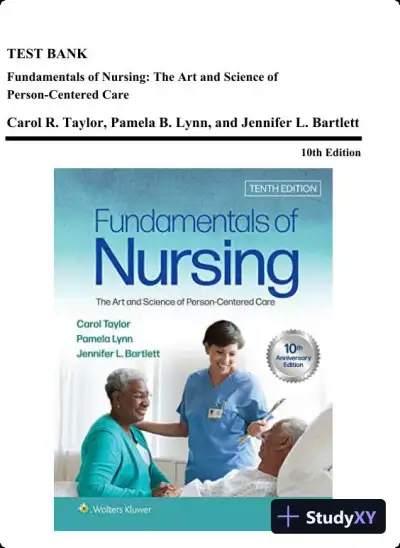 Exam Guides
Test Bank for Fundamentals of Nursing: The Art and Science of Person-Centered Care, 10th North American Edition (Chapters 1-47)
Nursing
268 pages55downloadsFeb 2025 Exam Guides
Test Bank for Critical Care Nursing: Diagnosis and Management, 9th Edition (Chapters 1-27)
Nursing
299 pages167downloadsFeb 2025 Class Notes
An Invitation To Health, Third Canadian Edition Lecture Notes
Nursing
439 pages163downloadsFeb 2025 Exam Guides
Test Bank for Physical Examination and Health Assessment, 9th Edition (Chapters 1-15)
Nursing
200 pages161downloadsFeb 2025 Exam Guides
Focus on Nursing Pharmacology Seventh, North American Edition Test Bank
Nursing
1144 pages160downloadsFeb 2025 Exam Guides
Test Bank for Fundamentals of Nursing, 11th edition (Chapters 1-24)
Nursing
200 pages160downloadsFeb 2025 Class Notes
Class Notes for Clinical Nursing Skills: Basic to Advanced Skills, 9th Edition
Nursing
150 pages154downloadsFeb 2025 Class Notes
Class Notes for Child Health Nursing, 3rd Edition
Nursing
861 pages154downloadsFeb 2025
Study this document with CramX
Once it is in your library, every tool can work from it.