

NCC EFM Exam Breakdown and Study Guide with Answers (72 Solved Questions)
- Other Exams & Certifications
- 24 pages
- Shared May 2025
Use NCC EFM Exam Breakdown and Study Guide with Answers to familiarize yourself with the exam format, providing solved questions and real exam scenarios.
Preview 8 of 24 pages
See the first 8 pages exactly as they appear in the document.
Page 1 Read page 1 as text
NCC EFM Exam Breakdown & Study Guide With Solution Content on exam - ANSWER -Pattern recognition & intervention: 70% -Physiology: 11% -Fetal assessment methods: 9% -EFM equipment: 5% -Professional issues: 5% Pattern recognition & intervention - ANSWER -FHR baseline ✓ -FHR variability ✓ -FHR accelerations ✓ -FHR decelerations ✓ -Normal uterine activity ✓ -Abnormal uterine activity ✓ -Fetal dysrhythmias ✓ -Maternal complications ✓ -Uteroplacental complications ✓ -Fetal complications ✓ FHR Descriptors - ANSWER 1) Baseline
Page 2 Page 3 Read page 3 as text
2) Variability 3) Presence of accels 4) Presence of decels 5) Changes in trends overtime FHR Baseline - ANSWER Average FHR rounded to nearest 5 during a 10 min window -110 to 160 -excludes accels, decels, & marked variability -must have 2 mins to identify as a baseline (doesn't need to be continuous) Fetal Bradycardia - ANSWER <110 for ≥ 10 min -Causes: hypotension (ex: after epi), cord prolapse, head compression, congenital defect, rapid descent, abruption or rupture, tachysystole, post dates, hypoglycemia, lupus (heart block) -With ↓ O2, blood will be shunted to brain, heart, & adrenals, eventually ↓ FHR to ↓ O2 demands of heart muscle -Verify not mom's HR, vaginal exam (r/o prolapse), resuscitate, evaluate arrhythmia, expedite delivery Fetal Tachycardia - ANSWER >160 for ≥ 10 min -Causes: fetal anemia, maternal fever or infection, fetal immaturity (preterm), SVT, maternal anxiety (catecholamines), dehydration, hyperthyroid, hypoxia -Med causes: terbutaline, catecholamines (epinephrine, norepi) -Assess mom's temp & infection risk (GBS, PROM)
Page 4 Read page 4 as text
FHR Variability - ANSWER Irregular in amplitude & frequency, quantified by peak to trough -Caused by sympathetic vs parasympathetic, r/t neuro maturity -Less in preterm due to undeveloped CNS -Absent: undetectable, flat -Minimal: ≤ 5 bpm but detectable -Moderate: 6-25 bpm -Marked: >25 bpm (indeterminate baseline), significance unknown Minimal variability - ANSWER ≤ 5 bpm but detectable Sleep, sedated, or sick -Sleep cycle: 20-60 mins -Sedated: CNS depressant (ex: mag), 1-2 hrs -Sick (acidemia): unresolved w intervention -Priority: maximize oxygenation (position, bolus, O2 if needed) Moderate variability - ANSWER 6 to 25 bpm -Reliably predicts the absence of metabolic acidosis (even w decels) FHR Accelerations - ANSWER Reliably predicts absence of metabolic acidemia (spontaneous or stimulated) -Onset to peak in <30 sec -For ≥ 32 wks: 15x15 (peak ≥ 15 bpm above baseline lasting ≥ 15 sec)
Page 5 Read page 5 as text
-For <32 wks: 10x10 -Prolonged accel: 2-9 mins (at 10 becomes change of baseline) Early deceleration - ANSWER Nadir aligns w contraction peak, gradual onset ( ≥ 30 secs to nadir), benign vagal response 1) Pressure on fetal head 2) Increased intracranial pressure 3) Alteration in cerebral blood flow 4) Central vagal stimulation 5) FHR deceleration Periodic vs Episodic - ANSWER Periodic: caused by contractions -recurrent: occurs w ≥ 50% of contractions in 20 min -intermittent: w <50% of contractions in 20 mins Episodic: spontaneous Variable deceleration - ANSWER Caused by cord compression -Interventions: position change, amnioinfusion -Abrupt onset: <30 seconds from onset to nadir dropping ≥ 15 bpm lasting 15 secs to <2min -Transient rise in PCO2 & fall in PO2 Mechanisms of variable decelerations - ANSWER Abruptness r/t pressure changes
Page 6 Read page 6 as text
1) Vein obstruction → reflex tachy - ↓ venous return & cardiac output → hypotens → baroreceptor reflex ↑ in FHR to maintain BP 2) Arterial obstruction → decreased FHR -obstructed blood flow back to placenta → HTN → baroreceptor reflex of slowing FHR to maintain BP Late decelerations - ANSWER Uteroplacental insufficiency -Indicative of transient fetal hypoxemia -Gradual onset: ≥ 30 secs to nadir w nadir occurring after peak of contraction -Priority is to maximize uteroplacental blood flow: position lateral (off vena cava & aorta), fluid bolus (perfusion), O2, avoid tachysystole Mechanisms of a late deceleration - ANSWER Low O2 → chemoreceptor response peripheral vasoconstriction → blood flow to vital organs → HTN → baroreceptor vagal stimulation → FHR decel 1) Decreased uteroplacental oxygenation (transient hypoxemia) 2) Chemoreceptor stimulation 3) Alpha adrenergic response (catecholamines, peripheral vasoconstriction) 4) Fetal HTN 5) Baroreceptor stimulation 6) Parasympathetic response 7) FHR deceleration 8) ↓ myocardial stress
Page 7 Read page 7 as text
Prolonged deceleration - ANSWER Decrease of ≥ 15 bpm lasting 2 to 9 mins ( ≥ 10 = change of baseline) -Vagal stimulation -Causes: hypotension, maternal hypoxia, cord prolapse, rapid decent, profound cord compression, uterine rupture Sinusoidal pattern - ANSWER Visually apparent, smooth, sine wave-like pattern in FHR lasting ≥ 20 minutes -oscillation frequency: 3-5 cycles/min -no variability classification or reactivity -r/t severe anemia: previa, hemorrhage, abruption, RH isoimmunization, asphyxia, infection, cardiac anomaly, twin to twin transfusion, gastroschesis -Transient if <20min, can be r/t thumb sucking or opioids (stadol, fentanyl) Interventions - ANSWER -Position change: off of vena cava & aorta, least invasive, 1st line of treatment -Fluid bolus -Amnioinfusion (for variables) -Tocolytics (terb) -Ephedrine to ↑ BP -Supplemental O2: not used w O2 >95%, can cause vasoconstriction, free radical formation, ocular toxicity if used limit to 15-30min Category I tracing - ANSWER Normal acid base balance -Baseline between 110 to 160
Page 8 Read page 8 as text
-Moderate variability -No late, variable, or prolonged decels -May have early decels -May or may not have accels Category II tracing - ANSWER Indeterminate acid base balance -Minimal variability -Marked variability -Late or variable decels -Bradycardia with variability -Tachycardia -Prolonged decels -Absent variability w NO decels -Absence of induced acccel WITH fetal stimulation Category III tracing - ANSWER Predictive of abnormal acid base balance at that moment -Sinusoidal rhythm: has to last ≥ 20min, r/t anemia (previa, bleeding, abruption) -Absent variability WITH one of the following: bradycardia, recurrent late or recurrent variable decels -Decide for c/s within 30min Normal uterine activity - ANSWER ≤ 5 contractions in 10 mins averaging over
16 more pages in the full document
Unlock it once and it stays in your library, ready to chat with or turn into flashcards.
Unlock the full documentMore Other Exams & Certifications study materials
See all Certification Guides
ACFT For Dummies (2020)
Other Exams & Certifications
467 pages156downloadsFeb 2025 Past Exams
Texas Real Estate Law - SAE Champions School Of Real Estate Practice Exam with Answers (81 Solved Questions)
Other Exams & Certifications
9 pages153downloadsFeb 2025 Past Exams
2024 Smart Serve Ontario Practice Exam with Answers (53 Solved Questions)
Other Exams & Certifications
6 pages153downloadsFeb 2025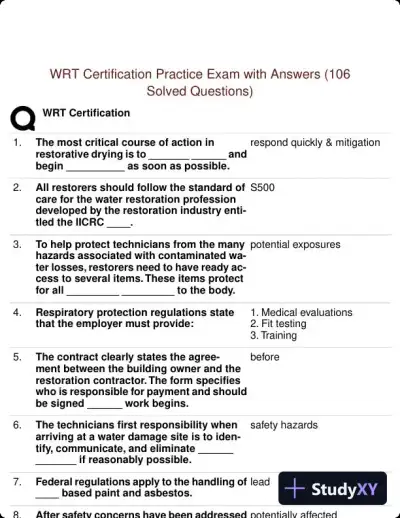 Past Exams
WRT Certification Practice Exam with Answers (106 Solved Questions)
Other Exams & Certifications
16 pages151downloadsFeb 2025 Past Exams
2024 Vivint SHP Practice Exam with Answers (35 Solved Questions)
Other Exams & Certifications
4 pages144downloadsFeb 2025 Past Exams
2024-2025 Wall Street Prep Premium Exam with Answers (50 Solved Questions)
Other Exams & Certifications
13 pages138downloadsFeb 2025 Past Exams
2024-2025 Lifeguard Final Exam with Answers (69 Solved Questions)
Other Exams & Certifications
11 pages137downloadsFeb 2025 Past Exams
2023-2024 ISSA Certification Final Exam with Answers (200 Solved Questions)
Other Exams & Certifications
49 pages136downloadsFeb 2025
Study this document with CramX
Once it is in your library, every tool can work from it.