
2023 MSN622 Final Exam with Answers (117 Solved Questions)

2023 MSN622 Final Exam with Answers helps you build confidence by practicing with past papers.

Isabella White
Contributor
4.3
139
about 1 year ago
Preview (7 of 21 Pages)
100%
Log in to unlock

Page 1

2023 MSN622 Final Exam with Answers (117 Solved Questions) - Page 1 preview image

Loading page ...

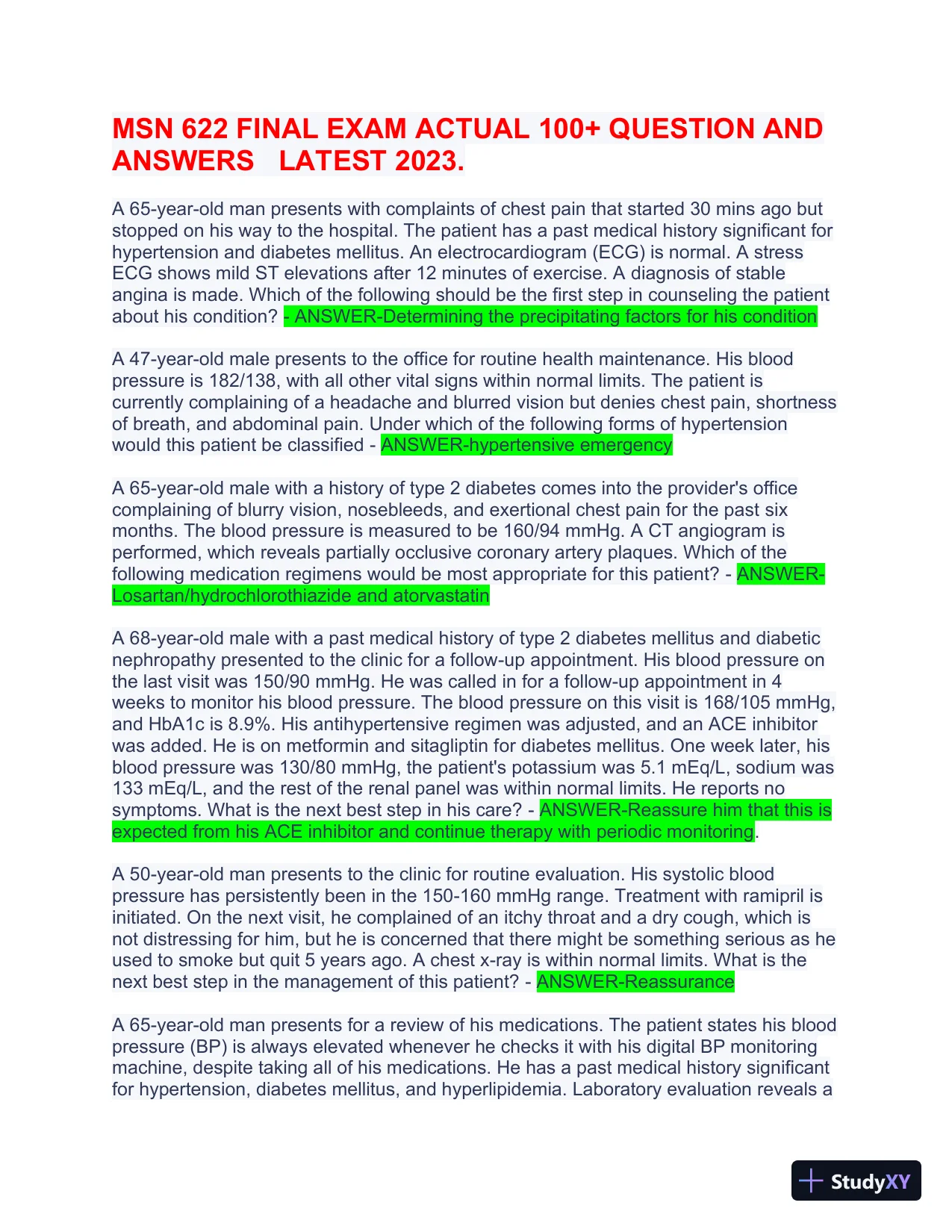
MSN 622 FINAL EXAM ACTUAL100+QUESTION ANDANSWERSLATEST2023.A 65-year-old man presents with complaints of chest pain that started 30 mins ago butstopped on his way to the hospital. The patient has a past medical history significant forhypertension and diabetes mellitus. An electrocardiogram (ECG) is normal. A stressECG shows mild ST elevations after 12 minutes of exercise. Adiagnosis of stableangina is made. Which of the following should be the first step in counseling the patientabout his condition?-ANSWER-Determining the precipitating factors for his conditionA 47-year-old male presents to the office for routine health maintenance. His bloodpressure is 182/138, with all other vital signs within normal limits. The patient iscurrently complaining of a headache and blurred vision but denies chest pain, shortnessof breath, and abdominal pain. Under which of the following forms of hypertensionwould this patient be classified-ANSWER-hypertensive emergencyA 65-year-old male with a history of type 2 diabetes comes into the provider's officecomplaining of blurry vision, nosebleeds, and exertional chest pain for the pastsixmonths. The blood pressure is measured to be 160/94 mmHg. A CT angiogram isperformed, which reveals partially occlusive coronary artery plaques. Which of thefollowing medication regimens would be most appropriate for this patient?-ANSWER-Losartan/hydrochlorothiazide and atorvastatinA 68-year-old male with a past medical history of type 2 diabetes mellitus and diabeticnephropathy presented to the clinic for a follow-up appointment. His blood pressure onthe last visit was 150/90 mmHg. He was called in for a follow-up appointment in 4weeks to monitor his blood pressure. The blood pressure on this visit is 168/105 mmHg,and HbA1c is 8.9%. His antihypertensive regimen was adjusted, and an ACE inhibitorwas added. He is on metformin and sitagliptin for diabetes mellitus. One week later, hisblood pressure was 130/80 mmHg, the patient's potassium was 5.1 mEq/L, sodium was133 mEq/L, and the rest of the renal panel was within normal limits. He reports nosymptoms. What is the next best step in his care?-ANSWER-Reassure him that this isexpected from his ACE inhibitor and continue therapy with periodic monitoring.A 50-year-old man presents to the clinic for routine evaluation. His systolic bloodpressure has persistently been in the 150-160 mmHg range. Treatment with ramipril isinitiated. On the next visit, he complained of an itchy throat and a dry cough, which isnot distressing for him, but he is concerned that there might be something serious as heused to smoke but quit 5 years ago. A chest x-rayis within normal limits. What is thenext best step in the management of this patient?-ANSWER-ReassuranceA 65-year-old man presents for a review of his medications. The patient states his bloodpressure (BP) is always elevated whenever he checks it with his digital BP monitoringmachine, despite taking all of his medications. He has a past medical history significantfor hypertension, diabetes mellitus, and hyperlipidemia. Laboratory evaluation reveals a

Page 2

2023 MSN622 Final Exam with Answers (117 Solved Questions) - Page 2 preview image

Loading page ...

Page 3

2023 MSN622 Final Exam with Answers (117 Solved Questions) - Page 3 preview image

Loading page ...

normal random blood glucose level and a normal lipid profile. Which of the following isthe most appropriate initial step before changing the patient's antihypertensivemedication?-ANSWER-Assess the accuracy of his digital BP readingsA 65-year-old man presents with episodic substernal pain. Initially, he experiencedchest pain with physical activity, which remits with rest. But now it occurs at rest too. Hehas a history of hypertension and smokes 30 cigarettes/day. In addition, he has aspirinhypersensitivity. His blood pressure is 145/90 mmHg, pulse is 78/min, and oxygensaturation is 97%. Physical examination is unremarkable. ECG reveals mild ST-segment depressions in V1-V2. Cardiac troponins are not elevated. Which of thefollowing is the best option for the management in this patient?-ANSWER-clopidogrelA 65-year-old female patient presents with worsening chest pain and blurring of vision.She has a history of hypertension, diabetes mellitus, hyperlipidemia, renal insufficiency,and atrial fibrillation. Vital signs show temperature 37.8°C (100 F), heart rate 98 bpm,blood pressure 190/110 mmHg, respiratory rate 20 breaths/min, and oxygen saturation91%. Her complete blood count shows a WBC of 12.0 and hematocrit 30%. Her eGFRis 39 ml/min/1.73 m2. What is the contraindication for cardiac catheterization inthispatient?-ANSWER-uncontrolled malignant hypertensionA 65-year-old male presents to the emergency department with chest pain for the pasttwo hours. The pain is located at the precordial region, described as sharp, 7/10intensity, lasting for 20 minutes, radiating to the upper left upper limb and accompaniedby dyspnea. His past medical history is significant for hypertension and diabetesmellitus type 2. His blood pressure is 120/80 mmHg, the pulse rate 72/min; thetemperature 98 F. EKG reveals ST-segment depression. What is the best enzymeassay to diagnose this condition?-ANSWER-troponinA 65-year-old male presents with severe substernal pain for 20 minutes, radiating to theupper left limb and accompanied by dyspnea. He has a history of hypertension andsmokes 30 cigarettes/day. His blood pressure is 145/90 mmHg and his pulse is 78/min.Physical examination is unremarkable. The pain settled promptly following 300 mgaspirin orally and 800 mcg glyceryl trinitrate (GTN) spray sublingually. What is the mostcommon underlying pathological cause for this patient's symptoms?-ANSWER-Coronary artery atherosclerosisA 65-year-old male client presents to the clinic for routine care after a year. The clienthas a long-standing history of hypertension and diabetes. He is non-compliant with hisdrug regimen. His vitals are remarkable for a heart rate of 80/min and blood pressure of166/90 mmHg. The physical exam reveals a loss of sensation to light touch andproprioception in the toes bilaterally. Which ofthe following would indicate that the clienthas been experiencing episodes of unstable angina at home?-ANSWER-chest painwhile watching TVA 68-year-old man calls emergency medical services (EMS) with a 20-minute episodeof shortness of breath and substernal chest pain. He has a past medical history of

Page 4

2023 MSN622 Final Exam with Answers (117 Solved Questions) - Page 4 preview image

Loading page ...

hypertension, type 1 diabetes, hyperlipidemia, coronary artery disease, and had acoronary artery bypass grafting two years ago. His current medications include aspirin,clopidogrel, atorvastatin, metoprolol, and lisinopril; however, he says he is non-compliant with his drug regime. An ambulance is fifteen minutes away. The EMS crewshould advise the patient to take which medication before they arrive?-ANSWER-aspirin 324 mgA 65-year-old man presents for preoperative evaluation. He plans to undergo bilateraltotal knee replacement for osteoarthritis, which has markedly limited his mobility. Allconservative measures for osteoarthritis treatment have failed. He has medical historysignificant for hypertension, hyperlipidemia, and smoking. He received one drug-elutingstent to the left anterior descending artery four months ago for stable ischemic heartdisease. Which of the following is the best step regarding this patient's clearance forsurgery?-ANSWER-defer surgery for at least 2 monthsA 55-year-old man calls emergency medical services for sudden onset chest pain,dizziness, and palpitations. He works as an office secretary and lives a sedentarylifestyle. He is an active smoker and drinks alcohol only occasionally. Emergencymedical service arrives in a few minutes and gives full dose aspirin to the patient orally.Current medications are sildenafil for erectile dysfunction and lisinopril for hypertension.Vital signs show a temperature of 37 C, respiratory rate of 17/min, heart rate of 111/min,and blood pressure of 88/60 mmHg. He has jugular venous distension, but his lungs areclear to auscultation. EKG shows ST-segment elevations in leads II, III, and aVF. Hereports severe chest pain, which hasnot resolved with the aspirin he obtainedsublingually. Which of the following medications or interventions is absolutelycontraindicated in this patient?-ANSWER-NitroglycerinA 65-year-old male patient with a history of hypothyroidism, hypertension, and diabetesmellitus presents to the clinic complaining of worsening weakness. On the physicalexam, he has cold extremities, bibasilar crackles, and wheezing. Which of the followingfindings would be expected to be seen in this patient?-ANSWER-decreasedurineoutputA 65-year-old man presents with complaints of exertional dyspnea, orthopnea, andgeneralized edema. The patient has a past medical history significant for heart failurewith preserved ejection fraction. On examination, bilateral crepitationsare present at thelung bases. Which of the following urinary complaints is associated with the patient'scondition?-ANSWER-nocturiaA patient with congestive heart failure is started on furosemide. They should also beprescribed which other medication?-ANSWER-lisinoprilA 65-year-old man presents with complaints of orthopnea, exertional dyspnea, andfatigue. The patient has a past medical history significant for hypertension and diabetesmellitus. He has been noncompliant with his medications and rarely visits his provider.The patient is diagnosed with American College of Cardiology (ACC) stage A heart

Page 5

2023 MSN622 Final Exam with Answers (117 Solved Questions) - Page 5 preview image

Loading page ...

failure. Which of the following medication should be started in this patient?-ANSWER-Angiotensin-converting enzyme inhibitorA 17-year-old male presents for a sports physical. He has been healthy up to this point.His blood pressure is 145/95 mmHg bilaterally on three separate occasions. Lowerextremity blood pressure is also elevated. The patient's father, uncle, and grandfatherall have hypertension, and his father and grandfather have chronic kidney disease aswell. Based on this information, the clinician ordered an echocardiogram and abdominalultrasound. The echocardiogram was unremarkable. What is the most likely reason forordering an abdominal ultrasound?-ANSWER-Polycystic kidneysA 65-year-old woman presents with a transient ischemic attack. Her medical history issignificant for hypertension and congestive heart failure, with an ejection fraction of35%. Current medications include lisinopril, bisoprolol, and empagliflozin. Her bloodpressure is 110/70 mmHg, and her heart rate is 70 beats per minute. Telemetrymonitoring reveals new-onset atrial fibrillation. Which antiarrhythmic drug is the bestinitial therapy for treating this patient?-ANSWER-AmiodaroneWhat is the most appropriate initial intervention for an older male who complains of legpain with walking and at night who is found to have weak pulses in bilateral lowerextremities and a reduced ankle-brachial index?-ANSWER-Lifestyle modificationA 42-year-old male is evaluated for the presence of a holosystolic murmur with adiastolic rumble. Echocardiography shows mitral regurgitation with a dilated left ventricleand left atrium as well as an ejection fraction of 40%. He says he feels fine. Whatshould be recommended?-ANSWER-Surgery consultA 28-year-old female with no significant past medical history presents to the clinic with acomplaint of feeling tired more than usual. She states that for the past few months, shehas also been short of breath more frequently and that she feels her "heart is racing outof her chest." As per the patient, her only family history is anemia in her mother andbreast cancer in her maternal grandmother. She is concerned that she is anemic as hermother complainedof similar symptoms in the past. On physical examination, her vitalsare stable. She is 6'1" with a body mass index (BMI) of 21 and has long slender armsand legs. On cardiopulmonary examination, the lungs were clear to auscultation, andthere was a grade2/6 systolic murmur with a mid-systolic click present. Pulses were 2+and equal bilaterally, and there is no peripheral edema appreciated. Which of thefollowing is the likely cause of this patient's symptoms?-ANSWER-Marfan syndromeA 74-year-old womansmoker with hypertension was found to have weak right lowerextremity pulses with a right ankle-brachial index (ABI) of 0.75. She denies any painwith walking. What is the most appropriate treatment?-ANSWER-Smoking cessationA 17-year-old woman presentsto the clinic with a complaint of feeling light-headedwhen she stands up from a sitting position. She also reports feeling a flutter in her chestduring the episodes. Her symptoms have been progressively worsening over the past

Page 6

2023 MSN622 Final Exam with Answers (117 Solved Questions) - Page 6 preview image

Loading page ...

couple of months. She hasa past medical history of generalized anxiety disorder andasthma. She denies chest pain, abdominal complaints, cough, or diaphoresis. She hasno history of recent travel or sick contacts. On physical exam, her heart rate is 104/min,blood pressure 106/72mmHg, temperature 98.6 F, and oxygen saturation of 98% onroom air. Her BMI is 18 kg/m2. Cardiac auscultation reveals a systolic-ejection murmurwith a mid-systolic click. On pulmonary exam, wheezes are heard throughout the lungfields, no crackles or rales appreciated. The abdomen is soft, nontender, nondistended,with bowel sounds, heard equally in all quadrants. She does not have limb edema.What is the most likely cause of this patient's findings?-ANSWER-mitral valve prolapseA 65-year-old male patient who is a heavy smoker presents with a complaint of pain inhis legs when he walks. He claims that over the past few years he can only walk half ablock without pain. He has been a smoker for 35 years and also drinks alcohol. He doeshave hypertension orheart disease. The ankle-brachial index in both legs is 0.70. Tolower the risk of myocardial infarction in this patient what should be done?-ANSWER-start patient on aspirin or clopidogrelA 65-year-old female with a history of hypertension, obesity, and a 10-pack-yearsmoking history presents with severe chest pain that started the previous night. Herchest x-ray revealed an enlarged cardiac silhouette and interstitial edema. Her vitalsigns are stable on admission. Her physical exam is unremarkable except for adiminished S1 and a high-pitched blowing systolic murmur that is best heard at the apexthat radiates to the axilla. At the same time, the provider also hears an extra heartsound. What is the cause of this extra heart sound?-ANSWER-continuousfilling of theleft ventricle with bloodA 79-year-old female with hypertension and diabetes mellitus is found to haveparoxysmal atrial fibrillation. She has limited funds and no coverage for prescriptionmedications. What is the current recommended treatment for primary strokeprophylaxis?-ANSWER-warfarinA 45-year-old male comes to the emergency room with a complaint of chest pain, runnynose, and fever. Past medical history is significant for diabetes mellitus. Vital signs arepulse rate 108/min, blood pressure 105/68 mmHg, respiratory rate 22/min, andtemperature 101 F (38.3 °C). Physical examination is remarkable for a holosystolicmurmur on auscultation. ECG shows sinus tachycardia with a low voltage complex.What is the next best step in the management of this patient?-ANSWER-supportivecare and observationA 65-year-old woman with type 2 diabetes mellitus and hyperlipidemia presents withdizziness and palpitations. She denies fever, weight loss, heat intolerance, andexcessive sweating. Her heart rate is 116 bpm, blood pressure 120/76 mmHg,respiratory rate 18 breaths/minute, and temperature 98.6°F (37°C). Anelectrocardiogram shows a narrow QRS complex tachycardia with an irregularlyirregular rhythm. What is the best next step in the evaluation of this patient?-ANSWER-transthoracic echocardiogram

Page 7

2023 MSN622 Final Exam with Answers (117 Solved Questions) - Page 7 preview image

Loading page ...

A 65-year-old female is admitted to the hospital with palpitations and shortness ofbreath. Her past medical history includes congestive heart failure with an ejectionfraction of 28%, hypertension, and asthma. She reports smoking 4 to 5 cigarettes a daybut no illicit drug use. She takes amlodipine 10 mg once a day, lisinopril 10 mg a dayand uses an albuterol inhaler about once a month in the spring and fall). Physical examreveals blood pressure140/80 mmHg, heart rate 164 bpm, irregular, respiratory rate 20.EKG results are shown. What is an appropriate rate control medication for her thatwould also be useful for her congestive heart failure?-ANSWER-metoprololA 48-year-old male with peripheral artery disease is being evaluated for a possibleangiogram of the right lower extremity. He currently complains of severe right thighclaudication and had minimal improvement with maximal medical therapy and exercise.What level of disease is most likely to be found based on the symptoms described?-ANSWER-aortoiliac stenosisA 70-year-old man presents to the emergency department with sudden pain in the leftleg. On examination, his leg appears white and cold to touch in comparison to the otherleg. His radial pulse is irregularly irregular in character, while peripheral pulses of the leftlower limbs are not palpable. The abdominal examination is normal. An EKG showsarrhythmia but no sign of ischemia. Which of the following best explains the symptomsof this patient?-ANSWER-atrial fibrillationA 49-year-old man undergoes a right upper lobectomy for a neoplasm. Theperioperative course was uncomplicated. He has a history of COPD and a 40 pack-yearhistory of smoking. His routine medications includea salbutamol inhaler andtheophylline tablet. On the second postoperative day in the high dependency unit, thepatient suddenly develops atrial fibrillation with a ventricular rate of 150 to 170beats/min. His blood pressure falls to 80/40 mmHg from a near-normal level for his age.His oxygen saturation is 96% on 2 L/min oxygen via nasal cannula. Which of thefollowing is the best initial step in the management of this patient?-ANSWER-synchronized DC shockA 67-year-old man with a history of hypertension and tobacco use presents with a two-day history of hypogastric pain. An examination reveals a 5 cm, non-tender, pulsatileabdominal mass above the umbilicus. Which of the following type of sounds might beheard upon auscultation at the midline, two inches cephalad to the umbilicus?-ANSWER-blowingWhat is the recommended management for a patient with a 3.5 cm abdominal aorticaneurysm?-ANSWER-ultrasound every 3 yearsA 75-year-old man presents to the emergency department with complaints of severeabdominal pain and sweating. The pain started about an hour ago and is becomingworse with time. He has been diagnosed with hypertension and diabetes and is onamlodipine and metformin, respectively. On presentation, the vital signs show bloodpressure 70/40 mmHg, pulse 140/min, respiratory rate 32/min, temperature 38.5 C
Preview Mode

This document has 21 pages. Sign in to access the full document!