

Pharmacological and Parenteral Therapies
- Pharmacology
- 15 pages
- Shared June 2025
This quiz reviews essential pharmacology concepts, including drug absorption, routes of administration, drug interactions, and medication functions—ideal for nursing and medical students preparing for exams like NCLEX or USMLE.
Preview 5 of 15 pages
See the first 5 pages exactly as they appear in the document.
Page 1 Read page 1 as text
Pharmacological a n d P a r e n t e r a l T h e r a p i e s Q u e s t i o n s w i t h A n s w e r s Question 1: Which term refers to the study of how drugs enter the body, are absorbed, distributed, metabolized, and excreted? A) Pharmacokinetics BjPharmacodynamics OPharmacology DjPharmacy Answer: A} Pharmacokinetics Question 2: Which of the following routes of drug administration bypasses the gastrointestinal tract? A) Oral BiSublingual Olntra venous DJIntramuscular Answer: C) Intravenous Question 3: What is the primary function of antiemetic medications? A) Reduce pain Bjlnduce sleep OControl nausea and vomiting DjLower blood pressure Answer: C) Control nausea and vomiting Question 4: Which type of drug interaction occurs when one drug enhances the effect of another drug? A) Additive effect BjSynergistic effect OAntagonistic effect D)ldiosyncratic effect Answer: B) Synergistic effect Question 5: Which term refers to the highest blood concentration of a drug? A) Bioavailability B)Peak plasma concentration C) Half-life D)Volume of distribution Answer: B} Peak plasma concentration Question 6: Which medication class is commonly used to treat hypertension by relaxing blood vessels? A) Antibiotics BjAnticoagulants ClDiuretics
Page 2 Read page 2 as text
□ ) Vasodilators Answer: D) Vasodilators Question 7: What is the main purpose of administering an intramuscular injection? A) Rapid drug absorption B)Prolonged drug effect OMinimized pain D)Slow drug absorption Answer: D) Slow drug absorption Question 8: Which medication is commonly used to reverse the effects of opioid overdose? A) Insulin BjNaloxone OEpinephrine DjWarfarin Answer: B) Naloxone Question 9: What is the purpose of administering a loading dose of a medication? A) To rapidly achieve therapeutic levels B)To minimize adverse effects C)To provide sustained release □ }To enhance absorption Answer: A} To rapidly achieve therapeutic levels Question 10: Which of the following medications is classified as an anticoagulant? A) Ibuprofen BjAspirin C)Warfarin □ )Acetaminophen Answer: C) Warfarin Question 11: Which medication classification is commonly used to treat bacterial infections? A) Diuretics BjAnticoagulants C)Antihypertensives □ )Antibiotics Answer: D) Antibiotics Question 12: The time required for the body to eliminate half of the drug's concentration is known as: A) Onset of action BjDuration of action C)Half-life D)Peak plasma concentration Answer: C) Half-life
Page 3 Read page 3 as text
Question 13: Which medication classification is used to relieve pain and reduce fever? A) Antihypertensives B}Antipyretics □ Anticoagulants D)Antidepressants Answer: B) Antipyretics Question 14: Which term refers to a severe and potentially life-threatening allergic reaction to a medication? A) Anaphylaxis B) l intolerance □ Idiosyncrasy DjTolerance Anaver: A) Anaphylaxis Question 15: Which route of drug administration offers a slower onset of action but longer duration of effect? A) Intravenous B}Subc utaneous □ Intramuscular D)Oral Anaver: D} Oral Question 16: Which medication class is commonly used to lower cholesterol levels? A) Antihypertensives B}Diureties □ Anticoagulants DjStatins Anaver: D) Statins Question 17: What is the primary purpose of administering a subcutaneous injection? A) Rapid drug absorption BjMinimized pain □ Prolonged drug effect DjSlow. sustained drug absorption Answer: D) Slow, sustained drug absorption Question 18: Which medication classification is used to treat diabetes by lowering blood sugar levels? A) Anticoagulants BjAntihype rtensives □ Antidiabetics DjAntidepressants Anaver: C) Antidiabetics Question 19: Which term refers to the study of the biochemical and physiological effects of drugs and their
Page 4 Read page 4 as text
m e c h a n i s m s o f a c t i o n ? A ) P h a r m a c o k i n e t i c s B j P h a r m a c o d y n a m i c s C ) P h a r m a c y D ) Pha r m a co Io g y Answer: B ) P h a r m a c o d y n a m i c s Q u e s t i o n 2 0 : W h a t i s the primary p u r p o s e o f a d m i n i s t e r i n g a m a i n t e n a n c e d o s e o f a m e d i c a t i o n ? A ) T o r a p i d l y a c h i e v e t h e r a p e u t i c l e v e l s B)T o m i n i m i z e a d v e r s e effects CjTo p r e v e n t r e c u r r e n c e o f s y m p t o m s D ) T o p r o v i d e i m m e d i a t e r e l i e f A n s w e r : C ) T o p r e v e n t r e c u r r e n c e o f s y m p t o m s Q u e s t i o n 2 1 : W h i c h t e r m d e s c r i b e s a d r u g ' s a b i l i t y t o p r o d u c e a t h e r a p e u t i c effect? A ) Efficacy B i Pc t e n c y C )A b s o r p t i o n D ) Half-life A n s w e r A ) Efficacy Q u e s t i o n 2 2 : W h i c h type o f d r u g a d m i n i s t r a t i o n i n v o l v e s p l a c i n g a d r u g u n d e r t h e t o n g u e for a b s o r p t i o n ? A ) S u b l i n g u a l B j l n t r a m u s c u a r C )I n t r a v e n o u s D ) Intra d e r m a l A n s w e r : A ) S u b l i n g u a l Q u e s t i o n 2 3 : W h i c h m e d i c a t i o n c l a s s i f i c a t i o n i s u s e d t o treat d e p r e s s i o n a n d a n x i e t y d i s o r d e r s ? A ) A n t i d i a b e t i c s B j Antih ype irte n s i ve s C )A n t i d e press a nts D j A n t i c o a g dla n t s A n s w e r : C ) A n t i d e p r e s s a n t s Q u e s t i o n 2 4 : W h i c h m e d i c a t i o n i s c o m m o n l y u s e d t o r e l i e v e severe p a i n a n d is c o n s i d e r e d a n o p i o i d a n a l g e s i c ? A ) A c e t a m i n e p h e n Bjlbuprofen C ) M o r p h i n e D )A s p i r i n A n s w e r : C) M o r p h i n e Q u e s t i o n 2 5 : W h i c h o f t h e following m e d i c a t i o n a d m i n i s t r a t i o n s w o u l d h a v e t h e fastest o n s e t o f act ion? A ) Intra v e n o u s B) S u b c u t a n e o u s C ) I n t r a m u s c u l a r D j O r a l A n s wer: A ) I n t r a v e n o u s Q u e s t i o n 2 6 : W h a t i s the p u r p o s e o f u s i n g a s p a c e r d e v i c e with a n i n h a e r w h e n administering r e s p i r a t o r y m e d i c a t i o n s ? A ) T o i n c r e a s e m e d i c a t i o n p o t e n c y E )T o r e d u c e t h e risk o f i n faction C)To e n h a n c e d r u g a b s o r p t i o n D}To e n s u r e a r o p e r m e d i c a t i o n d e l i 'very t o t h e l u n g s A n s w e r : D ) T o e n s u r e p r o p e r m e d i c a t i o n d e l i v e r y t o t h e l u n g s
Page 5 Read page 5 as text
Q u e s t i o n 2 7 : W h i c h m e d i c a t i o n c l a s s i f i c a t i o n i s u s e d t o treat i r r e g u l a r h e a r t r h y t h m s ? A) A n t i h y p e r t e n s i ves BjAntiarrhythmics C )Antic o a g ul a nts D )A n t i d i a b e t i c s Answer B ) A n t i a r r h y t h m i c s Q u e s t i o n 2 8 : W h a t i s the p n m a r y p u r p o s e o f a d m i n i s t e r i n g a t o p i c a l m e d i c a t i o n ? A ) T o p r o v d e i m m e d i a t e r e l i e f B j l o a c h i e v e r a p i d d r u g absorption C ) T o t a ■■ get a l o c a l i z e d a r e a D j T o a v o i d d r u g i n t e r a c t i o n s A n s w e r : C ) T o t a r g e t a l o c a l i z e d a r e a Q u e s t i o n 2 9 : W h i c h t e r m d e s c r i b e s t h e b o d y ' s a b i l i t y t o m e t a b o l i z e a n d e l i m i n a t e a d r u g ? A ) B i o a v a i l a b Ii t y B ) H aI f-life C ) B i o tra nsfo r m a t i o n D j D i s t r i b u t i o n Answer: C ) B i o t r a n s formation Q u e s t i o n 3 0 : W h i c h m e d i c a t i o n c l a s s i f i c a t i o n i s c o m m o n l y u s e d t o r e d u c e i n f l a m m a t i o n a n d p a i n ? A ) A n t i c o a g u l a n t s B ) Antih ype rte n s i ve s O A n a l g e s i c s D j A n t i d i a o e t i c s A n s w e r : C ) A n a l g e s i c s Q u e s t i o n 3 1 : W h a t i s the p n m a r y f u n c t i o n o f a n t i c o a g u l a n t m e d i c a t i o n s ? A) C o n t r o l n a u s e a a n d v o m i t i n g B j R e d u c e inflammation C ) Pre v e n t b l o o d c l o t formation D ) L o w e r b l o o d p r e s s u r e A n s w e r : C ) P r e v e n t b l o o d c l o t fo r m a t i o n Q u e s t i o n 3 2 : W h i c h t e r m refers t o the u n i n t e n d e d a n d u n d e s i r a b l e effects o f a m e d i c a t i o n ? A ) Efficac y B ) P h a r m a c o d y n a m i c s C ) S i d e effects D j P o t e n c y A n s w e r : C ) Side effects Q u e s t i o n 3 3 : W h i c h m e d i c a t i o n c l a s s i f i c a t i o n i s u s e d t o treat a s t h m a b y r e l a x i n g t h e b r o n c h i a l s m o o t h m u s c l e s ? A ) A n t i h y p e r t e n s i ves B ) B r o n c h o d i l a t o r s C j A n t i c o a g u a n t s D ) D i ureti c s A n s w e r B ) B r o n c h o d i l a t o r s Q u e s t i o n 3 4 : W h a t i s the p u r p o s e o f a d m i n i s t e r i n g a c o n t r o l l e d - r e l e a s e m e d i c a t i o n formulation? A ) T o p r o v d e i m m e d i a t e r e l i e f E)T o e n h a n c e d r u g a b s o r p t i o n CjT o pre v e n t d r u g o v e r d o s e D)T o o r o v i d e p r o l o n g e d d r u g effect A n s w e r : D ) T o p r o v d e p r o i o n g e d d r u g effect
10 more pages in the full document
Unlock it once and it stays in your library, ready to chat with or turn into flashcards.
Unlock the full documentMore Pharmacology study materials
See all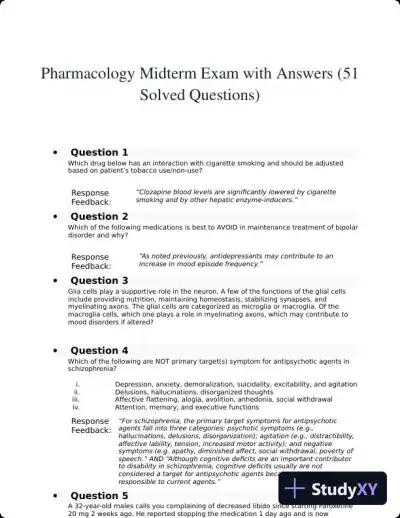 Past Exams
Pharmacology Midterm Exam with Answers (51 Solved Questions)
Pharmacology
10 pages140downloadsFeb 2025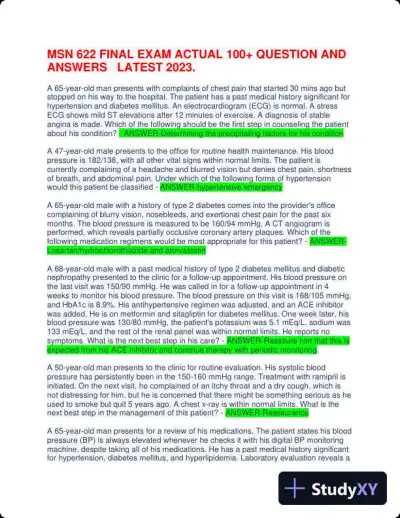 Past Exams
2023 MSN622 Final Exam with Answers (117 Solved Questions)
Pharmacology
21 pages139downloadsFeb 2025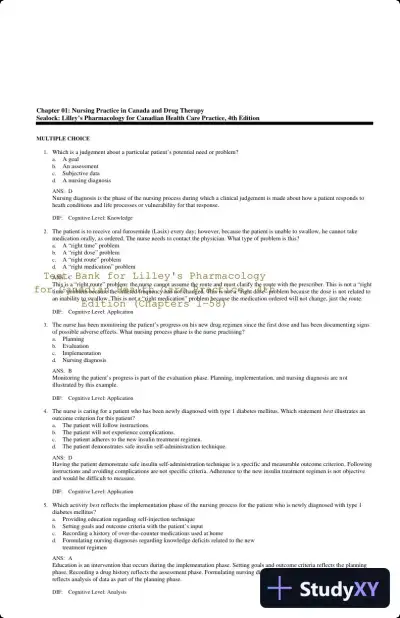 Exam Guides
Test Bank for Lilley's Pharmacology for Canadian Health Care Practice, 4th Edition (Chapters 1-58)
Pharmacology
133 pages131downloadsFeb 2025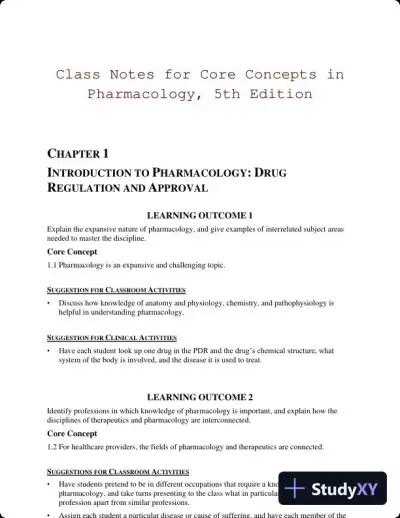 Class Notes
 for Core Concepts in Pharmacology, 5th Edition
Pharmacology
163 pages128downloadsFeb 2025 Exam Guides
Stahl's Essential Psychopharmacology: Neuroscientific Basis and Practical Applications 4th Edition Test Bank
Pharmacology
121 pages123downloadsFeb 2025 Past Exams
2024-2025 MN553 Advanced Pharmacology Final Exam with Answers (94 Solved Questions)
Pharmacology
28 pages104downloadsFeb 2025 Exam Guides
Pharmacology For Nurses: A Pathophysiologic Approach , 4th Edition Test Bank
Pharmacology
1193 pages102downloadsFeb 2025 Past Exams
MN553 Final Exam Quiz with Answers (97 Solved Questions)
Pharmacology
28 pages102downloadsFeb 2025
Study this document with CramX
Once it is in your library, every tool can work from it.