

Class Notes for Core Concepts in Pharmacology, 5th Edition
- Pharmacology
- 163 pages
- Shared February 2025
- 128 downloads
Class Notes for Core Concepts in Pharmacology, 5th Edition is designed to make learning faster and simpler.
Preview 31 of 163 pages
See the first 31 pages exactly as they appear in the document.
Page 1 Read page 1 as text
C HAPTER 1 I NTRODUCTION TO P HARMACOLOGY : D RUG R EGULATION AND A PPROVAL LEARNING OUTCOME 1 Explain the expansive nature of pharmacology , and give examples of interrelated subject area s needed to master the discipline. Core Concept 1.1 Pharmacology is an expansive and challenging topic. S UGGESTION FOR C LASSROOM A CTIVITIES • Discuss how knowledge of anatomy and physiology, chemistry, and pathophysiology is helpful in understanding pharmacology. S UGGESTION FOR C LINICAL A CTIVITIES • Have each student look up one drug in the PDR and the drug’s chemical structure, what system of the body is involved, and the disease it is used to treat. LEARNING OUTCOME 2 Identify professions in which knowledge of pharmacology is important , and explain how the disciplines of therapeutics and pharmacology are interconnected . Core Concept 1.2 For healthcare providers, the fields of pharmacology and therapeutics are connected. S UGGESTION S FOR C LASSROOM A CTIVITIES • Have students pretend to be in different occupations that require a knowledge of pharmacology, and take turns presenting to the class what in particular they do that sets their profession apart from similar professions. • Assign each student a particular disease or cause of suffering, and have each member of the class take turns explaining how therapeutics and pharmacology would play a role in a patient’s experience with the given ailment.
Page 2 Page 3 Read page 3 as text
LEARNING OUTCOME 3 Compare and contrast traditional drugs, biologics, and natural alternative therapies. Core Concept 1. 3 Medicines are classified as traditional drugs, biologics, and natural alternatives. S UGGESTION FOR C LASSROOM A CTIVITIES • Discuss examples of traditional drugs, biologics, and natural alternative therapies. LEARNING OUTCOME 4 Identify the advantages and disadvantages of prescription and over - the - counter drugs. Core Concept 1. 4 Medications are available by prescription or over the counter. S UGGESTIONS FOR C LASSROOM A CTIVITIES • Discuss why some drugs are prescription drugs and other drugs are OTC drugs. Give examples of prescription drugs and OTC drugs. • Discuss why a prescription drug sometimes becomes an OTC drug. Give examples. LEARNING OUTCOME 5 Distinguish between pharmaceutics and pharmacology. Core Concept 1. 5 Pharmaceutics is the science of pharmacy. S UGGESTION FOR C LASSROOM A CTIVITIES • Discuss the educational requirements to become a pharmacist. S UGGESTION FOR C LINICAL A CTIVITIES
Page 4 Read page 4 as text
• Have students observe a pharmacist and note activities of the pharmacist. LEARNING OUTCOME 6 Discuss the history of U.S. standards, acts, and organizations leading to the requirement that drug safety must be proven before marketing. Core Concept 1. 6 Drug regulations were created to protect the public from drug misuse. S UGGESTIONS FOR C LASSROOM A CTIVITIES • Have USP - NF available for the students to look at. • Design a matching quiz for the different drug acts. LEARNING OUTCOME 7 Discuss the emerging role s and responsibilities of the U.S. Department of Health and Human Services and the U . S . Food and Drug Administration (FDA) with its branches in determining the safety of drugs and whether they may be used for therapy. Core Concept 1. 7 U.S. drug standards have become increasingly complex. S UGGESTIONS FOR C LASSROOM A CTIVITIES • Have available several types of dietary supplements so that the students can look at the labels. • Discuss different herbs that may be used for medical purposes. • Discuss whether there should be stricter control over the marketing of herbal products and dietary supplements. • Discuss the MedWatch program and its purpose. LEARNING OUTCOME 8 Identify four stages of approval for therapeutic and biologic drugs. Core Concept
Page 5 Read page 5 as text
1. 8 There are four stages of approval for therapeutic and biologic drugs. S UGGESTION FOR C LASSROOM A CTIVITIES • Discuss drugs that have been removed from the market because of harmful effects. LEARNING OUTCOME 9 Discuss current challenges facing the FDA in approving new drugs for market. Core Concept 1. 9 Governmental agencies face the dual challenge of increasing the speed of drug approval while still ensuring the safety of new drugs . S UGGESTIONS FOR C LASSROOM A CTIVITIES • Discuss how the user fee increases the cost of prescription drugs. • Discuss examples of drugs that have unapproved uses. LEARNING OUTCOME 1 0 Discuss the challenges facing healthcare pro viders in view of modern - day pandemic and bioterrorist threats. Core Concept 1. 10 Healthcare providers must be prepared to deal with the threat of biologic al and chemical attack. S UGGESTIONS FOR C LASSROOM A CTIVITIES • Discuss how infectious agents, chemicals, and nuclear and radiation emergencies can be disseminated. • Discuss signs and symptoms of each form of bioterrorism. S UGGESTIONS FOR C LINICAL A CTIVITIES • Have students locate the bioterrorism manual in the clinical area. • Discuss the roles of different healthcare professionals in the event of a bioterrorism attack.
Page 6 Read page 6 as text
G ENERAL C HAPTER C ONSIDERATIONS 1. Have students study and learn the key terms listed at the beginning of the chapter. 2. Have students complete the end - of - chapter review questions in their book. 3. Use the Classroom Response Questions provided in PowerPoint to assess students prior to the lecture. R EFERENCES • U.S. Food and Drug Administration: http://www.fda.gov • U.S. Drug Recalls: http://www.fda.gov/Drugs/DrugSafety/DrugRecalls/default.htm • U.S. Homeland Security: http://www.dhs.gov S TUDENT W ORKBOOK AND R ESOURCE G UIDE • Chapter 1 activities • Separate purchase P EARSON N URSE ’ S D RUG G UIDE • Separate purchase C LASSROOM R ESPONSE Q UESTION P OWER P OINTS T ESTBANK
Page 7 Read page 7 as text
C HAPTER 2 D RUG C LASSES , S CHEDULES , AND C ATEGORIES LEARNING OUTCOME 1 Discuss the prototype approach to drug classification and the basi s for which drugs are placed into therapeutic and pharmacologic classes. Core Concept 2. 1 Drugs may be organized by their therapeutic and pharmacologic classifications. S UGGESTIONS FOR C LASSROOM A CTIVITIES • Discuss prototype drugs that have been replaced with a new, improved drug in a pharmacologic class. • Discuss different therapeutic classes of drugs. • Describe different mechanisms of action of drugs. • Discuss drugs that have the same therapeutic classification but have different mechanisms of action. • Design a matching quiz involving the mechanisms of action of drugs. S UGGESTION FOR C LINICAL A CTIVITIES • Have students identify the therapeutic and pharmacologic classifications of the drugs for their assigned patient. LEARNING OUTCOME 2 Distinguish between a drug’s chemical name, generic name, and trade name . Core Concept 2.2 Drugs have more than one name. S UGGESTION S FOR C LASSROOM A CTIVITIES • Provide the chemical, generic, or trade name of a drug and have students give the other two names. • Assign different students a generic, trade, or chemical name. Have the students try to find their correct matches to form a trio.
Page 8 Read page 8 as text
• Have a timed quiz that asks students to list how many generic and trade names they can come up with for popular drugs. Whoever gets the most in the time frame wins. S UGGESTION S FOR C LINICAL A CTIVITIES • Have students identify the chemical, generic, and trade names for the drugs an assigned patient is receiving. • Have students identify the mechanisms of action of drugs on assigned patients. LEARNING OUTCOME 3 Explain how trade name drugs are different from generic equivalent drugs . Core Concept 2.3 The differences between trade name drugs and their generic equivalents include price, formulations , and, most importantly, bioavailability. S UGGESTIONS FOR C LASSROOM A CTIVITIES • Discuss the advantages and disadvantages for drug companies and patients if only trade name drugs were used. • Discuss the advantages and disadvantages of using generic name drugs. S UGGESTION FOR C LINICAL A CTIVITIES • Have students determine a list of trade name drugs that are on their facility’s negative formulary. LEARNING OUTCOME 4 Discuss why drugs are sometimes placed on a restrictive list and referred to as schedule d drugs or controlled substances. Core Concept 2.4 Drugs with a potential for misuse and abuse are categorized into schedules. S UGGESTIONS FOR C LASSROOM A CTIVITIES • Discuss the differences between physical and psychological dependence.
Page 9 Read page 9 as text
• Discuss how scheduled drugs must be ordered. S UGGESTION FOR C LINICAL A CTIVITIE S • Have students compile a list of scheduled drugs in their own state. LEARNING OUTCOME 5 Identify the five pregnancy categories and explain what each category represents. Core Concept 2.5 In order to assess fetal risks, all prescription drugs are classified according to safety in pregnancy categories. S UGGESTIONS FOR C LASSROOM A CTIVITIES • Identify the five pregnancy categories and explain what each category represents. • Design a matching quiz involving the schedules of pregnancy drugs in various safety categories. G ENERAL C HAPTER C ONSIDERATIONS 1. Have students study and learn the key terms listed at the beginning of the chapter. 2. Have students complete the end - of - chapter questions in their book . 3. Use the Classroom Response Questions provided in PowerPoint to assess students prior to the lecture. R EFERENCES • U.S. Governmental Drug Regulation: http://www.usdoj.gov/dea/index.htm S TUDENT W ORKBOOK AND R ESOURCE G UIDE • Chapter 2 activities • Separate purchase P EARSON N URSE ’ S D RUG G UIDE • Separate purchase C LASSROOM R ESPONSE Q UESTION P OWER P OINTS
Page 10 Read page 10 as text
T ESTBANK
Page 11 Read page 11 as text
C HAPTER 3 P RINCIPLES OF D RUG A DMINISTRATION LEARNING OUTCOME 1 Discuss drug administration as a component of safe and effective healthcare , including the responsibilities of nurses, nursing assistants, therapists, and technicians . Core Concept 3. 1 A major goal in pharmacotherapy is to limit the number and severity of drug adverse events. S UGGESTION S FOR C LASSROOM A CTIVITIES • Discuss how drugs can be delivered safely to patients. • Review the roles of the nurse when administering a medication. • Review the roles of nursing assistants, therapists, and technicians when caring for a patient taking medications. • Define the difference between drug adverse events and side effects. • Discuss the signs and symptoms of an allergic reaction and an anaphylactic reaction. S UGGESTION FOR C LINICAL A CTIVITIES • Discuss ways to reduce medication errors in the clinical area. LEARNING OUTCOME 2 Explain how the six rights of drug administration affect patient safety . Core Concept 3.2 The rights of drug administration form the basis of proper drug delivery. S UGGESTIONS FOR C LASSROOM A CTIVITIES • Discuss the importance of each of the six rights of drug administration. • Discuss the importance of avoiding medication errors. S UGGESTION S FOR C LINICAL A CTIVITIES
Page 12 Read page 12 as text
• Have each student demonstrate the six rights of drug administration plus the three checks of drug administration on an assigned patient. • Following the roles of a nurse, have the student administer medication to an assigned patient. LEARNING OUTCOME 3 Give specific examples of how the healthcare provider can increase patient compliance in taking medications . Core Concept 3.3 Successful pharmacotherapy depends on patient compliance. S UGGESTIONS FOR C LASSROOM A CTIVITIES • Discuss the importance of patient compliance in pharmacotherapy and the reasons for noncompliance in pharmacotherapy. • Design a role - play exercise in which students are paired so that one plays the nurse and the other the patient. Provide “patients” with a variety of reasons for noncompliance, and have “nurses” ask them about their medication use. S UGGESTIONS FOR C LINICAL A CTIVITIES • Demonstrate how drug administration and drug refusals are documented. • Have students develop a plan of care using the nursing process regarding an assigned patient’s medications. LEARNING OUTCOME 4 Interpret abbreviations used in drug administration practices. Core Concept 3.4 Healthcare providers may use accepted abbreviations to communicate the directions and times for drug administration. S UGGESTION S FOR C LASSROOM A CTIVITIES • Design a matching quiz based on abbreviations and their meanings. • Discuss situations when STAT, ASAP, PRN, and standing orders may be used.
Page 13 Read page 13 as text
• Discuss abbreviations that are not accepted and give examples as to why. S UGGESTION S FOR C LINICAL A CTIVITIES • After administering medications to an assigned patient, have students correctly document. • Have students review charts and look for abbreviations. LEARNING OUTCOME 5 Compare and contrast the three systems of measurement used in pharmacology. Core Concept 3.5 Three systems of measurement are used in pharmacology: metric, apothecary, and household. S UGGESTIONS FOR C LASSROOM A CTIVITIES • Discuss the advantages and disadvantages of each system of measurement. • Display different devices used to measure metric, apothecary, and household units. S UGGESTION FOR C LINICAL A CTIVITIES • Discuss converting metric measurements to household measurements and why the nurse may need to do this. LEARNING OUTCOME 6 List guidelines common to all methods of drug administration. Core Concept 3.6 Certain protocols and techniques are common to all methods of drug administration. S UGGESTIONS FOR C LASSROOM A CTIVITIES • Demonstrate the protocols used for all drug administration. • Prepare a quiz comparing and contrasting the advantages and disadvantages of enteral, topical, and parenteral routes of drug administration. S UGGESTION FOR C LINICAL A CTIVITIES • Following the roles of a nurse, have the student demonstrate the common protocols for
Page 14 Read page 14 as text
administering any type of drug to an assigned patient. LEARNING OUTCOME 7 Explain the proper methods to administer enteral drugs. Core Concept 3.7 Enteral drugs are given orally or via nasogastric or gastrostomy tubes. S UGGESTIONS FOR C LASSROOM A CTIVITIES • Demonstrate administration of drugs via the enteral route . • Have the equipment available for students to see and handle. S UGGESTIONS FOR C LINICAL A CTIVITIES • Allow students to practice in the simulation laboratory administering practice medications via the enteral route to the mannequins. • With supervision, have students administer medications via the enteral route to assigned patients. LEARNING OUTCOME 8 Explain the proper methods to administer topical drugs. Core Concept 3.8 Topical drugs are applied locally to the skin and associated membranes. S UGGESTION S FOR C LASSROOM A CTIVITIES • Demonstrate administration of drugs via the topical route. • Have examples of various type s of topically applied medications available for students to see and handle. S UGGESTIONS FOR C LINICAL A CTIVITIES • Allow students to practice in the simulation laboratory administering practice medications
Page 15 Read page 15 as text
via the topical route to the mannequins. • With supervision, have students administer medications via the topical route to assigned patients. LEARNING OUTCOME 9 Explain the proper methods to administer parenteral drugs. Core Concept 3.9 Parenteral administration refers to dispensing medications by routes other than oral or topical. S UGGESTIONS FOR C LASSROOM A CTIVITIES • Demonstrate administration of drugs via the parenteral route. • Demonstrate safety precautions for parenteral drug administration and needle disposal. S UGGESTIONS FOR C LINICAL A CTIVITIES • Allow students to practice in the simulation laboratory administering practice medications via the parenteral route to the mannequins. • With supervision, have students administer medications via the parenteral route to assigned patients. G ENERAL C HAPTER C ONSIDERATIONS 1. Have students study and learn the key terms listed at the beginning of the chapter. 2. Have students complete the end - of - chapter questions in their book . 3. Use the Classroom Response Questions provided in PowerPoint to assess students prior to the lecture. R EFERENCES Institute for Safe Medical Practices: http://www.ismp.org/ U.S. Food and Drug Administration: http://www.fda.gov/drugs/drugsafety/medicationerrors/ S TUDENT W ORKBOOK AND R ESOURCE G UIDE • Chapter 3 activities
Page 16 Read page 16 as text
• Separate purchase P EARSON N URSE ’ S D RUG G UIDE • Separate purchase C LASSROOM R ESPONSE Q UESTION P OWER P OINTS T ESTBANK
Page 17 Read page 17 as text
C HAPTER 4 W HAT H APPENS A FTER A D RUG H AS B EEN A DMINISTERED LEARNING OUTCOME 1 Identify the four major processes of pharmacokinetics. Core Concept 4.1 Pharmacokinetics focuses on what the body does to the drugs. S UGGESTION FOR C LASSROOM A CTIVITIES • Select different drugs and compare and contrast the pharmacokinetics of each drug. S UGGESTION FOR C LINICAL A CTIVITIES • Using the PDR, have students select a drug that an assigned patient has been ordered and describe the pharmacokinetics of the drug. LEARNING OUTCOME 2 Discuss the factors affecting drug absorption. Core Concept 4.2 Absorption is the first step in drug transport. S UGGESTION FOR C LASSROOM A CTIVITIES • Discuss how different factors affect the absorption of drugs. S UGGESTION FOR C LINICAL A CTIVITIES • Have students identify factors that may speed up or slow down the absorption of drugs on an assigned patient.
Page 18 Read page 18 as text
LEARNING OUTCOME 3 Explain the significance of the blood - brain barrier, blood - placental barrier, and blood - testi cular barrier , and describe how plasma proteins affect drug distribution. Core Concept 4 .3 Distribution refers to how drugs are transported throughout the body. S UGGESTION S FOR C LASSROOM A CTIVITIES • Have students discuss selected drugs that bind albumin and how a second drug affects the bioavailability of the first drug. • Divide the class into three groups. Assign one group the blood - brain barrier; assign the second group the blood - placental barrier; and assign the third group the blood - testi cular barrier . Have each group find drugs that pass or do not pass the assigned blood barrier and determine whether the drugs that pass are harmful or beneficial. S UGGESTION FOR C LINICAL A CTIVITIES • Have students develop a nursing care plan instructing a pregnant woman about using any types of drugs, alcohol, and tobacco products while pregnant. LEARNING OUTCOME 4 Explain the importance of the first - pass effect, metabolic enzymes, and intermediate products of drug metabolism to the success of drug therapy. Core Concept 4.4 Metabolism is a process whereby drugs are made less or more active. S UGGESTION S FOR C LASSROOM A CTIVITIES • Discuss factors that affect the significance of the first - pass effect. • Discuss how the pharmacokinetics working behind the scenes for prodrugs differs from that involved when other types of drugs are administered. LEARNING OUTCOME 5 Identify the major processes by which drugs are eliminated from the body, including the importance of enterohepatic recirculation.
Page 19 Read page 19 as text
Core Concept 4.5 Excretion processes remove drugs from the body. S UGGESTION S FOR C LASSROOM A CTIVITIES • Discuss the effects of enterohepatic recirculation on elimination and drug effects. • Discuss the types of complications that may occur if drugs are inhibited from safe elimination from the body. • Review common drugs that can be excreted in breast milk. S UGGESTION FOR C LINICAL A CTIVITIES • Using the PDR, have students select a drug that an assigned patient has been ordered and determine how the drug is eliminated. LEARNING OUTCOME 6 Explain how rate of elimination and plasma half - life ( t 1/2 ) are related to the duration of drug action. Core Concept 4.6 The rate of elimination and half - life characteristics influence drug responsiveness. S UGGESTION S FOR C LASSROOM A CTIVITIES • Have available different dose - response curves for students to look at. • Have students practice determining the drug dosages that they would administer to sample patients, based upon provided patient specs and known half - life of a given drug. LEARNING OUTCOME 7 Discuss how successful pharmacotherapy depends on principles of pharmacodynamics. Core Concept 4.7 Pharmacodynamics focuses on what the drugs do to the body. S UGGESTION S FOR C LASSROOM A CTIVITIES • Discuss the various factors that may influence the effectiveness of drug therapy, and have students brainstorm specific examples.
Page 20 Read page 20 as text
• Discuss whether certain types of drugs rely on enterohepatic recirculation to achieve maximum effectiveness, as well as complications that may result from this process. LEARNING OUTCOME 8 Explain the significance of the receptor theory and how “blockers” of drug action work. Core Conc ept 4.8 Drugs activate specific receptors to produce a response. S UGGESTION S FOR C LASSROOM A CTIVITIES • Discuss the difference between agonists and antagonists and review common drugs to provide examples of each. • Describe how “blockers” of drug action work. LEARNING OUTCOME 9 Compare and contrast the therapeutic terms potency and efficacy . Core Conce pt 4.9 Potency and efficacy are terms often used to describe the ability of drug therapy to reduce or resolve symptoms. S UGGESTION S FOR C LASSROOM A CTIVITIES • Have various potency/efficacy curves available for students to look at . • Discuss why higher efficacy is generally more important than higher potency in pharmacotherapeutics. G ENERAL C HAPTER C ONSIDERATIONS 1. Have students study and learn the key terms listed at the beginning of the chapter. 2. Have students complete the end - of - chapter questions in their book . 3. Use the Classroom Response Questions provided in PowerPoint to assess students prior to the lecture. S TUDENT W ORKBOOK AND R ESOURCE G UIDE
Page 21 Read page 21 as text
• Chapter 4 activities • Separate purchase P EARSON N URSE ’ S D RUG G UIDE • Separate purchase C LASSROOM R ESPONSE Q UESTION P OWER P OINTS T ESTBANK
Page 22 Read page 22 as text
C HAPTER 5 T HE N URSING P ROCESS IN P HARMACOLOGY N URSING P ROCESS IN P HARMACOLOGY LEARNING OUTCOME 1 Identify how the assessment phase of the nursing process can be used to gather data pertinent to medication administration. Core Concept 5.1 The first step of the nursing process is the assessment phase. S UGGESTIONS FOR C LASSROOM A CTIVITIES • Discuss the steps in the nursing process. • Have the class discuss different actions that the nurse is responsible for during the assessment phase. S UGGESTION FOR C LINICAL A CTIVITIES • Have students perform a nursing assessment for assigned patients. LEARNING OUTCOME 2 Explain how nursing diagnoses can be used to improve medication administration. Core Conce pt 5.2 Nursing diagnoses are based on the data gathered in the assessment phase. S UGGESTION S FOR C LASSROOM A CTIVITIES • Discuss proper wording of nursing diagnoses. • Provide examples of common patient conditions and corresponding nursing diagnoses. S UGGESTION FOR C LINICAL A CTIVITIES • Have students develop nursing diagnoses for assigned patients.
Page 23 Read page 23 as text
LEARNING OUTCOME 3 Describe the steps in the planning phase of the nursing process. Core Concept 5.3 In the planning phase, the nurse creates an individualized plan of care for a patient based on the identified nursing diagnoses and etiologies. S UGGESTION S FOR C LASSROOM A CTIVITIES • Discuss different types of care plans and provide examples of them. • Discuss evaluation criteria that will be used to determine whether the goal has been met. S UGGESTION FOR C LINICAL A CTIVITIES • Have students devise care plans for assigned patients. LEARNING OUTCOME 4 Identify pharmacology applications included in the implementation phase of the nursing process. Core Concept 5.4 The implementation phase puts the plan of care into action. S UGGESTION S FOR C LASSROOM A CTIVITIES • Put students into groups, and assign each group a sample patient with an evolving condition. Have students practice how their implementation of the plan of care would change as the patient’s condition changes. • Have students model effective education strategies to use in the implementation phase. S UGGESTION S FOR C LINICAL A CTIVITIES • Have students educate assigned patients about medication regimens. • Have students document interventions carried out for drugs that were administered to assigned patients . LEARNING OUTCOME 5
Page 24 Read page 24 as text
Explain the importance of the evaluation phase in the nursing process as applied to pharmacotherapy. Core Concept 5.5 In the evaluation phase, the nurse obtains data to determine whether the goal or outcome has been achieved. S UGGESTION FOR C LASSROOM A CTIVITIES • Discuss the types of questions that students may ask themselves when evaluating a patient to determine whether the plan of care has been successful. S UGGESTION FOR C LINICAL A CTIVITIES • Have students evaluate patients that they encounter in the clinical setting, and determine whether the goal or outcome of the implemented plan of care has been achieved. G ENERAL C HAPTER C ONSIDERATIONS 1. Have students study and learn the key terms listed at the beginning of the chapter. 2. Have students complete the end - of - chapter questions in their book . 3. Use the Classroom Response Questions provided in PowerPoint to assess students prior to the lecture. R EFERENCES NANDA International : http://www.nanda.org/nanda - international - glossary - of - terms.html S TUDENT W ORKBOOK AND R ESOURCE G UIDE • Chapter 5 activities • Separate purchase P EARSON N URSE ’ S D RUG G UIDE • Separate purchase C LASSROOM R ESPONSE Q UESTION P OWER P OINTS T ESTBANK
Page 25 Read page 25 as text
C HAPTER 6 P REVENTING M EDICATION E RRORS LEARNING OUTCOME 1 Define medication error. Core Concept 6.1 Medication errors are preventable events that may significantly impact treatment outcomes. S UGGESTION S FOR C LASSROOM A CTIVITIES • Discuss the various events or practices from which medication errors can arise. • Devise a matching game in which students match the NCC MERP Index of medication error categories to the algorithm. LEARNING OUTCOME 2 Identify factors that contribute to medication errors. Core Concept 6.2 Both healthcare providers and patients can contribute to medication errors. S UGGESTION FOR C LASSROOM A CTIVITIES • Divide students into two groups. Have one group compile a list of factors that can contribute to medication errors by healthcare providers. Have the second group compile a list of factors that can contribute to medication errors by patients or caregivers. LEARNING OUTCOME 3 Explain the impact of medication errors on patients and why errors should be documented. Core Concept 6.3 Medication errors may affect patient health and should be documented.
Page 26 Read page 26 as text
S UGGESTIONS FOR C LASSROOM A CTIVITIES • Discuss the legal and ethical responsibilities for documenting and reporting medical errors. • Have students explain the steps in reporting medication errors. • Discuss sentinel events. S UGGESTION S FOR C LINICAL A CTIVITIES • Have students research medication errors on MedWatch and compile a list of the five most recently reported errors. • Ask students to research the steps to be taken to report an adverse event following a vaccination. LEARNING OUTCOME 4 Describe strategies that healthcare providers can implement to reduce medication errors. Core Concept 6.4 Healthcare providers use multiple strategies for reducing medication errors. S UGGESTION S FOR C LASSROOM A CTIVITIES • Divide students into two groups. Have one group find and share the list of Institute for Safe Medication Practices ( ISMP ) confused drug names. Have the other group find and share the list of ISMP high - alert medications. • Discuss root cause analysis (RCA) and how facilities use root cause analysis to identify system - wide problems that may contribute to medication errors. S UGGESTION FOR C LINICAL A CTIVITIES • Have students provide teaching to assigned patients that demonstrates how patients can minimize the potential for medication errors. G ENERAL C HAPTER C ONSIDERATIONS 1. Have students study and learn the key terms listed at the beginning of the chapter. 2. Have students complete the end - of - chapter questions in their book . 3. Use the Classroom Response Questions provided in PowerPoint to assess students prior to the lecture.
Page 27 Read page 27 as text
R EFERENCES Institute for Safe Medication Practices: http://www.ismp.org U.S. Food & Drug Administration, MedWatch: http://www.fda.gov/Safety/MedWatch/ Vaccine Adverse Event Reporting System: https://vaers.hhs.gov/data/index S TUDENT W ORKBOOK AND R ESOURCE G UIDE • Chapter 6 activities • Separate purchase P EARSON N URSE ’ S D RUG G UIDE • Separate purchase C LASSROOM R ESPONSE Q UESTION P OWER P OINTS T ESTBANK
Page 28 Read page 28 as text
C HAPTER 7 T HE R OLE OF C OMPLEMENTARY AND A LTERNATIVE T HERAPIES IN P HARMACOLOGY LEARNING OUTCOME 1 Compare and contrast complementary and alternative medicine therapies to conventional medical therapies. Core Concept 7.1 Complementary and alternative medicine focuses on treating the whole person using natural products and mind – body therapies. S UGGESTION FOR C LASSROOM A CTIVITIES • Assign groups of two or three students to provide information to the class about different complementary and alternative medicine therapies. S UGGESTION FOR C LINICAL A CTIVITIES • Assign students to observe different types of complementary and alternative medicine therapies. LEARNING OUTCOME 2 Discuss the reasons why herbal products and dietary supplements have steadily increased in popularity. Core Concept 7.2 Herbal products have been used as medicines for thousands of years. S UGGESTION S FOR C LASSROOM A CTIVITIES • In class, have a brainstorming session that covers the various reasons that people may opt for herbal products. • Discuss popular herbal products and their primary uses.
Page 29 Read page 29 as text
S UGGESTION FOR C LINICAL A CTIVITIES • Have students take note of the patients that they see in clinicals that opt for herbal therapies over synthetic medications. Do they see a trend emerging regarding the demographics of those individuals? LEARNING OUTCOME 3 Explain why it is important to standardize herbal products based on specific active ingredients . Core Concept 7.3 Many h erbal products are standardized with respect to a specific active ingredient. S UGGESTIONS FOR C LASSROOM A CTIVITIES • Discuss examples of active ingredients from different parts of an h erb. • Display different types of formulations. • Discuss, and compare generally, the active ingredients in herbal products versus those present in modern drugs. LEARNING OUTCOME 4 Describe drug interactions and adverse effects that may be caused by herbal and dietary supplements. Core Concept 7.4 Herbs can have significant pharmacologic actions and may interact with conventional drugs. S UGGESTION S FOR C LASSROOM A CTIVITIES • Have available different dietary supplement labels for students to look at . • Discuss different interactions between conventional drugs and herbs. • Discuss possible adverse effects of different herbal therapies. S UGGESTION FOR C LINICAL A CTIVITIES • Have students ask assigned patients about their use of herbal therapy along with conventional
Page 30 Read page 30 as text
drugs. LEARNING OUTCOME 5 Explain how a specialty supplement differs from an herbal product. Core Concept 7.5 Specialty supplements are nonherbal products that are widely used to promote wellness. S UGGESTIONS FOR C LASSROOM A CTIVITIES • Discuss the rationale for use of various specialty supplements. • Split students into small groups and have each group research the claims of one or two specialty supplements and what they are advertised to do. Have them then report their findings to the class. S UGGESTION FOR C LINICAL A CTIVITIES • Have students ask assigned patients about their use of specialty supplements and their reasons for taking them. LEARNING OUTCOME 6 Describe strengths and weaknesses of legislation governing the use of dietary supplements. Core Concept 7.6 Dietary supplements are not regulated in the same manner as prescription medications. S UGGESTION S FOR C LASSROOM A CTIVITIES • Discuss the limitations of DSHEA regulations of dietary supplements and how these regulations differ from those applied to prescription drugs. • Review the FDA’s current requirements for evaluating and labeling dietary supplements . G ENERAL C HAPTER C ONSIDERATIONS 1. Have students study and learn the key terms listed at the beginning of the chapter. 2. Have students complete the end - of - chapter questions in their book . 3. Use the Classroom Response Questions provided in PowerPoint to assess students prior to
Page 31 Read page 31 as text
the lecture. R EFERENCES • National Center of Complementary and Integrative Health : http://nccam.nih.gov/ • Medline Plus: http://www.nlm.nih.gov/medlineplus/herbalmedicine.html • U.S. Food & Drug Administration: Dietary Supplements: http://www.fda.gov/Food/DietarySupplements/ S TUDENT W ORKBOOK AND R ESOURCE G UIDE • Chapter 7 activities • Separate purchase P EARSON N URSE ’ S D RUG G UIDE • Separate purchase C LASSROOM R ESPONSE Q UESTION P OWER P OINTS T ESTBANK
132 more pages in the full document
Unlock it once and it stays in your library, ready to chat with or turn into flashcards.
Unlock the full documentMore Pharmacology study materials
See all Exam Guides
Test Bank For Core Concepts in Pharmacology, 3rd Edition
Pharmacology
150 pagesMay 2025 Past Exams
Pharmacology Midterm Exam with Answers (51 Solved Questions)
Pharmacology
10 pages140downloadsFeb 2025 Past Exams
2023 MSN622 Final Exam with Answers (117 Solved Questions)
Pharmacology
21 pages139downloadsFeb 2025 Exam Guides
Test Bank for Lilley's Pharmacology for Canadian Health Care Practice, 4th Edition (Chapters 1-58)
Pharmacology
133 pages131downloadsFeb 2025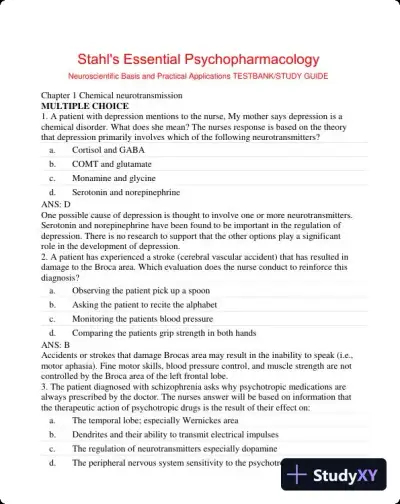 Exam Guides
Stahl's Essential Psychopharmacology: Neuroscientific Basis and Practical Applications 4th Edition Test Bank
Pharmacology
121 pages123downloadsFeb 2025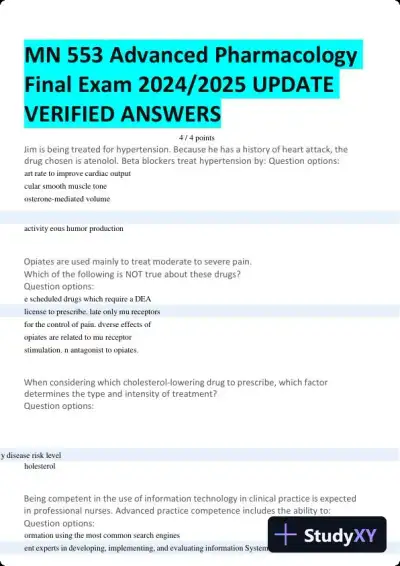 Past Exams
2024-2025 MN553 Advanced Pharmacology Final Exam with Answers (94 Solved Questions)
Pharmacology
28 pages104downloadsFeb 2025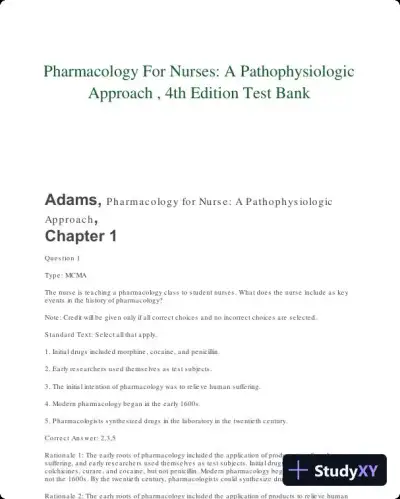 Exam Guides
Pharmacology For Nurses: A Pathophysiologic Approach , 4th Edition Test Bank
Pharmacology
1193 pages102downloadsFeb 2025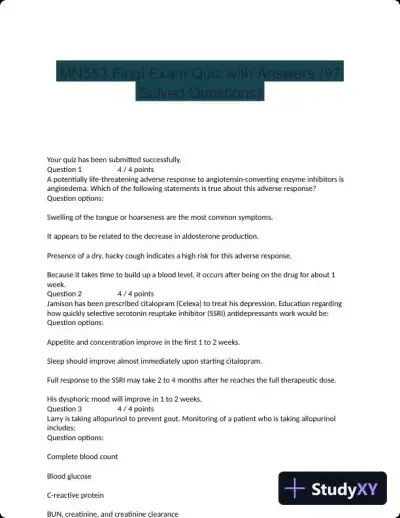 Past Exams
MN553 Final Exam Quiz with Answers (97 Solved Questions)
Pharmacology
28 pages102downloadsFeb 2025
Study this document with CramX
Once it is in your library, every tool can work from it.