

Solution Manual For Thermal Physics, 2nd Edition
- Physics
- 151 pages
- Shared May 2025
Solve your textbook questions faster and more accurately with Solution Manual For Thermal Physics, 2nd Edition, a reliable guide for every chapter.
Preview 16 of 151 pages
See the first 16 pages exactly as they appear in the document.
Page 1 Read page 1 as text
CHAPTER 2 2.1) ENTROPY AND TEMPERATURE (a) o = log g = log C + (3N/2)log U. (80/3U)y = 1/1 = (3N/2)(1/U), hence U = 3Nt/2. (®) (2%0/00%)N = (38/2) (-1/U%) < 0. 2.2) PARAMAGNETISM States with spin excess 2s have the energy U = -2smB, hence s = -U/2mB. Insertion into (40) yields (41). From (41) obtain (3a/3U)y B= 1/t = = U/m?B2N. Solve for U: U = <U> = = n2B2N/t = - MB. Hence M/Nm = mB/t. 2.3) QUANTUM HARMONIC OSCILLATOR (a) From (1.55): 0 = log g = log(N+n-1)! = log n! - log(N-1)! = log(N+n)! - log n! - log N! Replacing N-1 by N is equivalent to neglecting a term ~log( (N+n)/N}, which for large N is small compared to the factorial terms. With the Stirling approximation: o = (N+n) log(N+n) - n log n - N log N = (N+n) log[(N+n)/N] - n log(n/N) = N[(1+n/N) log(l+n/N) - (n/N) log(n/N)]. (b) Set n = U/Mw and Nfw = Uy(N): 0 (UN) = N[(1+U/U)) log(1+U/U) = (U/Uy) log(u/ug)]. -3- [2.3] — StudyXY
Page 2 Read page 2 as text
Downloaded from StudyXY.com ® + StudyXY Sd Ye. o> \ | iF ’ pr E \ 3 S Stu dy Anything This ContentHas been Posted On StudyXY.com as supplementary learning material. StudyXY does not endrose any university, college or publisher. Allmaterials posted are under the liability of the contributors. wv 8) www.studyxy.com
Page 3 Read page 3 as text
With the abbreviation x = U/U,: 1/t = (30/30) = (1/04) (30/3%) = (N/Uy) [log (1+x)-1log x] = (1/Mw) log(1+Uy/U). solving for U/N yields U/N = Juw/[exp(Mw/t1) - 1]. Alternate method: For large n: d(log n!)/dn = log n! - log(n-1)! = log n. With this, 1/t = (1/Mw)(3a/3n)y = (1/Hw)[log(N+n) - log n] = (1/Mw) log(1+N/n), which is the equivalent to the result above. 2.4) THE MEANING OF NEVER (a) The probability a correct key will be struck is 1/44. The probability a sequence of 10° keys will be correct is (1/44)100,000 = 107164,345 (b) On a single typewriter the number of keys that can be struck in 10%8s at 10 keys/s is 101°. The Hamlet sequence may start with any of these except the last 10%-1. Thus there are 10% - 10% + 1 = 101% possible starts. The probability of a correct Hamlet sequence on one typewriter is 10195707164,345 _ | -164,326 For 1010 monkeys : 1010x7~164,326 . 107164,316 [2.3] -4- | — StudyXY
Page 4 Read page 4 as text
Comment. One UCSB student suggested that the monkeys be permitted at least as many typographical errors as in the lecture notes from which the main text was prepared. It is not difficult to show that even 1000 errors would have increased the probability by less than a factor (43x10%)1000 M 106633 to a value that is still negligible. 2.5) ADDITIVITY OF ENTROPY FOR TWO SPIN SYSTEMS (a) From (17), with N = N, = 102%, 6 = 101%; = 2 - 919; = (979) ax ®XP(-467/N1) = (979,) 1, * exp(-4), (9195)/(979, pax = 0-0183. Compare this with 107174 for 6 = 10%2. (b) From (1.35): a(N,s) = (2/n)% x 2N x exp(-282/M). This may be applied both to the two individual systems (N = Ny = Ny), and to the combined system (N = N+ Ny). For the two individual systems in their most probable configuration we have from (14), §; = §,. Hence (919) dma = 1904 81% = (27m) x 2° Lx exp(-a8,2/m;) 9192) max = [90,5010 = 1 P(=45) Np) For the combined system, s = 28): 2 9, (Np i5))g,(Ny 5-51) = g(2N,281) S1 2N. 1 a 2 = @/mip)% x 2 tx exp(-a3, 2M) _5- [2.5] | — StudyXY
Page 5 Read page 5 as text
The two results differ by the factor 9(2M,28,)/[9(8), 81% = (N)/20)% = ax10t0 (c) The true entropy of the interacting combined system is o = log g(2N),25)) = 2M) log 2 ~ as,2/m, - log (nN, ) x 1.3863x10%% = 1018 = 25.9 = 1.3862x10%2 The error made in the entropy by estimating the entropy as 109(9;9,) pay = 09%0, is log(4x10'%) = 24.4. This is a fractional error of 1.76x1072L. 2.6) INTEGRATED DEVIATION For Ny = Ny. (17) becomes 2 919; = (919) pay SXP(-467/Np) ® . me 2 919% (919 Day J Sxwi-262/my a0 1 0, © = (919) pay N/0)% [ exp(-that X where x = 26/N%. We count both positive and negative § with [8] > 6). Then ® ® (18156) = [ exp(-t?)at/ [ exp(-t?)at x [J x 1 (NM 5 2 = (2/n%) erfc(x) = bony Fa exp (-46, /Ny) = 0.28 x exp(-400" = exp(-403.6) = 107273 | [2.5] -6- | — StudyXY
Page 6 Read page 6 as text
CHAPTER 3 3.1) FREE ENERGY FOR TWO STATE SYSTEM (a) By inserting (13) into (55): F = -1t log 2 = -t log[l+exp(-c/1)] . (b) Inserted into (49), o= -(3F/31) = log[l+exp(-e/t)] + (¢/1)/[1+exp(e/1)], (81) U =F + to = ¢/[l+exp(e/1)] , the same as (14) obtained directly from Zz. Comment. As t » 0 and hence exp(-£/t) » 0, the logarithm in (S1) may be expanded: log[l+exp(-e/t)] + exp(-£/1). Then o » (1l+e/t) exp(-¢£/1) » 0. The exponential factor goes to zero faster than any inverse power of 1 goes to infinity: Both o and all derivatives of o vanish when tT +» 0, as shown in Fig. 11. The high-temperature limit of o is obtained by letting exp(-£/t) > 1, in (Sl): o > log 2 + e/2t » log 2. 3.2) MAGNETIC SUSCEPTIBILITY (a) For a single magnet, with &£ = mB: zy = exp(mB/t) + exp(-mB/t) = 2 cosh(mB/t) , (s1) <m> = [m exp(+mB/1) - m exp (-mB/1)1/2; = m tanh(mB/t). The magnetization M is obtained by multiplying by the particle concentration n: M = n<m> = nm tanh(mB/t) . For weak fields, mB << t: — 2. M = nm°B/t (s2) _7- [3.2] | — StudyXY
Page 7 Read page 7 as text
For strong fields, mB >> 1: M = nm. These two limits are seen in Fig. 3.12. (b) Inserting (S1) into (55) and multiplying by n: F = -nt log 2q = -nt log[2 cosh(mB/t)] . To express cosh(mB/t) as a function of x = M/mm = tanh(mB/1) = tanh y we use the relation 1/cosh?y = (cosh?y - sinh®y)/cosh?y = 1- tanh?y = 1 - x2. We next write log(2 cosh y] = -% log(1/4cosh®y) = - % log[(1-x%)/4]. With this: F = +(n/2) logl(1-x")/4] (c) The susceptibility is defined as x = dM/dB. In the limit mB << t, from (S2): xX = nm? /t . 3.3) FREE ENERGY OF AN HARMONIC OSCILLATOR The partition function is a geometric series: z= poy exp(-sjw/t) = 1/[1-exp(-Hw/1)]. (a) Inserted into (55): F=-1 log Z = t log[l-exp(-fuw/t)] . (87) [3.2] -8-
Page 8 Read page 8 as text
At high temperatures, Mw/t << 1, so that l-exp(-Mw/1) = Yw/t. Hence from (S1): F = t log(fw/t) . (s2) (b) The expression (88) follows directly by inserting (87) into (49), o = -(3F/3T1). Comment. The low-temperature (1 << Mw) behavior of the harmonic oscillator is the same as for the two state system with ¢ = Jw, as is apparent from comparing Figs. 3.13 and 3.14 with Figs. 3.11 and 3.4: Only the two lowest states matter. The high-temperature behavior (tv >> Mw) is quite different, because the number of acces- sible states is not limited to 2. In this limit, from (s2): 0 = =(3F/31t) » 1 + log(t/Hw). If this is inserted into (17a): Cy = 1(da/31) >» 1, in fundamental units. 3.4) ENERGY FLUCTUATIONS Note first that <(e-<e>)2> = <6? — 2g<e> + <e5%> = eZ — <g> | Next write the partition function as a function of Bp =1/t: 2 = 2 exp(-Be,) . 2 Then =9- [3.4] | — StudyXY
Page 9 Read page 9 as text
= =1 - = -1ladz U = <g> = ze exp(-Bey) = - 7 5 w? = 156 ? exp(-pe,) = + = oz z45% 2 Z 452 From these, with dg/dt = - 1/12, 2 (3) Ze? (&) a8 (3), at), 3p), dr 3p “4 (5%) spfz 1 (=f dp \z ap Z gg2 TZ \@ = <e? = <>? Comment. Manipulations involving temperature differ- entials of the partition functions are frequently simpli- fied by using B = 1/1 rather than 1 as independent vari- able. 3.5) OVERHAUSER EFFECT Let U, be the energy of the reservoir when the energy of the system is zero. Then, when the system has the energy e, the reservoir has, by our supposition, the energy Ug - & + ag = Uy - (1-x)e. The probability P(e) to find the system in a particular state with energy eg is then proportional to the number of states of the reservoir with the energy Uy - (1-a)eg, Peg) = gplUg-(1-a)e ], with the same proportionality factor for all states. Hence, instead of (2) and (3): Bley) _ 9g [Ug-(1-a)e, } _ exp{op [Uy-(1-a)e, 1} (51) B(e,) = 9p(Uy-(1-a)e,] = expfoglUg-(1-a)e, 11° If the entropy of the reservoir is expanded about U = Uys as in (7): [3.4] -10- | — StudyXY
Page 10 Read page 10 as text
0plUg=(1-a)e] = 0, (Uy) = (305/8U)(1-a)e + ... If this is inserted into (S1), one obtains, instead of (9), P(e) expl-(l-a)e,/1] P(ey) expl-(1l-a)e,/t] which is equivalent to (91). 3.6) ROTATION OF DIATOMIC MOLECULE (a) There are 2j+1 states at energy j(i+l)c,, hence EN = Texploeg/) = z (23+1) expl[-i(i+l)eg/t] where the sum over all states has been converted into a sum over all energy levels. (b) The sum may be viewed as a sum over the areas of rectangles with the width aj = 1 and with the height £5 = (23+1) exp[-j(i+l)eg/T], as shown below. Also shown is the curve f(j), with j treated as a continuous rather than discrete variable. Note that this curve goes through the middle of the upper edge of each rectangle. £.,£03) 3 J AT] eg/T = 0.1 / AN N /| AN N / n <J : a 3 0 1 2 3 4 5 S11 [3.6] | \ — StudyXY
Page 11 Read page 11 as text
When © >> £qr the slope of the continuous curve f(j) varies only very little within each rectangle, and the sum can be approximated by the integral © z= / £(3)a3 =k Note that the lower integration limit is not zero; this is important. Substitute new variable: x = JG+e /T, dx = (2+1)(eo/1)dj: w z= [exp(-x)ax = I [1-exp(-x,)1 (s1) Ey Er 0 *o where x, = -e,/41 is the value of x corresponding to j = -1/2. When t>>eg, X,<<1, and the exponential may be expanded: exp(-x4) =z 1 - Xo Foe If this is inserted into (S1), Z=t/ey + 1/4 + cee 4 (s2) where all omitted terms decrease at least as rapidly as 1/t when 1 > @. A more careful treatment of the sum (see below) yields the slightly different result Z2=t/e, + 1/3 + Lo. . (s3) This is the form we will use in what follows. (€) 2 =1+3 exp(-2¢0/1) + ... (54) where the omitted terms vanish more rapidly than the second term when t > 0. (d) Insert z into (12), U(1) = t2(92/91)/2: [3.6] -12- | — StudyXY
Page 12 Read page 12 as text
— 2 — Treg: U(r) = © £02 = T/(1+ey/31) H Tx (l-ey/31) =1 - £o/3 . (85) cv) =1 . Tey UT) = beg exp(-2¢0/T)/2 = bey exp(-2¢,/1) << 6e B (s6) cr) = (12¢ 4/19) exp(-2e0/T) Note that, as in Problems 3.1 and 3.3, the exponential factor goes to zero much faster than 1/t° goes to in- finity, when 1 > 0 . (e) See drawings on next page. The approximation (S6) dips below (S5), suggesting that U(t) approaches the asymptote ($5) from below. This means that C = 3aU/dt > 1 above some temperature, that is, the heat capacity goes through a maximum. An accurate calculation confirms this prediction. The instructor should check that the student drawings show correctly the vanishing slope of both U(r) and C(t) as t + 0, rather than exhibiting a non-descript behavior. Discussion and Elaborations. Unless forewarned, many students are likely to replace the sum by an integral with a lower integration limit of zero. As the graphs of £5 and £(j) show, this is invalid. This pitfall may be taken as the point of departure for a classroom discussion on several mathematical points concerning the summation of series, starting with a warning against the purely formal replacement of sums by integrals without a graphical visualization of the difference between the two. The difference between (S2) and (S3) arises from the non-zero second derivative of the continuous function £(j), which integrates to a finite error in (S2). The formal tool for a more systematic accurate replacement of -13- [3.61 | — Study
Page 13 Read page 13 as text
u U=r pd £9 yd JS J Vi py Y Va I— U = 1-5/3 / / bs £9 2eq All derivatives are zero Cy Le I TT . py 2¢ey All derivatives are zero [3.61 “14- + StudyXy
Page 14 Read page 14 as text
sums by integrals is the Euler-McLaurin summing formula. The Supplementary Material to this Chapter gives a simple derivation that does not draw on the properties of the Euler polynomials, which are commonly utilized in the proofs found in most textbooks. If the Euler-McLaurin expansion is applied to our parti- tion function, one can obtain an expansion of Z by powers of n = £o/Tr 1,1 ,0 2 Z=g*t3+ig rom) (57) where O(n?) stands for omitted terms of order n2 or high- er. To obtain all contributions of order n, the Euler- McLaurin expansion must be carried up to the term (1/720) £3) (0). From (S7) one obtains, by standard methods, _ 2 2 U(r) = = &5 d(logz)/dn = 1 = 24/3 = £,°/45T + O(1/17) or) = 1+ (1/85) (e/0)7 + 01/3) The details are left to the reader. These results do indeed indicate that U(1) approaches its asymptote from below and that C(1) approaches its limiting value from above. As an alternative to these analytical treatments, it is not difficult to sum the partition function numerically on a programmable calculator. The summation is greatly speeded up by calculating the Boltzmann factors recursive- ly: Bj = exp[-j(i*l)eg/1] = By j x C5 C5 = exp[-2jey/t] = C51 x By By = Cy =1 . -15- [3.61 | — StudyXY
Page 15 Read page 15 as text
In this way only one exponential must be evaluated for each 1; the remaining exponentials in the series follow by simple multiplications, at a large saving in calculation time. If 2 is summed numerically, the energy is most conve- niently obtained from the first equality in (3.12), by also summing u = 1 &_exp(-e_/1) Tz z seXP(eg/T - In this way the differentiation of numerical data is avoided. similarly, the heat capacity can be obtained without differentiation from = _1 (1 2 - - v7 c= 5 2 [iz exp (-¢/1) v?] . 3.7) ZIPPER PROBLEM (a) A state in which s links are open can be realized in only one way. Thus the partition function is Z = 1 + exp(-¢/t) + exp(-2¢/t) + ... + exp(~-Ne/1) . N N+1 = 3x® = BE where x = exp(-e/1) (93) 2 x s=0 (b) The average number of open links is N = 1 Ss _ da <s> = 2 Y sx = x 3x log z . (s1) s=0 N+1 If ¢ >> tr, then x << 1, and we may neglect the term x in (93) to obtain <> = - x L 1og(1-x) = X= = 1/[exp(e/1) - 1] dx I-x : This is of the form of the Planck distribution. [3.61 -16- | — StudyXY
Page 16 Read page 16 as text
Extension. Our assumption that each link has only one open state is an unrealistic assumption, which neglects that the two halves of an open link may have many differ- ent orientations relative to each other. It is instruc- tive to generalize the problem by assuming that each open link has G open states with the energy &. The change has far-reaching consequences. A state of the zipper with s open links is then G°-fold degenerate, and the partition function now becomes Z = 1 + G exp(-£/1) + Glexp(-2e/1) + ... N N+1 coo + Mexp(anesr) = 3 xS = IE Z -x s=0 where Xx = G exp(-g/t) , which differs from the earlier form only by the factor G > 1 in the definition of x. Because of this factor, values x > 1 are now possible. This has drastic conse- quences if the total number of links is very large, N >> 1. In this case the opening of the zipper approaches the behavior of an abrupt phase transition at the sharp transition temperature Ty = €/log G which is ‘the temperature for which x = 1. For tempera- tures very little below t,, only a very small fraction of the links are open, for temperatures very little above Ty almost all links are open. The larger N, the narrower the temperature interval over which the opening takes place. We give here only the key points in the derivation of this result. It is not difficult to show that the expression (S1) for <s> can be written as _17- [3.71 | — Study
135 more pages in the full document
Unlock it once and it stays in your library, ready to chat with or turn into flashcards.
Unlock the full documentMore Physics study materials
See all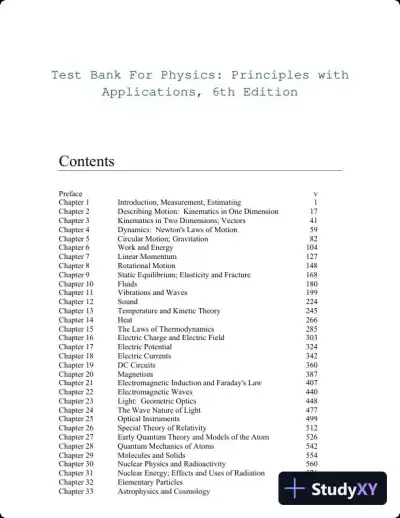 Exam Guides
Test Bank For Physics: Principles with Applications, 6th Edition
Physics
606 pages160downloadsFeb 2025 Textbook Guides
Solution Manual for Modern Physics, 2nd Edition
Physics
187 pages141downloadsFeb 2025 Class Notes
Class Notes for Financial Accounting, 10th Edition
Physics
208 pages139downloadsFeb 2025 Textbook Guides
Solution Manual for Physics: for Scientists and Engineers with Modern Physics, 3rd Edition
Physics
1291 pages136downloadsFeb 2025 Textbook Guides
Solution Manual for E and M TIPERs Electricity And Magnetism: Electricity And Magnetism Tasks: Inspried By Physics Education Research, 1st Edition
Physics
257 pages118downloadsFeb 2025 Textbook Guides
Solution Manual for Financial Accounting, 10th Edition
Physics
1061 pages107downloadsFeb 2025 Exam Guides
Test Bank for Conceptual Physics, 12th Edition
Physics
581 pages71downloadsFeb 2025 Textbook Guides
Solution Manual For College Physics With Masteringphysics, 7th Edition
Physics
536 pages37downloadsFeb 2025
Study this document with CramX
Once it is in your library, every tool can work from it.