

Tax Implications Of The Sale Of Rental Property: A Case Study On T. Terri's Apartment Sale
- Taxation
- 9 pages
- Shared May 2025
This Assignment Solution explores the tax implications of rental property sales, using a real-world case study.
Preview 3 of 9 pages
See the first 3 pages exactly as they appear in the document.
Page 1 Read page 1 as text
Tax Implications of the Sale of Rental Property: A Case Study on T. Terri's Apartment Sale FACTS: Ms. T Terri purchased an apartment on February 21, 2010 for $3,000,000 with 90% of the purchase price allocated to the building. 10% went to the land. She sold the apartment on September 2, 2012 for $3,600,000 with 90% of the sales price allocated to the building. The purchaser paid T. Terri $600,000 cash and assumed a $3,000,000 mortgage on the property. T. Terri’s only other taxable property transaction during the past ten years was three years ago and it resulted in a Sec. 1231 loss of $100,000. (Normally, T. Terri engages in wholly non - taxable Sec. 1031 exchanges.) While T. Terri owned the apartment, 100% of the gross rental income was “rental income from dwelling units” (You may assume that her rental of the apartment building was a profit - motivated “trade or business.”) T. Terri is single and had a taxable income of $1,000,000 in 2012 (without including the tax consequences of the sale of the apartment) Issues Part 1 1. What is T. Terri’s realized gain or loss on this transaction? (Assume for purposes of Part 1 only that T. Terri has, or will have, deducted in her federal income tax returns a total of $250,000 in depreciation on the apartment building through the date of the sale) Answer: To determine T. Terri's realized gain or loss on the sale of the apartment, we need to consider the following: 1. Selling Price of the Apartment : o The apartment was sold for $3,600,000.
Page 2 Page 3 Read page 3 as text
o 90% of the sales price was allocated to the building, which equals: 3,600,000×90%=3,240,0003,600,000 \ times 90 \ % = 3,240,000 (for the building). o The remaining 10% was allocated to the land: 3,600,000×10%=360,0003,600,000 \ times 10 \ % = 360,000 (for the land). 2. Adjusted Basis of the Apartment : o The original purchase price was $3,000,000. 90% of this amount was allocated to the building, and 10% was allocated to the land. ▪ The building's initial basis was: 3,000,000×90%=2,700,0003,000,000 \ times 90 \ % = 2,700,000. ▪ The land's initial basis was: 3,000,000×10%=300,0003,000,000 \ times 10 \ % = 300,000. 3. Depreciation Deduction : o T. Terri has taken a total of $250,000 in depreciation on the building, which will reduce the building's basis. The depreciation impacts only the building's basis, not the land's basis. ▪ The adjusted basis of the building after depreciation is: 2,700,000−250,000=2,450,0002,700,000 - 250,000 = 2,450,000. 4. Mortgage Assumed by the Purchaser : o The purchaser assumed a $3,000,000 mortgage, which does not affect the realized gain directly, but we will need to consider it as part of the overall financial structure of the transaction. For tax purposes, this is considered part of the sale proceeds. 5. Amount Realized on the Sale : o The amount realized on the sale includes the cash received from the buyer plus the amount of the mortgage assumed by the buyer. 600,000600,000 (cash received) + 3,000,0003,000,000 (mortgage assumed) = $3,600,000 (total amount realized). 6. Realized Gain or Loss Calculation : Realized gain (or loss) is calculated as the amount realized minus the adjusted basis of the property. In this case, we will focus on the building because the land is not depreciated, and the land will likely have a different tax treatment.
6 more pages in the full document
Unlock it once and it stays in your library, ready to chat with or turn into flashcards.
Unlock the full documentMore Taxation study materials
See all Textbook Guides
Canadian Income Taxation 2016/2017 Edition Solution Manual
Taxation
884 pages56downloadsFeb 2025 Exam Guides
Test Bank for Pearson's Federal Taxation 2020 Comprehensive, 33rd Edition
Taxation
1355 pagesMay 2025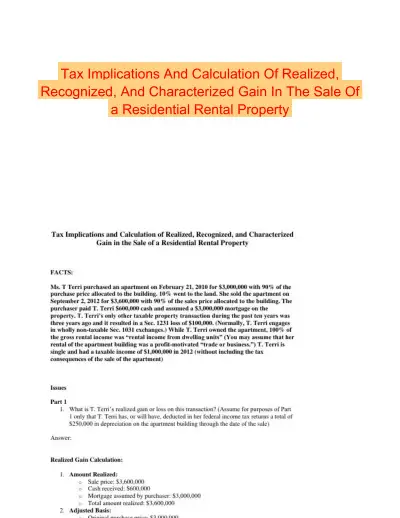 Practice Problems
Tax Implications And Calculation Of Realized, Recognized, And Characterized Gain In The Sale Of a Residential Rental Property
Taxation
5 pagesMay 2025 Exam Guides
Pearson�s Federal Taxation 2020 Comprehensive 33rd Edition Test Bank
Taxation
1355 pagesMay 2025 Solved Assignments
Exploring International Taxation Benefits and Strategies for U.S. Corporations
Taxation
2 pagesMay 2025 Solved Assignments
Analysis of Built-In Gains Tax for S Corporation Conversions and Asset Sales
Taxation
2 pagesMay 2025 Exam Guides
Principles of Taxation for Business and Investment Planning 2018 Edition 21st Edition Test Bank
Taxation
913 pagesMay 2025 Exam Guides
South-Western Federal Taxation 2018: Comprehensive 41st Edition Test Bank
Taxation
2933 pagesMay 2025
Study this document with CramX
Once it is in your library, every tool can work from it.