

Test Bank for Pearson's Federal Taxation 2020 Comprehensive, 33rd Edition
- Taxation
- 1355 pages
- Shared May 2025
Test Bank for Pearson's Federal Taxation 2020 Comprehensive, 33rd Edition is your ultimate exam companion, providing you with all the tools necessary to succeed.
Preview 16 of 1355 pages
See the first 16 pages exactly as they appear in the document.
Page 1 Read page 1 as text
1 Pearson's Federal Taxation 2020: Comprehensive, 33e (Rupert/Anderson/Hulse) Chapter C1: Tax Research LO1: Overview of Tax Research 1) Tax planning is not an integral part of open - fact situations. Answer: FALSE Explanation: It is integral. Page Ref.: C:1 - 2 Objective: 1 2) When a taxpayer contacts a tax advisor requesting advice as to the most advantageous way to dispose of a stock, the tax advisor is faced with A) a restricted - fact situation. B) a closed - fact situation. C) an open - fact situation. D ) a recognized - fact situation. Answer: C Explanation: Advice before transaction is open fact situation. Page Ref.: C:1 - 2 Objective: 1 3) Investigation of a tax problem that involves a closed - fact situation means that A) the c lient's transactions have a l ready occurred and the tax questions must now be resolved. B) the client's tax return has yet to be filed. C) future events may be planned and controlled. D) research is primarily concerned with applying the law to the facts as they exist. Answer: A Exp l a nation: After the fact request is a closed fact situation. Page Ref.: C:1 - 2 Objective: 1 4) Explain the difference between a closed - fact and open - fact situation. Answer: In a closed - fact situation, the transaction has occurred and the facts are not s u bject to change. In an open - fact situation, the transaction is in the formative or projected stage, and the taxpayer is able to structure the facts so that the tax consequences of the tra nsaction can be more favorable. Page Ref.: C:1 - 2 Objective: 1
Page 2 Page 3 Read page 3 as text
2 5 ) In all situations, tax considerations are of primary importance. Do you agree or disagree? Support your answer. Answer: It is important to consider nontax objectives as well as tax object ives. For instance, if a wealthy client wants to minimize her esta t e taxes while passing the greatest value possible to her descendants, you would not suggest that she leave the majority of her estate to charity and only a few hundred thousand dollars to h er descendants. Although this would reduce her estate tax liabilit y to zero, it would be inconsistent with her objective of allowing her descendants to receive as much after - tax wealth as possible. Page Ref.: C:1 - 2; Example C:1 - 2 Objective: 1 LO2: Step s in the Tax Research Process 1) Identify which of the following s t atements is true . A) Tax planning is an integral part of both closed - fact situations and open - fact situations. B) The first step in conducting tax research is to clearly understand the iss ues involved. C) The Statements on Standards for Tax Services reco m m end that only written tax advice be provided to the client in all situations. D) All of the above are false. Answer: C Explanation: The Statements on Standards for Tax Services recommend that only written tax advice be provided to the client in all sit u a tions. Page Ref.: C:1 - 3 through C:1 - 5 Objective: 2 2) Describe the format of a client memo. Answer: A client memo should include a statement of the facts, a list of issues, a discussio n of relevant authority, analysis, and recommendations of appropri a t e actions to the client based on the research results. Page Ref.: See Additional Comment page C:1 - 4 Objective: 2
Page 4 Read page 4 as text
3 3) Outline and discuss the tax research process. Answer: 1) The facts must be determined. However, some facts may not have occurred in a n open - fact situation. Where facts have not yet occurred, it is useful to review tax research material to determine which facts would produce the most favorable outcome. 2) The issues must be determined. The issues may not always be clear and may be diffe r e nt than the client believes. Thus, only a thorough understanding of the facts permits an adequate formulation of the issu es. 3) Determine which authorities are applicable. 4) Evaluate the authorities. Choose the ones to follow when there are conflicting a u thorities. 5) Communicate the result to the client. The communication with the client should not result in a misunderstan ding. While discussions with the client may be suitable, it is recommended by the AICPA's Statements on Standards for Tax Services th a t the communication be written where issues are important, unusual or complicated. Many firms require that conclusions be communicated in writing. Page Ref.: C:1 - 4 Objective: 2 LO3: Importance of the Facts to the Tax Consequences 1) There are no ques t i ons for this section. LO4: The Sources of Tax Law 1) The Internal Revenue Code of 1986 contains the current version of the tax law. Answer: TRUE Explanation: The last update was 1986. Page Ref.: C:1 - 8 Objective: 4 2) Regulations issued prior to t h e latest tax legislation dealing with a specific Code section are still effective to the extent they do not conflict with the provisions in the new legislation. Answer: TRUE Explanation: Per IRC this remains accurate. Page Ref.: C:1 - 9 Objective: 4 3) F inal regulations have almost the same legislative weight as the IRC. Answer: TRUE Explanation: The Courts have followed this concept. Page Ref.: C:1 - 10 Objective: 4
Page 5 Read page 5 as text
4 4) A revenue ruling is issued by the Internal Revenue Service only in response to a v erbal inquiry by a taxpayer. Answer: FALSE Explanation: The IRS may voluntarily issue a revenue ruling. Page Ref.: C:1 - 12 Objective: 4 5) Taxpayers must pay the disputed tax prior to filing a case with the Tax Court. Answer: FALSE Explanation: Tax C ourt is the only court available in which taxpayer does not have to prepay the tax. Page Ref.: C: 1 - 14 and C:1 - 15 Objective: 4 6) Appeals from the U.S. Tax Court are to the Court of Appeals for the Federal Circuit. Answer: FALSE Explanation: Appeals f r om the US Tax Court are to the Court of Appeals for the respective circuit. Page Ref.: C:1 - 14 and C:1 - 15 Objective: 4 7) Appeals from the Court of Appeals go to the Supreme Court under a writ of certiorari. The Supreme Court decides whether or not the y will hear the case. Answer: TRUE Explanation: USSC reviews requests before acceptance. Page Ref. : C:1 - 14 and C:1 - 15 Objective: 4 8) When the Tax Court follows the opinion of the circuit court of appeals to which the case is appealable, the court is f o llowing the A) Golsen rule. B) Acquiescence rule. C) Forum shopping rule. D) Conformity rule. Answer: A Explanation: Since 1970 the Tax Court has followed the Golsen concept. Page Ref.: C:1 - 21 Objective: 4
Page 6 Read page 6 as text
5 9) Which of the following citations denote s a regular decision of the Tax Court? A) 41 TCM 1272 B) 35 T.C. 1083 (2003) C) 39 AFTR 2d 77 - 640 D) all of the above Answer: B Explanation : TC is Tax Court citation. Page Ref.: C:1 - 17 Objective: 4 10) The primary citation for a federal circuit court o f appeals case would be A) 40 AFTR 2d 78 - 1234. B) 44 F.Supp. 403. C) 3 F.3d 134. D) 79 - 2 USTC & 9693. Answer: C Explanation: Citation for federal circuit. Page Ref.: C:1 - 20 Objective: 4 11) You have the following citation: Joel Munro, 92 T.C. 71 (198 9 ) . Which of the following statements is true ? A) The taxpayer, Joel Munro, won the case because there is no reference to the IRS. B) The case appears on page 71 in Volume 92 of the official Tax Court of the United States Reports and the case was decided i n 1989. C) This citation refers to a taxpayer conf erence between the IRS and the taxpayer. D) The case was tried in 1989 and was appealed in 1992. Answer: B Explanation: Citation locator is correct. Page Ref.: C:1 - 17 Objective: 4 12) The term "tax law " includes A) legislation. B) treasury regulations . C) judicial decisions. D) all of the above. Answer: D Explanation: Each of these have value of tax law. Page Ref.: C:1 - 7 Objective: 4
Page 7 Read page 7 as text
6 13) Identify which of the following statements is false . A) When t ax advisors speak of the "tax law," they usually have in mind just the Internal Revenue Code. B) Members from both the House and the Senate are on the Conference Committee. C) Records of committee hearings are helpful in determining Congressional intent. D ) All of the above are false. Answer: A Explanat ion: IRC is the main source document. Page Ref.: C:1 - 7 Objective: 4 14) The committee that is responsible for holding hearings on tax legislation for the House of Representatives is the A) Finance Comm i t tee. B) Joint Committee on Taxation. C) Conference Committee. D) Ways and Means Committee. Answer: D Explanation: The Ways and Means is responsible for holding hearings on tax legislation. Page Ref.: C:1 - 7 Objective: 4 15) A tax bill introduced in t h e House o f Representatives is then A) referred to the House Ways and Means Committee for hearings and approval. B) referred to the entire House for hearings. C) voted upon by the entire House. D) forwarded to the Senate Finance Committee for consideration . Answer: A Explanation: Tax bills are referred to the Ways and Means Committee. Page Ref.: C:1 - 7 Objective: 4 16) The Senate equivalent of the House Ways and Means Committee is the Senate A) Finance Committee. B) Ways and Means Committee. C) Tax Comm i t tee. D) Joint Conference Committee. Answer: A Explanation: Senate committee is Finance Committee. Page Ref.: C:1 - 7 Objective: 4
Page 8 Read page 8 as text
7 17) Which of the following steps, related to a tax bill, occurs first? A) signature or veto by the President of the Unit e d States B) consideration by the Senate Finance Committee C) consideration by the entire Senate D) consideration by the House Ways and Mean s Committee Answer: D Explanation: Tax bill is considered by House Ways and Means Committee. Page Ref.: C:1 - 7 Obj e c tive: 4 18) When the House and Senate versions of a tax bill are not in agreement, the disagreements are resolved by the A) Ways and Mea ns Committee. B) Mediation Committee. C) Revenue Committee. D) Conference Committee. Answer: D Explanation: Confer e n ce committee resolves disagreements. Page Ref.: C:1 - 7 Objective: 4 19) Identify which of the following statements is true . A) Paragraph references are most commonly used when citing or referring to the tax statutes. B) Title 26 of the United States Co d e and the Internal Revenue Code of 1986 are synonymous. C) Before 1939, tax statutes were codified or compiled into one document. D) The In ternal Revenue Code contains chapters, which are further subdivided into titles. Answer: B Explanation: IRC is Tit l e 26 of the USC. Page Ref.: C:1 - 8 Objective: 4 20) Title 26 of the U.S. Code includes A) income tax legislation only. B) gift tax and estate tax legislation only. C) alcohol and tobacco tax legislation only. D) all of the tax legislation mentioned abov e . Answer: D Explanation: Title 26 covers tax legislation. Page Ref.: C:1 - 8 Objective: 4
Page 9 Read page 9 as text
8 21) The tax statutes with the popular name "The Internal Revenue Code of 1986" are contained in which Title of the Code? A) 20 B) 25 C) 26 D) 301 Answer: C Expl a n ation: Title 26 covers tax legislation. Page Ref.: C:1 - 8 Objective: 4 22) Which of the following statements regarding proposed regulations is not correct? A) Proposed regulations expire after three years. B) Practitioners and other interested parties m ay comment on proposed regulations. C) Proposed and temporary regulations are generally issued simultaneously. D) Proposed regulations do not provide any insight into the IRS's interpretation of the tax law. Answer: D Explanation: Proposed regulations p r ovide insight into the IRS's interpretation of the tax law. Page Ref.: C:1 - 9 Objective: 4 23) Final regulations can take effect on any of the following dates except A) the effective date of the statutory language they interpret, p rovided they are issu e d within 18 months of the date of the change to the statute. B) the date on which final regulations were proposed. C) the date on which related temporary regulations were first published in the Federal Register. D) the date on which t hey were issued in fi n a l form. Answer: A Explanation: Once finalized, regulations can be effective the earliest of (1) the date they were filed with the Federal Register, a daily publication that contains federal government pronouncements; ( 2) the date temporary regulations p receding them were first published in the Federal Register ; or (3) the date on which a notice describing the expected contents of the regulation was issued to the public. For changes to the IRC enacted after July 29, 1996, the Treasu ry Department general l y cannot issue regulations with retroactive effect. Page Ref.: C:1 - 10 Objective: 4
Page 10 Read page 10 as text
9 24) When Congress passes a statute with language such as, "The Secretary shall prescribe such regulations as he may deem necessary," the regulations ultimately issued f o r that statute are A) congressional regulations. B) statutory regulations. C) interpretative regulations. D) legislative regulations. Answer: D Explanation: Whenever the IRC contains language such as "The Secretary shall prescribe su ch regulations as he m ay deem necessary" or "under regulations prescribed by the Secretary," the regulations interpreting the IRC provision are legislative. Page Ref.: C:1 - 10 Objective: 4 25) Regulations are A) equal in authority to legislation. B) equa l in authority to le g i slation if statutory. C) presumed to be valid and to have almost the same weight as the IRC. D) equal in authority to legislation if interpretative. Answer: C Explanation: Final Treasury Regulations are presumed to be valid and have almost the same aut h o ritative weight as the IRC. Page Ref.: C:1 - 10 Objective: 4 26) Identify which of the following statements is true . A) If regulations are issued prior to the latest tax leg islation dealing with a specific Code section, the regulations are no longer eff e c tive to the extent they conflict with the provisions in the new legislation. B) Legislative regulations are more likely to be invalidated by the courts than are interpretativ e regulations. C) Regulations have more authoritative weight than tax statutes. D ) All of the above are false. Answer: A Explanation: Because of frequent IRC changes, the Treasury Department does not always update the regulations in a timely manner. Cons equently, when consulting a regulation, a tax advisor should check its introduct o r y or end note to determine when the regulation was adopted. If the regulation was adopted before the most recent revision of the applicable IRC section, the regulation should be treated as authoritative to the extent consistent with the revision. Thus, f o r example, if a regulation issued before the passage of an IRC amendment specifies a dollar amount, and the amendment changed the dollar amount, the regulation should be regar ded as authoritative in all respects except for the dollar amount. Page Ref.: C : 1 - 9 Objective: 4
Page 11 Read page 11 as text
10 27) Identify which of the following statements is false . A) The number "5" in the citation Reg. Sec. 1.166 - 5 refers to the paragraph number. B) The Cumulati ve Bulletin is issued semiannually while the Internal Revenue Bulletin is issue d weekly. C) The citation Rev. Rul. 2006 - 5, I.R.B. 2006 - 1, 33, indicates that the revenue ruling can be found on page 33 of the 1st I.R.B. for 2006. D) All of the above are fals e. Answer: A Explanation: - # does not reference the paragraph number. Page Re f . : C:1 - 11 Objective: 4 28) The number appearing immediately following the decimal place in a regulation citation refers to the A) general subject matter of the regulation. B ) Code section being interpreted. C) sequential number of the regulation. D) su b s ection of the Code section being interpreted. Answer: B Explanation: # appearing after decimal refers to code section. Page Ref.: C:1 - 11 Objective: 4 29) The citation "Reg. Sec. 1.199 - 2" refers to A) the first regulation issued in 1999. B) the secon d regulation issued in 1999. C) a regulation that interprets Code Section 199. D) a regulation that can be found on page 199. Answer: C Explanation: # appearin g after decimal refers to code section. Page Ref.: C:1 - 11 Objective: 4 30) Which regulation d e als with Code Section 165? A) Reg. Sec. 1.165 - 5 B) Reg. Sec. 165.183 - 5 C) Reg. Sec. 1.5 - 165 D) Reg. Sec. 165 - 5 Answer: A Explanation: # appearing after decim al refers to code section. Page Ref.: C:1 - 11 Objective: 4
Page 12 Read page 12 as text
11 31) Which regulation deals with t h e gift tax? A) Reg. Sec. 1.165 - 5 B) Reg. Sec. 20.2014 - 5 C) Reg. Sec. 25.2518 - 5 D) Reg. Sec. 301.7002 - 5 Answer: C Explanation: Code section 2518 is a gift tax matter. Page Ref.: C:1 - 11 Objective: 4 32) Which of the following best describes the weight o f a revenue ruling? A) Revenue rulings carry more weight than regulations. B) Revenue rulings carry more weight than federal cou rt decisions. C) Regulations carry more weight than revenue rulings. D) Revenue rulings should never be used as authority since t hey only apply to the taxpayer requesting the ruling. Answer: C Explanation: Regulations carry more weight than revenue rulin gs. Page Ref.: C:1 - 12 Objective: 4 33) The citation "Rev. Rul. 2006 - 8, 2006 - 1 C.B. 541" refers to A) the eighth ruling of 20 0 6 found on page 541 in Vol. 1 of the 2006 Cumulative Bulletin . B) the eighth ruling of 2006 found on page 541 in the 2006 volume of the Cumulative Bulletin . C) the 541st ruling of 2006 found on page eight in Vol. 1 of the 2006 Cumulative Bulletin . D) the 1 s t ruling of 2006 found on page 541 in the 2006 volume of the Cumulative Bulletin . Answer: A Explanation: Citation log is corr ect. Page Ref.: C:1 - 12 Objective: 4 34) Which of the following documents is issued by the IRS to a specific taxpayer? A) reg u l ation B) revenue procedure C) letter ruling D) information release Answer: C Explanation: Letter rulings are addressed to specific taxpayer. Page Ref.: C:1 - 12 Objective: 4
Page 13 Read page 13 as text
12 35) Identify which of the following statements is false . A) A revenue ruling i s issued by the Internal Revenue Service only in response to a written inquiry by a taxpayer. B) Rev. Proc. 2006 - 19 is a revenue procedure that was published in 2006. C) The citation Ltr. Rul. 200611075 usually indicates the ruling was made public in the 1 1th week of 2006. D) A technical advice memorandum is made available as a letter ruling. Answ er: A Explanation: Letter rulings are only issued in response to written taxpayer request. Page Ref.: C:1 - 11 through C:1 - 13 Objective: 4 36) Identify which o f the following statements is false . A) Letter rulings are not published by the U.S. Governmen t Printing Office. B) Technical advice memoranda are issued by the Internal Revenue Service's National Office to provide an answer to a technical question that a r i ses in an audit. C) The citation Ann. 2006 - 12, I.R.B. 2006 - 51, 22 refers to an annotation of an Internal Revenue Service release. D) Announcements are more technical than information releases. Answer: C Explanation: Citation is wrong. Page Ref.: C:1 - 1 3 Objective: 4 37) A Technical Advice Memorandum is usually A) an internal IRS document describing alternative legislative proposals. B) part of a Tax Court decision. C) requested by the taxpayer before entering into a taxable transaction. D) issued by t h e national office in response to an audit request. Answer: D Explanation: TAMs are usually issued to address request from IRS auditors. Page Ref.: C:1 - 13 Objective: 4 38) Which of the following courts is not a trial court for tax cases? A) U.S. Bankr u p tcy Court B) U.S. D istrict Court C) U.S. Tax Court D) U.S. Court of Federal Claims Answer: A Explanation: Bankruptcy Court does not have jurisdiction for tax matters. Page Ref.: C:1 - 14 and C:1 - 15 Objective: 4
Page 14 Read page 14 as text
13 39) The taxpayer need not pay the dispu t e d tax in advance whe n the suit is initiated in A) U.S. Court of Federal Claims. B) U.S. Tax Court. C) U.S. District Court. D) both A and B. Answer: B Explanation: Tax Court taxpayer does not have to pay disputed amount up front. Page Ref.: C:1 - 14 and C : 1 - 15 Objective: 4 40) If the U.S. Supreme Court decides to hear an appeal of a tax case, it will grant a A) writ of appeal. B) writ of certiorari. C) writ of detainer. D) writ of habeas corpus. Answer: B Explanation: Granting review by USSC is done v i a writ of certiorari . Page Ref.: C:1 - 14 and C:1 - 15 Objective: 4 41) Tax Court memorandum decisions A) cannot be appealed. B) are not published. C) have less precedential value than regular decisions. D) usually deal with factual variations of issues li t i gated previously. A nswer: D Explanation: Tax Court memos usually deal with factual variations of issues litigated previously. Page Ref.: C:1 - 15 and C:1 - 17 Objective: 4 42) George's case was handled under the "small tax case procedure." He does not a g r ee with the finding s of the Tax Court. He would like to appeal the decision. Which one of the following is true ? A) There is no appeal. B) He can appeal the case, but only if the amount of tax involved is greater than $5,000. C) He would appeal first to t h e U.S. Court of App eals for the Federal Circuit. D) He would appeal first to the U.S. Court of Federal Claims. Answer: A Explanation: Small Tax Case do not allow appeal process. Page Ref.: C:1 - 17 Objective: 4
Page 15 Read page 15 as text
14 43) Identify which of the following sta t e ments is false . A) The acquiescence policy was adopted by the U.S. Tax Court to permit litigating parties to agree on the exact amount of the tax due. B) Letter rulings are binding only with respect to the taxpayer requ esting the ruling. C) The small cas e s procedure of the U.S. Tax Court allows a less formal hearing but provides for no appeal. D) The IRS may retroactively revoke an acquiescence. Answer: A Explanation: Acquiescence policy the party states it does not ag ree but will not appeal the decisio n . Page Ref.: C:1 - 17 Objective: 4 44) The phrase "Entered under Rule 155" indicates that A) the computation of the exact amount of the tax deficiency has been left to the litigating parties. B) the court has not reache d a decision concerning the appropr i a te tax treatment of an issue. C) the parties have agreed not to appeal the decision. D) only one Tax Court judge reviewed the case. Answer: A Explanation: Rule 155 allows computation of exact amount been left to the l itigating parties. Page Ref.: C:1 - 1 7 Objective: 4 45) Small case procedures of the U.S. Tax Court requires that the amount in dispute not exceed A) $5,000. B) $10,000. C) $50,000. D) $100,000. Answer: C Explanation: Small tax court cap is 50,000. Page Ref.: C:1 - 17 Objective: 4 46) T h e acquiescence policy of the IRS extends to the A) U.S. Supreme Court decisions. B) U.S. Tax Court regular decisions. C) U.S. District Court decisions. D) both B and C Answer: D Explanation: IRS cannot appeal USSC decisions. Page Ref.: C:1 - 17 Objective : 4
Page 16 Read page 16 as text
15 47) A tax case cannot be appealed when initiated in the A) U.S. Court of Federal Claims. B) U.S. Tax Court. C) U.S. Tax Court using the small case procedures. D) none of the above Answer: C Explanation: Small tax case does not allow appeal. Page R e f .: C:1 - 17 Objective: 4 48) Identify which of the following statements is false . A) Regular and memorandum decisions of the Tax Court are published by the government in the Tax Court of the United States Reports . B) The citation Cristofani , 97 T.C. 74 ( 1 991) indicates that the decision is a regular decision of the Tax Court. C) The citati on Estate of Newhouse , 94 T.C. 193 (1990), nonacq. 1991 - 1 C.B. 1 indicates that the IRS did not formally disagree with this 1990 Tax Court decision until 1991. D) The B o a rd of Tax Appeals preceded the Tax Court. Answer: A Explanation: Tax Court decisions are not published in this reporter. Page Ref.: C:1 - 17 Objective: 4 49) You need to locate a recent tax case that was tried in a Federal district court. The decision i s an "unreported" decision. This means the decision was A) not publ ished in the Federal Supplement. B) not published in American Federal Tax Reports. C) not published in United States Tax Cases. D) settled out of court. Answer: A Explanation: Unreporte d means it was not published in the federal supplement. Page Ref.: C :1 - 18 Objective: 4 50) A jury trial is permitted in the A) U.S. District Court. B) U.S. Tax Court. C) U.S. Court of Federal Claims. D) U.S. Tax Court when the small case procedures are u s ed. Answer: A Explanation: Tax Court does not permit a jury trial . Page Ref.: C:1 - 18 Objective: 4
1339 more pages in the full document
Unlock it once and it stays in your library, ready to chat with or turn into flashcards.
Unlock the full documentMore Taxation study materials
See all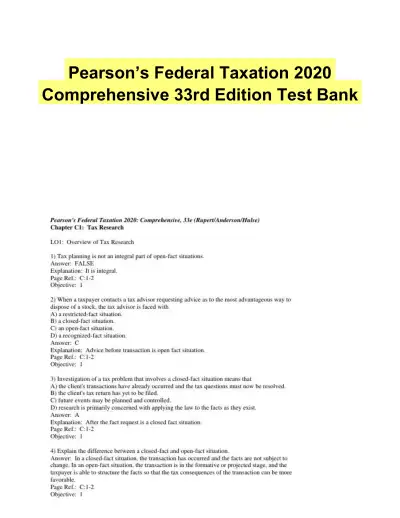 Exam Guides
Pearson�s Federal Taxation 2020 Comprehensive 33rd Edition Test Bank
Taxation
1355 pagesMay 2025 Textbook Guides
Canadian Income Taxation 2016/2017 Edition Solution Manual
Taxation
884 pages56downloadsFeb 2025 Exam Guides
Principles of Taxation for Business and Investment Planning 2018 Edition 21st Edition Test Bank
Taxation
913 pagesMay 2025 Practice Problems
Tax Implications And Calculation Of Realized, Recognized, And Characterized Gain In The Sale Of a Residential Rental Property
Taxation
5 pagesMay 2025 Solved Assignments
Exploring International Taxation Benefits and Strategies for U.S. Corporations
Taxation
2 pagesMay 2025 Solved Assignments
Analysis of Built-In Gains Tax for S Corporation Conversions and Asset Sales
Taxation
2 pagesMay 2025 Practice Problems
Tax Implications Of The Sale Of Rental Property: A Case Study On T. Terri's Apartment Sale
Taxation
9 pagesMay 2025 Exam Guides
South-Western Federal Taxation 2018: Comprehensive 41st Edition Test Bank
Taxation
2933 pagesMay 2025
Study this document with CramX
Once it is in your library, every tool can work from it.