

Taxation For Decision Makers, 2017th Edition Solution Manual
- Taxation
- 468 pages
- Shared May 2025
Study efficiently with Taxation For Decision Makers, 2017th Edition Solution Manual, featuring expert insights and textbook breakdowns.
Preview 16 of 468 pages
See the first 16 pages exactly as they appear in the document.
Page 1 Read page 1 as text
Solutions to Chapter 1 Problem Assignments Check Your Understanding 1. [LO 1.1] What is a tax? What is a tax? How does a tax differ from a fine? Solution: A tax is a payment that is not voluntary but is required to be paid to a governmental unit to support its operations; it is not based on the value of goods or services the person or business receives, however. A fine is levied as a result of an unlawful act. 2. [LO 1.1] Constitutional Authority What Constitutional Amendment allowed implementation of an income tax? In what year was it ratified? Solution: The federal income tax system as we know it today did not begin until 1913 when the 16th Amendment to the U.S. Constitution was ratified. The 16th Amendment gave Congress the power to lay and collect taxes “on income, from whatever source derived,” without the previous requirement that all direct taxes be imposed based on population. 3. [LO 1.1] Current Tax Code Which version of the tax code is applicable today? Solution: The Tax Reform Act of 1986 was so extensive, the Code was renamed the Internal Revenue Code of 1986 . Any current changes to the tax laws are now amendments to the Internal Revenue Code of 1986. 4. [LO 1.1] Tax Expenditures Define tax expenditure? Solution: Tax expenditures can take the form of special exclusions, deductions, credits or preferential rates for specific activities. These tax expenditures result in a reduction in the revenue that would be collected under a more comprehensive income tax. 5. [LO 1.1] SALT What is a SALT practice? Solution: The practice of s tate a nd l ocal t axation is commonly referred to as a SALT practice. 6. [LO 1.1] Franchise Tax How does a franchise tax differ from an income tax? Solution: A franchise tax is an excise tax based on the right to do business or own property in a state. It is, however, usually determined based on corporate income so would, in effect, simply be another name for the income tax . 7. [LO 1.1] State Income Allocation What three factors determine the percentage of corporate income allocated to a particular state? Solution: The three - factor allocation formula uses a percentage of corporate sales, payroll
Page 2 Page 3 Read page 3 as text
2 Solutions Manual for Taxation for Decision Makers costs, and tangible property allocated to the state. 8. [LO 1.1] Employment Taxes What employment taxes are imposed on an employee and an employer? Solution: An employee pays the Social Security and Medicare (FICA) tax ; the employer also pays an equivalent Social Security and Medicare (FICA) tax , but the employer also may have to pay an unemployment tax. 9. [LO 1.1] Wealth Taxes What is the most common wealth tax and how is it levied? Solution: The most common wealth tax is the real property tax based on the fair market value of property owned by an individual or a business. 10. [LO 1.1] Intangible Tax What property is subject to the intangible tax? Solution: The i ntangible tax is levied on intangible property such as receivables, stocks, bonds, and other forms of investment instruments owned by businesses and individuals. 11. [LO 1.1] Estate and Gift Tax Explai n the integration of the gift and estate taxes. Solution: Property that is given away during a lifetime that exceeds a certain amount is subject to a gift tax after using up a lifetime exemption. When the person passes away, property that the person still owned (had not given away) is now subject to the estate tax. Any gift tax exemption that has not been used by the decedent is the n available as an exemption from the estate tax. Thus, a decedent’s estate escapes taxation unless his or her total lifetime taxable gifts plus taxable transfers at death exceed the lifetime exclusion. 12. [LO 1.1] Consumption vs Income Tax Differentiate a consumption based tax from an income tax and illustrate with an example. Solution: A consumption tax is levied on purchases of goods or services that are going to be used or consumed. The most common consumption tax is the sales tax, but the value - added tax is another form used in many countries outside the United States. The income tax is based on the value of money or goods that are received, whether it is spent or saved. An income tax will tax money that is going to be saved rather than spent while the consumption tax only taxes money that is spent. The consumption tax is thought to encourage savings. 13. [LO 1.1] Wealth Taxes Differentiate a wealth tax from a wealth transfer tax and give examples of each. Solution: A wealth tax is based on the value of wealth that a person has at a particular point in time. The real or personal property taxes are wealth taxes. The wealth transfer tax is based on the value of money or property that is passed on to another person. The estate, gift, and inheritance taxes are wealth transfer taxes.
Page 4 Read page 4 as text
Chapter 1: An Introduction to Taxation 3 14. [LO 1.1] Income Taxes Over what ranges of taxable income in 2016 will the total income tax liability two persons with equal incomes who file as single individuals equal their income tax liability if they file jointly as a married couple? Solution: Two persons with taxable income of $75, 9 50 each will pay the same total tax as a married couple with taxable income of $151, 9 00. Above $151, 9 00 the married couple’s rate increases to 28 % while each of the single persons does not reach that rate until taxable income is over $91,150. 15. [LO 1.2] Types of Taxes Differentiate a progressive tax system from a proportional and a regressive system and give examples of each. Solution: The income tax system in the United States is a progressive system; that is, as income increases, the tax rate increases and the person pays a greater percentage of income as a tax. A person who has $9,000 of taxable income will pay $900 in taxes (10%). A person who makes $18,000 will pay $2,236.25 ($927.50 + .15 ($18,000 - $9,275). $2,236.25/$18,000 = 12.42%. A regressive tax system imposes a lower tax rate as income increases; that is, a person pays a decreasing percentage of their income in taxes as income increases. The Social Security portion of the FICA tax is a regressive tax; as the taxpayer’s income on which the tax is based exceeds a maximum, the tax is no longer collected and the rate declines. A proportional tax would collect the same percentage of tax on the tax base, regardless of the size of the base. The sales tax is a proportional tax as the same percent tax is collected regardless of the amount spent. 16. [LO 1.2] Income Tax Rates What basic tax rates apply to the ordinary income, dividend income, and interest income of an individual? What are they for a corporation? Solution: Individuals have basic tax rates of 10%, 15%, 25%, 28%, 33%, 35%, and 39.6% that apply to their ordinary income and their interest income. The basic tax rates for their dividend income are 0%, 15%, and 20%. Corporations have no tax - favored incomes so they pay tax on all income at rates of 15%, 25%, 34%, and 35%, excluding surtaxes on certain portions of income that ultimately produce a flat tax of 35% on income above $18,333,333. 17. [LO 1.2] Income Tax Rates What tax rates apply to an individual’s capital gains and to which tax brackets do each of this rates apply? Solution: Individual’s short - term capital gains tax rates are the same as the tax rates on ordinary income. A single individual’s long - term capital gains rates are 0% on long - term capital gains ( LTCG ) from 0 to $37,650; 15% on LTCG from $37,651 to $415,050, and 20% on LTCG exceeding $415,050. 18. [LO 1.3] Canons of Taxation Briefly explain Adam Smith’s four canons of taxation.
Page 5 Read page 5 as text
4 Solutions Manual for Taxation for Decision Makers Solution: The basic idea of equity is that persons with similar incomes will face similar taxes. Thus, individuals each with $200,000 in taxable income will pay the same amount of tax. A tax meets the criterion of economy when the amount of revenue it raises is at an optimum level after the costs of administration and compliance are considered. The canon of certainty would dictate that a taxpayer know with reasonable accuracy the tax consequences of a transaction at the time the transaction takes place. The last canon of convenience states that a convenient tax is one that would be readily determined and paid with little effort. 19. [LO 1.3] Equity Concepts Differentiate horizontal from vertical equity. S olution: Horizontal equity would require persons with equal incomes pay equal amounts of taxes. Vertical equity would require persons with higher incomes to pay a higher percentage of their income than persons with lower incomes. This is the basis of the U.S. tax system. 20. [LO 1.4] Taxable Persons Which three taxable persons pay all of the income taxes? Solution: Only individuals, regular (or C) corporations, and fiduciaries (estates and trusts) pay income taxes . 21. [LO 1.4] Gross Income Define gross income. Solution: The term gross income is an all - inclusive term that includes income from all sources that are not specifically excluded. 22. [LO 1.4] Basic Tax Model Briefly describe the basic elements of the tax model. Solution: The basic elements of the tax model are gross income, less deductions, that equal taxable income or loss. To this i t applies the applicable tax rate to determine the gross tax liability. From this tax credits and prepayments are deducted to determine the tax liability owed or the refund due. 23. [LO 1.4] Capital Losses Differentiate the tax treatment of an individual’s capital losses from the tax treatment of corporate capital losses. Solution: An individual may deduct up to $3,000 of capital losses in excess of capital gains annually ; the excess may be carried forward to succeeding years. A corporation can only offset capital losses against capital gains; they are not deductible against other income. I nstead the corporation first carr ies the losses back to the three previous years and then forward for 5 year s . 24. [LO 1.4] Basic Income Tax Rates What are the basic tax rates for an individual and a corporation? Solution: Individuals have basic tax rates of 10%, 15%, 25%, 28%, 33%, 35%, and 39.6%
Page 6 Read page 6 as text
Chapter 1: An Introduction to Taxation 5 that are applied to their ordinary income. A corporation’s basic tax rates rates are 15%, 25%, 34%, and 35%, excluding surtaxes. 25. [LO 1.4] Fiduciaries What are two fiduciary entities and how are they created? Define grantor, trustee, and beneficiary for a trust. Solution: Trusts and estates are two fiduciary entities; a trust is established by a grantor who appoints a trustee to manag e the assets for the benefit of the trust ’ s beneficiaries. An estate is an entity that is created on the death of a person that provides manag ement for the assets in the decedent’s estate until they can be distributed to the beneficiaries. A grantor is the person who creates the trust when assets are placed in the trust for the benefit of the beneficiaries. The trustee is the person selected by the grantor to oversee the assets and ensure the trust functions as specified by the grantor. The beneficiary of the trust is the person for whom the trust was established and who is to benefit from the income from the trust (an income beneficiary) or receive the assets when the trust is closed (the remainderman). 26. [LO 1.5] Sole Proprietorships What are three characteristics of a sole proprietorship? Are these characteristics the same as or different from those of a partnership? What are three characteristics of a limited liability company that differ from those of a partnership? So lution: Only one taxable person, who must be an individual, can own a sole proprietorship. The sole proprietor is personally liable for all debts of the business. The sole proprietor cannot be an employee of the business and must pay self - employment tax . The results of operations of the sole proprietorship are reported on the Schedule C and these are then included in the owner’s personal tax return. A partnership must have more than one owner. A general partner is liable for partnership debts but limited partners are only liable for their investment in the partnership. Like sole proprietors, partners cannot be employees of the partnership and general partners are required to pay self - employment tax . Although partnerships do not pay taxes directly, they must file information tax returns. The income/loss from the partnership flows through to the partners and is reported on their own tax returns . Partners pay any taxes owing on the income items but loss is deductible only if a partner has sufficient basis. A partner’s basis begins with his or her investment in the partnership and is increased for the partner’s share of partnership liabilities . Partnerships and limited liability companies differ in a number of ways. Owners of partnerships are partners while owners of limited liability companies are called members. There are no legal requirements to set up a partnership but a limited liability company must be established according to the laws of the state of domicile. Limited liability companies can elect to be taxed as corporations while partnerships do not have that option. In some states, a limited liability company may have only one owner bu t a partnership must have two or more owners. O nly the managing member s of a limited liability company may be subject to self -
Page 7 Read page 7 as text
6 Solutions Manual for Taxation for Decision Makers employment taxes. 27. [LO 1.5] Corporations Compare a C corporation to an S corporation. Solution: The principal difference between a C corporation and an S corporation is in the method of taxation. A corporation pays a tax directly on its income. Any net after - tax income that is distributed to its shareholders as dividends is subject to a second level of tax. Thus, these corporate earnings are said to be subject to double taxation. An S corporation’s income flows directly through to its shareholders (whether there is an actual distribution of this income in cash or not) undiminished by taxes at the corporate level. The income is then taxed once only at the shareholder level. The corporation can then make actual distributions of this previously - taxed income to the S corporation shareholders without any additional taxes due. There are a number of other differences in that the number and type of S corporation shareholders is limited; it can only have one class of stock outstanding, and its choice of tax year is restricted. None of these restrictions apply to a C corporation. Other items of comparison could be drawn from the table in the text comparing business entity attributes. Crunch the Numbers 28. [LO 1.1] Property Taxes Dane City's total assessed valuation for all of the property in its jurisdiction is $4,000,000,000. It needs $20,000,000 in revenue for the services it provides its citizens. Joe owns property that is assessed at $150,000. How much will he pay in property taxes? Solution: He will pay $750. $20,000,000 / $4,000,000,000 = .005 or 5 mills per $1 of valuation. $150,000 x .005 = $750 in tax 29. [LO 1.1] FICA Tax If a taxpayer has $40,000 of employee salary in 2016, how much will be withheld for the Social Security and Medicare taxes? Solution: $40,000 x 7.65% = $3,060 30. [LO 1.1] FICA Taxes If a taxpayer has $140,000 of employee salary, how much will be withheld for the Social Security and Medicare taxes in 2016? Solution: 9,377 is withheld for FICA taxes in 2016. $118,500 x 6.2% = $7,347 $140,000 x 1.45% = 2,030 Total $9,377 31. [LO 1.4] Taxable Income Determine Amy's taxable income for 2016 if she has $40,000 of salary income, is single, and has $10,350 in total allowable deductions.
Page 8 Read page 8 as text
Chapter 1: An Introduction to Taxation 7 Solution: Taxable income = $29,650 $40,000 Salary minus 10,350 Deductions equals $29,650 Taxable income 32. [LO 1.4] Taxable Income Marlee is a single parent with $25,450 in total allowable deductions and qualifies as head of household for 2016. Determine her taxable income if she has a salary of $71,000 and interest income of $1,500. Solution: Taxable income = $47,0 5 0 $71,000 Salary p lus 1,500 Interest income minus 25,450 D eduction s equals $47,050 Taxable income 33. [LO 1.4] Taxable Income Determine a corporation's taxable income if it has $450,000 of gross receipts, $145,000 cost of goods sold, $276,000 of deductible business expenses, $20,000 of gain on the sale of machinery, and $500 of interest income from State of New York bonds. Solution: Taxable income = $49,000 $450,000 Gross receipts minus 145,000 Cost of goods sold equals $305,000 Gross income plus 20,000 Gain on sale minus 276,000 Expenses equals $49,000 Taxable income The $500 interest on State of New York bonds is tax - exempt. 34. [LO 1.4] Taxable Income The Warner Corporation has gross income of $560,000. It has business expenses of $325,000, a capital loss of $20,000, and $2,500 of interest income on temporary investments. What is the corporation's taxable income? Solution: Taxable income = $237,500 $560,000 Gross income plus 2,500 Interest income minus 325,000 Expenses equals $237,500 Taxable income The $20,000 capital loss is not deductible currently. 35. [LO 1.4] Taxable Income Determine George and Mary's taxable income and tax liability for 2016 if George has $65,000 and Mary has $45,000 of salary income, they have $36,200 of total allowable deductions, and they file a joint tax return.
Page 9 Read page 9 as text
8 Solutions Manual for Taxation for Decision Makers Solution : Taxable income = $7 3 , 8 00 George's salary $65,000 plus Mary's salary 45,000 equals G ross income $110,000 minus Deductions 36,200 equals Taxable income $73,800 36. [LO 1.4] Determining Tax Liability Refer to the information in problem 31. Determine Amy's income tax liability for 2016. Solution: Taxable income = $29,650; income tax = $4,023.75. Income Tax: ($9,275 x 10%) + ($20,375 x 15%) = $3,983.75. 37. [LO 1.4] Determining Tax Liability Refer to the information in problem 32. Determine Marlee's income tax liability for 2016. Solution: Taxable income = $47,050; income tax = 6, 395 . Income Tax: [ ( $47,050 - $13,250 ) x 15% ] + $1,325 = $6,395 38. [LO 1.4] Determining Tax Liability Refer to the information in problem 33. Determine the corporation's income tax liability. Solution: Taxable income = $49,000 ; income tax = $7,350. Income Tax: $49,000 x 15% = $7,350. 39. [LO 1.4] Determining Tax Liability Refer to the information in problem 34. Determine Warner Corporation's income tax liability. Solution: Taxable income = $237,500 ; Income tax = $75,875 [($237,500 - $100,000) x 39%] + $22,250 = $75,875 ( The $20,000 capital loss is not deductible currently. ) 40. [LO 1.4] Marriage Penalty Sally and Jim are married and have taxable income in 2016 of $160,000. If they could file their income tax as single individuals, each of them would have taxable income of $80,000. Do they have a marriage penalty when they file their joint return? If so, what is the amount of the penalty? Solution: They have a marriage penalty of $24 3 ($31,785.50 - $31,54 2.50 ). MFJ: [($160,000 - $151,900) x 28%] + $29,517.50 = $31,785.50 Single: [($80,000 - $37,650) x 25%] + $5,183.75 = $15,771.25 x 2 = $31,542.50 41. [LO 1.4] Joint vs. Single Filing Conrad and Anita (a college student with no income) plan to marry on December 21, 201 6 . Filing jointly, they expect to have $180,000 of taxable income for the year. If they wait until January of 201 7 to marry, Conrad will file as a single person and report the $180,000 of taxable income on his separate return.
Page 10 Read page 10 as text
Chapter 1: An Introduction to Taxation 9 a. Will it be to their advantage to marry before the end of 201 6 or should they wait until 201 7 ? b. How much in tax will they save or have to pay extra if they marry in 201 6 ? c. How would your answers change if Conrad and Anita each expect $90,000 of taxable income in 201 6 ? Solution: a. It will be to their advantage to marry in 201 6 . b. By marrying before the end of 201 6 and filing jointly, they save $ 6 ,0 51 . 2 5 ( $43,43 6 . 7 5 - $37,385 .50 ) in taxes. MFJ: [($180,000 - $151,900) x 28%] + $29,517.50 = $37,385.50 Single: [($180,000 - $91,150) x 28%] + $18,558.75 = $43,436.75 c. If they each have $90,000 of income, they would each pay $18,271.25 in taxes and they would then have a marriage penalty of $842.50 ($37,385 - $36,542.50). In this case, they would be slightly better off by postponing their wedding until 2016. Tax on $90,000 (Single) : [($90,000 - $37,650) x 25%] + $5,183.75 = $18,271.25 $ 1 8,271.25 x 2 = $36,542.50 42. [LO 1.4] Income Tax Liability Carrie and Stephen have gross salary and wages of $76,000 in 2016 and file a joint return. They have $27,150 of total allowable deductions and a $240 child care credit. Determine their taxable income and their tax liability. Solution: Taxable income = $48,850 and the net tax liability = $6, 160 . $76,000 salary and wages - $27,150 allowable deductions = $48,850 taxable income. Income tax liability is: $1,855 + .15 x [$48,850 - $18,550] = $6,400 $6,400 - $240 credit = $6,160 43. [LO 1.4] Tax Liability An estate has $20,000 of taxable income in 2016. What amount of tax will the estate pay if it fails to d i stribute the income to the beneficiaries? Solution: The estate will pay $6,215.60. $2,550 x 15% = $382.50 $3,400 x 25% = 850.00 $3,100 x 28% = 868.00 $3,350 x 33% = 1,105.50 $7,600 x 39.6 = 3,009.60 Total tax $6,215.60 44. [LO 1.4] Tax R ates Perform the calculations to prove that the 5 percent surtax on corporate income between $100,000 and $335,000 equals the benefit that the corporation enjoys on income of no more than $100,000. Solution : .05 x ($335,000 - $100,000) = $11,750 $50,000 (.34 - .15) = $9,500 ($75,000 - $50,000)(.34 - .25) = $2,250.
Page 11 Read page 11 as text
10 Solutions Manual for Taxation for Decision Makers $9,500 + $2,250 = $11,750 45. [LO 1.4] Tax R ates Perform the calculation to prove that the 3 percent surtax on corporate income between $15,000,000 and $18,333,333 equals the benefit of the 34 percent tax rate on income of no more than $10,000,000. Solution: . 03 x ($18,333,333 - $15,000,000) = $100,000 (.35 - .34)($10,000,000) = $100,000 46. [LO 1.5] Tax Liability John has taxable income of $30,000. William has taxable income of $60,000. Determine their 2016 income taxes if they are both single individuals. Compare their incomes and their income taxes. What does this illustrate? Solution: William’s income is twice John’s, but his taxes are 2.67 ($10,771.25/$4,036.25) times John’s. This illustrates the progressive nature of the tax system as well as vertical equity. [($30,000 - $9,275) x 15%] + $927.50 = $4,036.25 [($60,000 - $37,650) x 25%] + $5,183.75 = $10,771.25 47. [LO 1.5] Net Operating Loss Lilikoi Corporation began business in 2014. Lilikoi earned taxable income of $40,000 in 2014 and $120,000 in 2015. For 2016, Lilikoi Corporation has a net operating loss of $50,000 and decides to carry the loss back, filing a refund claim. Compute the amount of corporate income tax that Lilikoi paid for 2014 and 2015 and then determine the amount of tax that will be refunded from carrying back the 2016 NOL. Solution: Lilikoi paid $6,000 tax for 2014 and $30,050 tax for 2015. Lilikoi will have a refund of $9,900 from carrying back $40,000 of the 2016 loss to 2014 and $10,000 of the loss to 2015. (Note that Lilikoi cannot carry the loss back to only 2015 without first carrying it back to 2014.) Tax paid for 2014 on $40,000 was $40,000 x 15% = $6,000 Tax paid for 2015 on $120,000 was [ ($20,000 x 39%) + $22,250] = $30,050. The $10,000 loss that is carried back to 2015 reduces the taxable income for that year from $120,000 to $110,000 saving tax at the 39% rate that applies to income between $110,000 and $120,000. Tax refund from 2016 loss is ($40,000 x 15%) + ($10,000 x 39%) = $9,900 48. [LO 1.5] Determining Tax Liability Hunter Corporation has $250,000 in gross income, $125,000 in deductible business expenses, and a $12,000 business tax credit. Determine the corporation's net tax liability. Solution: The net tax liability is $20,000. $250,000 gross income - $125,000 expenses = $125,000 taxable income.
Page 12 Read page 12 as text
Chapter 1: An Introduction to Taxation 11 The income tax liability is: [ ($2 5 ,000 x 39%) + $22,250] = $3 2 ,0 0 0 gross tax $32,000 - $12,000 tax credit = $20,000 net tax 49. [LO 1.5] Determining Tax Liability Carolyn has a 50 percent interest in a general partnership that has a $14,000 loss for the year. She materially participates in the partnership. Her basis in the partnership is $10,000. S he also has salary from other employment of $46,000. If she is single with $10,350 in allowable deductions, what is her taxable income and her tax liability in 2016? Solution: Taxable income = $28,650 and the tax liability is $3,833.75 $46,000 Salary minus 7,000 Partnership loss (50% x $14,000) equals $39,000 Gross income minus 10,350 D eduction equals $ 28,650 Taxable income Tax: [($28,650 - $9,275) x 15%] + $92 7 .50 = $3,833.75 50. [LO 1.4 & 1.5] Tax Liability Comparisons June and John decide to form a business. They each plan to contribute $20,000 in exchange for a 50 percent interest in the business. They will then take out a bank loan for $30,000 to cover the balance of their working capital needs. They expect that the business will make a profit of $64,000 in the first year and that it will not make any cash distributions that year. Excluding the business income, June, who files as head of household, has $475,000 of other ordinary taxable income. John is married and files a joint return; he and his wife have $130,000 of other ordinary taxable income. They want to know how much tax the business will pay and how much additional tax they will personally pay in 2016 if they form the business as a partnership, S corporation, or C corporation. Consider only income taxes. Solution: Partnership : Pays no tax. June and John are each taxed on the $32,000 passed through to them at their marginal tax rates. To determine their marginal tax rates, find the tax bracket in which their other taxable income falls. (Note that the “other ordinary taxable income” is provided; either the standard or their itemized deductions and the personal exemptions have already been subtracted.) June’s $475,000 of other ordinary taxable income puts her in the 39.6% marginal tax bracket because she is a head of household with taxable income over $441,000. John’s $32,000 straddles the 25% and 28% marginal tax brackets because his $130,000 of taxable income plus the additional $32,000 exceeds $151,900 – the 25% tax bracket. Thus, $21,900 is taxed at 25% and $10,100 ($162,000 - $151,900) is taxed at 28% for a married taxpayer filing a joint return. June’s tax = $32,000 x 39.6% = $12,672. John’s tax = [$21,900 x 25% = $5,475] + [10,100 x 28 % = $2,828] = $8,303. Together they pay a total of $20,975 in taxes. S Corporation : Pays no tax. June and John are each taxed on the $32,000 passed through to them at their marginal tax rates as shown above for the partnership and together they pay $20,975 in taxes.
Page 13 Read page 13 as text
12 Solutions Manual for Taxation for Decision Makers C Corporation : The corporation pays a tax of $11,000 [ $7,500 + ($ 64 ,000 - $50,000) x 25%] = $11,000 Neither June nor John pay any taxes as they received no distributions from the corporation. Note the problem specified only income taxes; employment taxes are not included in the solution to this problem. 51. [LO 1.4 & 1.5] Tax Liability Comparisons Assume the same facts as problem 50, except that the business expects to make a cash distribution of $28,000 each to June and John the first year. Determine how much tax the business will pay and how much additional tax they will personally pay if they form the business as a partnership, S corporation, or C corporation. Consider only income taxes. Solution: Partnership : The answer does not change because June and John are taxed fully on their shares of income whether they are distributed or not and the partnership pays no tax. Thus, June’s tax is still $12,672 and John’s tax is $8,3 03 for a total of $20,9 75 in taxes. They pay no additional tax on the $28,000 distribution. S Corporation : The answer does not change because June and John are taxed fully on their shares of income whether they are distributed or not and the S corporation pays no tax. Thus, June’s tax is still $12,672 and John’s tax is $8,3 03 for a total of $20,9 75 in taxes. They pay no additional tax on the $28,000 distribution. C Corporation : The corporation pays the same tax of $11,000 [($50,000 x 15%) + ($14,000 x 25%)]. June and John, however, will now have to recognize $28,000 of dividend income; John will be taxed at the 15% dividend rate but June will be taxed at 20% (the dividend rate for taxpayers in the 39.6% marginal tax bracket). June’s tax = $28,000 x 20% = $5,600. John’s tax = $28,000 x 15% = $4,200. The total tax for the corporation, June, and John is $20,800 ($11,000 + $5,600 + $4,200). Note the problem specified only income taxes; Medicare surtaxes and employment taxes are not included in the solution to this problem. 52 . [LO 1.4 & 1.5] Tax Liability Comparisons Assume the same facts as problem 50, except that John and June expect the business will have a $44,000 loss in the first year (instead of a $64,000 profit) and will not make any cash distributions. Determine the income tax savings in the current year for the business and for them personally if they form the business as a partnership, S corporation, or C corporation. (They both materially participate in the business and their marginal tax bracket will not change because of the business loss. ) Solution: Partnership : The partnership does not benefit from the loss. June and John are each allocated $22,000 of loss and can deduct the loss against their other income because they have sufficient basis in the partnership [$15,000 invested + ($30,000 bank loan x 50%) = $30,000 basis before loss - $22,000 loss = $8,000 ending
Page 14 Read page 14 as text
Chapter 1: An Introduction to Taxation 13 basis]. June’s and John’s incomes are high enough for them to remain fully in their respective marginal tax rates of 39.6% and 25%. June benefits from a reduction in taxes of $8,712 ($22,000 x 39.6%) and John saves $5,500 ($22,000 x 25%) in taxes at his marginal tax rate. The total tax savings for both are $14,212 ($8,712 + $5,500). S Corporation : The S corporation does not benefit from the loss. June and John are each allocated $22,000 of the loss but they can only deduct $15,000 of this loss against their other income because their deduction is limited to their basis in their S corporation stock (which does not include any of the corporation’s liabilities). Thus, June benefits from a reduction in taxes of $5,940 ($15,000 x 39.6 % ) at her marginal tax rate. John reduces his taxes by $3,750 ($15,000 x 25%) at his marginal tax rate. They will each carry their excess $7,000 loss forward; these losses can be deducted in a future year when they have sufficient basis. The total tax savings for the current year is $9,690 ($5,940 + $3,750). C Corporation : Neither June nor John have any current tax savings from the $44,000 loss. As a new corporation, it can only carry its loss forward to offset income (and realize tax savings) in a future year. Losses of a C corporation do not pass through to shareholders. Note the problem specified only income taxes; Medicare surtaxes and employment taxes were not included in the solution. 53. [LO 1.4 & 1.5 Choice of Business Entity ] Clara and Charles decide to form a business. They each plan to contribute $15,000 in exchange for a 50 percent interest. The business will borrow $20,000 to cover the balance of its working capital needs. In their business plan, Clara and Charles show that the business will have a loss of $54,000 in its first year. In the second year, however, the business will have a profit of $60,000 and they will each be able to withdraw $5,000 from the business. Clara is in the 28 percent marginal tax bracket and Charles is in the 25 percent marginal tax bracket. a. Determine the taxes paid by the business (if any) in the first and second year if they organize the business as (1) a partnership, (2) an S corporation and (3) a C corporation. b. Determine Clara's and Charles's income tax savings in the first year and their bases in the business at year - end if they organize the business as (1) a partnership, (2) an S corporation, and (3) a C corporation. c. Determine the income tax Clara and Charles will pay in the second year from business operations and their bases in the business at year - end if they organize the business as (1) a partnership, (2) an S corporation, and (3) a C corporation. Solution: a. (1) The partnership does not pay any tax in years 1 or 2. (2) The S corporation does not pay any tax in years 1 or 2. (3) The C corporation pays no tax in year 1 but its year - 1 loss can be carried forward to year 2 to offset $54,000 of its year - 2 $60,000 income; it will pay a tax of $900 ($6,000 x 15%) on this remaining $6,000 income in year 2.
Page 15 Read page 15 as text
14 Solutions Manual for Taxation for Decision Makers b . (1) Tax savings for first year of partnership: Clara and Charles are each allocated $27,000 of loss and each can deduct $25,000 of the loss (the extent of basis [$15,000 investment + (50% x $20,000 loan)]. Clara’s tax savings will be $7,000 ($25,000 deductible loss x 28%) and Charles’s tax savings will be $6,250 ($25,000 deductible loss x 25%). The excess loss is carried forward to the next year. Partner’s basis computations: $15,000 Partner’s original investment +10,000 Partner’s share of liabilities ($20,000 loan x 50%) $25,000 Basis before deducting loss - 25,000 Deductible loss ($54,000 loss x 50% = $27,000 but limited to basis and $2,000 excess loss carried forward) 0 Basis at end of first year (2) Tax savings for first year of S corporation: Clara and Charles are each allocated $27,000 of loss and can deduct loss to the extent of the basis in the S corporation stock. Clara’s tax savings will be $4,200 ($15,000 deductible loss x 28%) and Charles’s savings will be $3,750 ($15,000 deductible loss x 25%). S corporation shareholder’s stock basis computations: $15,000 Shareholder’s original investment - 15,000 Deductible loss ($54,000 loss x 50% = $27,000 but limited to basis and $12,000 excess loss carried forward) 0 Basis at end of first year Note that an S corporation shareholder does not increase stock basis for any corporate liabilities. (3) First year of C corporation: No effect on Clara or Charles. Their basis in stock remains $15,000 each. c. (1) Income tax for second year of partnership: Clara pays $7,840 income tax [($30,000 profit - $2,000 loss carried forward) x 28%] and Charles pays $7,000 income tax [($30,000 profit - $2,000 loss carried forward) x 25%]. The cash distribution is not taxed but is a reduction of basis. Partner’s basis computations: 0 Basis at end of first year $30,000 Year 2 profit ($60,000 x 50%) - 5,000 Cash distribution $25,000 Subtotal - 2,000 Deduct loss carried forward from previous year $23,000 Basis at end of second year (2) Income tax for second year of S corporation: Clara pays $5,040 in tax [($30,000 profit - $12,000 loss carried forward) x 28%] and Charles pays $4,500 tax [($30,000 profit - $12,000 loss carried forward) x 25%]. The cash distribution is not taxed but is a reduction of basis.
Page 16 Read page 16 as text
Chapter 1: An Introduction to Taxation 15 S corporation shareholder’s stock basis computations: 0 Basis at end of first year $30,000 Year 2 profit ($60,000 x 50%) - 5,000 Cash distribution $25,000 Subtotal - 12,000 Deduct loss carried forward from previous year $13,000 Basis at end of second year (3) Income tax for second year of C corporation: Clara and Charles each pay $750 tax on their dividend income ($5,000 dividend income x 15% dividend rate = $750 tax). Their basis in the corporate stock remains $15,000. 54. [LO 1.5] Partnership Basis Carl is a 30 percent partner in the CCF Partnership. At the beginning of the year, his basis in the partnership is $4,000. The partnership reports $7,000 of ordinary income and distributes $3,000 to the partners. What is Carl's basis at the end of the year? Solution: His basis is $5,200. $4,000 beginning basis + (30% x $7,000 partnership income) – (30% x $3,000 distribution) = $4,000 + $2,100 - $900 = $5,200 Develop Planning Skills 55. [LO 1.4] Single vs. Married Filing Status John and Martha are planning to be married. Both are professionals each with taxable incomes of $89,700 annually. They are deciding on a wedding date. They have two dates to choose from: December 14, 2016, or January 11, 2017. If they marry on December 14, 2016, they will have to choose between married filing separately and married filing jointly. Is there an advantage to either method of filing? If they postpone their wedding until the January date and file as single persons, will they reduce their tax bill for 2016? Solution: Married Filing Separately: [($89,700 - $75,950) x 28%] + $14,758.75 = $18,608.75 $18,608.75 x 2 = $37,217.50 Married Filing Jointly : [($ 179 , 4 00 - $ 151 , 900 ) x 28%] + $ 29 , 517 . 50 = $ 37 , 217 . 50 Single : [($89,700 - $ 37 , 650 ) x 2 5 %] + $ 5 , 183 .75 = $18, 196 . 2 5 x 2 = $36,392.50 It makes no difference if they marry this year and file either as married filing jointly or separately. If they postpone the wedding until next year, they will save $8 25 ($37, 217 .50 - $36, 392 .50) in taxes filing as single individuals this year. 56. [LO 1.4 & 1.5] Total Tax Comparison Jeremy is setting up a service business. He can either operate the business as a sole proprietorship or he can incorporate as a regular C corporation. He expects that the business will have gross income of $ 8 0,000 in the first year with expenses of $12,000 excluding the
452 more pages in the full document
Unlock it once and it stays in your library, ready to chat with or turn into flashcards.
Unlock the full documentMore Taxation study materials
See all Exam Guides
Taxation for Decision Makers Test Bank
Taxation
318 pagesMay 2025 Textbook Guides
Taxation For Decision Makers, 2016 6th Edition Solution Manual
Taxation
393 pagesMay 2025 Textbook Guides
Canadian Income Taxation 2016/2017 Edition Solution Manual
Taxation
884 pages56downloadsFeb 2025 Exam Guides
Test Bank for Pearson's Federal Taxation 2020 Comprehensive, 33rd Edition
Taxation
1355 pagesMay 2025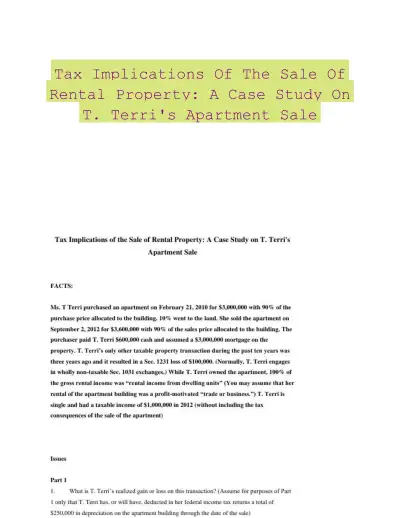 Practice Problems
Tax Implications Of The Sale Of Rental Property: A Case Study On T. Terri's Apartment Sale
Taxation
9 pagesMay 2025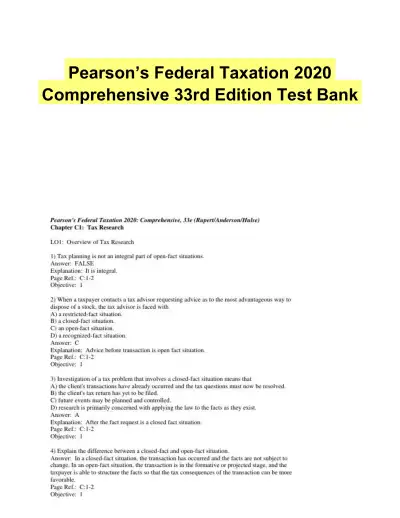 Exam Guides
Pearson�s Federal Taxation 2020 Comprehensive 33rd Edition Test Bank
Taxation
1355 pagesMay 2025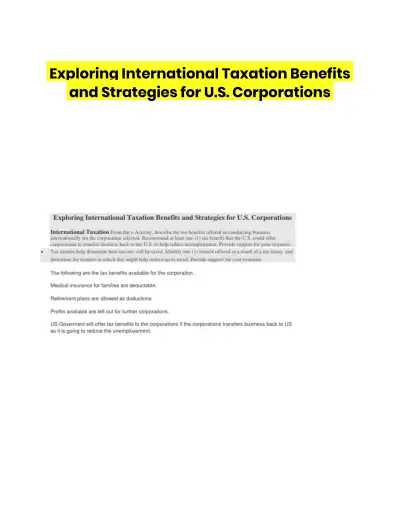 Solved Assignments
Exploring International Taxation Benefits and Strategies for U.S. Corporations
Taxation
2 pagesMay 2025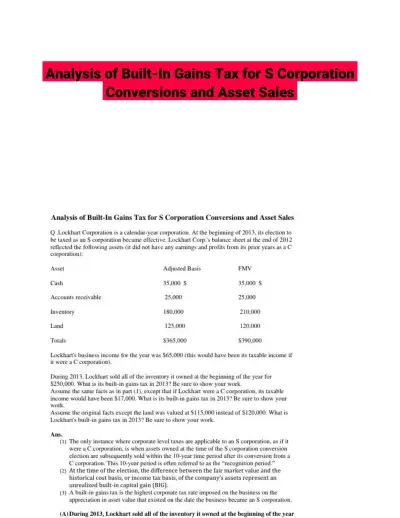 Solved Assignments
Analysis of Built-In Gains Tax for S Corporation Conversions and Asset Sales
Taxation
2 pagesMay 2025
Study this document with CramX
Once it is in your library, every tool can work from it.