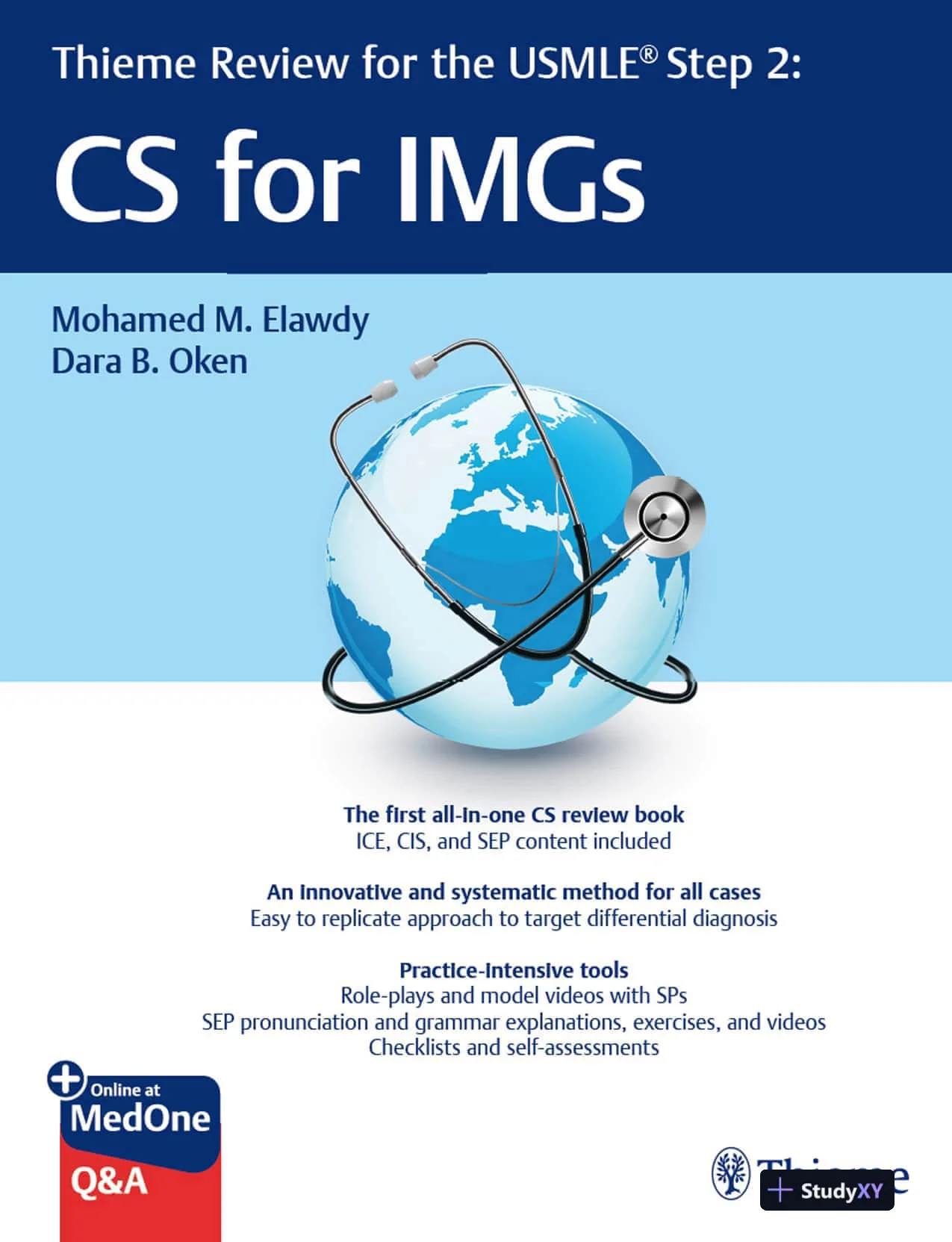
Thieme Review for the USMLE� Step 2: CS for IMGs (2020)

Thieme Review for the USMLE� Step 2: CS for IMGs (2020) provides an in-depth review of exam topics, offering structured explanations, solved examples, and tips to boost your success.

Anna Wilson
Contributor
4.2
33
10 months ago
Preview (16 of 326 Pages)
100%
Log in to unlock

Page 1

Thieme Review for the USMLE� Step 2: CS for IMGs (2020) - Page 1 preview image

Loading page ...

Page 2

Thieme Review for the USMLE� Step 2: CS for IMGs (2020) - Page 2 preview image

Loading page ...

Page 3

Thieme Review for the USMLE� Step 2: CS for IMGs (2020) - Page 3 preview image

Loading page ...

To access the additional media content available with this e-book via Thieme MedOne,please use the codeand follow the instructionsprovided at the back of the e-book.

Page 4

Thieme Review for the USMLE� Step 2: CS for IMGs (2020) - Page 4 preview image

Loading page ...

Page 5

Thieme Review for the USMLE� Step 2: CS for IMGs (2020) - Page 5 preview image

Loading page ...

Page 6

Thieme Review for the USMLE� Step 2: CS for IMGs (2020) - Page 6 preview image

Loading page ...

Thieme Review for the USMLE®Step 2:CS for IMGsMohamed M. Elawdy, MD, MSc, ECFMG certifiedSpecialist (A) in UrologySohar HospitalMinistry of HealthSohar, Oman;Urology and Nephrology CenterMansoura, Egypt;International FellowThomas Jefferson University HospitalPhiladelphia, Pennsylvania, USADara B. Oken, MEdPronunciation Modification TrainerArticulation LLC;Adult ELL TeacherMinneapolis Adult EducationMinneapolis Center for Adult LearningMinneapolis, Minnesota, USAThiemeNew York • Stuttgart • Delhi • Rio de Janeiro144 illustrations

Page 7

Thieme Review for the USMLE� Step 2: CS for IMGs (2020) - Page 7 preview image

Loading page ...

Library of Congress Cataloging-in-Publication Datais availablewith the publisher.© 2020. Thieme. All rights reserved.Thieme Medical Publishers New York333 Seventh AvenueNew York, New York 10001 USA+1 800 782 3488, customerservice@thieme.comGeorg Thieme Verlag KGRüdigerstrasse 14, 70469 Stuttgart, Germany+49 [0]711 8931 421, customerservice@thieme.deThieme Publishers DelhiA-12, Second Floor, Sector-2, Noida-201301Uttar Pradesh, India+91 120 45 566 00, customerservice@thieme.inThieme Publishers Rio de Janeiro,Thieme Publicações Ltda.Edifício Rodolpho de Paoli, 25º andarAv. Nilo Peçanha, 50 – Sala 2508,Rio de Janeiro 20020-906 Brasil+55 21 3172-2297Cover design: Thieme Publishing GroupTypesetting by DiTech Process Solutions, IndiaPrinted in USA by King Printing Company, Inc.5 4 3 2 1ISBN 978-1-68420-196-9Also available as an e-book:eISBN 978-1-68420-197-6This book, including all parts thereof, is legally protected bycopyright. Any use, exploitation, or commercialization out-side the narrowlimits set by copyright legislation, withoutthe publisher’s consent, isillegal and liable to prosecution.This applies in particular to photostatreproduction, copying,mimeographing,preparationofmicrofilms,andelectronicdata processing and storage.Important note:Medicine is an ever-changing science undergo-ingcontinual development. Research and clinical experience arecontinually expanding our knowledge, in particular our knowl-edge of proper treatment and drug therapy. Insofar as this bookmentions any dosage or application, readers may rest assuredthat the authors, editors, and publishers have made every effortto ensure that such references are in accordance withthe state ofknowledge at the time of production of the book.Nevertheless, this does not involve, imply, or express anyguarantee or responsibility on the part of the publishers in re-spect to any dosage instructions and forms ofapplications statedin the book.Every user is requested to examine carefullythemanufacturers’ leaflets accompanying each drug and to check, ifnecessary in consultation with aphysician or specialist, whetherthe dosage schedules mentioned therein or the contraindicationsstated by the manufacturers differ from the statements madein the present book. Such examination is particularly impor-tant with drugs that are either rarely used or have been newlyreleased on the market. Every dosage schedule or every form ofapplication used is entirely at the user’s own risk and responsi-bility. The authors and publishers requestevery user to report tothe publishers any discrepancies or inaccuracies noticed. If errorsin this work are found after publication,errata will be posted atwww.thieme.com on the product description page.Some of the product names, patents, and registered designsreferred to in this book are in fact registered trademarks or pro-prietary names even though specific reference to this fact is notalways made in the text. Therefore, the appearance of a namewithout designation asproprietary is not to be construed as arepresentation by the publisher that it is in the public domain.

Page 8

Thieme Review for the USMLE� Step 2: CS for IMGs (2020) - Page 8 preview image

Loading page ...

To all of my colleagues who reviewed this book and the Thieme team.Mohamed M. ElawdyIn memory of my father, Dr. Martin Oken, and his gifts to medicine.Dara B. Oken

Page 9

Thieme Review for the USMLE� Step 2: CS for IMGs (2020) - Page 9 preview image

Loading page ...

Page 10

Thieme Review for the USMLE� Step 2: CS for IMGs (2020) - Page 10 preview image

Loading page ...

viiContentsVideosixAudiosxPrefacexiAcknowledgmentsxiv1The Basics, Component 1, Integrated Clinical Encounter12The Basics, Component 2, Communication and Interpersonal Skills163The Basics, Component 3, English Proficiency25Dara B. Oken and Mohamed M. Elawdy4Chest (Cardiology and Respiratory)45Role-Play 1: Sore Throat50Role-Play 2: A Telephone Encounter54Role-Play 358Role-Play 4: Rapidly Beating Heart61Role-Play 5: Chest Pain (I)67Role-Play 6: Chest Pain (II)70Role-Play 7: Chest Pain (III)74Role-Play 8775Abdomen(Gastroenterology and Urology)80Role-Play 982Role-Play 1085Role-Play 1188Role-Play 12(Video51)92Role-Play 1396Role-Play 1499Role-Play 15102Role-Play 16105Role-Play 17110Role-Play 18113Role-Play 19116Role-Play 20120Role-Play 211236Obstetrics and Gynecology127Role-Play 22128Role-Play 23132Role-Play 24135Role-Play 25139Role-Play 26143Role-Play 271467Pediatrics149Role-Play 28152Role-Play 29157Role-Play 30160Role-Play 31164Role-Play 321678Musculoskeletal System171Role-Play 33174Role-Play 34179Role-Play 35183Role-Play 36187Role-Play 37192Role-Play 38196

Page 11

Thieme Review for the USMLE� Step 2: CS for IMGs (2020) - Page 11 preview image

Loading page ...

viii9Psychiatry199Role-Play 39201Role-Play 40202Role-Play 41205Role-Play 42209Role-Play 43212Role-Play 4421410Neurology217Role-Play 45223Role-Play 46229Role-Play 47231Role-Play 48235Role-Play 49 (Video101)238Role-Play 50242Role-Play 51246Role-Play 5225011Miscellaneous254Role-Play 53256Role-Play 54261Role-Play 55265Role-Play 56268Role-Play 57273Role-Play 5827412Mini Cases279Case 59279Case 60279Case 61279Case 62280Case 63280Case 64280Case 65280Case 66281Case 67281Case 68281Case 69281Case 70282Case 71282Case 72282Case 73283Case 74283Case 75283Case 7628313Appendix284Checklists289Index305Contents

Page 12

Thieme Review for the USMLE� Step 2: CS for IMGs (2020) - Page 12 preview image

Loading page ...

ixVideosVideo 1.1This video will teach you how to tailor the medical history to satisfy CS requirements and timelimitation. The emphasis is on the analysis of the most common complaints in the CS.Video 1.2This video gives a realistic approach to perform the physical exam within the allocated time on the CSexam.Video 1.3The current CS resources have failed to introduce a universal system for PN typing. This video wasprepared to help the candidate to document PN effectively.Video 2.1The closure includes a summary of the medical history, physical exam, preliminary diagnosis and more.This video explores these components, and includes a live demo of different types of closure.Video 3.1This video helps the speaker pronounce individual words clearly with the concepts of syllables, stress,and unstressed syllables.Video 3.2This video helps the speaker differentiate between similar consonants sounds and provides tips to avoidcommon errors.Video 3.3The two consonants spelled with ‘th’, voiced and unvoiced sounds, are described and practiced withwords and sentences/questions.Video 3.4This video helps the speaker differentiate between similar vowel sounds and provides tips to avoidcommon errors.Video 3.5The “short A” vowel sound is described and practiced with words and sentences/questions.Video 3.6The “vocalic-r” vowel is described and practiced with words and sentences/questions.Video 3.7This video covers high-use verb tenses and their meanings in question examples from the patientencounter. Also covered is question intonation, the rise and fall of the voice, that is important to askingclear questions.Video 4.1Chest Examination for CS.Video 5.1This is a live demo of a 30-year-old female who has right-sided abdominal painVideo 7.1This demo gives you a solid road map to study and practice different pediatric cases. The video providesa set of questions that should be asked in almost all pediatric cases.Video 7.2This is an example of a telephone encounter. The mother called the clinic because her child who is1-year-old has a fever. The video follows the up-to-date CS instructions and allocated CS time.Video 8.1This video demo is designed and tailored to the lengthy musculoskeletal exam to meet the CSrequirements and SPs’ checklists.Video 10.1Dizziness is a common case on the CS exam. At the end of the video, a live demo is introduced to teachyou how to type the PN within the CS time frame.Video 11.1This is a special lecture that collects unclassified cases. Examples are checkup visits/medications refillfor D.M, hypertension and more.Video 11.2This is a real patient encounter of a 55-year-old female patient who has hearing loss. The Demo includesalso patient note documentation.Video 12.1A real live patient encounter demo for a patient who has urethral discharge.

Page 13

Thieme Review for the USMLE� Step 2: CS for IMGs (2020) - Page 13 preview image

Loading page ...

xAudiosAudio 2.1The audio contains the core of the CIS and can be used as a quick review before the exam.Audio 9.1The audio contains the core of psychiatry and can be used as a quick review before the exam.Audio 10.1The audio contains the core of neurology and can be used as a quick review before the exam.

Page 14

Thieme Review for the USMLE� Step 2: CS for IMGs (2020) - Page 14 preview image

Loading page ...

xiPrefaceThe United States Medical License Examination (USMLE)Step 2 Clinical Skills (CS) is one of three exams (Step 1,Step 2 CK, and Step 2 CS) that one must pass to qualify forECFMG certification. This certification is a requirement forboth international medical graduates (IMGs) and US med-ical graduates to apply for residency training.The USMLE website includes exam candidate require-ments, exam description, scoring, and other importantgeneral information regarding the CS exam. Please be sureto read the most up-to-date CS Bulletin of Informationcarefully.TheCSexamisscoredonthebasisofthreesub-components. Each of the following three sub-componentsmust be passed in order to achieve an overall “passing”result:Integrated Clinical Encounter (ICE)Communication and Interpersonal Skills (CIS)Spoken English Proficiency (SEP)Although one may be able to pass the CS exam with goodtraining and practice, it is a challenging exam. It is a daylong exam with 12 patient encounters, each followed byPatient Note (PN) documentation. The exam utilizes Stand-ardized Patients (SPs), actors who lack any actual physi-cal signs. Each encounter is limited to 15 minutes, and thePN is limited to 10 minutes. For IMGs, there are additionalchallenges like SEP component, the high cost of traveling,accommodation, visa application fees that is in addition tothe exam fees, and the difficulty of procuring an exam dateat one of the only five exam centers in the United States.As an IMG myself, and as someone whose exam prepa-rations were limited due to the lack of resources such asadequate guidance, I had two unsuccessful attempts in theCS exam before I ultimately passed in my third attempt.Through this learning process, I became acutely awareof what I needed to do to be successful, and what lack ofinformation there is in the existing commercial resources.This was the prime motivator for me to start writing thisbook, so that I may help others pass the exam and theymay not have to learn through their mistakes.The exam is unique and unconventional; it requiresan unparalleled preparation resource that not onlypro-videsmedical information but also shows how tousethis information. This book will assist the exam candi-date to overcome specific challenges encountered duringtheexam by using a unique format tailored specifically tothe requirements of the CS exam.The available commercial resources for the CS exam arefew, and they have many limitations. They present CS casesindividuallywithoutorganizingthemintobody-systemchapters. They contain no specific questions for analyzingpossible differential diagnoses, physical exam steps for eachcase, checklist, or a self-assessment scoring system. Althoughpractice is the key to passing the CS exam, these resources donot provide authentic role-plays for this purpose. In addition,they do not provide any guidance for the SEP component,and most of them have been edited by medical professionalsrather than those who have experience as examinees.We worked extensively to compensate for the limita-tions in the presently available commercial resources, andto fill in the gaps. We have put great effort into makingCS for IMGsa comprehensive and user-friendly resource thatwill help candidates pass the CS exam in the first attempt.How isCS for IMGsorganized?The central strength of this book is its organization whichprovides a solid foundation that can be utilized in all CScases. The book starts with “The Basics” and then offersdifferent types of cases that are divided into individualchapters:The Basics:A.Integrated Clinical Encounter (ICE): In this chapter, thefundamentals of medical history and physical examthat are relevant to the CS exam are covered. This pro-vides a simple and reproducible approach that can beutilized in all CS cases. There are also reproduciblemnemonics, as well as tips on how to write completeand effective PNs.B.Communication Interpersonal Skills (CIS): The CIS forthe CS exam is written concisely in order to be eas-ily understood by the reader. It also provides tips for“model answers” to the questions commonly asked bySPs.C.Spoken English Proficiency (SEP): It is a comprehensiveoverview of key sounds and patterns in English. Thereare tips to guide you through some language-specificchallenges, and examples include pertinent sentencesand questions you will likely use with the SPs.Systematically arranged chapters:Practice cases have been organized according to appro-priate body systems and disciplines. These have beenarranged into individual chapters. The proper approachto history, physical exam, and workup are explained. Eachchapter contains a number of practice cases that are com-monly tested in the actual CS exam.Miscellaneouschapter:Inthischapter,unclassifiedcases, medical check-up, medication refill, and infrequentcases are covered.ThebookconcludeswithanAppendixthatdetailsscreening protocols, medications that are commonly seenin the CS along with the associated side effects, differentmnemonics, and more.In an effort to help you emulate role-plays to closelyresemble the actual CS exam, we have included instruc-tions for the SP role and the “Doorway Information.” Eachpractice case begins with an introduction that gives yousome basic information about the case. An answer key isprovided that includes the recommended line of question-ing for history-taking, the possible differential diagnoses,the physical exam technique, a sample closure, and a sug-gested PN. This is a unique system that will give you a solidstrategy to approach various types of cases. This is a moreuser-friendly method than what has been traditionallyproposed in other commercial CS books.To further understand how this book is structured, hereis an analogy: Imagine this book was built just as a build-ing is constructed. Thebasicsrepresent the solid “founda-tion” that will be used for all cases and serve all levels. Thisincludes general medical history, general physical exam,closure, counseling, and communication skills.Individualchaptersrepresent the “levels/floors,” and contain specific

Page 15

Thieme Review for the USMLE� Step 2: CS for IMGs (2020) - Page 15 preview image

Loading page ...

xiiPrefacehistory-taking questions, focused clinical exam maneu-vers, and suggested workup that arecommon to a particu-lar group of cases. Finally,each individual caserepresentsthe individual “apartment units.” Just as each apartmentunit in a building has unique furniture and decorations,each case has various differential diagnoses, specific ques-tions to ask, analysis of complaints, special clinical tests,and recommended special workups. This unique arrange-ment facilitates rapid retrieval of the content.Step-by-step studying strategy for success in CS examSeveral months to a year before the exam:Immerse yourself in the English component. Do not hesi-tate to take live or online courses to improve your English.It is an investment in your ability to communicate. Make acommitment to gradually improve your English, not onlyfor the exam but for the upcoming residency interviewsand your medical career in the United States. Efficienttyping skills also require significant time to be mastered.Please read the SEP chapter and our recommendation forthe PN and watch the videos.Weeks to months before the exam:The book is a good starter for those who are fresh gradu-ates, or who have recently completed the CK exam. Oth-erwise, reviewing the CS topics in a medical textbook isstrongly recommended. We advise a quick prerequisitereview of the fundamentals of history-taking and clini-cal exam from your standard medical textbooks beforestarting the CS exam preparation usingCS for IMGs. Wehave minimized redundancy and repetition of these spe-cific basic concepts in an effort to make this book as con-cise as possible, and more exam-oriented.Start by reading “The Basics” that includes history-tak-ing questions, physical exam, and PN. Try to memorizethe mnemonics. Learn how to quickly go through taking ageneral medical history. Practice the history-taking ques-tions and the physical exam steps with a partner until youfeel comfortable doing so, and they flow automatically.Next, read the Communication and Interpersonal Skills(CIS) chapter. Once you feel that you have truly grasped itscontent, try to practice communication with a partner. It isvital to act “in character” and behave in a professional manner.In each chapter, review the common line of questioningthat should be asked for history, clinical exam technique,suggested diagnostic studies, and the commonly askedCIS questions. Prior to beginning your practice case, it isadvised to read the discussion of PNs in each chapter.When you begin readingCS for IMGs, explore thetypicalcase presentations of each chapter. For example, in theChest chapter, you will find cases such as sore throat,cough, chest pain, palpitation, etc. You may find it neces-sary to go back and review some of these topics from yourmedical textbooks in order to gain a full understanding.Then come back toCS for IMGsand continue.Never practice without completing a PN for each case.When you first begin practice cases, we advise you tostick to “The CS for IMGs method.” Over time, and withpractice, you will feel more comfortable with the format.You will be able to develop your own personal mnemonicsand create your own method.The online videos, which are available for this book, willhelp you grasp the concepts of this book more thoroughly,and this will help enhance your performance.Few weeks before the exam:Find a study partner whose exam is scheduled close toyour exam date. In the beginning, do not choose randomcases; instead, start practicing chapter by chapter. Withineach chapter, choose the case first, and study it well beforepracticing.Do not move on to another chapter until you finish theone in hand. Apply the same strategy for the entire book.Always practice with PN typing.A couple of weeks before the exam:Ask your study partner to select practice cases randomlyfrom different chapters. This is an opportunity to find yourareas of weakness so that you can address them before theexam day.A full day of practicing cases may seem grueling, but youwill find that this is a highly effective method of prepara-tion. It is the only way to build stamina for the long hoursof testing at the CS exam center. Try to practice at least sixcases at a time (half a day) in a continuous manner. Thiswill help simulate the rigors of the actual CS exam.Stress only on analysis of each complaint and a possibledifferential diagnosis. Practice live for the physical examand focus on typing the PN.How to perform practice casesFind a practice-partner who will assist you with role-play.The acting needs to be as realistic as possible; however,your partner does not necessarily have to be of the samegender as the particular practice case you are performing.Ask him/her to use a stopwatch or timer to help you man-age time precisely. There are CS timer apps available forsmartphones that can be downloaded from the Apple orAndroid app stores. Moreover, CS for IMGs timer is alsoavailable online.While performing the “physician role” in your practicecases, ensure that you do NOT know what the SP will say.This will train you to think of appropriate replies to theSP’s questions as well as appropriate actions to take. Thiskind of role-play is what will best prepare you for the realCS exam.Make sure to take the role-play seriously and followthe CS exam protocol. Begin the encounter by reading thedoorway information, knocking on the door, and address-ing your practice-partner by the family name, as indicatedon the doorway information sheet. At about 10 minutes,make sure an announcement of “Five minutes remainingis made. End your encounter with a final announcement at15 minutes.Once the 15 minutes is up, you must proceed directly towriting the PN. Allow yourself only 10 minutes to com-plete it.It is vital that you simulate the role-play as realisticallyas possible to the CS environment. Your practice-partnershould act like a real SP. Signs and symptoms should bepresented by simulating acute pain, lying supine on theexam table without movement, simulating photophobia,displaying the blunt affect of depression, acting anxious,etc. If your practice-partner is not a medical professional,he/she must learn how to simulate physical exam signs,such as rebound tenderness, muscle weakness, CVA ten-derness, Rinne test, etc.The use of patient gown, bedsheet, gloves, and othersimple tools will help you recreate the CS environment

Page 16

Thieme Review for the USMLE� Step 2: CS for IMGs (2020) - Page 16 preview image

Loading page ...

xiiiPrefacemore realistically. We have provided blank checklists forCIS and SEP. These can be copied for multiple use and uti-lized for all practice cases. For ICE, a customized checklistis provided at the end of each chapter. The checklist willimprove your performance while practicing.When you begin performing practice cases, initially youmay feel that you are:Nervous and rushed during the encounterShort on time to finish the encounter and/or for clo-sure and counselingForgetting to ask important questions to the SPMissing important clinical exam stepsRunning short of time for PN documentationDon’t worry! This is typical and happens to all of us inthe initial phases of practicing cases. Your performancewill improve over time and with practice.When you finish each encounter, ask your partner tograde you on three checklists (ICE, CIS, and SEP). If yourpartner is a medical student or graduate, he/she can gradethe PN as well. If not, you will have to grade the PN yourself.1–2 days before the exam:Review the cream only—the disciplines for medical his-tory,physicalexam,andCIS.Reviewcommoncasesexpected on the CS exam like abdominal, chest, joint pain,and others. Review the differential diagnosis for all cases.A day before the exam:If needed, review only the differential diagnosesquickly for each case.Prepare and iron your attire including your whitecoat. Make sure you have your stethoscope ready aswell. Those tiny things may cause unnecessary delayon the exam day.Check that you have your identification such as yourpassport and your scheduling permit in order.In the late afternoon, stop reading any books orstudying. Go outside and relax. Enjoy yourself at apark or spend time with your family and friends.Choose accommodations that are close by or withinan easy commute to the exam center.Recheck the address of the exam center and arrangefor transportation if needed.On the exam day:Plan to arrive at the testing center no later than7:30 a.m. (30 minutes before the exam time) as youmay encounter delays. No one is allowed to enterthe exam center after 8:30 a.m. You must monitorUSMLE websitefor the latest information.Be sure that you have your identification and sched-uling permit before leaving your hotel or home.Theon-sitevideoorientationsessionstartsat8:30 a.m. Afterward, there is an opportunity topreview a simulation room that looks exactly likeone of the real exam rooms (on-site orientation).Try out all of the equipment (the exam table, thedimmer on the light switch, otoscope, ophthal-moscope, reflex hammer, instruments used to testfor sensory exam, etc.). Getting acclimated at thispoint will help you avoid embarrassment once thereal exam begins.You get three breaks during the exam: Ten minutesafter case #3, 30 minutes after case #6 with a meal,and 10 minutes break after case #9.You may expect little stress in the first case, but thisis the norm and will disappear in the second caseand thereafter.Finally, be sure to bring your white coat and stetho-scope with you to the center on exam day; othertools areusually provided for you.Remember that each encounter is videotaped. This isdone in order to ensure the SP’s safety and for researchpurposes but is not used in grading.Do not expect the real exam cases to be presentedEXACTLY as they are inCS for IMGs. However, with yourtraining fromCS for IMGs, you will find yourself comfort-able to handle most of the exam cases. Typically, you willfind a few cases that present with vague, odd, or uniquecomplaints. Many times, these cases have been added forresearch or experimental purposes.When encountering an odd case, follow the same stepspresented in the book. Write down the possible differen-tial diagnoses, knock on the door, smile, ask the essentialquestions for history-taking, do a focused general andlocal exam, and do a simple closure and counseling. Do notforget to address the SP’s questions and concerns. Writethe PN and go on to the next case.In the CS exam, you are not expected to be perfect inevery encounter or in all three components. Mistakes hap-pen for all of us; just try your best to keep them to a min-imum. If a portion of a case goes wrong, let go of it beforeyou move on to your next case.After the exam:Once you’ve finished the exam,do not discuss the examcases with other past or future examinees. Do not sharecases online either.Try not to be overly anxious about the exam results.It is obviously preferable to pass the exam on your firstattempt. But in case you do not, please realize that it is notthe end of the world. Many brilliant and outstanding peo-ple throughout history have experienced failures beforerealizing great success in life.This book is a result of my cumulative experience gainedin three CS exam attempts, having had a scholarship in theUnited States, writing this book for more than three years,and teaching the CS to various IMGs. This book is sufficientto help you pass the CS exam in the first attempt with noneed for other resources, if used correctly. However, youcan take advantage of other exam preparation resources aswell. In addition to any study resources, practicing is thekey to pass this exam. Try to seek the advice and opinionsand feedback of past examinees and those who practice indifferent medically oriented professions (students, nurses,attending physicians, and tutors).Lastly, my advice to you is to take the exam only whenyou feel that you are truly prepared. If you are not trulyready in even one component, failure is quite likely. Do nottake the exam unless you are confident that you can passall three components with ease.I do believe that this first edition ofCS for IMGswill notbe the last one. I will endeavor to continually improve thisbook. I encourage readers to please send me suggestions,comments, or criticisms at info@csshool.org.Best of luck,Mohamed M. Elawdy, MD
Preview Mode

This document has 326 pages. Sign in to access the full document!