
Past Exams
2019 ATI Mental Health Proctored Exam with Answers (71 Solved Questions)
- Assessment Technologies Institute
- 22 pages
- Shared May 2025
Strengthen your knowledge with 2019 ATI Mental Health Proctored Exam with Answers, a powerful study tool packed with real past exams.
Preview · 7 of 22 pages
100%
Page 1
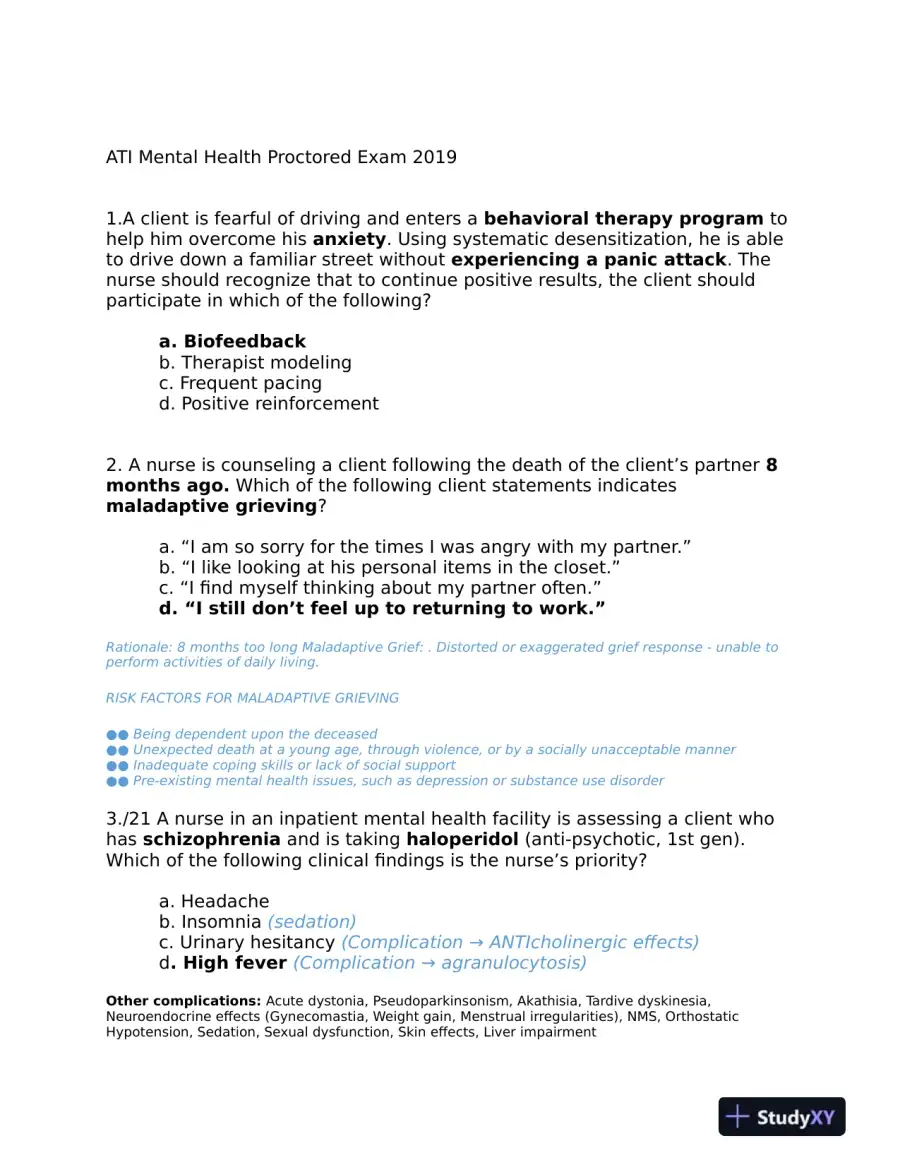 ATI Mental Health Proctored Exam 20191.A client is fearful of driving and enters abehavioral therapy programtohelp him overcome hisanxiety. Using systematic desensitization, he is ableto drive down a familiar street withoutexperiencing a panic attack. Thenurse should recognize that to continue positive results, the client shouldparticipate in which of the following?a. Biofeedbackb. Therapist modelingc. Frequent pacingd. Positive reinforcement2. A nurse is counseling a client following the death of the client’s partner8months ago.Which of the following client statements indicatesmaladaptive grieving?a. “I am so sorry for the times I was angry with my partner.”b. “I like looking at his personal items in the closet.”c. “I find myself thinking about my partner often.”d. “I still don’t feel up to returning to work.”Rationale: 8 months too long Maladaptive Grief: . Distorted or exaggerated grief response - unable toperform activities of daily living.RISK FACTORS FOR MALADAPTIVE GRIEVING●● Being dependent upon the deceased●● Unexpected death at a young age, through violence, or by a socially unacceptable manner●● Inadequate coping skills or lack of social support●● Pre-existing mental health issues, such as depression or substance use disorder3./21 A nurse in an inpatient mental health facility is assessing a client whohasschizophreniaand is takinghaloperidol(anti-psychotic, 1st gen).Which of the following clinical findings is the nurse’s priority?a. Headacheb. Insomnia(sedation)c. Urinary hesitancy(Complication → ANTIcholinergic effects)d. High fever(Complication → agranulocytosis)Other complications:Acute dystonia, Pseudoparkinsonism, Akathisia, Tardive dyskinesia,Neuroendocrine effects (Gynecomastia, Weight gain, Menstrual irregularities), NMS, OrthostaticHypotension, Sedation, Sexual dysfunction, Skin effects, Liver impairmentlOMoARcPSD|9700590
Page 2

Page 3
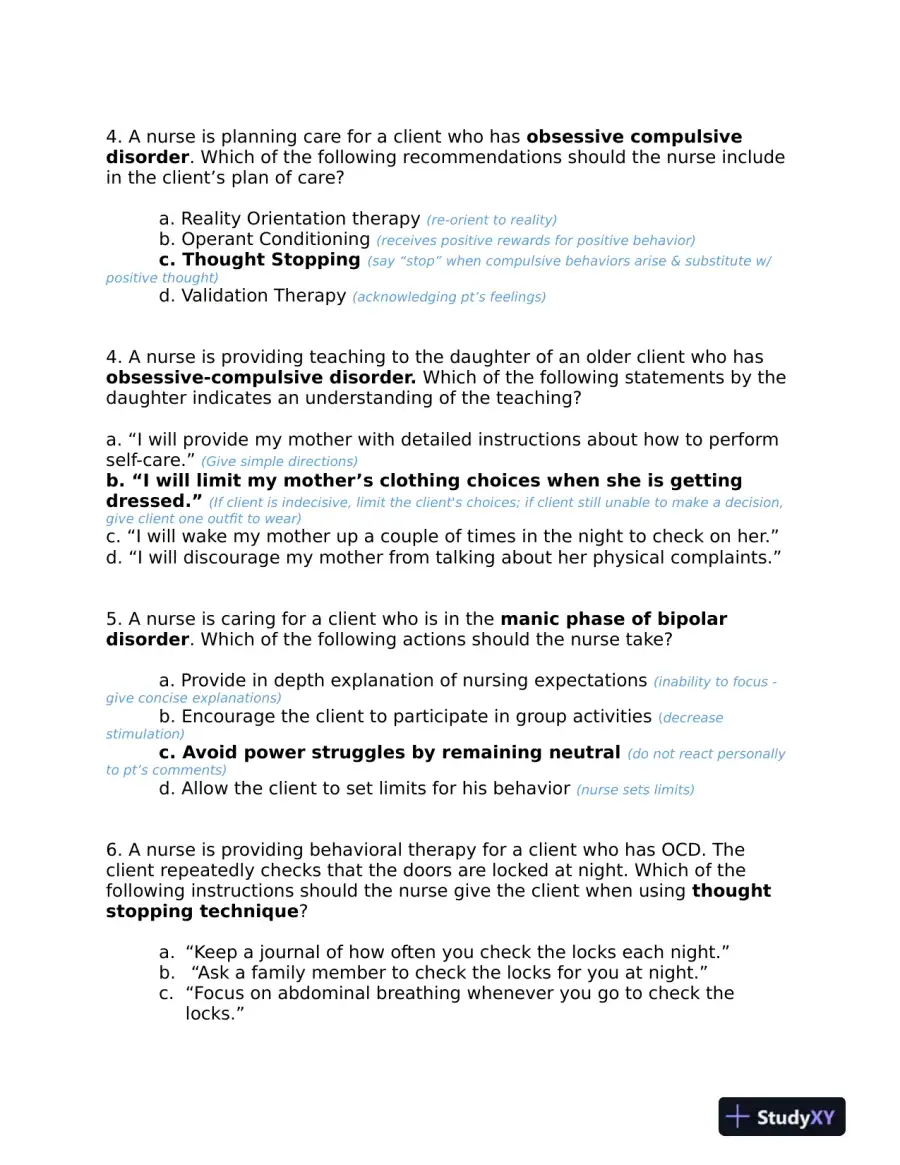 4. A nurse is planning care for a client who hasobsessive compulsivedisorder. Which of the following recommendations should the nurse includein the client’s plan of care?a. Reality Orientation therapy(re-orient to reality)b. Operant Conditioning(receives positive rewards for positive behavior)c. Thought Stopping(say “stop” when compulsive behaviors arise & substitute w/positive thought)d. Validation Therapy(acknowledging pt’s feelings)4. A nurse is providing teaching to the daughter of an older client who hasobsessive-compulsive disorder.Which of the following statements by thedaughter indicates an understanding of the teaching?a. “I will provide my mother with detailed instructions about how to performself-care.”(Give simple directions)b. “I will limit my mother’s clothing choices when she is gettingdressed.”(If client is indecisive, limit the client's choices; if client still unable to make a decision,give client one outfit to wear)c. “I will wake my mother up a couple of times in the night to check on her.”d. “I will discourage my mother from talking about her physical complaints.”5. A nurse is caring for a client who is in themanic phase of bipolardisorder. Which of the following actions should the nurse take?a. Provide in depth explanation of nursing expectations(inability to focus -give concise explanations)b. Encourage the client to participate in group activities(decreasestimulation)c. Avoid power struggles by remaining neutral(do not react personallyto pt’s comments)d. Allow the client to set limits for his behavior(nurse sets limits)6. A nurse is providing behavioral therapy for a client who has OCD. Theclient repeatedly checks that the doors are locked at night. Which of thefollowing instructions should the nurse give the client when usingthoughtstopping technique?a. “Keep a journal of how often you check the locks each night.”b.“Ask a family member to check the locks for you at night.”c.“Focus on abdominal breathing whenever you go to check thelocks.”lOMoARcPSD|9700590
Page 4
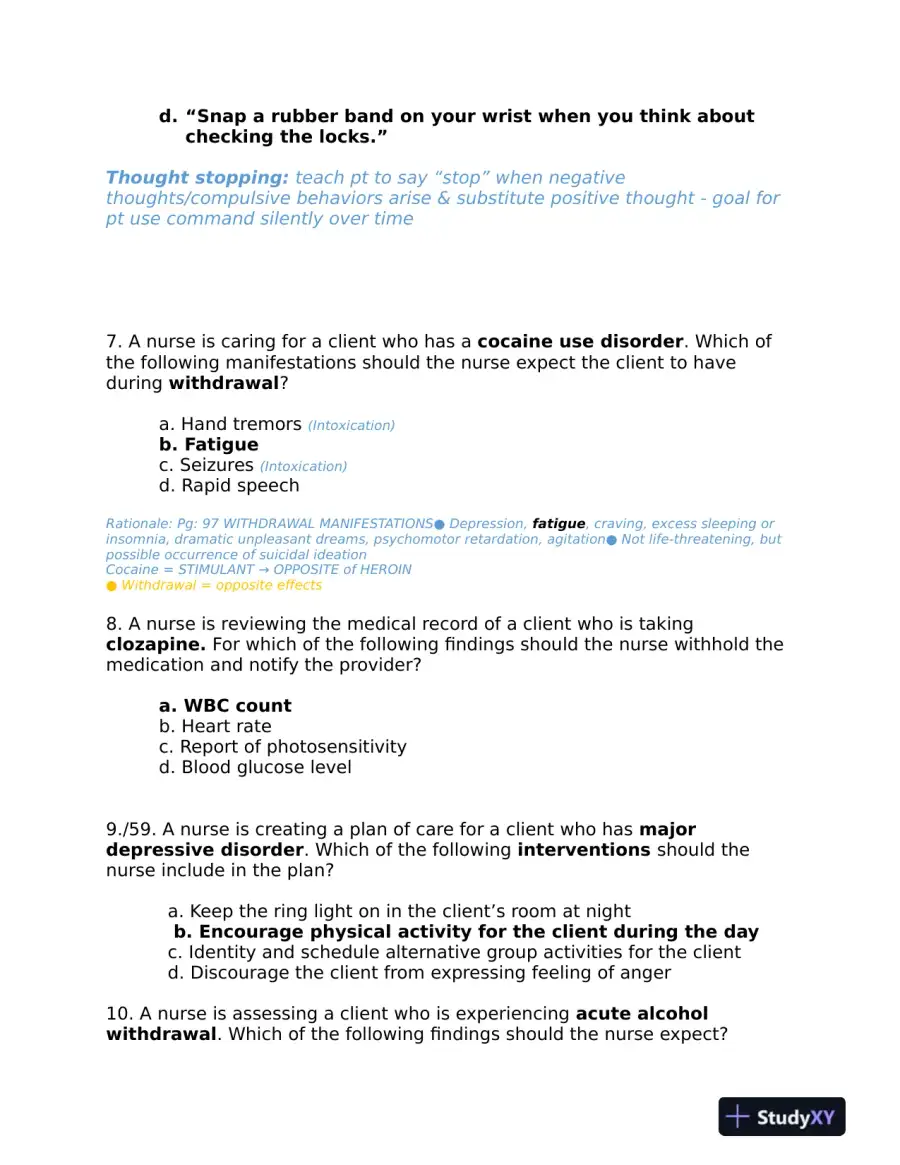 d. “Snap a rubber band on your wrist when you think aboutchecking the locks.”Thought stopping:teach pt to say “stop” when negativethoughts/compulsive behaviors arise & substitute positive thought - goal forpt use command silently over time7. A nurse is caring for a client who has acocaine use disorder. Which ofthe following manifestations should the nurse expect the client to haveduringwithdrawal?a. Hand tremors(Intoxication)b. Fatiguec. Seizures(Intoxication)d. Rapid speechRationale: Pg: 97 WITHDRAWAL MANIFESTATIONS● Depression,fatigue, craving, excess sleeping orinsomnia, dramatic unpleasant dreams, psychomotor retardation, agitation● Not life-threatening, butpossible occurrence of suicidal ideationCocaine = STIMULANT → OPPOSITE of HEROIN● Withdrawal = opposite effects8. A nurse is reviewing the medical record of a client who is takingclozapine.For which of the following findings should the nurse withhold themedication and notify the provider?a. WBC countb. Heart ratec. Report of photosensitivityd. Blood glucose level9./59. A nurse is creating a plan of care for a client who hasmajordepressive disorder. Which of the followinginterventionsshould thenurse include in the plan?a. Keep the ring light on in the client’s room at nightb. Encourage physical activity for the client during the dayc. Identity and schedule alternative group activities for the clientd. Discourage the client from expressing feeling of anger10. A nurse is assessing a client who is experiencingacute alcoholwithdrawal. Which of the following findings should the nurse expect?lOMoARcPSD|9700590
Page 5
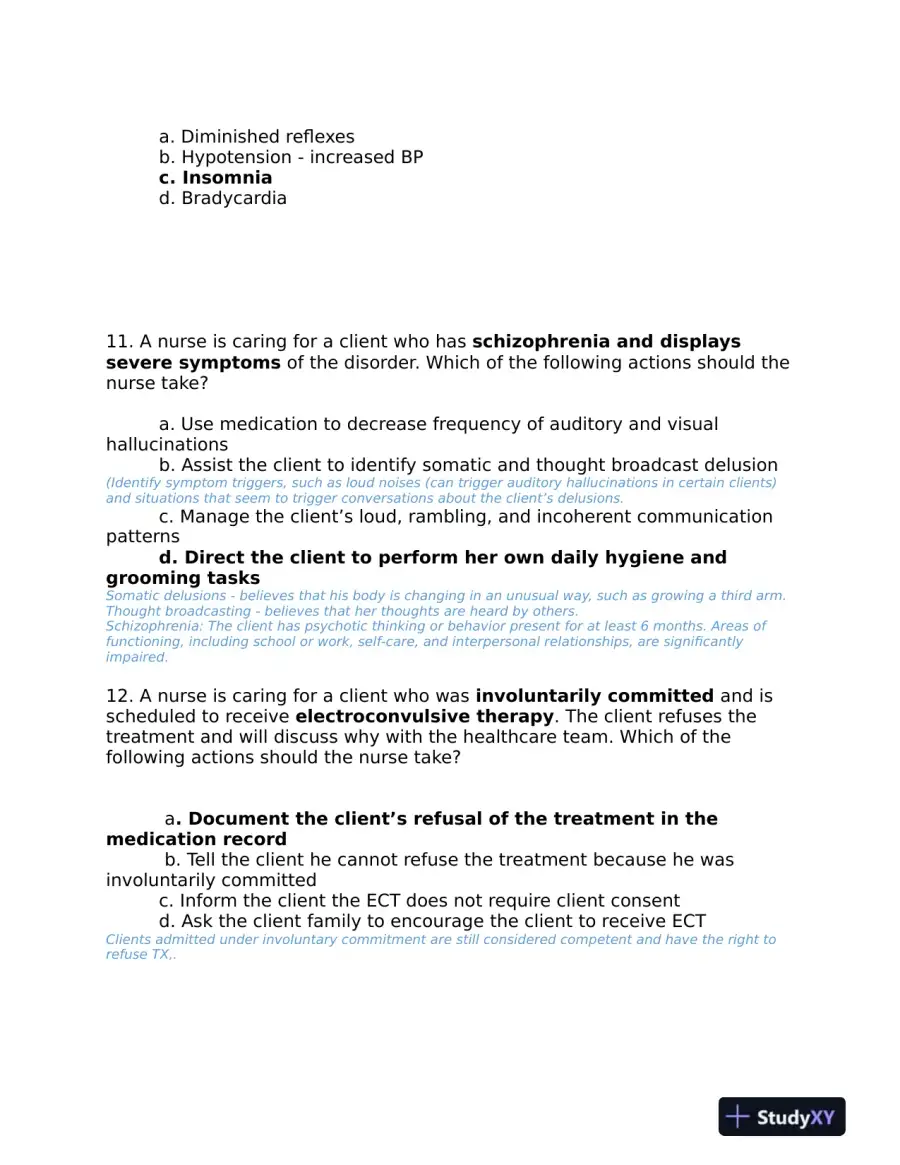 a. Diminished reflexesb. Hypotension - increased BPc. Insomniad. Bradycardia11. A nurse is caring for a client who hasschizophrenia and displayssevere symptomsof the disorder. Which of the following actions should thenurse take?a. Use medication to decrease frequency of auditory and visualhallucinationsb. Assist the client to identify somatic and thought broadcast delusion(Identify symptom triggers, such as loud noises (can trigger auditory hallucinations in certain clients)and situations that seem to trigger conversations about the client’s delusions.c. Manage the client’s loud, rambling, and incoherent communicationpatternsd. Direct the client to perform her own daily hygiene andgrooming tasksSomatic delusions - believes that his body is changing in an unusual way, such as growing a third arm.Thought broadcasting - believes that her thoughts are heard by others.Schizophrenia: The client has psychotic thinking or behavior present for at least 6 months. Areas offunctioning, including school or work, self-care, and interpersonal relationships, are significantlyimpaired.12. A nurse is caring for a client who wasinvoluntarily committedand isscheduled to receiveelectroconvulsive therapy. The client refuses thetreatment and will discuss why with the healthcare team. Which of thefollowing actions should the nurse take?a. Document the client’s refusal of the treatment in themedication recordb. Tell the client he cannot refuse the treatment because he wasinvoluntarily committedc. Inform the client the ECT does not require client consentd. Ask the client family to encourage the client to receive ECTClients admitted under involuntary commitment are still considered competent and have the right torefuse TX,.lOMoARcPSD|9700590
Page 6
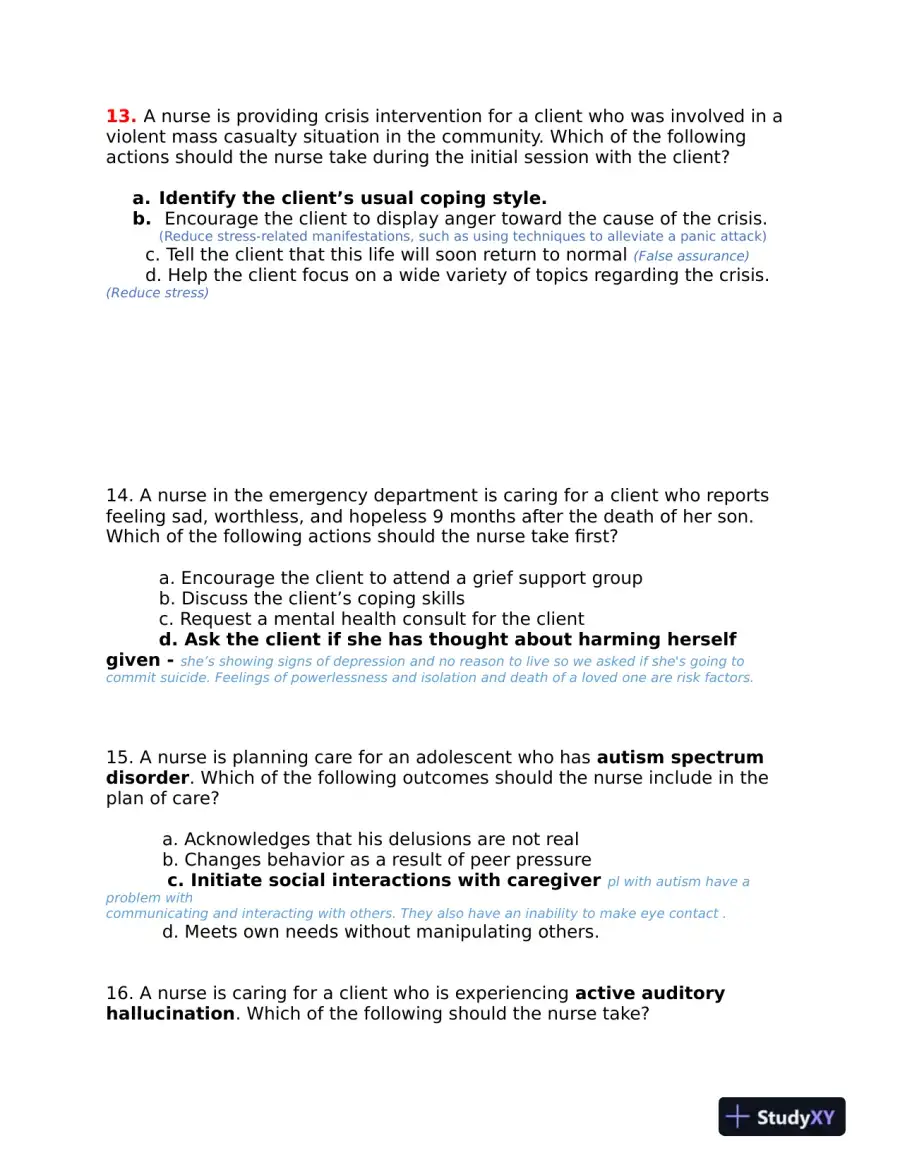 13.A nurse is providing crisis intervention for a client who was involved in aviolent mass casualty situation in the community. Which of the followingactions should the nurse take during the initial session with the client?a. Identify the client’s usual coping style.b.Encourage the client to display anger toward the cause of the crisis.(Reduce stress-related manifestations, such as using techniques to alleviate a panic attack)c. Tell the client that this life will soon return to normal(False assurance)d. Help the client focus on a wide variety of topics regarding the crisis.(Reduce stress)14. A nurse in the emergency department is caring for a client who reportsfeeling sad, worthless, and hopeless 9 months after the death of her son.Which of the following actions should the nurse take first?a. Encourage the client to attend a grief support groupb. Discuss the client’s coping skillsc. Request a mental health consult for the clientd. Ask the client if she has thought about harming herselfgiven -she’s showing signs of depression and no reason to live so we asked if she's going tocommit suicide. Feelings of powerlessness and isolation and death of a loved one are risk factors.15. A nurse is planning care for an adolescent who hasautism spectrumdisorder. Which of the following outcomes should the nurse include in theplan of care?a. Acknowledges that his delusions are not realb. Changes behavior as a result of peer pressurec. Initiate social interactions with caregiverpl with autism have aproblem withcommunicating and interacting with others. They also have an inability to make eye contact .d. Meets own needs without manipulating others.16. A nurse is caring for a client who is experiencingactive auditoryhallucination. Which of the following should the nurse take?lOMoARcPSD|9700590
Page 7
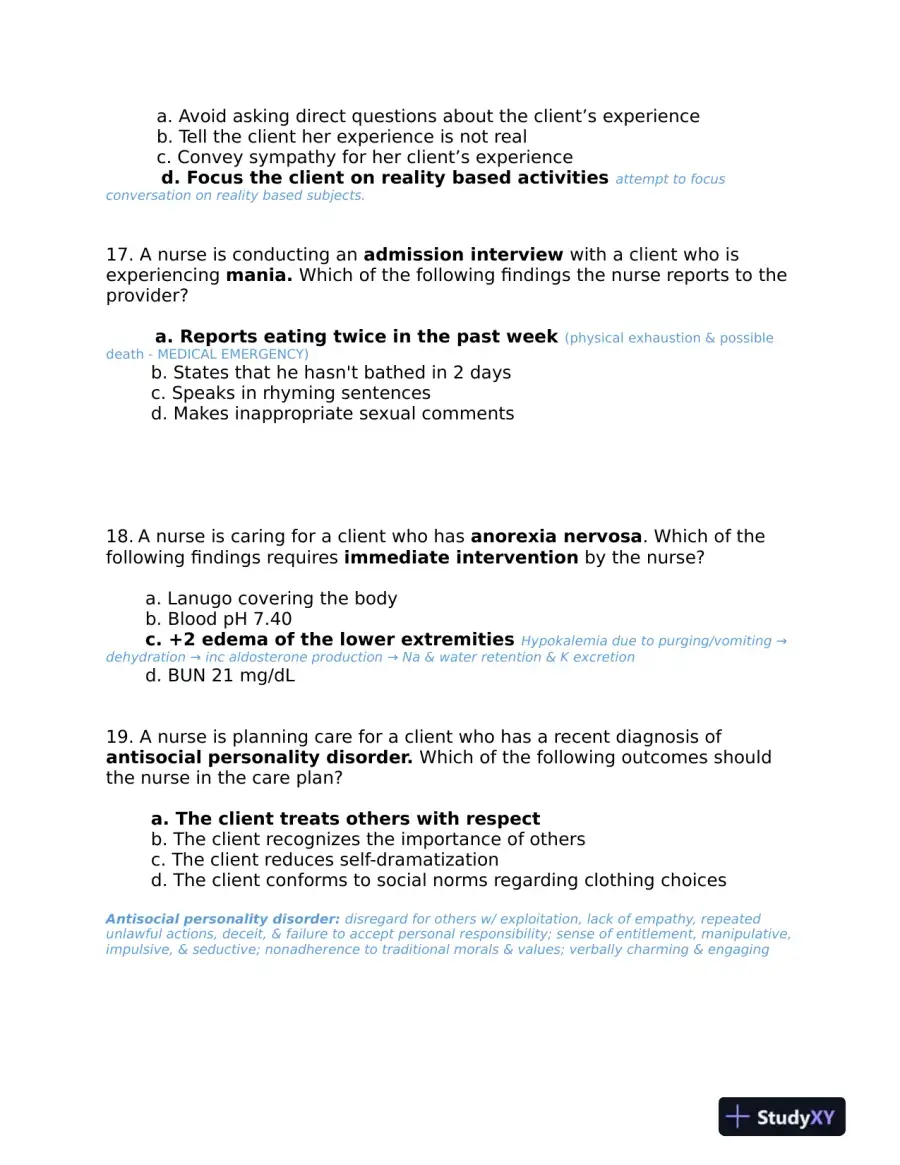 a. Avoid asking direct questions about the client’s experienceb. Tell the client her experience is not realc. Convey sympathy for her client’s experienced. Focus the client on reality based activitiesattempt to focusconversation on reality based subjects.17. A nurse is conducting anadmission interviewwith a client who isexperiencingmania.Which of the following findings the nurse reports to theprovider?a. Reports eating twice in the past week(physical exhaustion & possibledeath - MEDICAL EMERGENCY)b. States that he hasn't bathed in 2 daysc. Speaks in rhyming sentencesd. Makes inappropriate sexual comments18.A nurse is caring for a client who hasanorexia nervosa. Which of thefollowing findings requiresimmediate interventionby the nurse?a. Lanugo covering the bodyb. Blood pH 7.40c. +2 edema of the lower extremitiesHypokalemia due to purging/vomiting →dehydration → inc aldosterone production → Na & water retention & K excretiond. BUN 21 mg/dL19. A nurse is planning care for a client who has a recent diagnosis ofantisocialpersonality disorder.Which of the following outcomes shouldthe nurse in the care plan?a. The client treats others with respectb. The client recognizes the importance of othersc. The client reduces self-dramatizationd. The client conforms to social norms regarding clothing choicesAntisocial personality disorder:disregard for others w/ exploitation, lack of empathy, repeatedunlawful actions, deceit, & failure to accept personal responsibility; sense of entitlement, manipulative,impulsive, & seductive; nonadherence to traditional morals & values; verbally charming & engaginglOMoARcPSD|9700590
15 more pages in the full document
Unlock it once and it stays in your library, ready to chat with or turn into flashcards.
Unlock the full documentMore Assessment Technologies Institute study materials
See all Past Exams
ATI Maternal Newborn Practice Exam with Answers (210 Solved Questions)
Assessment Technologies Institute
114 pages141downloadsFeb 2025 Past Exams
ATI PN Pediatrics Proctored Exam Version 8 with Answers (166 Solved Questions)
Assessment Technologies Institute
40 pages126downloadsFeb 2025 Past Exams
2023 ATI NGN Comprhensive Exit Exam with Answers (87 Solved Questions)
Assessment Technologies Institute
40 pages115downloadsFeb 2025 Past Exams
2021 ATI Medical/Surgical Neurosensory AH1 with Answers (80 Solved Questions)
Assessment Technologies Institute
19 pages106downloadsFeb 2025 Past Exams
2024-2025 ATI Leadership Proctored Focus Practice Exam with Answers (63 Solved Questions)
Assessment Technologies Institute
27 pages99downloadsFeb 2025 Past Exams
2024-2025 ATI Comprehensive Exit Exam with Answers (13 Solved Questions)
Assessment Technologies Institute
6 pages77downloadsFeb 2025 Past Exams
2023 ATI RN Adult Medical Surgical For NGN Form A, B, C with Answers (21 Solved Questions)
Assessment Technologies Institute
9 pages71downloadsFeb 2025 Past Exams
2022-2023 ATI Med Surg Proctored Exam Retake with Answers (111 Solved Questions)
Assessment Technologies Institute
37 pages68downloadsFeb 2025
Study this document with CramX
Once it is in your library, every tool can work from it.