
Past Exams
2021 ATI PN Proctored Exam with Answers (11 Solved Questions)
- Assessment Technologies Institute
- 23 pages
- Shared May 2025
Reduce exam stress with 2021 ATI PN Proctored Exam with Answers, a structured past exam guide.
Preview · 7 of 23 pages
100%
Page 1
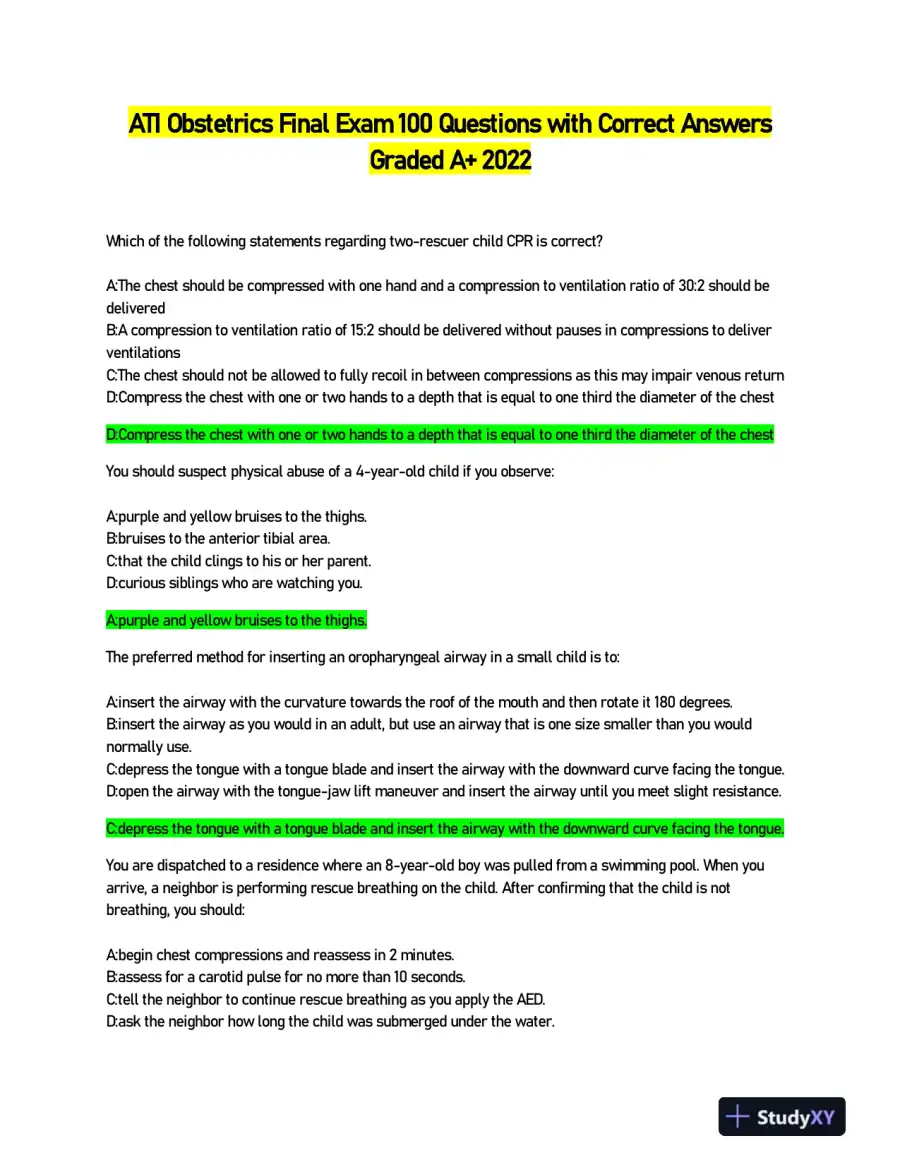 ATIObstetricsFinal Exam 100 Questions with Correct AnswersGraded A+2022Which of the following statements regarding two-rescuer child CPR is correct?A:The chest should be compressed with one hand and a compression to ventilation ratio of 30:2 should bedeliveredB:A compression to ventilation ratio of 15:2 should be delivered without pauses in compressions to deliverventilationsC:The chest should not be allowed to fully recoil in between compressions as this may impair venous returnD:Compress the chest with one or two hands to a depth that is equal to one third the diameter of the chestD:Compress the chest with one or two hands to a depth that is equal to one third the diameter of the chestYou should suspect physical abuse of a 4-year-old child if you observe:A:purple and yellow bruises to the thighs.B:bruises to the anterior tibial area.C:that the child clings to his or her parent.D:curious siblings who are watching you.A:purple and yellow bruises to the thighs.The preferred method for inserting an oropharyngeal airway in a small child is to:A:insert the airway with the curvature towards the roof of the mouth and then rotate it 180 degrees.B:insert the airway as you would in an adult, but use an airway that is one size smaller than you wouldnormally use.C:depress the tongue with a tongue blade and insert the airway with the downward curve facing the tongue.D:open the airway with the tongue-jaw lift maneuver and insert the airway until you meet slight resistance.C:depress the tongue with a tongue blade and insert the airway with the downward curve facing the tongue.You are dispatched to a residence where an 8-year-old boy was pulled from a swimming pool. When youarrive, a neighbor is performing rescue breathing on the child. After confirming that the child is notbreathing, you should:A:begin chest compressions and reassess in 2 minutes.B:assess for a carotid pulse for no more than 10 seconds.C:tell the neighbor to continue rescue breathing as you apply the AED.D:ask the neighbor how long the child was submerged under the water.
Page 2

Page 3
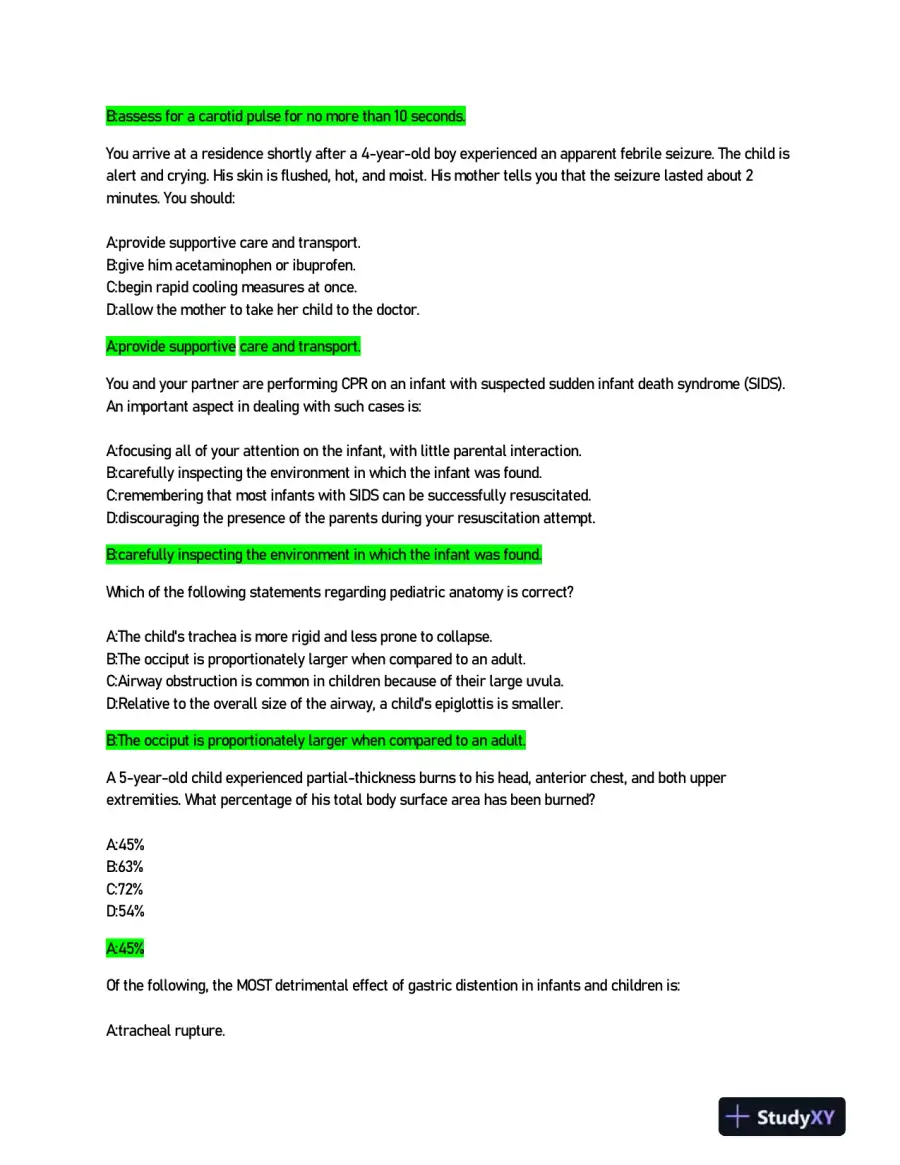 B:assess for a carotid pulse forno more than 10 seconds.You arrive at a residence shortly after a 4-year-old boy experienced an apparent febrile seizure. The child isalert and crying. His skin is flushed, hot, and moist. His mother tells you that the seizure lasted about 2minutes. You should:A:provide supportive care and transport.B:give him acetaminophen or ibuprofen.C:begin rapid cooling measures at once.D:allow the mother to take her child to the doctor.A:provide supportivecare and transport.You and your partner are performing CPR on an infant with suspected sudden infant death syndrome (SIDS).An important aspect in dealing with such cases is:A:focusing all of your attention on the infant, with little parental interaction.B:carefully inspecting the environment in which the infant was found.C:remembering that most infants with SIDS can be successfully resuscitated.D:discouraging the presence of the parents during your resuscitation attempt.B:carefully inspecting the environment in which the infant was found.Which of the following statements regarding pediatric anatomy is correct?A:The child's trachea is more rigid and less prone to collapse.B:The occiput is proportionately larger when compared to an adult.C:Airway obstruction is common in children because of their large uvula.D:Relative to the overall size of the airway, a child's epiglottis is smaller.B:The occiput is proportionately larger when compared to an adult.A 5-year-old child experienced partial-thickness burns to his head, anterior chest, and both upperextremities. What percentage of his total body surface area has been burned?A:45%B:63%C:72%D:54%A:45%Of the following, the MOST detrimental effect of gastric distention in infants and children is:A:tracheal rupture.
Page 4
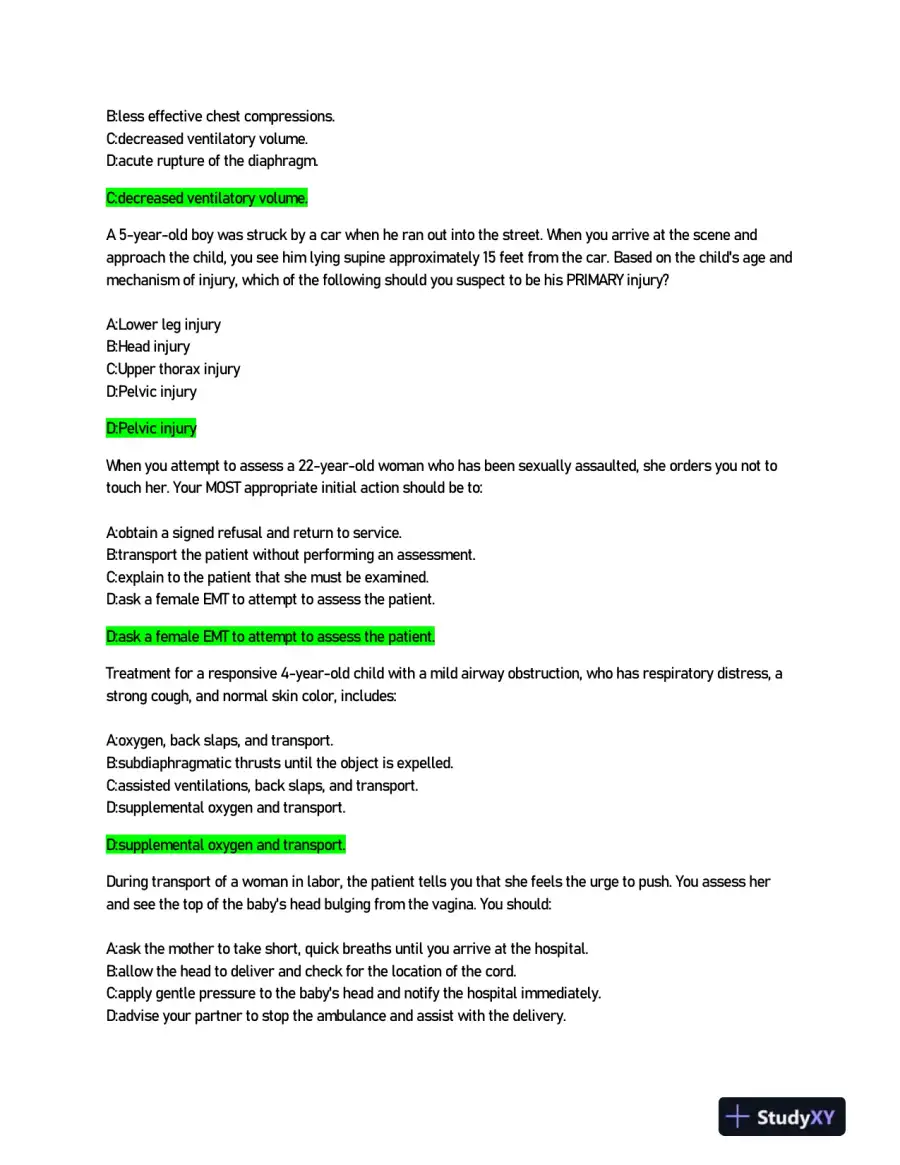 B:less effective chest compressions.C:decreased ventilatory volume.D:acute rupture of the diaphragm.C:decreased ventilatory volume.A 5-year-old boy was struck by a car when he ran out into the street. When you arrive at the scene andapproach the child, you see him lying supine approximately 15 feet from the car. Based on the child's age andmechanism of injury, which of the following should you suspect to be his PRIMARY injury?A:Lower leg injuryB:Head injuryC:Upper thorax injuryD:Pelvic injuryD:Pelvic injuryWhen you attempt to assess a 22-year-old woman who has been sexually assaulted, she orders you not totouch her. Your MOST appropriate initial action should be to:A:obtain a signed refusal and return to service.B:transport the patient without performing an assessment.C:explain to the patient that she must be examined.D:ask a female EMT to attempt to assess the patient.D:ask a female EMT to attempt to assess the patient.Treatment for a responsive 4-year-old child with a mild airway obstruction, who has respiratory distress, astrong cough, and normal skin color, includes:A:oxygen, back slaps, and transport.B:subdiaphragmatic thrusts until the object is expelled.C:assisted ventilations, back slaps, and transport.D:supplemental oxygen and transport.D:supplemental oxygen and transport.During transport of a woman in labor, the patient tells you that she feels the urge to push. You assess herand see the top of the baby's head bulging from the vagina. You should:A:ask the mother to take short, quick breaths until you arrive at the hospital.B:allow the head to deliver and check for the location of the cord.C:apply gentle pressure to the baby's head and notify the hospital immediately.D:advise your partner to stop the ambulance and assist with the delivery.
Page 5
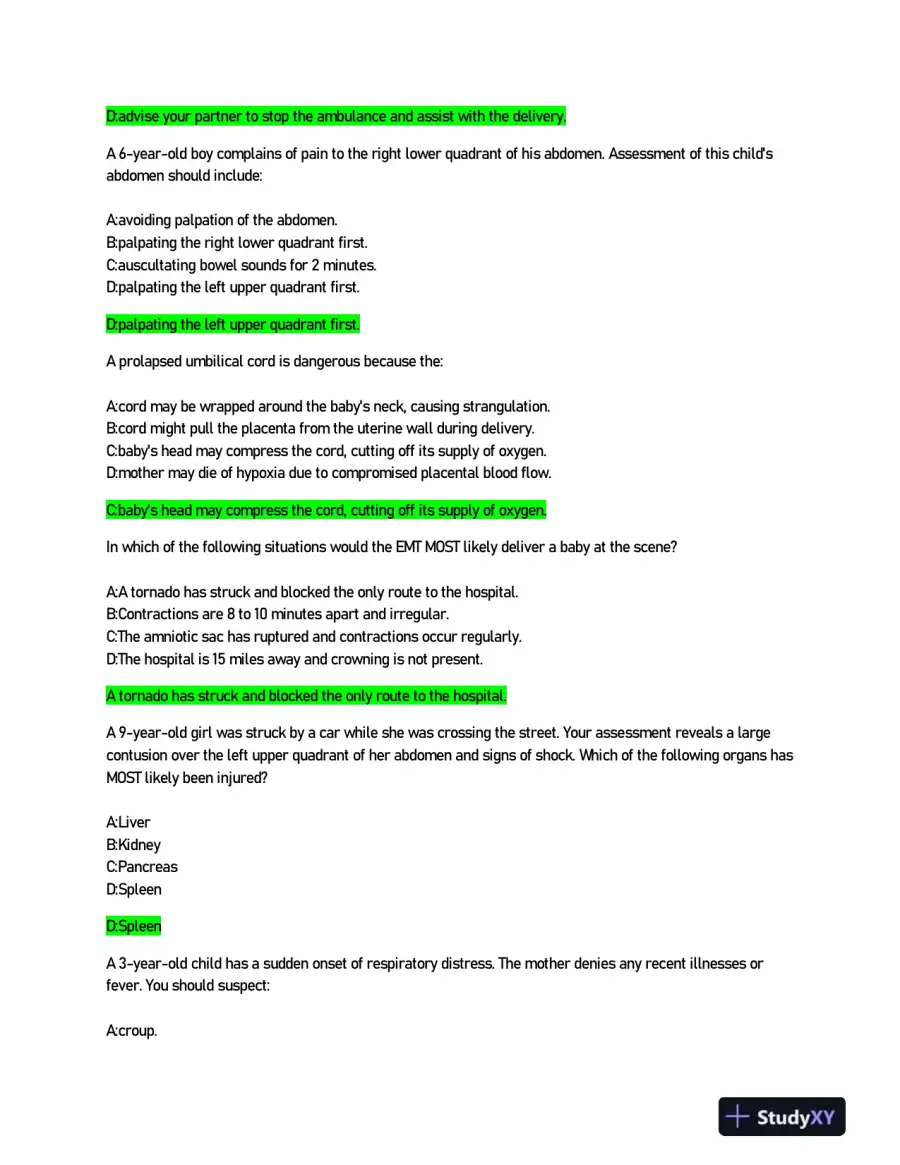 D:advise your partner to stopthe ambulance and assist with the delivery.A 6-year-old boy complains of pain to the right lower quadrant of his abdomen. Assessment of this child'sabdomen should include:A:avoiding palpation of the abdomen.B:palpating the right lower quadrant first.C:auscultating bowel sounds for 2 minutes.D:palpating the left upper quadrant first.D:palpating the left upper quadrant first.A prolapsed umbilical cord is dangerous because the:A:cord may be wrapped around the baby's neck, causing strangulation.B:cord might pull the placenta from the uterine wall during delivery.C:baby's head may compress the cord, cutting off its supply of oxygen.D:mother may die of hypoxia due to compromised placental blood flow.C:baby's head may compress the cord, cutting offits supply of oxygen.In which of the following situations would the EMT MOST likely deliver a baby at the scene?A:A tornado has struck and blocked the only route to the hospital.B:Contractions are 8 to 10 minutes apart and irregular.C:The amniotic sac has ruptured and contractions occur regularly.D:The hospital is 15 miles away and crowning is not present.A tornado has struck and blocked the only route to the hospital.A 9-year-old girl was struck by a car while she was crossing the street. Your assessment reveals a largecontusion over the left upper quadrant of her abdomen and signs of shock. Which of the following organs hasMOST likely been injured?A:LiverB:KidneyC:PancreasD:SpleenD:SpleenA 3-year-old child has a sudden onset of respiratory distress. The mother denies any recent illnesses orfever. You should suspect:A:croup.
Page 6
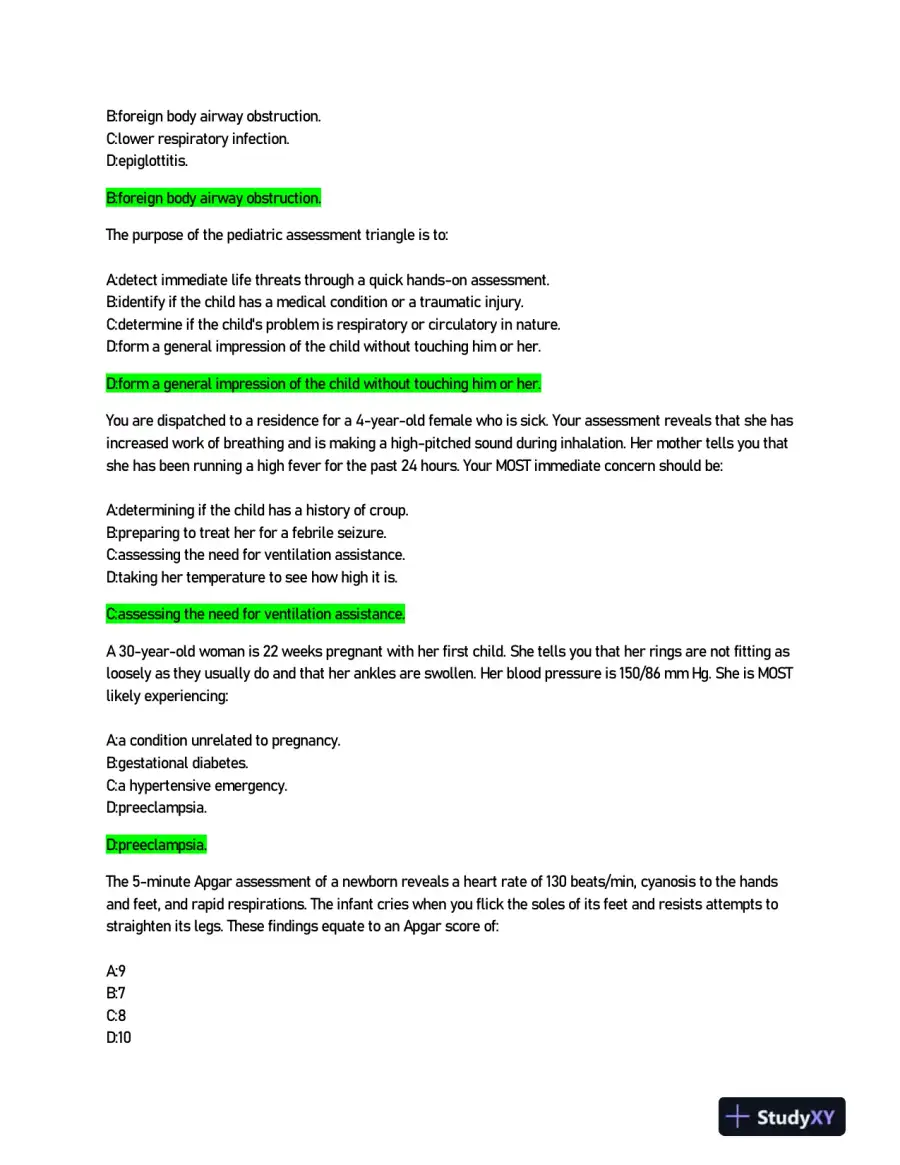 B:foreign body airway obstruction.C:lower respiratory infection.D:epiglottitis.B:foreign body airway obstruction.The purpose of the pediatric assessment triangle is to:A:detect immediate life threats through a quick hands-on assessment.B:identify if the child has a medical condition or a traumatic injury.C:determine if the child's problem is respiratory or circulatory in nature.D:form a general impression of the child without touching him or her.D:form a general impression of the child without touching him or her.You are dispatched to a residence for a 4-year-old female who is sick. Your assessment reveals that she hasincreased work of breathing and is making a high-pitched sound during inhalation. Her mother tells you thatshe has been running a high fever for the past 24 hours. Your MOST immediate concern should be:A:determining if the child has a history of croup.B:preparing to treat her for a febrile seizure.C:assessing the need for ventilation assistance.D:taking her temperature to see how high it is.C:assessing the need for ventilation assistance.A 30-year-old woman is 22 weeks pregnant with her first child. She tells you that her rings are not fitting asloosely as they usually do and that her ankles are swollen. Her blood pressure is 150/86 mm Hg. She is MOSTlikely experiencing:A:a condition unrelated to pregnancy.B:gestational diabetes.C:a hypertensive emergency.D:preeclampsia.D:preeclampsia.The 5-minute Apgar assessment of a newborn reveals a heart rate of 130 beats/min, cyanosis to the handsand feet, and rapid respirations. The infant cries when you flick the soles of its feet and resists attempts tostraighten its legs. These findings equate to an Apgar score of:A:9B:7C:8D:10
Page 7
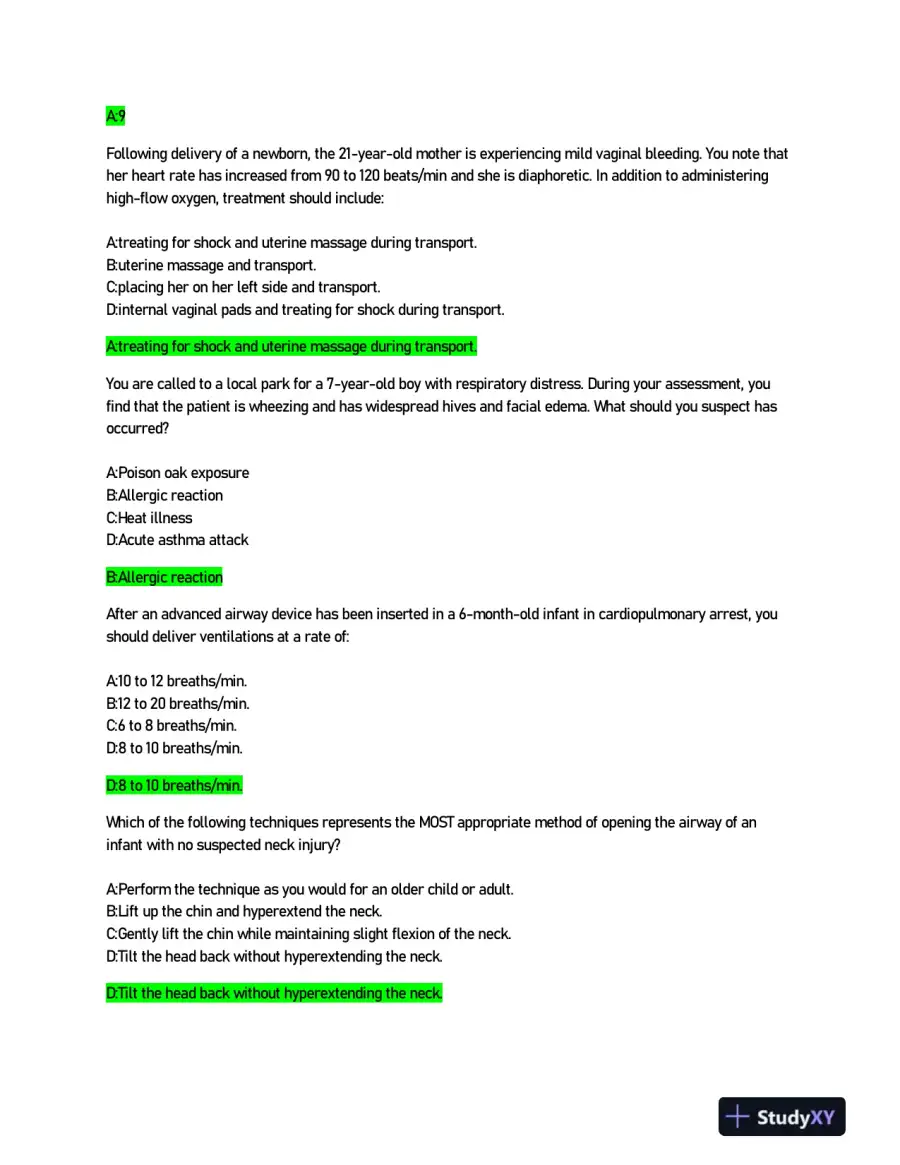 A:9Following delivery of a newborn, the 21-year-old mother is experiencing mild vaginal bleeding. You note thather heart rate has increased from 90 to 120 beats/min and she is diaphoretic. In addition to administeringhigh-flow oxygen, treatment should include:A:treating for shock and uterine massage during transport.B:uterine massage and transport.C:placing her on her left side and transport.D:internal vaginal pads and treating for shock during transport.A:treating for shock and uterine massage during transport.You are called to a local park for a 7-year-old boy with respiratory distress. During your assessment, youfind that the patient is wheezing and has widespread hives and facial edema. What should you suspect hasoccurred?A:Poison oak exposureB:Allergic reactionC:Heat illnessD:Acute asthma attackB:Allergic reactionAfter an advanced airway device has been inserted in a 6-month-old infant in cardiopulmonary arrest, youshould deliver ventilations at a rate of:A:10 to 12 breaths/min.B:12 to 20 breaths/min.C:6 to 8 breaths/min.D:8 to 10 breaths/min.D:8 to 10 breaths/min.Which of the following techniques represents the MOST appropriate method of opening the airway of aninfant with no suspected neck injury?A:Perform the technique as you would for an older child or adult.B:Lift up the chin and hyperextend the neck.C:Gently lift the chin while maintaining slight flexion of the neck.D:Tilt the head back without hyperextending the neck.D:Tilt the head back without hyperextending the neck.
16 more pages in the full document
Unlock it once and it stays in your library, ready to chat with or turn into flashcards.
Unlock the full documentMore Assessment Technologies Institute study materials
See all Past Exams
ATI Maternal Newborn Practice Exam with Answers (210 Solved Questions)
Assessment Technologies Institute
114 pages141downloadsFeb 2025 Past Exams
ATI PN Pediatrics Proctored Exam Version 8 with Answers (166 Solved Questions)
Assessment Technologies Institute
40 pages126downloadsFeb 2025 Past Exams
2023 ATI NGN Comprhensive Exit Exam with Answers (87 Solved Questions)
Assessment Technologies Institute
40 pages115downloadsFeb 2025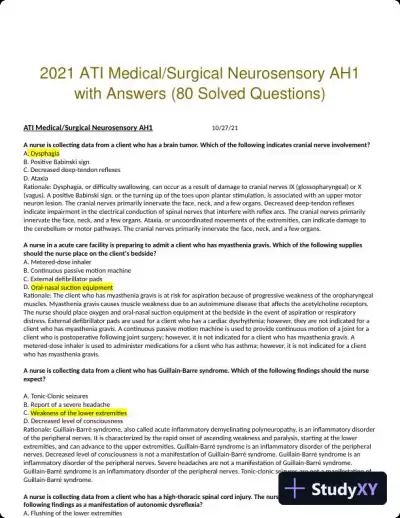 Past Exams
2021 ATI Medical/Surgical Neurosensory AH1 with Answers (80 Solved Questions)
Assessment Technologies Institute
19 pages106downloadsFeb 2025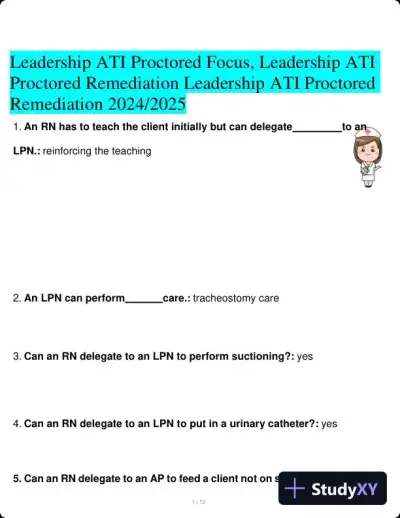 Past Exams
2024-2025 ATI Leadership Proctored Focus Practice Exam with Answers (63 Solved Questions)
Assessment Technologies Institute
27 pages99downloadsFeb 2025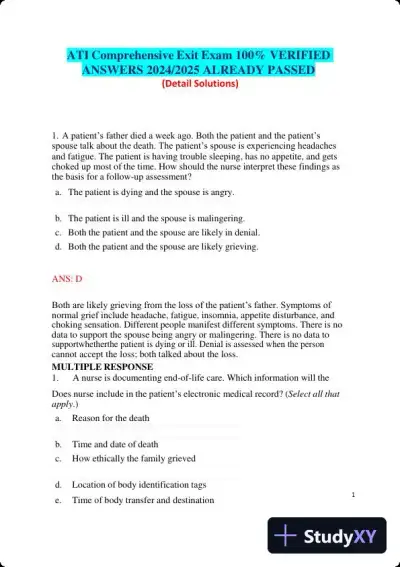 Past Exams
2024-2025 ATI Comprehensive Exit Exam with Answers (13 Solved Questions)
Assessment Technologies Institute
6 pages77downloadsFeb 2025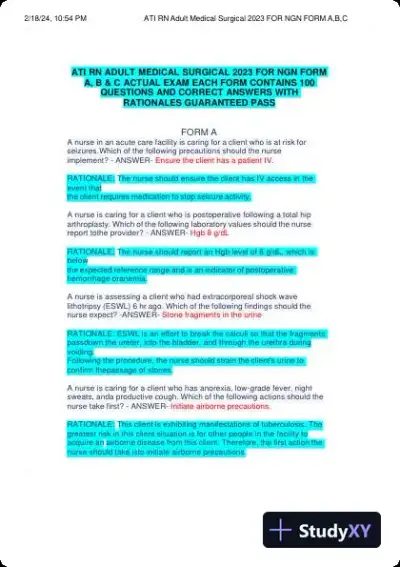 Past Exams
2023 ATI RN Adult Medical Surgical For NGN Form A, B, C with Answers (21 Solved Questions)
Assessment Technologies Institute
9 pages71downloadsFeb 2025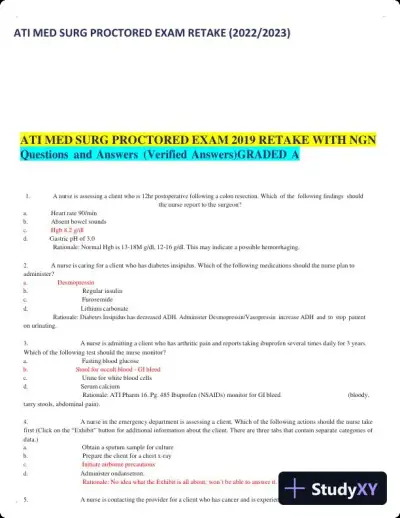 Past Exams
2022-2023 ATI Med Surg Proctored Exam Retake with Answers (111 Solved Questions)
Assessment Technologies Institute
37 pages68downloadsFeb 2025
Study this document with CramX
Once it is in your library, every tool can work from it.