
Past Exams
2021-2022 ATI Fundamentals Proctored Exam with Answers (400 Solved Questions)
- Assessment Technologies Institute
- 145 pages
- Shared May 2025
2021-2022 ATI Fundamentals Proctored Exam with Answers prepares you for your exams with solved papers that reflect the format of real test questions.
Preview · 16 of 145 pages
100%
Page 1
 ATI FundamentalsProctored Exam |Questions and AnswersComplete withRationalesLATEST 2021/ 2022lOMoARcPSD|13778330
Page 2

Page 3
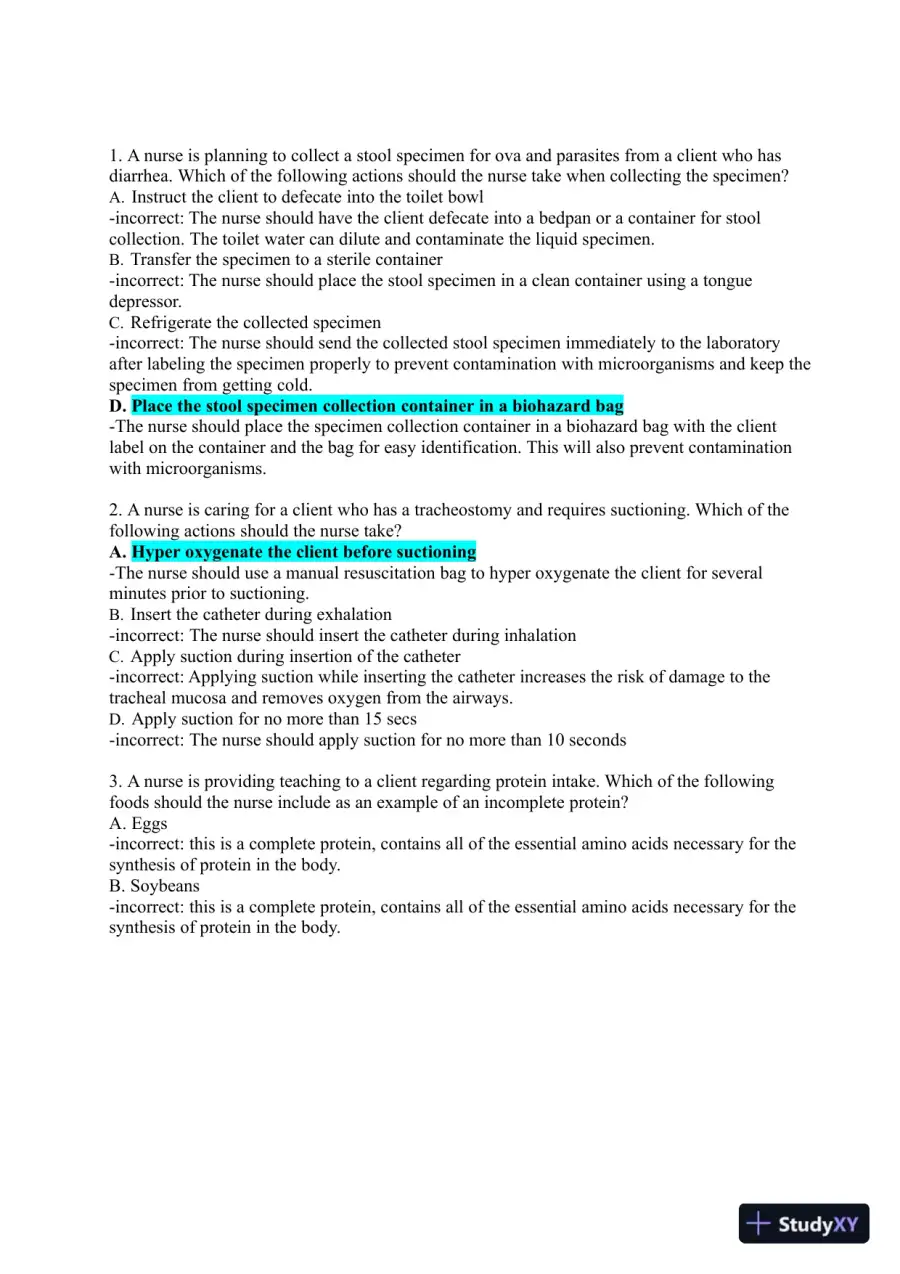 1. A nurse is planning to collect a stool specimen for ova and parasites from a client who hasdiarrhea. Which of the following actions should the nurse take when collecting the specimen?A.Instruct the client to defecate into the toilet bowl-incorrect: The nurse should have the client defecate into a bedpan or a container for stoolcollection. The toilet water can dilute and contaminate the liquid specimen.B.Transfer the specimen to a sterile container-incorrect: The nurse should place the stool specimen in a clean container using a tonguedepressor.C.Refrigerate the collected specimen-incorrect: The nurse should send the collected stool specimen immediately to the laboratoryafter labeling the specimen properly to prevent contamination with microorganisms and keep thespecimen from getting cold.D. Place the stool specimen collection container in a biohazard bag-The nurse should place the specimen collection container in a biohazard bag with the clientlabel on the container and the bag for easy identification. This will also prevent contaminationwith microorganisms.2. A nurse is caring for a client who has a tracheostomy and requires suctioning. Which of thefollowing actions should the nurse take?A. Hyper oxygenate the client before suctioning-The nurse should use a manual resuscitation bag to hyper oxygenate the client for severalminutes prior to suctioning.B.Insert the catheter during exhalation-incorrect: The nurse should insert the catheter during inhalationC.Apply suction during insertion of the catheter-incorrect: Applying suction while inserting the catheter increases the risk of damage to thetracheal mucosa and removes oxygen from the airways.D.Apply suction for no more than 15 secs-incorrect: The nurse should apply suction for no more than 10 seconds3. A nurse is providing teaching to a client regarding protein intake. Which of the followingfoods should the nurse include as an example of an incomplete protein?A. Eggs-incorrect: this is a complete protein, contains all of the essential amino acids necessary for thesynthesis of protein in the body.B. Soybeans-incorrect: this is a complete protein, contains all of the essential amino acids necessary for thesynthesis of protein in the body.lOMoARcPSD|13778330
Page 4
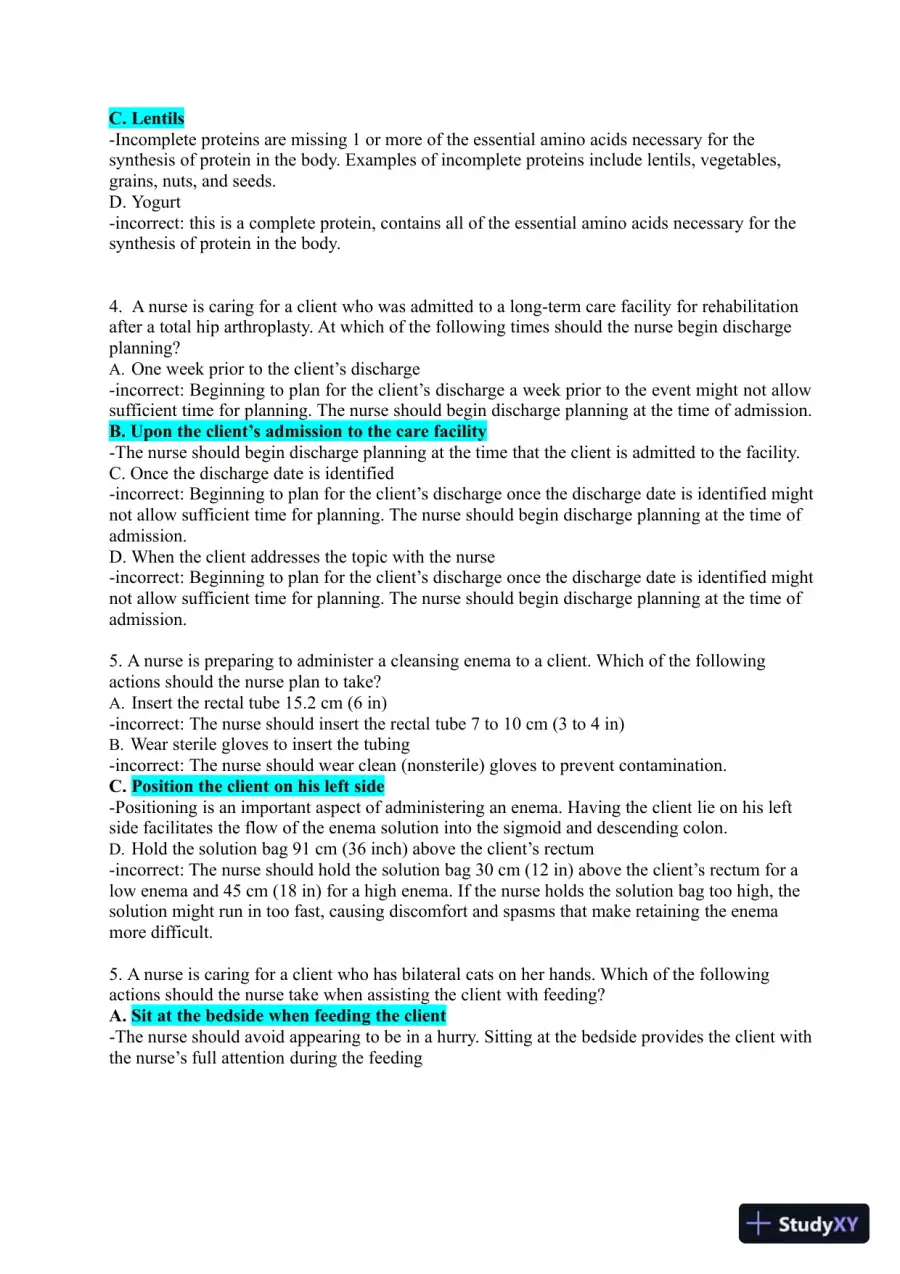 C. Lentils-Incomplete proteins are missing 1 or more of the essential amino acids necessary for thesynthesis of protein in the body. Examples of incomplete proteins include lentils, vegetables,grains, nuts, and seeds.D. Yogurt-incorrect: this is a complete protein, contains all of the essential amino acids necessary for thesynthesis of protein in the body.4. A nurse is caring for a client who was admitted to a long-term care facility for rehabilitationafter a total hip arthroplasty. At which of the following times should the nurse begin dischargeplanning?A.One week prior to the client’s discharge-incorrect: Beginning to plan for the client’s discharge a week prior to the event might not allowsufficient time for planning. The nurse should begin discharge planning at the time of admission.B. Upon the client’s admission to the care facility-The nurse should begin discharge planning at the time that the client is admitted to the facility.C. Once the discharge date is identified-incorrect: Beginning to plan for the client’s discharge once the discharge date is identified mightnot allow sufficient time for planning. The nurse should begin discharge planning at the time ofadmission.D. When the client addresses the topic with the nurse-incorrect: Beginning to plan for the client’s discharge once the discharge date is identified mightnot allow sufficient time for planning. The nurse should begin discharge planning at the time ofadmission.5. A nurse is preparing to administer a cleansing enema to a client. Which of the followingactions should the nurse plan to take?A.Insert the rectal tube 15.2 cm (6 in)-incorrect: The nurse should insert the rectal tube 7 to 10 cm (3 to 4 in)B.Wear sterile gloves to insert the tubing-incorrect: The nurse should wear clean (nonsterile) gloves to prevent contamination.C. Position the client on his left side-Positioning is an important aspect of administering an enema. Having the client lie on his leftside facilitates the flow of the enema solution into the sigmoid and descending colon.D.Hold the solution bag 91 cm (36 inch) above the client’s rectum-incorrect: The nurse should hold the solution bag 30 cm (12 in) above the client’s rectum for alow enema and 45 cm (18 in) for a high enema. If the nurse holds the solution bag too high, thesolution might run in too fast, causing discomfort and spasms that make retaining the enemamore difficult.5. A nurse is caring for a client who has bilateral cats on her hands. Which of the followingactions should the nurse take when assisting the client with feeding?A. Sit at the bedside when feeding the client-The nurse should avoid appearing to be in a hurry. Sitting at the bedside provides the client withthe nurse’s full attention during the feedinglOMoARcPSD|13778330
Page 5
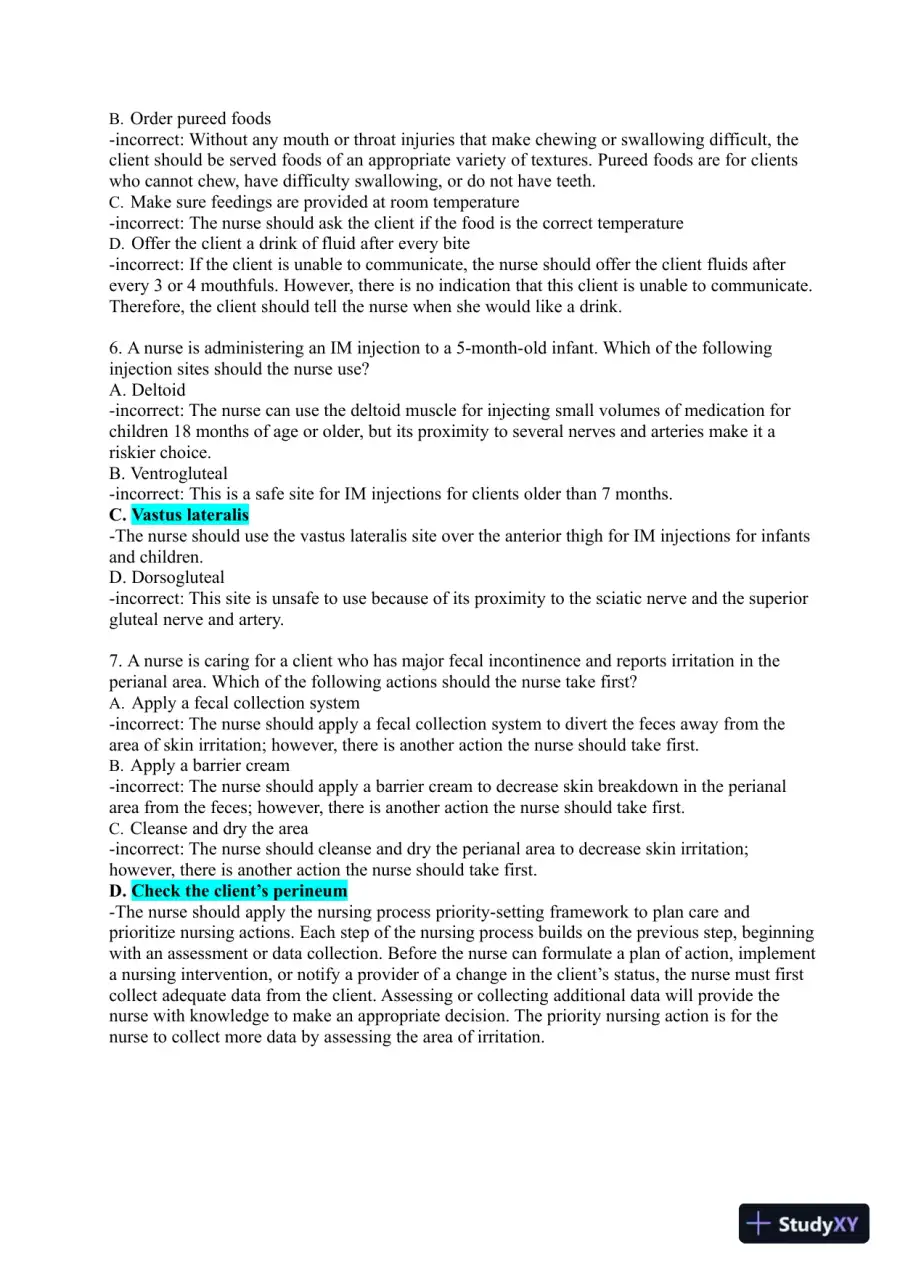 B.Order pureed foods-incorrect: Without any mouth or throat injuries that make chewing or swallowing difficult, theclient should be served foods of an appropriate variety of textures. Pureed foods are for clientswho cannot chew, have difficulty swallowing, or do not have teeth.C.Make sure feedings are provided at room temperature-incorrect: The nurse should ask the client if the food is the correct temperatureD.Offer the client a drink of fluid after every bite-incorrect: If the client is unable to communicate, the nurse should offer the client fluids afterevery 3 or 4 mouthfuls. However, there is no indication that this client is unable to communicate.Therefore, the client should tell the nurse when she would like a drink.6. A nurse is administering an IM injection to a 5-month-old infant. Which of the followinginjection sites should the nurse use?A. Deltoid-incorrect: The nurse can use the deltoid muscle for injecting small volumes of medication forchildren 18 months of age or older, but its proximity to several nerves and arteries make it ariskier choice.B. Ventrogluteal-incorrect: This is a safe site for IM injections for clients older than 7 months.C. Vastus lateralis-The nurse should use the vastus lateralis site over the anterior thigh for IM injections for infantsand children.D. Dorsogluteal-incorrect: This site is unsafe to use because of its proximity to the sciatic nerve and the superiorgluteal nerve and artery.7. A nurse is caring for a client who has major fecal incontinence and reports irritation in theperianal area. Which of the following actions should the nurse take first?A.Apply a fecal collection system-incorrect: The nurse should apply a fecal collection system to divert the feces away from thearea of skin irritation; however, there is another action the nurse should take first.B.Apply a barrier cream-incorrect: The nurse should apply a barrier cream to decrease skin breakdown in the perianalarea from the feces; however, there is another action the nurse should take first.C.Cleanse and dry the area-incorrect: The nurse should cleanse and dry the perianal area to decrease skin irritation;however, there is another action the nurse should take first.D. Check the client’s perineum-The nurse should apply the nursing process priority-setting framework to plan care andprioritize nursing actions. Each step of the nursing process builds on the previous step, beginningwith an assessment or data collection. Before the nurse can formulate a plan of action, implementa nursing intervention, or notify a provider of a change in the client’s status, the nurse must firstcollect adequate data from the client. Assessing or collecting additional data will provide thenurse with knowledge to make an appropriate decision. The priority nursing action is for thenurse to collect more data by assessing the area of irritation.lOMoARcPSD|13778330
Page 6
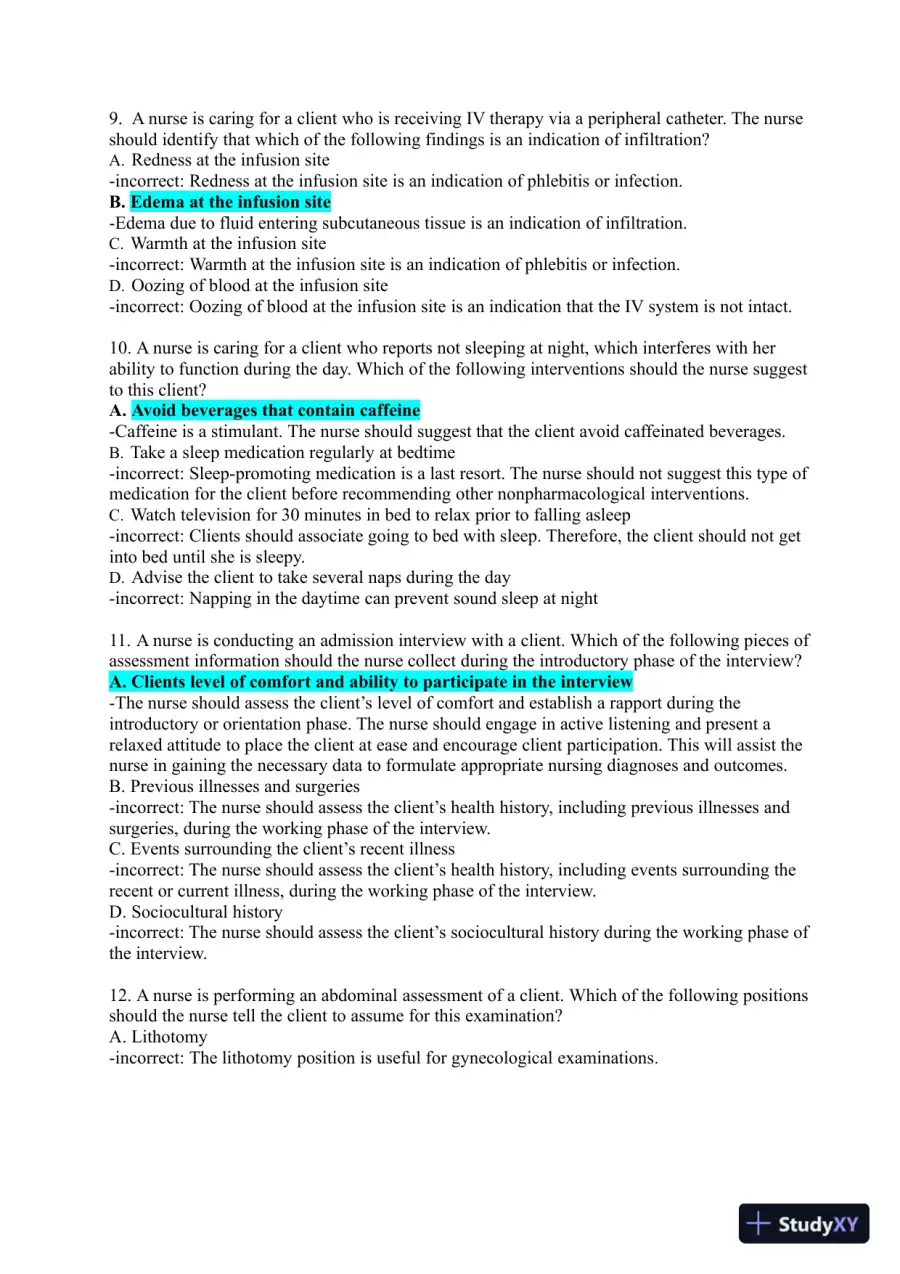 9. A nurse is caring for a client who is receiving IV therapy via a peripheral catheter. The nurseshould identify that which of the following findings is an indication of infiltration?A.Redness at the infusion site-incorrect: Redness at the infusion site is an indication of phlebitis or infection.B. Edema at the infusion site-Edema due to fluid entering subcutaneous tissue is an indication of infiltration.C.Warmth at the infusion site-incorrect: Warmth at the infusion site is an indication of phlebitis or infection.D.Oozing of blood at the infusion site-incorrect: Oozing of blood at the infusion site is an indication that the IV system is not intact.10. A nurse is caring for a client who reports not sleeping at night, which interferes with herability to function during the day. Which of the following interventions should the nurse suggestto this client?A. Avoid beverages that contain caffeine-Caffeine is a stimulant. The nurse should suggest that the client avoid caffeinated beverages.B.Take a sleep medication regularly at bedtime-incorrect: Sleep-promoting medication is a last resort. The nurse should not suggest this type ofmedication for the client before recommending other nonpharmacological interventions.C.Watch television for 30 minutes in bed to relax prior to falling asleep-incorrect: Clients should associate going to bed with sleep. Therefore, the client should not getinto bed until she is sleepy.D.Advise the client to take several naps during the day-incorrect: Napping in the daytime can prevent sound sleep at night11. A nurse is conducting an admission interview with a client. Which of the following pieces ofassessment information should the nurse collect during the introductory phase of the interview?A. Clients level of comfort and ability to participate in the interview-The nurse should assess the client’s level of comfort and establish a rapport during theintroductory or orientation phase. The nurse should engage in active listening and present arelaxed attitude to place the client at ease and encourage client participation. This will assist thenurse in gaining the necessary data to formulate appropriate nursing diagnoses and outcomes.B. Previous illnesses and surgeries-incorrect: The nurse should assess the client’s health history, including previous illnesses andsurgeries, during the working phase of the interview.C. Events surrounding the client’s recent illness-incorrect: The nurse should assess the client’s health history, including events surrounding therecent or current illness, during the working phase of the interview.D. Sociocultural history-incorrect: The nurse should assess the client’s sociocultural history during the working phase ofthe interview.12. A nurse is performing an abdominal assessment of a client. Which of the following positionsshould the nurse tell the client to assume for this examination?A. Lithotomy-incorrect: The lithotomy position is useful for gynecological examinations.lOMoARcPSD|13778330
Page 7
 B. Lateral-incorrect: The lateral recumbent, or side-lying position, limits access to the abdomen. Thisposition is useful when auscultating the heart to detect murmurs.C. Supine-The nurse should tell the client to assume the supine position to promote relaxation of theabdominal muscles. Having the client bend the knees enhances relaxation of the stomachmuscles.D. Sims-incorrect: The Sims’ position limits access to the abdomen. This position is useful for rectal andvaginal examinations.13. A nurse is caring for a client who is postoperative following an abdominal surgery. Which ofthe following actions should the nurse perform first after discovering the client’s wound haseviscerated?A. Cover the incision with a moist sterile dressing- The nurse should apply the safety and risk-reduction priority-setting framework, which assignspriority to the factor or situation posing the greatest safety risk to the client. When there areseveral risks to client safety, the one posing the greatest threat is the highest priority. The nurseshould use Maslow’s Hierarchy of Needs, the ABC priority-setting framework, and/or nursingknowledge to identify which risk poses the greatest threat to the client. An open wound increasesthe risk of peritonitis, and any exposed organ tissue could dry out. Therefore, covering thewound with a moist sterile dressing is the first action the nurse should take to protect the client.B.Have the client lie on his back with his knees flexed-incorrect: The nurse should use this position to reduce pressure on the incision. However, thenurse should take another action first.C.Call the client’s surgeon-incorrect: The nurse should notify the surgeon or direct a colleague to notify the surgeon whiletending to the client’s immediate need. However, the nurse should take another action first.D.Reassure the client-incorrect: The nurse should respond to the client’s emotional needs. However, the nurse shouldtake another action first.14. A nurse is preparing to insert an NG tube for a client who has a bowel obstruction. Which ofthe following actions should the nurse take first?A.Give the client a glass of water-incorrect: The nurse should provide a glass of water to facilitate swallowing during tubeinsertion of the NG tube. However, there is another action the nurse should take first.B.Assist the client into a sitting position-incorrect: The nurse should assist the client into a sitting position to insert the NG tube moreeasily and allow gravity to help facilitate the passage of the tube. However, there is anotheraction the nurse should take first.C. Explain the procedure to the client-The nurse should apply the least invasive priority-setting framework when caring for this client,which assigns priority to nursing interventions that are least invasive to the client, as long asthose interventions do not jeopardize client safety. The nurse should take interventions that arenot invasive to the client before interventions that are invasive. This reduces the number oflOMoARcPSD|13778330
Page 8
 organisms introduced into the body, decreasing the number of facility-acquired infections.Informing the client about the procedure reduces fear and assists in gaining the client’scooperation, which is important for NG tube insertion and is the priority nursing intervention.D.Measure the length of tubing to be inserted-incorrect: The nurse should measure the length of the tubing to be inserted to ensure proper tubeplacement. However, there is another action the nurse should take first.15. A nurse is providing discharge teaching to a client who is recovering from lung cancer. Theprovider instructed the client that he could resume lower-intensity activities of daily living.Which of the following activities should the nurse recommend to the client?A.Sweeping the floor-incorrect: sweeping the floor is moderate-intensity activityB.Shoveling snow-incorrect: Shoveling snow is a high-intensity activityC.Cleaning windows-incorrect: Cleaning windows is a moderate-intensity activityD. Washing dishes-Washing dishes requires a low level of activity and is appropriate for this client.16. A nurse is caring for a client who is receiving dextrose 5% in water IV at 150 mL/hr and hasingested 4 oz of water and ½ pint of milk. What is the total 8-hr fluid intake in milliliters that thenurse should document for this client? (round to nearest whole number)-156017. A nurse is performing a physical examination of a client. The nurse should use percussion toevaluate which of the following parts of the client’s body?A. Heart-incorrect: The nurse uses inspection, palpation, and auscultation to evaluate the heart.B. Lungs-Percussion creates a vibration that helps the examiner determine the density of the underlyingtissue. The lungs are hollow organs that can produce sounds such as resonance (a hollow soundover alveoli) or dullness (a dull sound over consolidated areas of the lungs or diaphragm). Thenurse also uses auscultation and palpation when evaluating the lungs.C.Thyroid gland-incorrect: The nurse uses inspection and palpation to evaluate the thyroid gland.D. Skin-incorrect: The nurse uses inspection and palpation to evaluate the skin.18. A nurse is supervising a newly licensed nurse who is administering a controlled substance.Which of the following actions by the newly licensed nurse indicates an understanding of theprocedure?A.Placing an unused portion of the medication in a sharps box-incorrect: The nurse should not dispose of an unused portion of a controlled substance in thesharps container because this action does not maintain safe control of the narcotic.B. Asking another nurse to observe the disposal of an unused portion of the medicationlOMoARcPSD|13778330
Page 9
 -The nurse should ask another nurse to witness the disposal of a controlled substance to maintainsafe control of the narcotic.C.Counting the inventory of the available narcotic after administering the medication-incorrect: The nurse should count the inventory of the controlled substance before removing adosage to maintain safe control of the narcotic.D.Ensuring that another nurse signs the control inventory form after disposal of an unusedportion of medication-incorrect: Two nurses should sign the control inventory form after the disposal of a portion of anarcotic to maintain safe control.19. A nurse is caring for a client who has acute renal failure. Which of the following assessmentsprovides the most accurate measure of the client’s fluid status?A. Daily weight-According to the evidence-based priority-setting framework, daily weight provides importantinformation about the client’s fluid status. A gain or loss of 1 kg (2.2 lb) indicates a gain or lossof 1 L of fluid; therefore, weighing the client daily will provide the most accurate fluid statusmeasurement.B.Blood Pressure-incorrect: While blood pressure can indicate a client’s fluid gain or losses, it is not the mostaccurate method of measuring fluid changes.C.Specific gravity-incorrect: Specific gravity reflects the kidney’s ability to concentrate urine. While specificgravity reflects client’s fluid gains or losses, it is not the most accurate method used to measurefluid changes.D.Intake and Output-incorrect: Intake and output reflect a client’s fluid status. However, this is not the most accuratemethod to measure fluid changes.20. A nurse in a long-term care facility is admitting a client who is incontinent and smellsstrongly of urine. His partner, who has been caring for him at home, is embarrassed andapologizes for the smell. Which of the following responses should the nurse make?A.“A lot of clients who are cared for at home have the same problem”-incorrect: This automatic response implies that caregivers in the home are not able to keepclient’s odor-free. It is a judgmental statement that is not therapeutic.B.“Don’t worry about it. He will get a bath, and that will take care of the odor.”-incorrect: Telling the partner not to worry blocks communication by devaluing her feelings andher concern about the odor.C. “It must be difficult to care for someone who is confined to bed.”-This response addresses the feelings of the partner by reflecting her feelings, which facilitatestherapeutic communication because it is nonjudgmental and encourages the partner to expressher feelings.D.“When was the last time that he had a bath?”-incorrect: This response implies that the odor of urine has developed because she has not bathedher husband for some time, which is judgmental and nontherapeutic.lOMoARcPSD|13778330
Page 10
 21. A nurse in an emergency department is assessing a client who reports diarrhea and decreasedurination for 4 days. Which of the following actions should the nurse take to assess the client’sskin turgor?A.Push on a fingernail bed until it blanches, release it, and observe how long it takes the skin tobecome pink.-incorrect: This technique assesses capillary refill.B. Grasp a skin fold on the chest under the clavicle, release it, and note whether it springsback.-The nurse should use this technique to assess skin turgor. If the client has good turgor and isproperly hydrated, the skin will immediately return to normal; in dehydration, the skin willremain tented. The nurse can also assess turgor by grasping a skinfold on the back of theforearm.C.Press the skin above the ankle for 5 seconds, release it, and note the depth of the impression.-incorrect: This technique determines the extent of a client’s pitting edema.D.Measure the skinfold thickness on the upper arm using a pair of calibrated skinfold calipers.-incorrect: This technique determines a client’s body fat percentage.22. A nurse discovers that a client received the wrong medication. Which of the followingactions should the nurse take first?A.Complete a medication error report-incorrect: The nurse should follow the facility’s protocol for documenting the incident;however, this is not the first action the nurse should take.B.Notify the prescribing provider-incorrect: The nurse should follow the facility’s protocol for reporting a medication error, whichusually involves notifying the prescribing provider; however, this is not the first action the nurseshould take.C. Assess the client-The greatest risk to the client’s safety is adverse effects from either receiving the wrongmedication or not receiving the prescribed medication. The nurse should assess the client first forany possible adverse effects. This assessment also serves as a baseline for further monitoring foradverse effects.D.Notify the charge nurse-The nurse should follow the facility’s protocol for reporting a medication error, which usuallyinvolves notifying the charge nurse; however, this is not the first action the nurse should take.23. A nurse is performing a breast examination for a female client. Which of the followingtechniques should the nurse use first?A. Inspect both breasts simultaneously-According to evidence-based practice, the nurse should first inspect both breasts with theclient’s arms in several different positions to look for asymmetry, masses, retraction, lesions,inflammation, and dimpling.B.Squeeze the nipples-incorrect: The nurse should compress the nipples to identify the presence of any discharge.However, evidence-based practice indicates that the nurse should use a different techniquebefore compression.C.Palpate the breast and tail of SpencelOMoARcPSD|13778330
Page 11
 -incorrect: The nurse should palpate the breast and tail of Spence to determine the consistency ofbreast tissue and assess the presence of masses. However, evidence-based practice indicates thatthe nurse should use a different technique before palpation of the breast because doing so canalter the accuracy or effectiveness of another phase of the examination.D.Palpate the axillary lymph nodes-incorrect: The nurse should palpate the axillary lymph nodes, which become involved whencancerous lesions metastasize. However, evidence-based practice indicates that the nurse shoulduse a different technique before palpation of the axillary lymph nodes because doing so can alterthe accuracy or effectiveness of another phase of the examination.24. A nurse is helping a client change his hospital gown. The client has an IV infusion via aninfusion pump. Which of the following actions should the nurse take first?A. Remove the sleeve of the gown from the arm without the IV line.-According to evidence-based practice, the nurse should first remove the gown from the client’sarm without the IV line. Beginning this process will enable the nurse to move the gown fully offthe client before stopping the system to remove the gown from the line, resulting in minimalinterruption of the IV flow.B.Slow the infusion using a roller clamp-incorrect: The nurse should slow the infusion using the roller clamp to prevent a large volumeinfusion of IV solution while changing the gown. However, evidence-based practice indicatesthat the nurse should take a different action first.C.Disconnect the IV line from the pump-incorrect: The nurse should disconnect the IV line from the pump while removing andreapplying the gown quickly to maintain the infusion rate prescribed with the pump, however,evidence-based practice indicates that the nurse should take a different action first.D.Bring the IV solution and tubing from the outside to the inside of the sleeve of the gown-incorrect: The nurse should bring the IV solution and tubing through the outside to the inside ofthe sleeve of the gown to avoid tangling of the tubing and the gown. However, evidence-basedpractice indicates that the nurse should take a different action first.25. A nurse is preparing to administer a unit of packed RBC’s to a client when she discovers thatthe IV line is no longer patent. The IV team informs her that someone can come to initiate a newline in 30 min. Which of the following actions should the nurse take?A. Return the blood to the laboratory-Because the nurse knows that the delay will be more than a few minutes, she should return theunit of packed RBCs immediately to the laboratory where the technician will maintain it at theappropriate temperature until the client is ready to receive it.B.Place the blood in the medication room-incorrect: The unit of packed RBCs should not be at room temperature for any length of timebecause the lack of temperature control could damage the blood.C.Place the blood in the refrigeratorIncorrect: Blood products require specific temperature regulation, which is not consistentlypossible in a standard nursing unit refrigerator.D.Leave the blood at the client’s bedside-The nurse should never leave blood products or medication at the bedside due to the potentialfor loss, misuse, or contamination.lOMoARcPSD|13778330
Page 12
 26. A hospice nurse is reviewing religious practices of a group of clients with a newly licensednurse. Which of the following statements by the newly licensed nurse indicates an understandingof the teaching?A.People who practice the Islamic faith pray over the deceased for a period of 5 days beforeburial.-incorrect: For those who practice the Islamic faith, the body of the deceased is washed andwrapped during a ritual and then buried as soon as possible following death.B.People who practice the Hindu faith bury the deceased with their head facing north.-incorrect: People who practice the Hindu faith may place the body with the head facing northfollowing death. However, cremation rather than burial is practiced by those of the Hindu faith.C. People who practice Judaism stay with the body of the deceased until burial.-In the Jewish faith, a family member often stays with the body until burial occurs.D. People who are practicing the Buddhist faith have the female family members prepare thebody following death.-incorrect: Male family members prepare the body following death for individuals practicing theBuddhist faith.27. A nurse is planning an in-service training session about nutrition. Which of the followingstatements should the nurse include in the teaching?A. “Fats provide energy”-Fat serves as a stored energy source for the body, providing 9 cal/g of energy.B.“Carbohydrates repair body tissue”-incorrect: Proteins play a role in tissue repair.C.“Fats regulate fluid balance”-incorrect: Protein is primarily responsible for regulating fluid balance.D.“Carbohydrates prevent interstitial edema”-incorrect: The presence of protein prevents interstitial edema. An appropriate amount ofalbumin in blood keeps interstitial edema from occurring.28. A nurse is caring for a client who requires fluid restriction and may drink only 1 oz of waterwith each oral medication. How many milliliters of water should the nurse document as intakefor the 3 separate medications the client receives during 12-hour night shift? (round to thenearest whole number)9029. A nurse is caring for a client who is dehydrated. The nurse should expect that insensible fluidloss of approximately 500 to 600 mL occurs each day through which of the following organs?A. Kidney’s-incorrect: The kidneys excrete approximately 1,200 to 1,500 mL of urine daily. However, urineis not considered insensible fluid loss. This can increase depending on the client’s intake ofwater.B. Lungs-incorrect: The lungs excrete approximately 400 mL of insensible fluid loss each day.C.Gastrointestinal TractlOMoARcPSD|13778330
Page 13
 -incorrect: The GI tract loses approximately 100-200 mL of fluid each day through feces.However, this is not considered insensible fluid loss.D. Skin-The skin can excrete approximately 500 to 600 mL of insensible fluid loss. This type of fluidloss is continuous and can increase if the client is experiencing a fever or has had a recent burn tothe skin.30. A nurse is caring for an adult client who communicates an unmet spiritual need. Which of thefollowing client statements should indicate to the nurse that the client is experiencing spiritualdistress?A.“Life has its ups and downs”-incorrect: This statement suggests the client is experiencing and incorporating a sense ofspiritual wellbeing by accepting life’s ups and downs.B.“I believe that I control my own destiny”-incorrect: This statement suggests the client is experiencing and incorporating a sense ofspiritual wellbeing by being in control of personal destiny.C. “God is punishing me for something”-Spiritual distress is an impaired ability to integrate meaning and purpose in life through variousmeans, including belief systems and relationships. Manifestations of spiritual distress can includea feeling that a higher power is punishing the individual for some behavior.D.“I like to keep my rosary beads in bed with me”-incorrect: This statement suggests that the client is experiencing and incorporating a sense ofspiritual wellbeing by engaging in prayer activities such as the rosary.31. While in the hospital, a client who has a terminal illness tells the nurse, “I can’t believe I’mdying. A lot of bad people in the world are healthy and here I am dying!” Which of the followingresponses should the nurse provide?A.“Everyone dies sometimes; some die sooner than others.”-incorrect: This is a nontherapeutic response that dismisses and minimizes the client’s feelings.B.“Who do you think deserves to die more than you?”-incorrect: This is a nontherapeutic response that could be perceived as confrontational by theclient.C.“It does seem unfair, doesn’t it?”-incorrect: While this response acknowledges the client’s feelings, it is a closed-ended statementthat does not facilitate further exploration of the client’s feelings.D. “Tell me more about how you feel about dying?”-This therapeutic response from the nurse seeks more information to form an accurateassessment of the client’s feelings.32. A nurse is administering medication to a client who asks the nurse to leave the medication atthe bedside to be taken at a later time. Which of the following responses should the nurse make?A. “Call me when you are ready, and I will return with the medication.”-The nurse is responsible for administering the medication and for following professionalstandards by adhering to the 6 rights of medication administration.B. “Since you were taking this mediation at home, I will leave it for you to take.”lOMoARcPSD|13778330
Page 14
 -incorrect: At home, the client is responsible and accountable for actions regarding self-administration of medications. In an inpatient setting, the nurse is responsible for administeringmedication to the client.C. “I will come back in 30 mins to check that you took the medication so I can chart the time.”-incorrect: If the nurse returns to the client’s room in 30 minutes, the nurse will not be able toverify that the client took the medication since the client could have hidden or discarded themedication.D. “If you refuse to take the medication now, I can’t give it again until your next scheduledtime.”-incorrect: The nurse is responsible for administering the medication at the scheduled time.Although the policy about time may vary by facility, a medication generally may be given within1 hour of the prescribed time.33. A nurse is admitting a client who will undergo a craniotomy. During the planning phase ofthe nursing process, which of the following actions should the nurse take?A. Establish client outcomes-The planning phase of the nursing process includes developing goals and outcomes that help thenurse create the client’s plan of care.B.Collect information about past health problems-incorrect: The nurse should collect information about the client’s past health problems duringthe assessment phase of the nursing process.C.Determine whether the client has met specific goals-incorrect: The nurse should determine whether the client has met goals during the evaluationphase of the nursing process.D.Identify the client’s specific health problems-incorrect: The nurse should identify the client’s specific health problems during the analysisphase of the nursing process.34. A nurse in a provider’s office is teaching a client about foods that are high in fiber. Which ofthe following food choices made by the client indicate an understanding of the teaching? (SATA)A.Canned peaches-incorrect: Canned fruits, including peaches, are recommended for clients on a low-fiber diet.Fresh fruits contain more fiber.B.White rice-incorrect: White rice is recommended for clients on a low-fiber diet. Brown rice is higher infiber.C. Black beans-Dried peas and beans, including black beans, are high in fiber.D. Whole-grain bread-Whole grains consist of the entire kernel and are also high in fiber.E.Tomato juice-incorrect: Canned juices, with the exception of prune juice, are recommended for clients on alow-fiber diet.35. A nurse is preparing to provide chest physiotherapy for a client who has left lower lobeatelectasis. Which of the following actions should the nurse plan to take?lOMoARcPSD|13778330
Page 15
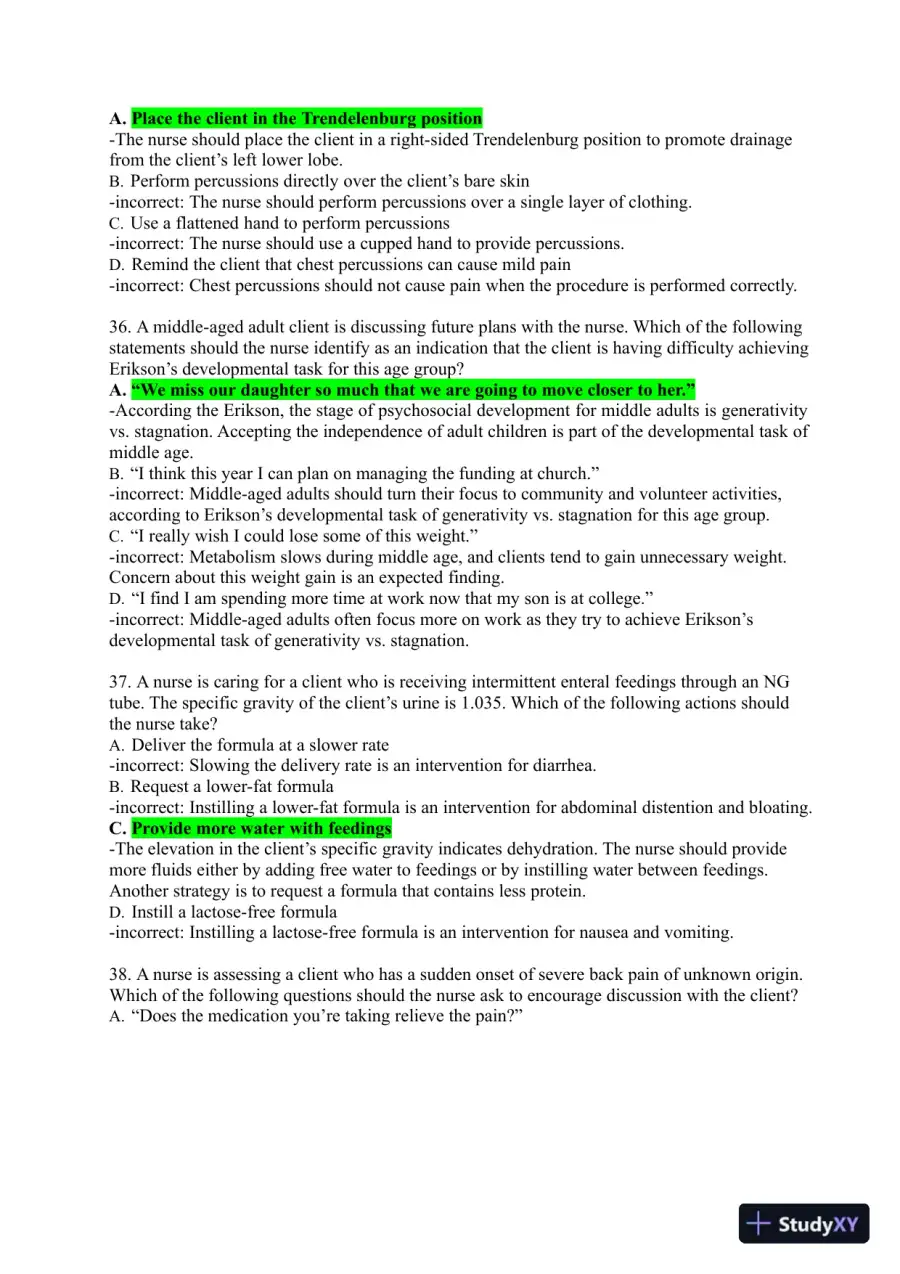 A. Place the client in the Trendelenburg position-The nurse should place the client in a right-sided Trendelenburg position to promote drainagefrom the client’s left lower lobe.B.Perform percussions directly over the client’s bare skin-incorrect: The nurse should perform percussions over a single layer of clothing.C.Use a flattened hand to perform percussions-incorrect: The nurse should use a cupped hand to provide percussions.D.Remind the client that chest percussions can cause mild pain-incorrect: Chest percussions should not cause pain when the procedure is performed correctly.36. A middle-aged adult client is discussing future plans with the nurse. Which of the followingstatements should the nurse identify as an indication that the client is having difficulty achievingErikson’s developmental task for this age group?A. “We miss our daughter so much that we are going to move closer to her.”-According the Erikson, the stage of psychosocial development for middle adults is generativityvs. stagnation. Accepting the independence of adult children is part of the developmental task ofmiddle age.B.“I think this year I can plan on managing the funding at church.”-incorrect: Middle-aged adults should turn their focus to community and volunteer activities,according to Erikson’s developmental task of generativity vs. stagnation for this age group.C.“I really wish I could lose some of this weight.”-incorrect: Metabolism slows during middle age, and clients tend to gain unnecessary weight.Concern about this weight gain is an expected finding.D.“I find I am spending more time at work now that my son is at college.”-incorrect: Middle-aged adults often focus more on work as they try to achieve Erikson’sdevelopmental task of generativity vs. stagnation.37. A nurse is caring for a client who is receiving intermittent enteral feedings through an NGtube. The specific gravity of the client’s urine is 1.035. Which of the following actions shouldthe nurse take?A.Deliver the formula at a slower rate-incorrect: Slowing the delivery rate is an intervention for diarrhea.B.Request a lower-fat formula-incorrect: Instilling a lower-fat formula is an intervention for abdominal distention and bloating.C. Provide more water with feedings-The elevation in the client’s specific gravity indicates dehydration. The nurse should providemore fluids either by adding free water to feedings or by instilling water between feedings.Another strategy is to request a formula that contains less protein.D.Instill a lactose-free formula-incorrect: Instilling a lactose-free formula is an intervention for nausea and vomiting.38. A nurse is assessing a client who has a sudden onset of severe back pain of unknown origin.Which of the following questions should the nurse ask to encourage discussion with the client?A.“Does the medication you’re taking relieve the pain?”lOMoARcPSD|13778330
Page 16
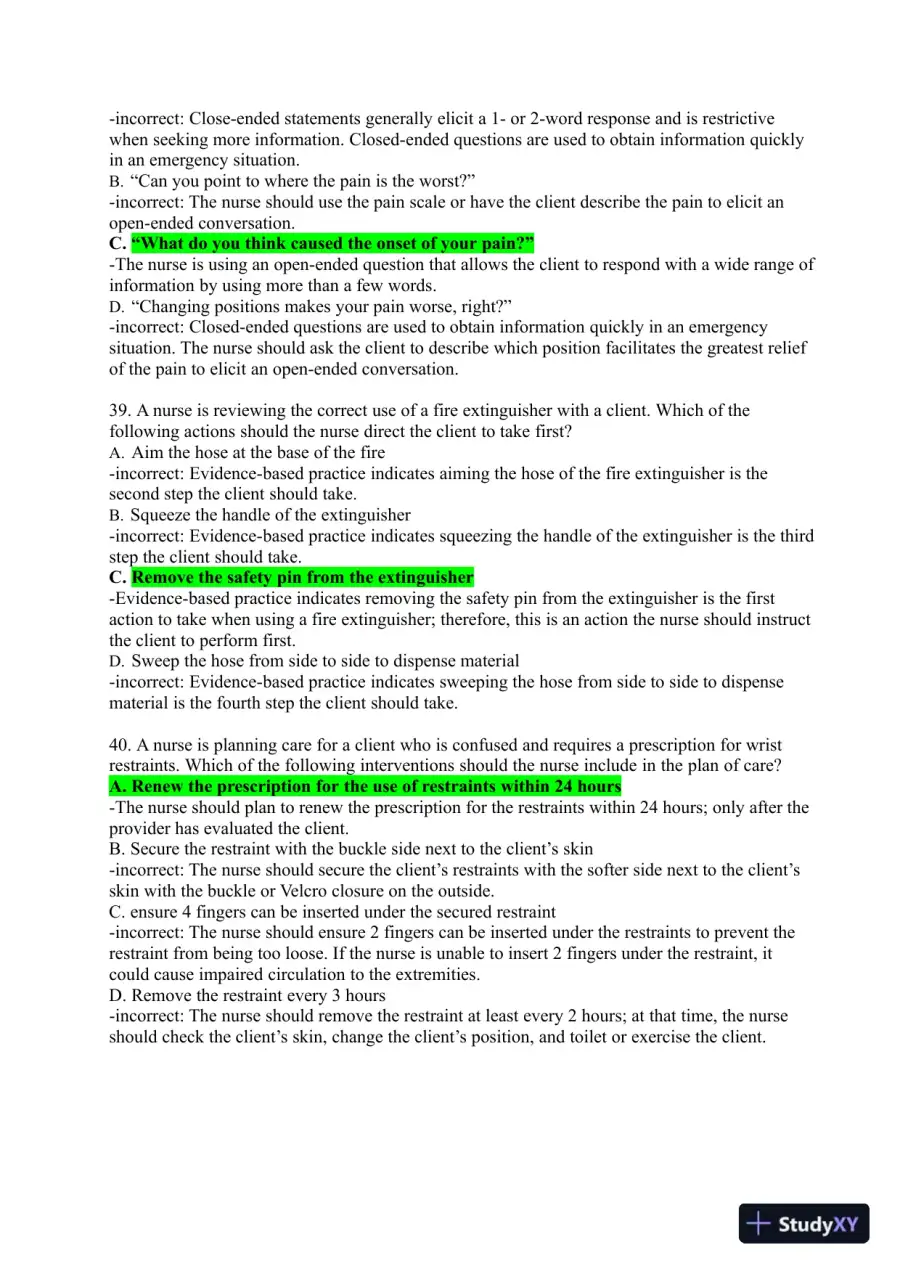 -incorrect: Close-ended statements generally elicit a 1- or 2-word response and is restrictivewhen seeking more information. Closed-ended questions are used to obtain information quicklyin an emergency situation.B.“Can you point to where the pain is the worst?”-incorrect: The nurse should use the pain scale or have the client describe the pain to elicit anopen-ended conversation.C. “What do you think caused the onset of your pain?”-The nurse is using an open-ended question that allows the client to respond with a wide range ofinformation by using more than a few words.D.“Changing positions makes your pain worse, right?”-incorrect: Closed-ended questions are used to obtain information quickly in an emergencysituation. The nurse should ask the client to describe which position facilitates the greatest reliefof the pain to elicit an open-ended conversation.39. A nurse is reviewing the correct use of a fire extinguisher with a client. Which of thefollowing actions should the nurse direct the client to take first?A.Aim the hose at the base of the fire-incorrect: Evidence-based practice indicates aiming the hose of the fire extinguisher is thesecond step the client should take.B.Squeeze the handle of the extinguisher-incorrect: Evidence-based practice indicates squeezing the handle of the extinguisher is the thirdstep the client should take.C. Remove the safety pin from the extinguisher-Evidence-based practice indicates removing the safety pin from the extinguisher is the firstaction to take when using a fire extinguisher; therefore, this is an action the nurse should instructthe client to perform first.D.Sweep the hose from side to side to dispense material-incorrect: Evidence-based practice indicates sweeping the hose from side to side to dispensematerial is the fourth step the client should take.40. A nurse is planning care for a client who is confused and requires a prescription for wristrestraints. Which of the following interventions should the nurse include in the plan of care?A. Renew the prescription for the use of restraints within 24 hours-The nurse should plan to renew the prescription for the restraints within 24 hours; only after theprovider has evaluated the client.B. Secure the restraint with the buckle side next to the client’s skin-incorrect: The nurse should secure the client’s restraints with the softer side next to the client’sskin with the buckle or Velcro closure on the outside.C. ensure 4 fingers can be inserted under the secured restraint-incorrect: The nurse should ensure 2 fingers can be inserted under the restraints to prevent therestraint from being too loose. If the nurse is unable to insert 2 fingers under the restraint, itcould cause impaired circulation to the extremities.D. Remove the restraint every 3 hours-incorrect: The nurse should remove the restraint at least every 2 hours; at that time, the nurseshould check the client’s skin, change the client’s position, and toilet or exercise the client.lOMoARcPSD|13778330
129 more pages in the full document
Unlock it once and it stays in your library, ready to chat with or turn into flashcards.
Unlock the full documentMore Assessment Technologies Institute study materials
See all Past Exams
ATI Maternal Newborn Practice Exam with Answers (210 Solved Questions)
Assessment Technologies Institute
114 pages141downloadsFeb 2025 Past Exams
ATI PN Pediatrics Proctored Exam Version 8 with Answers (166 Solved Questions)
Assessment Technologies Institute
40 pages126downloadsFeb 2025 Past Exams
2023 ATI NGN Comprhensive Exit Exam with Answers (87 Solved Questions)
Assessment Technologies Institute
40 pages115downloadsFeb 2025 Past Exams
2021 ATI Medical/Surgical Neurosensory AH1 with Answers (80 Solved Questions)
Assessment Technologies Institute
19 pages106downloadsFeb 2025 Past Exams
2024-2025 ATI Leadership Proctored Focus Practice Exam with Answers (63 Solved Questions)
Assessment Technologies Institute
27 pages99downloadsFeb 2025 Past Exams
2024-2025 ATI Comprehensive Exit Exam with Answers (13 Solved Questions)
Assessment Technologies Institute
6 pages77downloadsFeb 2025 Past Exams
2023 ATI RN Adult Medical Surgical For NGN Form A, B, C with Answers (21 Solved Questions)
Assessment Technologies Institute
9 pages71downloadsFeb 2025 Past Exams
2022-2023 ATI Med Surg Proctored Exam Retake with Answers (111 Solved Questions)
Assessment Technologies Institute
37 pages68downloadsFeb 2025
Study this document with CramX
Once it is in your library, every tool can work from it.