
Past Exams
2022-2023 ATI RN Medical Surgical Exam with Answers (269 Solved Questions)
- Assessment Technologies Institute
- 58 pages
- Shared May 2025
Use 2022-2023 ATI RN Medical Surgical Exam with Answers to practice real exam questions and answers, helping you achieve exam success.
Preview · 16 of 58 pages
100%
Page 1
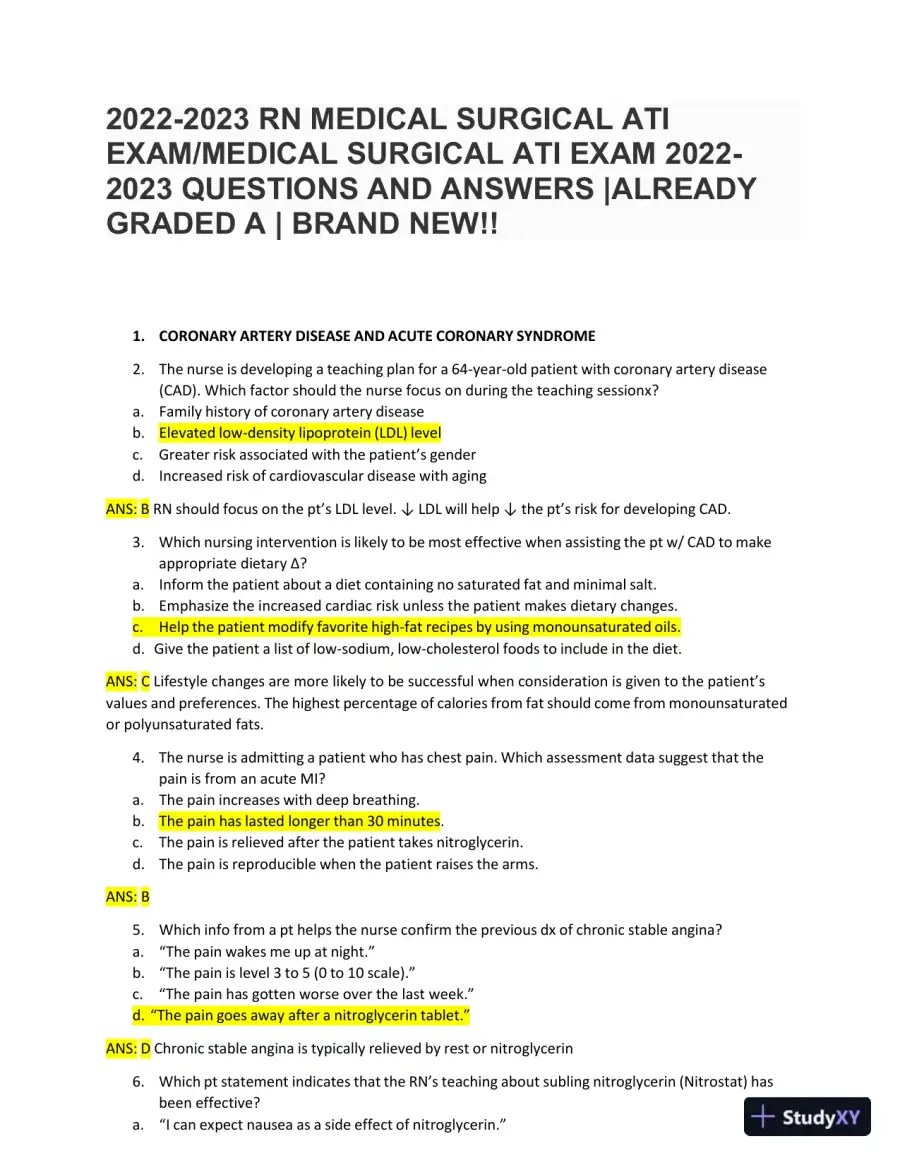 2022-2023 RN MEDICAL SURGICAL ATIEXAM/MEDICAL SURGICAL ATI EXAM 2022-2023 QUESTIONS AND ANSWERS |ALREADYGRADED A | BRAND NEW!!1.CORONARYARTERYDISEASEANDACUTECORONARYSYNDROME2.Thenurseisdevelopingateachingplanfora64-year-oldpatientwithcoronaryarterydisease(CAD).Whichfactorshouldthenursefocusonduringtheteachingsessionx?a.Familyhistoryofcoronaryarterydiseaseb.Elevatedlow-densitylipoprotein(LDL)levelc.Greaterriskassociatedwiththepatient’sgenderd.IncreasedriskofcardiovasculardiseasewithagingANS:BRNshouldfocusonthept’sLDLlevel.↓LDLwillhelp↓thept’sriskfordevelopingCAD.3.Whichnursinginterventionislikelytobemosteffectivewhenassistingtheptw/CADtomakeappropriate dietary∆?a.Informthepatientaboutadietcontainingnosaturatedfatandminimalsalt.b.Emphasize the increased cardiac risk unless the patient makes dietary changes.c.Helpthepatientmodifyfavoritehigh-fatrecipesbyusingmonounsaturatedoils.d.Givethepatientalistoflow-sodium,low-cholesterolfoodstoincludeinthediet.ANS:CLifestyle changes are more likely to be successful when consideration is given to the patient’svaluesandpreferences.Thehighestpercentageofcaloriesfromfatshouldcomefrommonounsaturatedorpolyunsaturatedfats.4.Thenurseisadmittingapatientwhohaschestpain.Whichassessmentdatasuggestthatthepainisfromanacute MI?a.Thepainincreaseswithdeepbreathing.b.Thepainhaslastedlongerthan30minutes.c.Thepainisrelievedafterthepatienttakesnitroglycerin.d.Thepainisreproduciblewhenthepatientraisesthearms.ANS:B5.Whichinfofromapthelpsthenurseconfirmthepreviousdxofchronicstableangina?a.“Thepainwakesmeupatnight.”b.“Thepainislevel3to5(0to10scale).”c.“The pain has gotten worse over the last week.”d.“Thepaingoesawayafteranitroglycerintablet.”ANS:DChronicstableanginaistypicallyrelievedbyrestornitroglycerin6.WhichptstatementindicatesthattheRN’steachingaboutsublingnitroglycerin(Nitrostat)hasbeeneffective?a.“Icanexpectnauseaasasideeffectofnitroglycerin.”
Page 2

Page 3
 b.“IshouldonlytakenitroglycerinwhenIhavechestpain.”c.“Nitroglycerinhelpspreventaclotfromformingandblockingbloodflowtomyheart.”d.“IwillcallanambulanceifIhavepainaftertaking3nitroglycerin5minutesapart.”ANS:D
Page 4
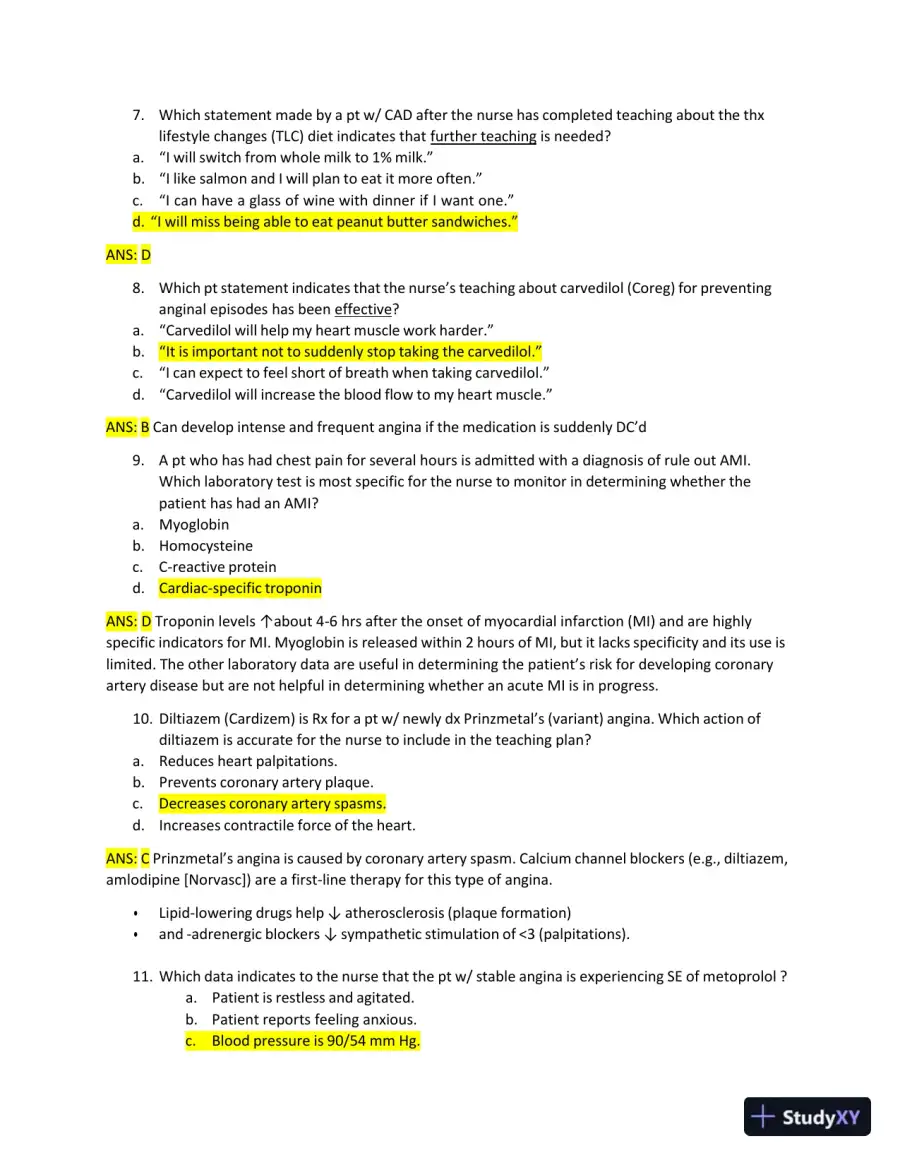 7.Whichstatementmadebyaptw/CADafterthenursehascompletedteachingaboutthethxlifestylechanges(TLC)dietindicatesthatfurtherteachingisneeded?a.“Iwillswitchfromwholemilkto1%milk.”b.“IlikesalmonandIwillplantoeatitmoreoften.”c.“IcanhaveaglassofwinewithdinnerifIwantone.”d.“Iwillmissbeingabletoeatpeanutbuttersandwiches.”ANS:D8.Whichptstatementindicatesthatthenurse’steachingaboutcarvedilol(Coreg)forpreventinganginalepisodeshasbeeneffective?a.“Carvedilolwillhelpmyheartmuscleworkharder.”b.“Itisimportantnottosuddenlystoptakingthecarvedilol.”c.“Icanexpecttofeelshortofbreathwhentakingcarvedilol.”d.“Carvedilolwillincreasethebloodflowtomyheartmuscle.”ANS:BCandevelopintenseandfrequentanginaifthemedicationissuddenlyDC’d9.AptwhohashadchestpainforseveralhoursisadmittedwithadiagnosisofruleoutAMI.WhichlaboratorytestismostspecificforthenursetomonitorindeterminingwhetherthepatienthashadanAMI?a.Myoglobinb.Homocysteinec.C-reactiveproteind.Cardiac-specifictroponinANS:DTroponin levels ↑about 4-6 hrs after the onset of myocardial infarction (MI) and are highlyspecificindicatorsforMI.Myoglobinisreleasedwithin2hoursofMI,butitlacksspecificityanditsuseislimited. The other laboratory data are useful in determining the patient’s risk for developing coronaryarterydiseasebutarenothelpful indeterminingwhetheranacute MIisinprogress.10.Diltiazem(Cardizem)isRxforaptw/newlydxPrinzmetal’s(variant)angina.Whichactionofdiltiazemisaccurateforthenursetoincludeintheteaching plan?a.Reducesheartpalpitations.b.Preventscoronaryarteryplaque.c.Decreasescoronaryarteryspasms.d.Increasescontractileforceoftheheart.ANS:CPrinzmetal’sanginaiscausedbycoronaryarteryspasm.Calciumchannelblockers(e.g.,diltiazem,amlodipine[Norvasc])are afirst-line therapyforthistype ofangina.•Lipid-loweringdrugshelp↓atherosclerosis(plaqueformation)•and-adrenergicblockers↓sympatheticstimulationof<3(palpitations).11.Whichdataindicatestothenursethattheptw/stableanginaisexperiencingSEofmetoprolol?a.Patientisrestlessandagitated.b.Patient reportsfeeling anxious.c.Bloodpressureis90/54mmHg.
Page 5
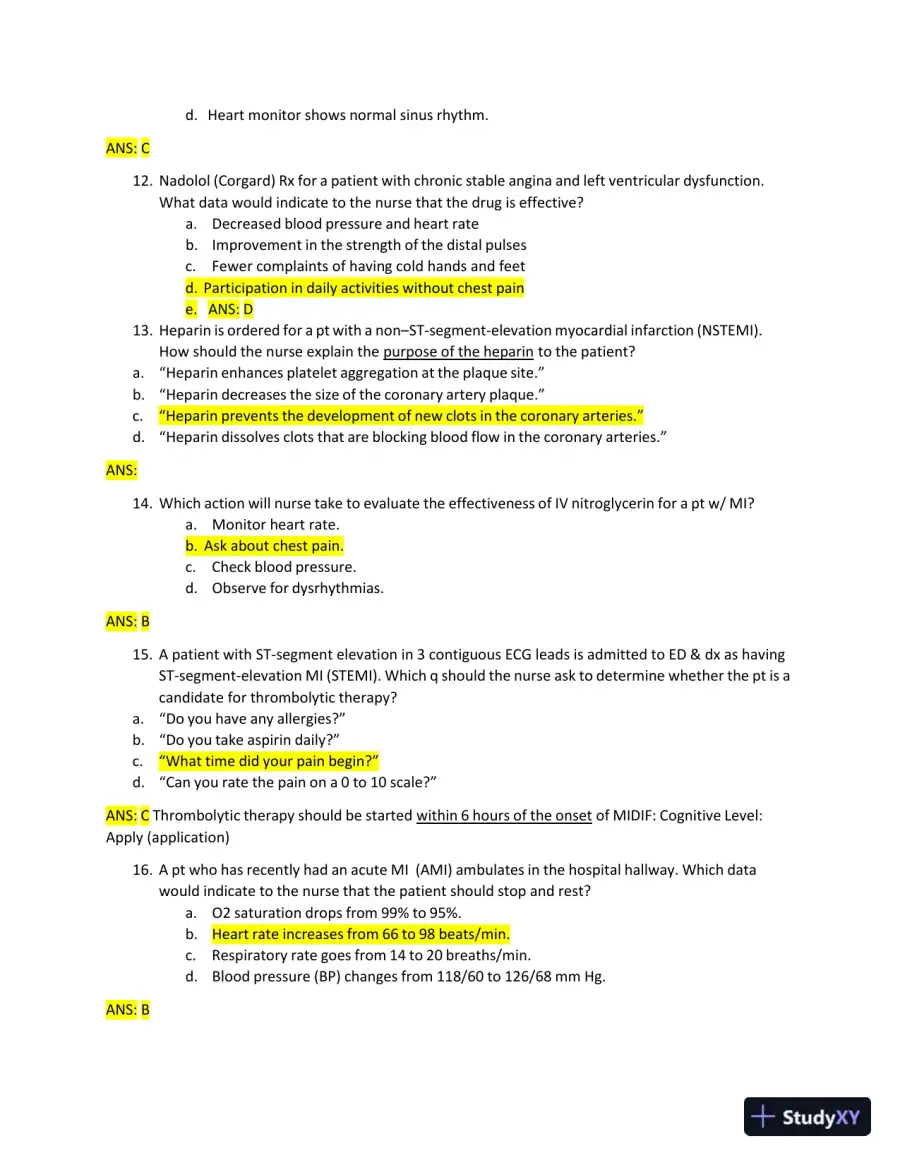 d.Heartmonitorshowsnormalsinusrhythm.ANS:C12.Nadolol(Corgard)Rxforapatientwithchronicstableanginaandleftventriculardysfunction.Whatdatawouldindicate tothenurse thatthedrug iseffective?a.Decreasedbloodpressureandheartrateb.Improvementinthestrengthofthedistalpulsesc.Fewer complaints of having cold hands and feetd.Participationindailyactivitieswithoutchestpaine.ANS:D13.Heparinisorderedforaptwithanon–ST-segment-elevationmyocardialinfarction(NSTEMI).Howshouldthe nurseexplainthepurposeof theheparintothepatient?a.“Heparinenhancesplateletaggregationattheplaquesite.”b.“Heparindecreasesthesizeofthecoronaryarteryplaque.”c.“Heparinpreventsthedevelopmentofnewclotsinthecoronaryarteries.”d.“Heparindissolvesclotsthatareblockingbloodflowinthecoronaryarteries.”ANS:14.WhichactionwillnursetaketoevaluatetheeffectivenessofIVnitroglycerinforaptw/MI?a.Monitor heart rate.b.Askaboutchestpain.c.Checkbloodpressure.d.Observefordysrhythmias.ANS:B15.A patient with ST-segment elevation in 3 contiguous ECG leads is admitted to ED & dx as havingST-segment-elevationMI(STEMI).Whichqshouldthenurseasktodeterminewhethertheptisacandidatefor thrombolytic therapy?a.“Doyouhaveanyallergies?”b.“Doyoutakeaspirindaily?”c.“Whattimedidyourpainbegin?”d.“Canyouratethepainona0to10scale?”ANS:CThrombolytictherapyshouldbestartedwithin6hoursoftheonsetofMIDIF:CognitiveLevel:Apply(application)16.AptwhohasrecentlyhadanacuteMI(AMI)ambulatesinthehospitalhallway.Whichdatawouldindicatetothe nursethatthe patientshouldstopandrest?a.O2saturationdropsfrom99%to95%.b.Heartrateincreasesfrom66to98beats/min.c.Respiratoryrategoesfrom14to20breaths/min.d.Bloodpressure(BP)changesfrom118/60to126/68mmHg.ANS:B
Page 6
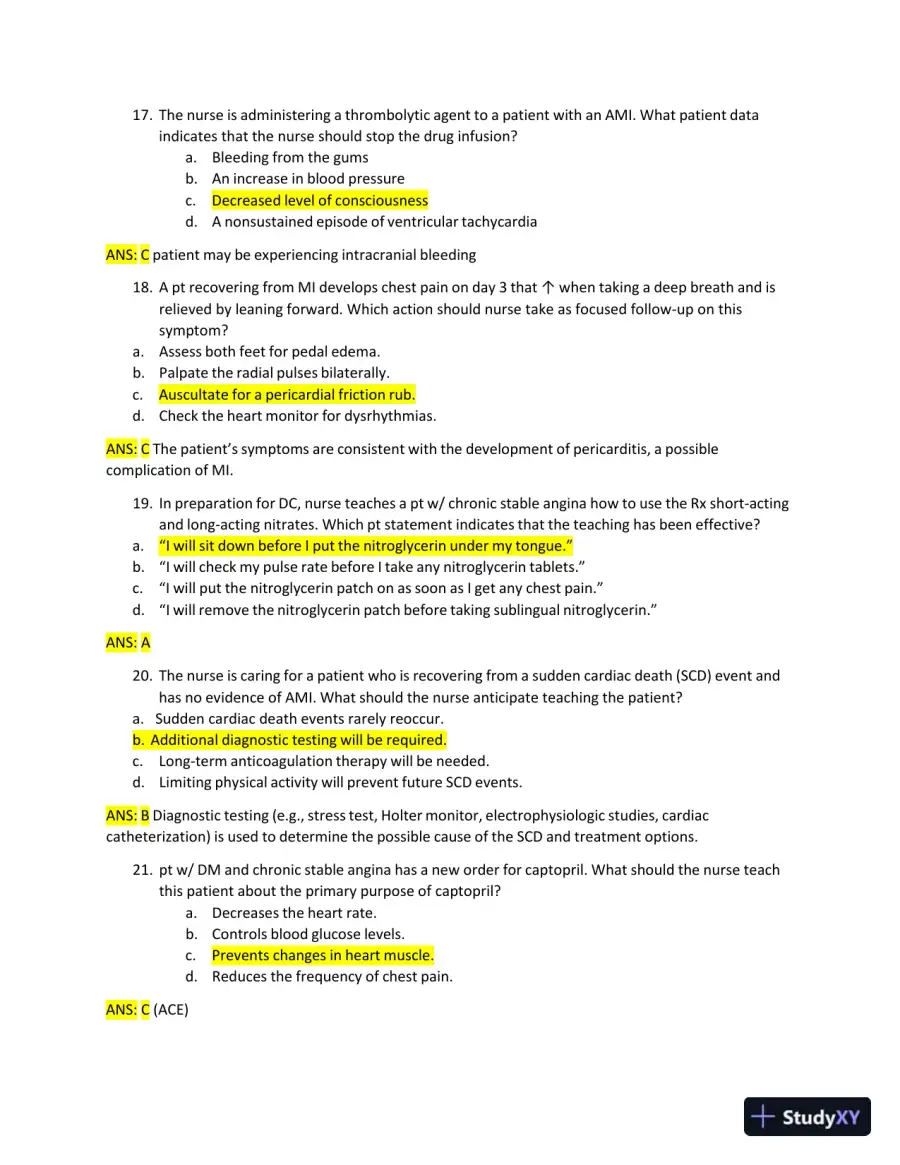 17.ThenurseisadministeringathrombolyticagenttoapatientwithanAMI.Whatpatientdataindicatesthatthe nurseshouldstopthedrug infusion?a.Bleedingfromthegumsb.Anincreaseinbloodpressurec.Decreasedlevelofconsciousnessd.AnonsustainedepisodeofventriculartachycardiaANS:Cpatientmaybeexperiencingintracranialbleeding18.AptrecoveringfromMIdevelopschestpainonday3that↑whentakingadeepbreathandisrelieved by leaning forward. Which action should nurse take as focused follow-up on thissymptom?a.Assessbothfeetforpedaledema.b.Palpatetheradialpulsesbilaterally.c.Auscultateforapericardialfrictionrub.d.Checktheheartmonitorfordysrhythmias.ANS:CThepatient’ssymptomsareconsistentwiththedevelopmentofpericarditis,apossiblecomplicationofMI.19.InpreparationforDC,nurseteachesaptw/chronicstableanginahowtousetheRxshort-actingandlong-actingnitrates.Whichptstatementindicatesthattheteachinghasbeeneffective?a.“IwillsitdownbeforeIputthenitroglycerinundermytongue.”b.“IwillcheckmypulseratebeforeItakeanynitroglycerintablets.”c.“IwillputthenitroglycerinpatchonassoonasIgetanychestpain.”d.“Iwillremovethenitroglycerinpatchbeforetakingsublingualnitroglycerin.”ANS:A20.Thenurseiscaringforapatientwhoisrecoveringfromasuddencardiacdeath(SCD)eventandhasnoevidenceofAMI.Whatshouldthenurseanticipateteachingthepatient?a.Sudden cardiac death events rarely reoccur.b.Additionaldiagnostictestingwillberequired.c.Long-termanticoagulationtherapywillbeneeded.d.LimitingphysicalactivitywillpreventfutureSCDevents.ANS:BDiagnostictesting(e.g.,stresstest,Holtermonitor,electrophysiologicstudies,cardiaccatheterization)isusedtodeterminethepossiblecauseoftheSCDandtreatmentoptions.21.ptw/DMandchronicstableanginahasaneworderforcaptopril.Whatshouldthenurseteachthispatientaboutthe primarypurposeof captopril?a.Decreasestheheartrate.b.Controlsbloodglucoselevels.c.Preventschangesinheartmuscle.d.Reducesthefrequencyofchestpain.ANS:C(ACE)
Page 7
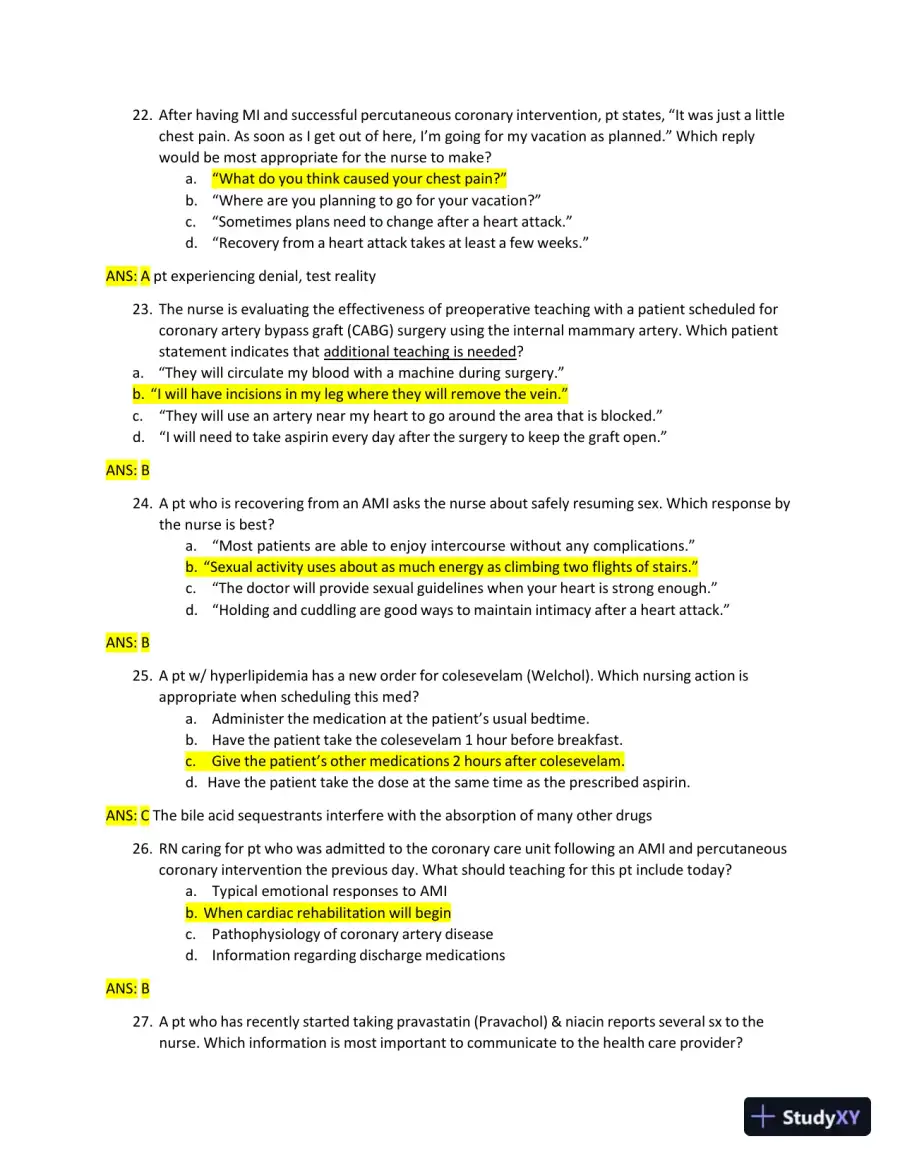 22.AfterhavingMIandsuccessfulpercutaneouscoronaryintervention,ptstates,“Itwasjustalittlechest pain. As soon as I get out of here, I’m going for my vacation as planned.” Which replywouldbe mostappropriateforthe nursetomake?a.“Whatdoyouthinkcausedyourchestpain?”b.“Whereareyouplanningtogoforyourvacation?”c.“Sometimesplansneedtochangeafteraheartattack.”d.“Recoveryfromaheartattacktakesatleastafewweeks.”ANS:Aptexperiencingdenial,testreality23.Thenurseisevaluatingtheeffectivenessofpreoperativeteachingwithapatientscheduledforcoronaryarterybypassgraft(CABG)surgeryusingtheinternalmammaryartery.Whichpatientstatementindicatesthatadditionalteaching isneeded?a.“Theywillcirculatemybloodwithamachineduringsurgery.”b.“Iwillhaveincisionsinmylegwheretheywillremovethevein.”c.“Theywilluseanarterynearmyhearttogoaroundtheareathatisblocked.”d.“Iwillneedtotakeaspirineverydayafterthesurgerytokeepthegraftopen.”ANS:B24.AptwhoisrecoveringfromanAMIasksthenurseaboutsafelyresumingsex.Whichresponsebythe nurseisbest?a.“Mostpatientsareabletoenjoyintercoursewithoutanycomplications.”b.“Sexualactivityusesaboutasmuchenergyasclimbingtwoflightsofstairs.”c.“Thedoctorwillprovidesexualguidelineswhenyourheartisstrongenough.”d.“Holdingandcuddlingaregoodwaystomaintainintimacyafteraheartattack.”ANS:B25.Aptw/hyperlipidemiahasaneworderforcolesevelam(Welchol).Whichnursingactionisappropriate whenscheduling thismed?a.Administerthemedicationatthepatient’susualbedtime.b.Havethepatienttakethecolesevelam1hourbeforebreakfast.c.Givethepatient’sothermedications2hoursaftercolesevelam.d.Havethepatienttakethedoseatthesametimeastheprescribedaspirin.ANS:CThebileacidsequestrantsinterferewiththeabsorptionofmanyotherdrugs26.RNcaringforptwhowasadmittedtothecoronarycareunitfollowinganAMIandpercutaneouscoronaryinterventionthepreviousday.Whatshouldteachingforthisptincludetoday?a.TypicalemotionalresponsestoAMIb.Whencardiacrehabilitationwillbeginc.Pathophysiologyofcoronaryarterydiseased.InformationregardingdischargemedicationsANS:B27.Aptwhohasrecentlystartedtakingpravastatin(Pravachol)&niacinreportsseveralsxtothenurse.Whichinformationismostimportanttocommunicatetothehealthcareprovider?
Page 8
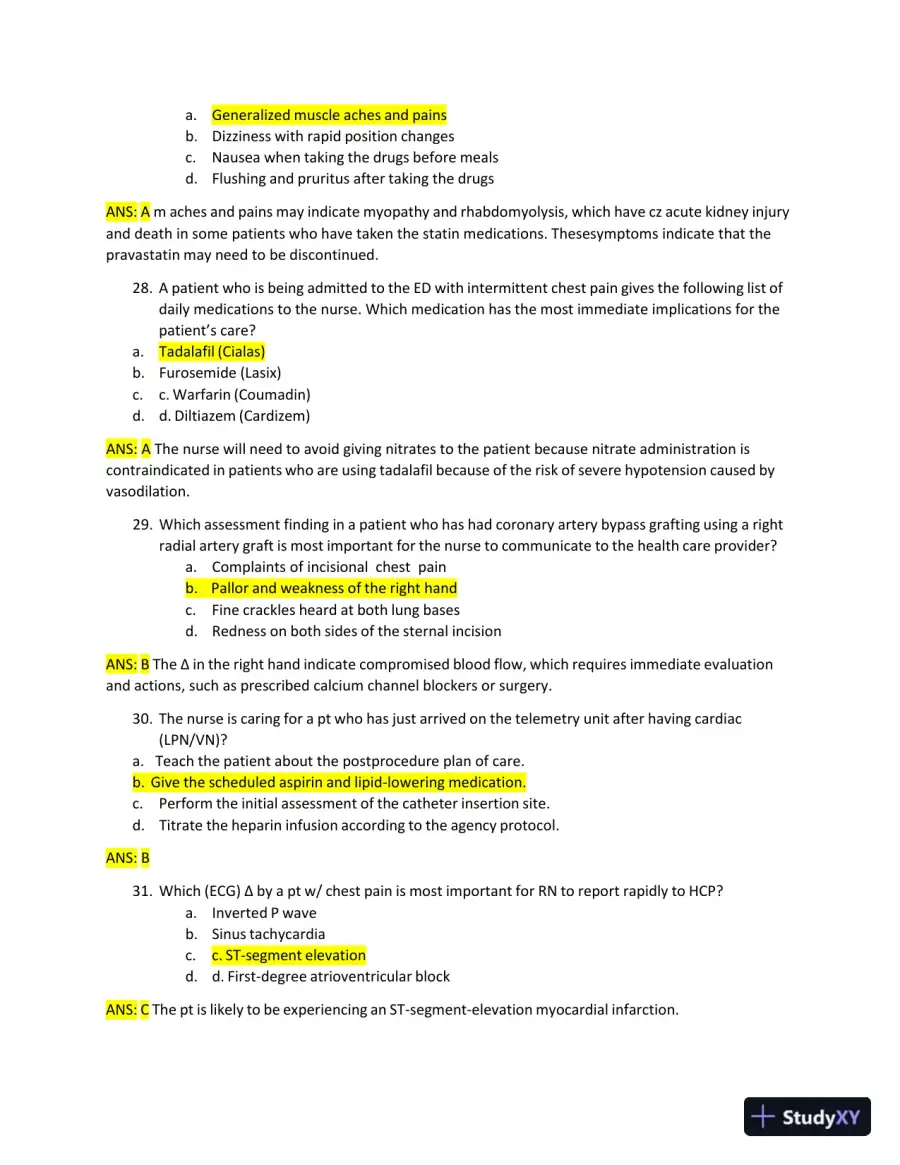 a.Generalizedmuscleachesandpainsb.Dizzinesswithrapidpositionchangesc.Nauseawhentakingthedrugsbeforemealsd.FlushingandpruritusaftertakingthedrugsANS:Amachesandpainsmayindicatemyopathyandrhabdomyolysis,whichhaveczacutekidneyinjuryand death in some patients who have taken the statin medications. Thesesymptoms indicate that thepravastatinmay needtobe discontinued.28.ApatientwhoisbeingadmittedtotheEDwithintermittentchestpaingivesthefollowinglistofdaily medications to the nurse. Which medication has the most immediate implications for thepatient’scare?a.Tadalafil(Cialas)b.Furosemide(Lasix)c.c.Warfarin(Coumadin)d.d.Diltiazem(Cardizem)ANS:AThe nurse will need to avoid giving nitrates to the patient because nitrate administration iscontraindicatedinpatientswhoareusingtadalafilbecauseoftheriskofseverehypotensioncausedbyvasodilation.29.Whichassessmentfindinginapatientwhohashadcoronaryarterybypassgraftingusingarightradialarterygraftismostimportantforthenursetocommunicatetothehealthcareprovider?a.Complaintsofincisionalchestpainb.Pallorandweaknessoftherighthandc.Finecracklesheardatbothlungbasesd.RednessonbothsidesofthesternalincisionANS:BThe∆intherighthandindicatecompromisedbloodflow,whichrequiresimmediateevaluationandactions,suchasprescribedcalciumchannelblockers orsurgery.30.Thenurseiscaringforaptwhohasjustarrivedonthetelemetryunitafterhavingcardiac(LPN/VN)?a.Teach the patient about the postprocedure plan of care.b.Givethescheduledaspirinandlipid-loweringmedication.c.Performtheinitialassessmentofthecatheterinsertionsite.d.Titratetheheparininfusionaccordingtotheagencyprotocol.ANS:B31.Which(ECG)∆byaptw/chestpainismostimportantforRNtoreportrapidlytoHCP?a.InvertedPwaveb.Sinustachycardiac.c.ST-segmentelevationd.d.First-degreeatrioventricularblockANS:CTheptislikelytobeexperiencinganST-segment-elevationmyocardialinfarction.
Page 9
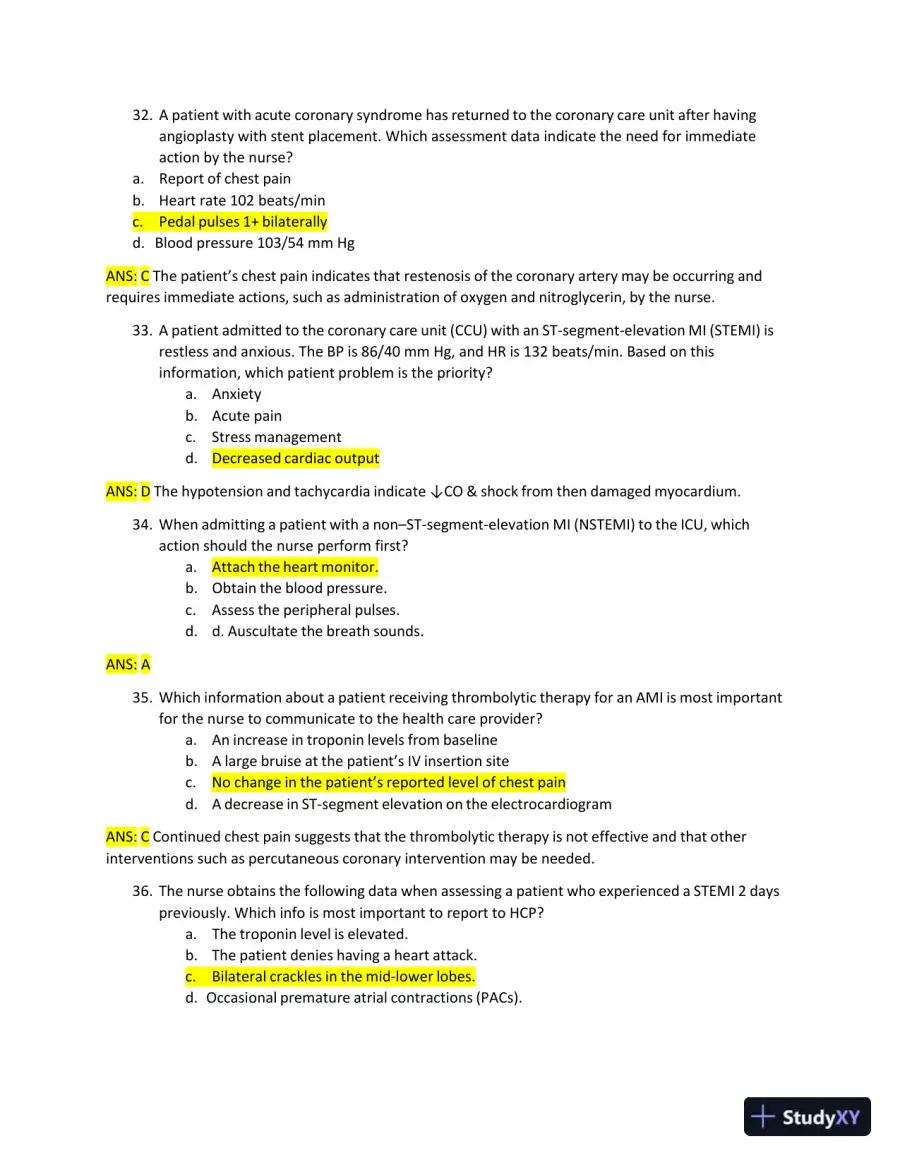 32.Apatientwithacutecoronarysyndromehasreturnedtothecoronarycareunitafterhavingangioplasty with stent placement. Which assessment data indicate the need for immediateactionby the nurse?a.Reportofchestpainb.Heart rate 102 beats/minc.Pedalpulses1+bilaterallyd.Bloodpressure103/54mmHgANS:CThepatient’schestpainindicatesthatrestenosisofthecoronaryarterymaybeoccurringandrequiresimmediateactions,suchasadministrationofoxygenandnitroglycerin,bythenurse.33.Apatientadmittedtothecoronarycareunit(CCU)withanST-segment-elevationMI(STEMI)isrestless and anxious. The BP is 86/40 mm Hg, and HR is 132 beats/min. Based on thisinformation,whichpatientproblemisthepriority?a.Anxietyb.Acutepainc.Stressmanagementd.DecreasedcardiacoutputANS:DThehypotensionandtachycardiaindicate↓CO&shockfromthendamagedmyocardium.34.Whenadmittingapatientwithanon–ST-segment-elevationMI(NSTEMI)totheICU,whichactionshouldthe nurseperformfirst?a.Attachtheheartmonitor.b.Obtainthebloodpressure.c.Assesstheperipheralpulses.d.d.Auscultatethebreathsounds.ANS:A35.WhichinformationaboutapatientreceivingthrombolytictherapyforanAMIismostimportantforthe nursetocommunicatetothehealthcareprovider?a.Anincreaseintroponinlevelsfrombaselineb.Alargebruiseatthepatient’sIVinsertionsitec.Nochangeinthepatient’sreportedlevelofchestpaind.AdecreaseinST-segmentelevationontheelectrocardiogramANS:CContinuedchestpainsuggeststhatthethrombolytictherapyisnoteffectiveandthatotherinterventionssuchaspercutaneouscoronaryinterventionmaybeneeded.36.ThenurseobtainsthefollowingdatawhenassessingapatientwhoexperiencedaSTEMI2dayspreviously.WhichinfoismostimportanttoreporttoHCP?a.Thetroponinleveliselevated.b.Thepatientdenieshavingaheartattack.c.Bilateralcracklesinthemid-lowerlobes.d.Occasionalprematureatrialcontractions(PACs).
Page 10
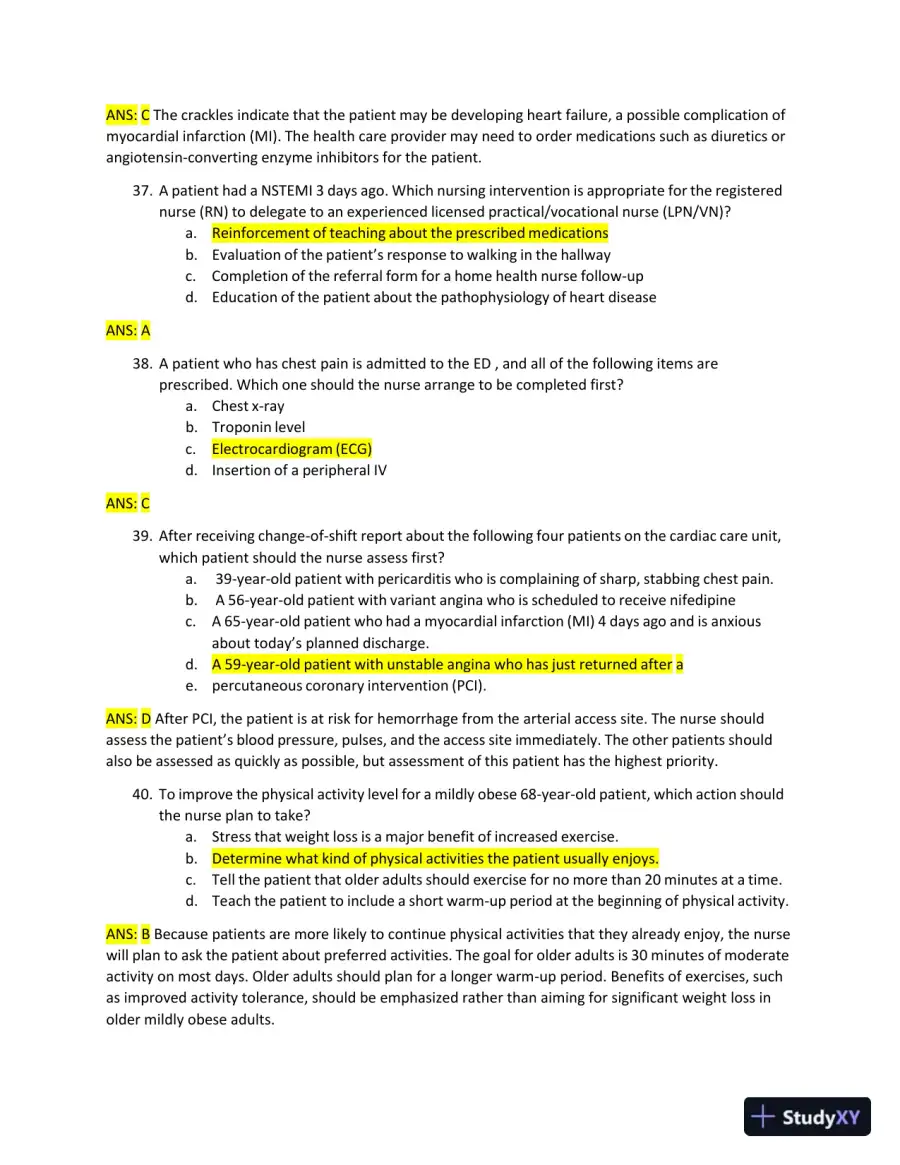 ANS:CThecracklesindicatethatthepatientmaybedevelopingheartfailure,apossiblecomplicationofmyocardialinfarction(MI).Thehealthcareprovidermayneedtoordermedicationssuchasdiureticsorangiotensin-convertingenzyme inhibitorsfor the patient.37.ApatienthadaNSTEMI3daysago.Whichnursinginterventionisappropriatefortheregisterednurse(RN)todelegatetoanexperiencedlicensedpractical/vocationalnurse(LPN/VN)?a.Reinforcementofteachingabouttheprescribedmedicationsb.Evaluationofthepatient’sresponsetowalkinginthehallwayc.Completionofthereferralformforahomehealthnursefollow-upd.EducationofthepatientaboutthepathophysiologyofheartdiseaseANS:A38.A patient who has chest pain is admitted to the ED , and all of the following items areprescribed.Whichoneshouldthenursearrangetobecompletedfirst?a.Chestx-rayb.Troponinlevelc.Electrocardiogram(ECG)d.InsertionofaperipheralIVANS:C39.Afterreceivingchange-of-shiftreportaboutthefollowingfourpatientsonthecardiaccareunit,whichpatientshouldthe nurseassessfirst?a.39-year-oldpatientwithpericarditiswhoiscomplainingofsharp,stabbingchestpain.b.A56-year-oldpatientwithvariantanginawhoisscheduledtoreceivenifedipinec.A65-year-oldpatientwhohadamyocardialinfarction(MI)4daysagoandisanxiousabouttoday’splanneddischarge.d.A59-year-oldpatientwithunstableanginawhohasjustreturnedafterae.percutaneouscoronaryintervention(PCI).ANS:DAfter PCI, the patient is at risk for hemorrhage from the arterial access site. The nurse shouldassessthepatient’sbloodpressure,pulses,andtheaccesssiteimmediately.Theotherpatientsshouldalsobeassessedasquicklyaspossible,butassessmentofthispatienthasthehighestpriority.40.Toimprovethephysicalactivitylevelforamildlyobese68-year-oldpatient,whichactionshouldthe nurseplantotake?a.Stressthatweightlossisamajorbenefitofincreasedexercise.b.Determinewhatkindofphysicalactivitiesthepatientusuallyenjoys.c.Tellthepatientthatolderadultsshouldexercisefornomorethan20minutesatatime.d.Teachthepatienttoincludeashortwarm-upperiodatthebeginningofphysicalactivity.ANS:BBecause patients are more likely to continue physical activities that they already enjoy, the nursewillplantoaskthepatientaboutpreferredactivities.Thegoalforolderadultsis30minutesofmoderateactivity on most days. Older adults should plan for a longer warm-up period. Benefits of exercises, suchas improved activity tolerance, should be emphasized rather than aiming for significant weight loss inoldermildly obeseadults.
Page 11
 41.Whichpatientatthecardiovascularclinicrequiresthemostimmediateactionbythenurse?a.Patientwithtype2diabeteswhosecurrentbloodglucoselevelis145mg/dL.b.Patientwithstableanginawhosechestpainhasrecentlyincreasedinfrequency.c.Patientwithfamilialhypercholesterolemiaandatotalcholesterolof465mg/dL.d.Patientwithchronichypertensionwhosebloodpressuretodayis172/98mmHg.ANS:B42.Thenursereviewsinformationshownintheaccompanyingfigurefromthemedicalrecordsofa43-year-oldpatient.Whichriskfactormodificationforcoronaryarterydiseaseshouldthenurseincludeinpatientteaching?a.Importanceofdailyphysicalactivityb.Effectofweightlossonbloodpressurec.Dietarychangestoimprovelipidlevelsd.CardiacriskassociatedwithprevioustobaccouseANS:CThepatienthasanelevatedlow-densitylipoproteincholesterolandlowhigh-densitylipoproteincholesterol,whichwillincreasethe riskof coronaryartery disease.43.After reviewinga patient’s history, vital signs, physical assessment, and laboratory data, whichinformationshownintheaccompanyingfigureismostimportantforthenursetocommunicatetothe HCP?a.Hyperglycemiab.Bilateralcracklesc.QwavesonECGd.ElevatedtroponinANS:BPulmonarycongestionsuggeststhatthepatientmaybedevelopingheartfailure2.HEARTFAILURE1.Whileassessinganolderadultpatient,thenursenotesjugularvenousdistention(JVD)withtheheadofthepatient’sbedelevated45degrees.Whatdoesthisfindingindicate?a.Decreasedfluidvolumeb.Jugularveinatherosclerosisc.Increasedrightatrialpressured.IncompetentjugularveinvalvesANS:CThejugularveinsemptyintothesuperiorvenacavaandthenintotherightatrium,soJVDwiththepatientsittingata45-degreeangle reflectsincreasedrightatrialpressure.2.The nurse is caring for a patient who is receiving IV furosemide (Lasix) and morphine for tx ofacutedecompensatedheartfailure(ADHF)withsevereorthopnea.Whichclinicalfindingisthebestindicator tx beeneffective?a.Weightlossof2lbin24hoursb.Hourlyurineoutputgreaterthan60mLc.Reduceddyspneawiththeheadofbedat30degrees
Page 12
 d.PatientdeniesexperiencingchestpainorchestpressureANS:CBecausept’smajorclinicalmanifestationofADHFisorthopnea(causedbythepresenceoffluidinthe alveoli), the best indicator that the medications are effective is a decrease in dyspnea with the headof the bedat30degrees.3.WhichtopicwillRNplantoincludeinDCteachingforptw/HFreducedejectionfraction(HFrEF)?a.Needtobeginanaerobicexerciseprogramseveraltimesweeklyb.Benefitsandeffectsofangiotensin-convertingenzyme(ACE)inhibitorsc.Useofsaltsubstitutestoreplacetablesaltwhencookingandatthetabled.ImportanceofmakinganannualappointmentwiththehealthcareproviderANS:BThecoremeasuresfortxofHFindicatethatptsw/anejectionfractionbelow40%shouldreceiveanACE inhibitorto↓ progressionofHF.4.IVNa+nitroprussideisorderedforptw/acutepulmonaryedema.Whichreassessmentfindingduring1sthrsofadminindicatesthatRNshould↓therateofnitroprussideinfusion?a.Ventricularectopyb.Dry,hackingcoughc.SystolicBPbelow90mmHgd.Heartratebelow50beats/minANS:CNa+nitroprussideisapotentvasodilatorandthemajoradverseeffectisseverehypotension.5.A pt who has chronic HF tells the nurse, “I was fine when I went to bed, but I woke up in themiddleofthenightfeelinglikeIwassuffocating!”Howshouldthenursedocumentthisfinding?a.Orthopneab.Pulsusalternansc.Paroxysmalnocturnaldyspnead.AcutebilateralpleuraleffusionANS:CParoxysmal nocturnal dyspnea is caused by the reabsorption of fluid from dependentbody areaswhen the patient is sleeping and is characterized by waking up suddenly with the feeling of suffocation.Pulsus alternans is the alteration of strong and weak peripheral pulses during palpation. Orthopneaindicatesthatthepatientisunabletolieflatbecauseofdyspnea.Pleuraleffusionsdevelopoveralongertime period.6.Whichstatementbyaptnewlydxw/HFindicatestothenursethatteachingwaseffective?a.“Iwilltakefurosemide(Lasix)everydayjustbeforebedtime.”b.“IwillusethenitroglycerinpatchwheneverIhavechestpain.”c.“IwilluseanadditionalpillowifIamshortofbreathatnight.”d.“Iwillcalltheclinicifmyweightgoesup3poundsinaweek.”ANS:D7.Whenteachingptw/HFona2000-mgNa+diet,whichfoodsshouldthenurserecommendlimiting?a.Chickenandeggsb.Cannedandfrozenfruits
Page 13
 c.Yogurtandmilkproductsd.FreshorfrozenvegetablesANS:CYogurtandmilkproducts(e.g.,cheese)naturallycontainasignificantamountofNa+8.ThenurseplansDCteachingforptw/chronicHFwhohasRxfordigoxin(Lanoxin)andhydrochlorothiazide.Whichinstructionshouldthenurseinclude?a.Limitdietarysourcesofpotassium.b.Takethehydrochlorothiazideatbedtime.c.Notifythehealthcareproviderifnauseadevelops.d.Takethedigoxinifthepulseisbelow60beats/min.ANS:CNauseaisasymptomofdigoxintoxicityandshouldbereportedsothattheprovidercanassessthepatientfor toxicityandadjustthe digoxindose,if necessary.9.Whileadmitting82yow/acutedecompensatedHFtothehospital,RNlearnsthatptlivesalone&sometimesconfuses“waterpill”w/“<3pill.”WhatshouldRNincludeinDCplan?a.Consultwithapsychologist.b.Transfertoalong-termcarefacility.c.Referraltoahomehealthcareagency.d.Arrangementsforaround-the-clockcare.ANS:C10.FollowinganAMI,apreviouslyhealthy60yodevelopsHF.WhatmedtopicshouldRNanticipateincludingin discharge teaching?a.-Adrenergicblockersb.Calciumchannelblockersc.Digitalisandpotassiumtherapyregimend.Angiotensin-convertingenzyme(ACE)inhibitorsANS:DACEinhibitortherapyiscurrentlyrecommendedtopreventthedevelopmentofHFptswhohavehad an MI & as a 1st-line thx for pts w/ chronic HF. Digoxin thx for HF is no longer considered a first-linemeasure, and digoxin is added to tx protocol when thx w/ other drugs such as ACE-inhibitors, diuretics,and-adrenergic blockersisinsufficient.11.53yow/stageDHF&type2DMasksRNif<3transplantisanoption.Accurateresponse?a.“Yourheartfailurehasnotreachedtheendstageyet.”b.“Youcouldnotmanagethemultiplecomplicationsofthatsurgery.”c.“Thesuitabilityofahearttransplantforyoudependsonmanyfactors.”d.“Becauseyouhavediabetes,youwouldnotbeahearttransplantcandidate.”ANS:CIndicationsforahearttransplantincludeend-stageheartfailure(stageD),butotherfactorssuchascopingskills/familysupport/ptmotivationtofollowrigorousposttransplantregimenareconsidered.12.WhichdxtestmostusefultoRNindeterminingwhetherptadmittedw/acuteSOBhasHF?a.Serumtroponinb.Arterialbloodgasesc.B-typenatriureticpeptide(BNP)
Page 14
 d.12-leadelectrocardiogramANS:C(BNP is secreted whenventricular pressures ↑, as they do w/ HF. ↑ BNP indicates a probable orveryprobabledxofHF.A12-leadECG,ABG,andtroponinmayalsobeusedindeterminingthecausesoreffectsof HFbutare notasclearly dxof HFasBNP.13.WhichactionshouldthenurseincludeinPOCforaptadmittedwithacutedecompensatedheartfailure(ADHF)whoisreceivingnesiritide (Natrecor)?a.Monitorbloodpressurefrequently.b.Encouragepatienttoambulateinroom.c.Teachpatienttodrinkatleast3litersoffluiddaily.d.Titratenesiritidedosedownslowlybeforestopping.ANS:ANesiritide is a potent arterial and venous dilator, and the major adverse effect is hypotension.Becausetheptislikelytohaveorthostatichypotension,theptshouldnotbeencouragedtoambulate.Nesiritidedoesnotrequiretitration.ExcessivehydrationcouldexacerbateADHF.14.Ptw/chronicHFhasaneworderforcaptopril12.5mgPO.Aftergivingthe1stdose&teachingptaboutthedrug,whichstatementbyptindicatesthatteachinghasbeeneffective?a.“Iplantotakethemedicationwithfood.”b.“Ishouldeatmorepotassium-richfoods.”c.“IwillcallforhelpwhenIneedtogetuptousethebathroom.”d.“Icanexpecttofeelmoreshortofbreathforthenextfewdays.”ANS:CCaptoprilcancausehypotension,especiallyaftertheinitialdose15.Ptwho’sjustbeenadmittedw/PEisscheduledtoreceivethefollowingmeds.Whichmedshouldnursequestion?a.captopril(Capoten)25mgb.furosemide(Lasix)60mgc.digoxin (Lanoxin) 0.125 mgd.carvedilol(Coreg)3.125mgANS:DAlthough carvedilol is appropriate for tx of chronic HF, it is not used for pts w/ acutedecompensatedHF(ADHF)becauseoftheriskofworseningHF.Theotherdrugsareappropriatefortheptw/ADHF.16.AptwhohaschronicHFisadmittedtotheEDw/severedyspneaandadry,hackingcough.Whichactionshouldthe nursetake 1st?a.Auscultatetheabdomen.b.Checkthecapillaryrefill.c.Auscultatethebreathsounds.d.Askaboutthepatient’sallergies.ANS:CThispt’sseveredyspneaandcoughindicatethatacutedecompensatedHF(ADHF)maybeoccurring.ADHFusuallymanifestsasPE,whichshouldbedetectedandtximmediatelytopreventongoinghypoxemia andcardiac/respiratory arrest.
Page 15
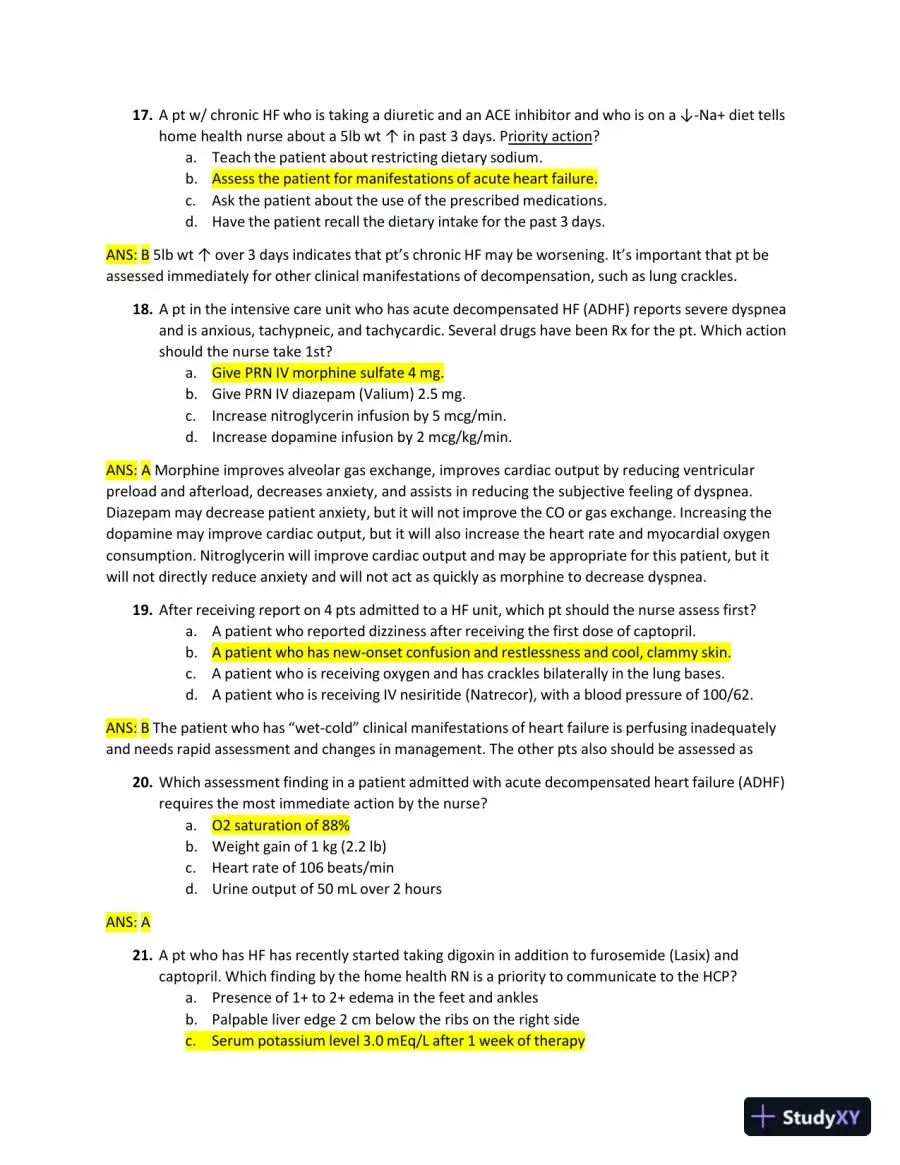 17.Aptw/chronicHFwhoistakingadiureticandanACEinhibitorandwhoisona↓-Na+diettellshomehealthnurseabouta 5lbwt↑inpast3days.Priority action?a.Teachthepatientaboutrestrictingdietarysodium.b.Assessthepatientformanifestationsofacuteheartfailure.c.Askthepatientabouttheuseoftheprescribedmedications.d.Havethepatientrecallthedietaryintakeforthepast3days.ANS:B5lbwt↑over3daysindicatesthatpt’schronicHFmaybeworsening.It’simportantthatptbeassessedimmediatelyforotherclinicalmanifestationsofdecompensation,suchaslungcrackles.18.AptintheintensivecareunitwhohasacutedecompensatedHF(ADHF)reportsseveredyspneaandisanxious,tachypneic,andtachycardic.SeveraldrugshavebeenRxforthept.Whichactionshouldthe nursetake 1st?a.GivePRNIVmorphinesulfate4mg.b.GivePRNIVdiazepam(Valium)2.5mg.c.Increasenitroglycerininfusionby5mcg/min.d.Increasedopamineinfusionby2mcg/kg/min.ANS:AMorphine improves alveolar gas exchange, improves cardiac output by reducing ventricularpreload and afterload, decreases anxiety, and assists in reducing the subjective feeling of dyspnea.Diazepammaydecreasepatientanxiety,butitwillnotimprovetheCOorgasexchange.Increasingthedopamine may improve cardiac output, but it will alsoincrease the heart rate and myocardial oxygenconsumption.Nitroglycerinwillimprovecardiacoutputandmaybeappropriateforthispatient,butitwillnotdirectlyreduceanxietyandwillnotactasquicklyasmorphinetodecreasedyspnea.19.Afterreceivingreporton4ptsadmittedtoaHFunit,whichptshouldthenurseassessfirst?a.Apatientwhoreporteddizzinessafterreceivingthefirstdoseofcaptopril.b.Apatientwhohasnew-onsetconfusionandrestlessnessandcool,clammyskin.c.Apatientwhoisreceivingoxygenandhascracklesbilaterallyinthelungbases.d.ApatientwhoisreceivingIVnesiritide(Natrecor),withabloodpressureof100/62.ANS:BThepatientwhohas“wet-cold”clinicalmanifestationsofheartfailureisperfusinginadequatelyandneedsrapidassessmentandchangesinmanagement.Theotherptsalsoshouldbeassessedas20.Whichassessmentfindinginapatientadmittedwithacutedecompensatedheartfailure(ADHF)requiresthe mostimmediate actionby the nurse?a.O2saturationof88%b.Weightgainof1kg(2.2lb)c.Heartrateof106beats/mind.Urineoutputof50mLover2hoursANS:A21.A pt who has HF has recently started taking digoxin in addition to furosemide (Lasix) andcaptopril.WhichfindingbythehomehealthRNisaprioritytocommunicatetotheHCP?a.Presenceof1+to2+edemainthefeetandanklesb.Palpable liver edge 2 cm below the ribs on the right sidec.Serumpotassiumlevel3.0mEq/Lafter1weekoftherapy
Page 16
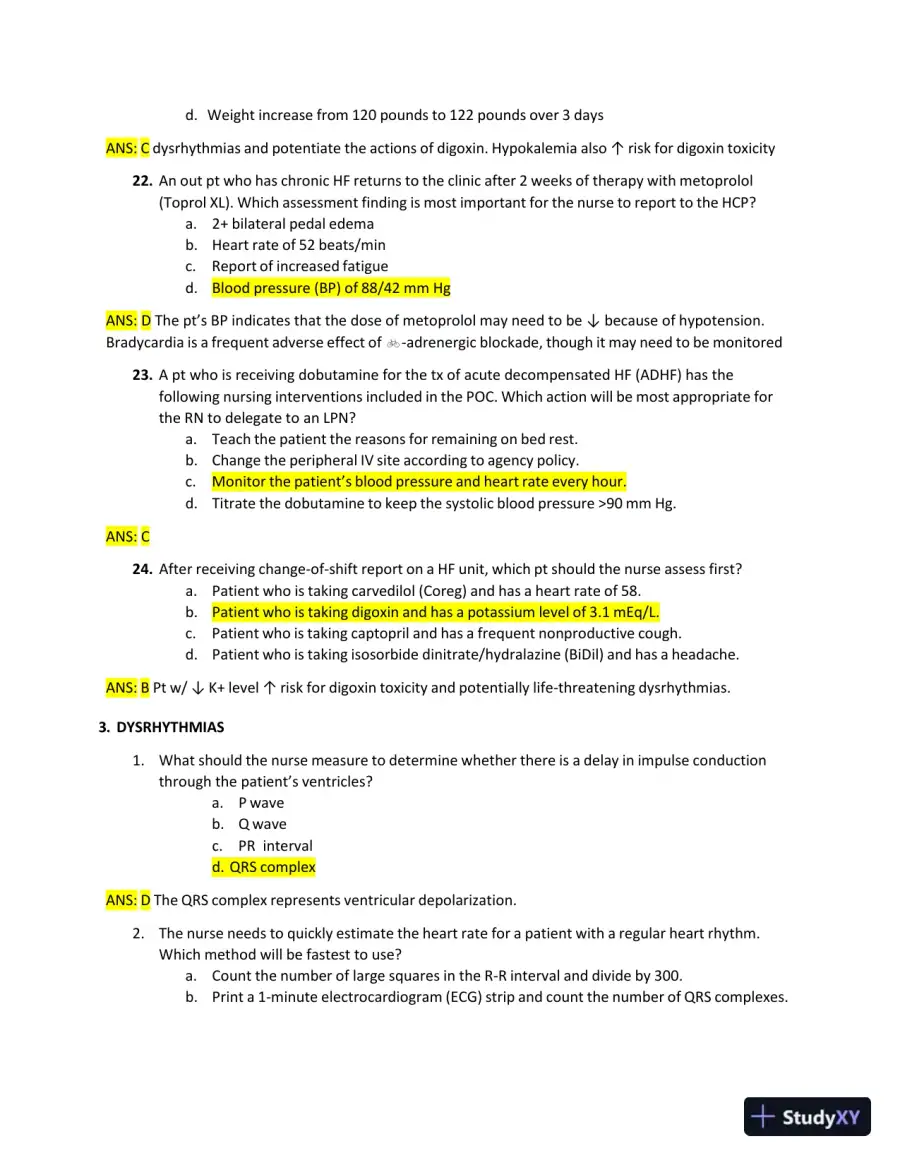 d.Weightincreasefrom120poundsto122poundsover3daysANS:Cdysrhythmiasandpotentiatetheactionsofdigoxin.Hypokalemiaalso↑riskfordigoxintoxicity22.AnoutptwhohaschronicHFreturnstotheclinicafter2weeksoftherapywithmetoprolol(ToprolXL).WhichassessmentfindingismostimportantforthenursetoreporttotheHCP?a.2+bilateralpedaledemab.Heartrateof52beats/minc.Reportofincreasedfatigued.Bloodpressure(BP)of88/42mmHgANS:DThe pt’s BP indicates that the dose of metoprolol may need to be ↓ because of hypotension.Bradycardiaisafrequentadverseeffectof-adrenergicblockade,thoughitmayneedtobemonitored23.A pt who is receiving dobutamine for the tx of acute decompensated HF (ADHF) has thefollowingnursinginterventionsincludedinthePOC.Whichactionwillbemostappropriateforthe RNtodelegate toanLPN?a.Teachthepatientthereasonsforremainingonbedrest.b.ChangetheperipheralIVsiteaccordingtoagencypolicy.c.Monitorthepatient’sbloodpressureandheartrateeveryhour.d.Titratethedobutaminetokeepthesystolicbloodpressure>90mmHg.ANS:C24.Afterreceivingchange-of-shiftreportonaHFunit,whichptshouldthenurseassessfirst?a.Patientwhoistakingcarvedilol(Coreg)andhasaheartrateof58.b.Patientwhoistakingdigoxinandhasapotassiumlevelof3.1mEq/L.c.Patientwhoistakingcaptoprilandhasafrequentnonproductivecough.d.Patientwhoistakingisosorbidedinitrate/hydralazine(BiDil)andhasaheadache.ANS:BPtw/↓K+level↑riskfordigoxintoxicityandpotentiallylife-threateningdysrhythmias.3.DYSRHYTHMIAS1.Whatshouldthenursemeasuretodeterminewhetherthereisadelayinimpulseconductionthroughthepatient’sventricles?a.Pwaveb.Qwavec.PRintervald.QRScomplexANS:DTheQRScomplexrepresentsventriculardepolarization.2.Thenurseneedstoquicklyestimatetheheartrateforapatientwitharegularheartrhythm.Whichmethodwillbefastesttouse?a.CountthenumberoflargesquaresintheR-Rintervalanddivideby300.b.Printa1-minuteelectrocardiogram(ECG)stripandcountthenumberofQRScomplexes.
42 more pages in the full document
Unlock it once and it stays in your library, ready to chat with or turn into flashcards.
Unlock the full documentMore Assessment Technologies Institute study materials
See all Past Exams
ATI Maternal Newborn Practice Exam with Answers (210 Solved Questions)
Assessment Technologies Institute
114 pages141downloadsFeb 2025 Past Exams
ATI PN Pediatrics Proctored Exam Version 8 with Answers (166 Solved Questions)
Assessment Technologies Institute
40 pages126downloadsFeb 2025 Past Exams
2023 ATI NGN Comprhensive Exit Exam with Answers (87 Solved Questions)
Assessment Technologies Institute
40 pages115downloadsFeb 2025 Past Exams
2021 ATI Medical/Surgical Neurosensory AH1 with Answers (80 Solved Questions)
Assessment Technologies Institute
19 pages106downloadsFeb 2025 Past Exams
2024-2025 ATI Leadership Proctored Focus Practice Exam with Answers (63 Solved Questions)
Assessment Technologies Institute
27 pages99downloadsFeb 2025 Past Exams
2024-2025 ATI Comprehensive Exit Exam with Answers (13 Solved Questions)
Assessment Technologies Institute
6 pages77downloadsFeb 2025 Past Exams
2023 ATI RN Adult Medical Surgical For NGN Form A, B, C with Answers (21 Solved Questions)
Assessment Technologies Institute
9 pages71downloadsFeb 2025 Past Exams
2022-2023 ATI Med Surg Proctored Exam Retake with Answers (111 Solved Questions)
Assessment Technologies Institute
37 pages68downloadsFeb 2025
Study this document with CramX
Once it is in your library, every tool can work from it.