

2023 ATI Mental Health Proctored Exam with Answers (144 Solved Questions)
- Assessment Technologies Institute
- 25 pages
- Shared May 2025
2023 ATI Mental Health Proctored Exam with Answers helps you analyze previous exam trends and prepare effectively.
Preview 8 of 25 pages
See the first 8 pages exactly as they appear in the document.
Page 1 Read page 1 as text
ATI FUNDAMENTALS PROCTORED CUMULATIVE FINAL EXAM COMPLETE QNS & ANS FINAL LATEST 2023 • The nurse is preparing a 4 year old for surgery. Which technique is most appropriate? • a.allow the child to handle safe medical equipment b.limit the teaching to one 1 hour session c.explain to the child that she will be put to sleep for the procedure d.use an anatomically correct doll to explain the procedure • The nurse is admitting a patient with a methicillin - resistant Staphylococcus aureus (MRSA) infection isolated in his stage III pressure ulcer. The nurse places the patient on: a.contact precautions . b.airborne precautions. c.droplet precautions. d.protective environment. • The nurse is caring for a school - aged child who has injured the right leg after a bicycle accident. Which signs and symptoms will the nurse assess for to determine if the child is experiencing a localized inflammatory response? • Malaise, anorexia, enlarged lymph nodes, and increased white blood cells • Chest pain, shortness of breath, and nausea and vomiting • Dizziness and disorientation to time, date, and place • Edema, redness, tenderness, and loss of function • A diabetic patient presents to the clinic for a dressing change. The wound is located on the right foot and has purulent yellow drainage. Which action will the nurse take to prevent the spread of infection? • Position the patient comfortably on the stretcher. • Explain the procedure for dressing change to the patient. • Review the medication list that the patient brought from home. • Don gloves and other appropriate personal protective equipment. • The nurse is caring for a patient in labor and delivery. When near completing an assessment of the patient’s cervix, the electronic infusion device being used on the intravenous (IV) infusion alarms. Which sequence of actions is mostappropriate for the nurse to take? • Complete the assessment, remove gloves, and silence the alarm.
Page 2 Page 3 Read page 3 as text
• Discontinue the assessment, silence the alarm, and assess the intravenous site. • Complete the assessment, remove gloves, wash hands, and assess the intravenous infusion. • Discontinue the assessment, remove gloves, use hand gel, and assess the intravenous infusion. • The nurse is dressed and is preparing to care for a patient in the perioperative area. The nurse has scrubbed hands and has donned a sterile gown and gloves. Which action will indicate a break in sterile technique? • Touching clean protective eyewear • Standing with hands above waist area • Accepting sterile supplies from the surgeon • Staying with the sterile table once it is open • The nurse is caring for a patient with an incision. Which actions will best indicate an understanding of medical and surgical asepsis for a sterile dressing change? • Donning clean goggles, gown, and gloves to dress the wound • Donning sterile gown and gloves to remove the wound dressing • Utilizing clean gloves to remove the dressing and sterile supplies for the new dressing • Utilizing clean gloves to remove the dressing and clean supplies for the new dressing • The nurse is caring for a patient who has just delivered a neonate. The nurse is checking the patient for excessive vaginal drainage. Which precaution will the nurse use? • Contact • Droplet • Standard • Protective environment • The nurse is performing hand hygiene before assisting a health care provider with insertion of a chest tube. While washing hands, the nurse touches the sink. Which action will the nurse take next? • Inform the health care provider and recruit another nurse to assist. • Rinse and dry hands, and begin assisting the health care provider. • Extend the handwashing procedure to 5 minutes. • Repeat handwashing using antiseptic soap . • The nurse is caring for a patient on contact precautions. Which action will be most appropriate to prevent the spread of disease? • Place the patient in a room with negative airflow. • Wear a gown, gloves, face mask, and goggles for interactions with the patient. • Transport the patient safely and quickly when going to the radiology department.
Page 4 Read page 4 as text
• Use a dedicated blood pressure cuff that stays in the room and is used for that patient only . • The nurse is caring for a patient who has cultured positive for Clostridium difficile. Which action will the nurse take next? • Instruct assistive personnel to use soap and water rather than sanitizer. • Wear an N95 respirator when entering the patient room. • Place the patient on droplet precautions. • Teach the patient cough etiquette. • The nurse is caring for a patient who has a bloodborne pathogen. The nurse splashes blood above the glove to intact skin while discontinuing an intravenous (IV) infusion. Which step(s) will the nurse take next? • Obtain an alcohol swab, remove the blood with an alcohol swab, and continue care. • Immediately wash the site with soap and running water, and seek guidance from the manager . • Do nothing; accidentally getting splashed with blood happens frequently and is part of the job. • Delay washing of the site until the nurse is finished providing care to the patient. • The nurse has received a report from the emergency department that a patient with tuberculosis will be coming to the unit. Which items will the nurse need to care for this patient? (Select all that apply.) • Private room • Negative - pressure airflow in room • Surgical mask, gown, gloves, eyewear • N95 respirator, gown, gloves, eyewear • Communication signs for droplet precautions • Communication signs for airborne precautions • When providing hygiene for an older - adult patient, the nurse closely assesses the skin. What is the • rationale for the nurse’s action? • Outer skin layer becomes more resilient. • Less frequent bathing may be required . • Skin becomes less subject to bruising. • Sweat glands become more active. • The patient has been brought to the emergency department following a motor vehicle accident. The patient is unresponsive. The driver’s license states that glasses are needed to operate a motor
Page 5 Read page 5 as text
vehicle, but no glasses were brought in with the patient. Which action should the nurse take next? • Stand to the side of the patient’s eye and observe the cornea. • Conclude that the glasses were lost during the accident. • Notify the ambulance personnel for missing glasses. • Ask the patient where the glasses are. • The nurse is caring for a patient who is immobile. The nurse frequently checks the patient for impaired skin integrity. What is the rationale for the nurse’s action? • Inadequate blood flow leads to decreased tissue ischemia. • Patients with limited caloric intake develop thicker skin. • Pressure reduces circulation to affected tissue. • Verbalization of skin care needs is decreased • The nurse is caring for a patient who has diabetes mellitus and circulatory insufficiency, with peripheral neuropathy and urinary incontinence. On which areas does the nurse focus care? • Decreased pain sensation and increased risk of skin impairment • Decreased caloric intake and accelerated wound healing • High risk for skin infection and low saliva pH level • High risk for impaired venous return and dementia • The nurse is caring for a patient who has undergone surgery for a broken leg and has a cast in place. What should the nurse do to prevent skin impairment? • Assess surfaces exposed to the edges of the cast for pressure areas. • Keep the patient’s blood pressure low to prevent overperfusion of tissue. • Do not allow turning in bed because that may lead to redislocation of the leg. • Restrict the patient’s dietary intake to reduce the number of times on the bedpan. • The nurse is providing oral care to an unconscious patient and notes that the patient has extremely bad breath. Which term will the nurse use when reporting to the oncoming shift? • Cheilitis • Halitosis • Glossitis • Dental caries • The patient is being treated for cancer with weekly radiation therapy to the head and chemotherapy treatments. Which assessment is the priority? • Feet • Nail beds • Perineum • Oral cavity
Page 6 Read page 6 as text
• The nurse is caring for an older - adult patient with Alzheimer’s disease who is ambulatory but requires total assistance with activities of daily living (ADLs). The nurse notices that the patient is edentulous. Which area should the nurse assess? • Assess oral cavity. • Assess room for drafts. • Assess ankles for edema. • Assess for reduced sensations. • A nurse is providing perineal care to a female patient. Which washing technique will the nurse use? • Back to front • In a circular motion • From pubic area to rectum • Upward from rectum to pubic area • The patient is reporting an inability to clear nasal passages. Which action will the nurse take? • Use gentle suction to prevent tissue damage . • Instruct patient to blow nose forcefully to clear the passage. • Place a dry washcloth under the nose to absorb secretions. • Insert a cotton - tipped applicator to the back of the nose. • A nurse is performing an admission assessment on a middle - age patient. A normal change seen in this age group includes which of the following? (Select all that apply.) a.A progressive decrease in skin turgor b.Decreased visual acuity c.Decreased ability to solve practical problems d.Decreased strength of abdominal muscles e.Loss of accommodation • A nurse is teaching young adults about health risks. Which statement from a young adult indicates a correct understanding of the teaching? • “It’s probably safe for me to start smoking. At my age, there’s not enough time for cancer to develop.” • “My mother had appendicitis so this increases my chance for developing appendicitis.” • c. “Controlling the amount of stress in my life may decrease the risk of illness.” d. “I don’t do drugs. I do drink coffee, but caffeine is not a drug.” • A nurse is choosing an appropriate topic for a young - adult health fair. Which topic should the nurse include? • Retirement • Menopause
Page 7 Read page 7 as text
• Climacteric factors • Unplanned pregnancies • During a routine physical assessment, the nurse obtaining a health history notes that a 50 - year - old female patient reports pain and redness in the right breast. Which action is best for the nurse to take in response to this finding? • Assess the patient as thoroughly as possible. • Explain to the patient that breast tenderness is normal at her age. • Tell the patient that redness is not a cause for concern and is quite common. • Inform her that redness is the precursor to normal unilateral breast enlargement • A young - adult patient is brought to the hospital by police after crashing the car in a high - speed chase when trying to avoid arrest for spousal abuse. Which action should the nurse take? • Question the patient about drug use. • Offer the patient a cup of coffee to calm nerves. • Discretely assess the patient for sexually transmitted infections. • Deal with the issue at hand, not asking about previous illnesses • A nurse is assessing the cognitive changes in a preschooler. Which standard will the nurse use to determine normal? • The ability to think abstractly and deal effectively with hypothetical problems • The ability to think in a logical manner about the here and now • The ability to assume the view of another person • d. The ability to classify objects by size or color • The nurse is observing a 2 - year - old hospitalized patient in the playroom. Which activity will the nurse most likely observe? • Seeking out same sex children to play with • Participating as the leader of a small group activity • c. Sitting beside another child while playing with blocks d. Separating building blocks into groups by size and color • Which action should the nurse take when teaching a 5 - year - old patient about a scheduled surgery? • Do not discuss the procedure with the child to decrease anxiety. • Let the child know the surgery will be at 9:00 AM in the morning. • Insist that the parents wait outside the room to ensure privacy of the child. • d. Allow the child to touch and hold medical equipment such as thermometers. • While receiving a shift report on a patient, the nurse is informed that the patient has urinary incontinence. Upon assessment, which finding will the nurse expect? • An indwelling Foley catheter • Reddened irritated skin on buttocks
Page 8 Read page 8 as text
• Tiny blood clots in the patient’s urine • Foul - smelling discharge indicative of infection • Which clinical manifestation will the nurse expect to observe in a patient with excessive white blood cells present in the urine? • Reduced urine specific gravity • Increased blood pressure • Abnormal blood sugar • d. Fever with chills • The nurse will anticipate inserting a Coudé catheter for which patient? • An 8 - year - old male undergoing anesthesia for a tonsillectomy • A 24 - year - old female who is going into labor • c. A 56 - year - old male with an enlarged prostate d. An 86 - year - old female admitted for a urinary tract infection • A nurse is evaluating a nursing assistive personnel’s (NAP) care for a patient with an indwelling catheter. Which action by the NAP will cause the nurse to intervene? • Emptying the drainage bag when half full • Kinking the catheter tubing to obtain a urine specimen • Placing the drainage bag on the side rail of the patient’s bed • Securing the catheter tubing to the patient’s thigh • Which nursing actions will the nurse implement when collecting a urine specimen from a patient? (Select all that apply.) • Growing urine cultures for up to 12 hours • Labeling all specimens with date, time, and initials • Allowing the patient adequate time and privacy to void • Wearing gown, gloves, and mask for all specimen handling • e. Transporting specimens to the laboratory in a timely manner f. Collecting the specimen from the drainage bag of an indwelling catheter • The nurse is obtaining a 24 - hour urine specimen collection from the patient. Which actions should the nurse take? (Select all that apply.) • Keeping the urine collection container on ice when indicated • Withholding all patient medications for the day • Irrigating the sample as needed with sterile solution • Testing the urine sample with a reagent strip by dipping it in the urine • Asking the patient to void and discarding that urine to start the collection • The nurse is planning care for a group of patients. Which task will the nurse assign to the nursing assistive personnel? • Measuring capillary blood glucose level • Measuring nasoenteric tube for insertion
17 more pages in the full document
Unlock it once and it stays in your library, ready to chat with or turn into flashcards.
Unlock the full documentMore Assessment Technologies Institute study materials
See all Past Exams
ATI Maternal Newborn Practice Exam with Answers (210 Solved Questions)
Assessment Technologies Institute
114 pages141downloadsFeb 2025 Past Exams
ATI PN Pediatrics Proctored Exam Version 8 with Answers (166 Solved Questions)
Assessment Technologies Institute
40 pages126downloadsFeb 2025 Past Exams
2023 ATI NGN Comprhensive Exit Exam with Answers (87 Solved Questions)
Assessment Technologies Institute
40 pages115downloadsFeb 2025 Past Exams
2021 ATI Medical/Surgical Neurosensory AH1 with Answers (80 Solved Questions)
Assessment Technologies Institute
19 pages106downloadsFeb 2025 Past Exams
2024-2025 ATI Leadership Proctored Focus Practice Exam with Answers (63 Solved Questions)
Assessment Technologies Institute
27 pages99downloadsFeb 2025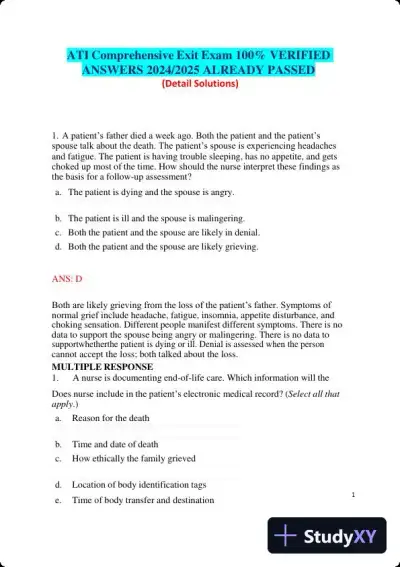 Past Exams
2024-2025 ATI Comprehensive Exit Exam with Answers (13 Solved Questions)
Assessment Technologies Institute
6 pages77downloadsFeb 2025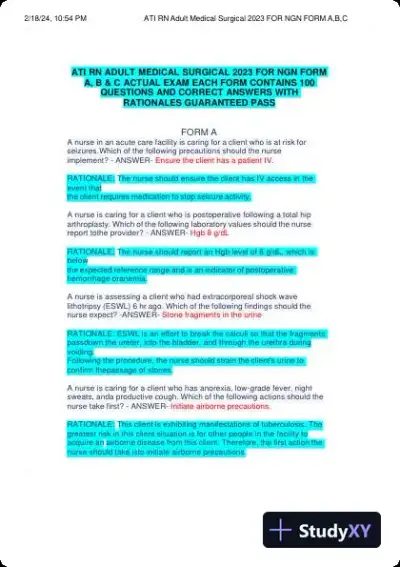 Past Exams
2023 ATI RN Adult Medical Surgical For NGN Form A, B, C with Answers (21 Solved Questions)
Assessment Technologies Institute
9 pages71downloadsFeb 2025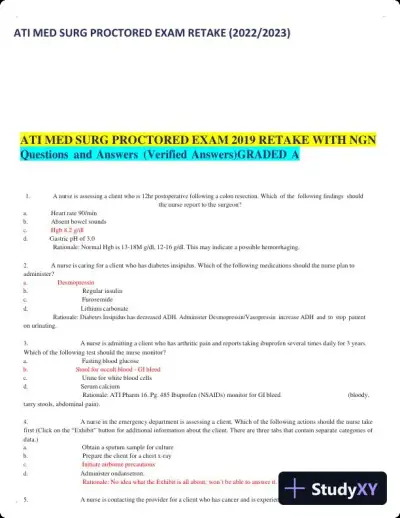 Past Exams
2022-2023 ATI Med Surg Proctored Exam Retake with Answers (111 Solved Questions)
Assessment Technologies Institute
37 pages68downloadsFeb 2025
Study this document with CramX
Once it is in your library, every tool can work from it.