
Past Exams
2023-2024 ATI Peds Proctored Final Exam with Answers (60 Solved Questions)
- Assessment Technologies Institute
- 55 pages
- Shared February 2025
- 56 downloads
Boost your score by practicing with 2023-2024 ATI Peds Proctored Final Exam with Answers, featuring past exam content.
Preview · 17 of 55 pages
100%
Page 1
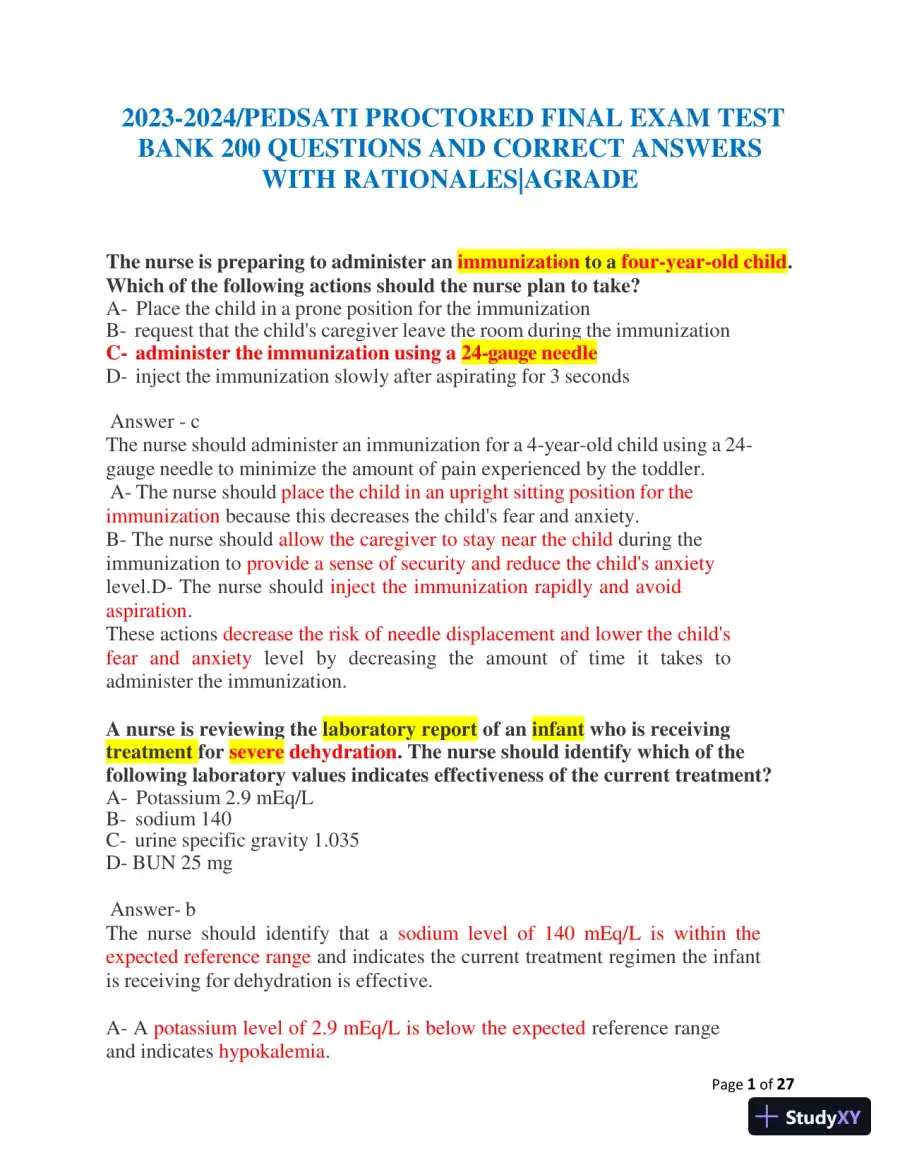 Page1of272023-2024/PEDSATI PROCTORED FINAL EXAM TESTBANK 200 QUESTIONS AND CORRECT ANSWERSWITH RATIONALES|AGRADEThe nurse is preparing to administer an immunization to a four-year-old child.Which of the following actions should the nurse plan to take?A- Place the child in a prone position for the immunizationB- request that the child's caregiver leave the room during the immunizationC- administer the immunization using a 24-gauge needleD- inject the immunization slowly after aspirating for 3 secondsAnswer - cThe nurse should administer an immunization for a 4-year-old child using a 24-gauge needle to minimize the amount of pain experienced by the toddler.A- The nurse should place the child in an upright sitting position for theimmunization because this decreases the child's fear and anxiety.B- The nurse should allow the caregiver to stay near the child during theimmunization to provide a sense of security and reduce the child's anxietylevel.D- The nurse should inject the immunization rapidly and avoidaspiration.These actions decrease the risk of needle displacement and lower the child'sfear and anxiety level by decreasing the amount of time it takes toadminister the immunization.A nurse is reviewing the laboratory report of an infant who is receivingtreatment for severe dehydration. The nurse should identify which of thefollowing laboratory values indicates effectiveness of the current treatment?A- Potassium 2.9 mEq/LB- sodium 140C- urine specific gravity 1.035D- BUN 25 mgAnswer- bThe nurse should identify that a sodium level of 140 mEq/L is within theexpected reference range and indicates the current treatment regimen the infantis receiving for dehydration is effective.A- A potassium level of 2.9 mEq/L is below the expected reference rangeand indicates hypokalemia.lOMoARcPSD|13778330
Page 2

Page 3
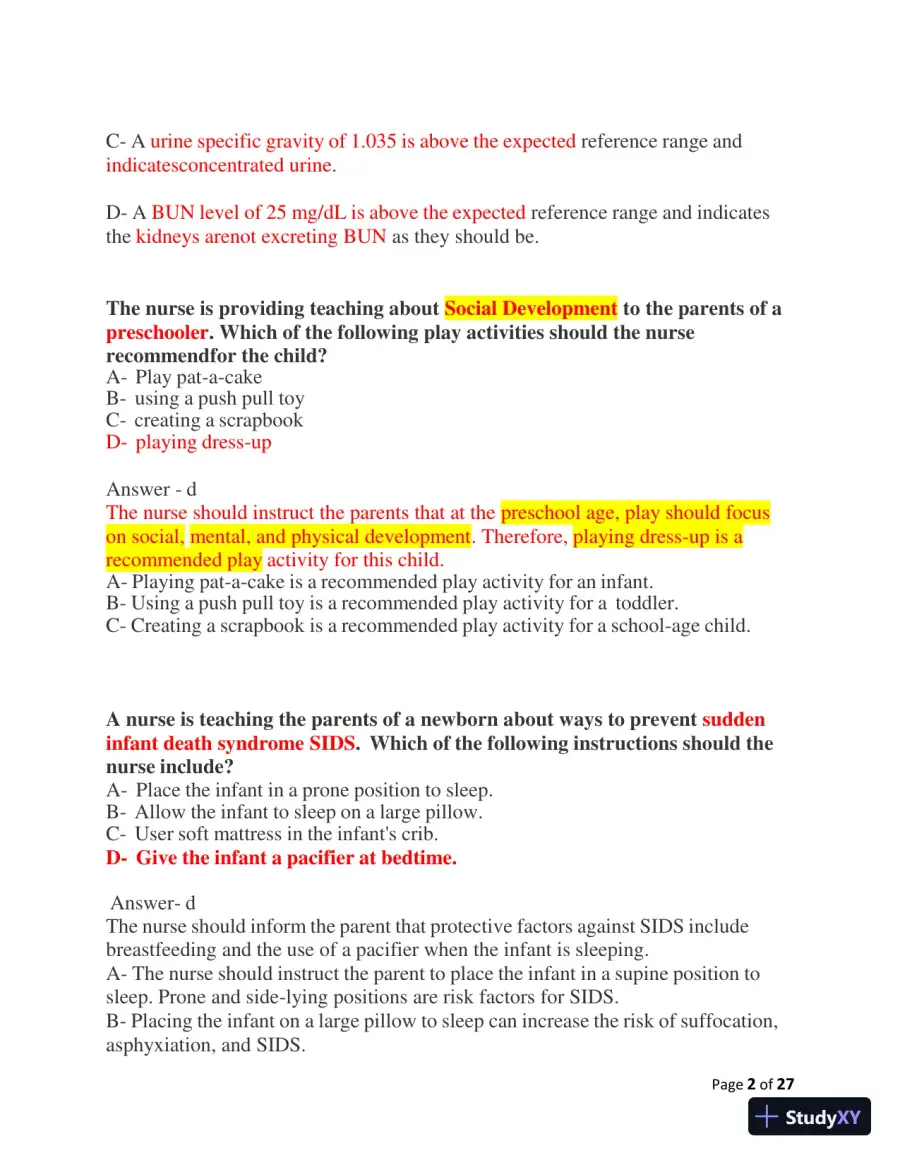 Page2of27C- A urine specific gravity of 1.035 is above the expected reference range andindicatesconcentrated urine.D- A BUN level of 25 mg/dL is above the expected reference range and indicatesthe kidneys arenot excreting BUN as they should be.The nurse is providing teaching about Social Development to the parents of apreschooler. Which of the following play activities should the nurserecommendfor the child?A- Play pat-a-cakeB- using a push pull toyC- creating a scrapbookD- playing dress-upAnswer - dThe nurse should instruct the parents that at the preschool age, play should focuson social, mental, and physical development. Therefore, playing dress-up is arecommended play activity for this child.A- Playing pat-a-cake is a recommended play activity for an infant.B- Using a push pull toy is a recommended play activity for a toddler.C- Creating a scrapbook is a recommended play activity for a school-age child.A nurse is teaching the parents of a newborn about ways to prevent suddeninfant death syndrome SIDS. Which of the following instructions should thenurse include?A- Place the infant in a prone position to sleep.B- Allow the infant to sleep on a large pillow.C- User soft mattress in the infant's crib.D- Give the infant a pacifier at bedtime.Answer- dThe nurse should inform the parent that protective factors against SIDS includebreastfeeding and the use of a pacifier when the infant is sleeping.A- The nurse should instruct the parent to place the infant in a supine position tosleep. Prone and side-lying positions are risk factors for SIDS.B- Placing the infant on a large pillow to sleep can increase the risk of suffocation,asphyxiation, and SIDS.lOMoARcPSD|13778330
Page 4
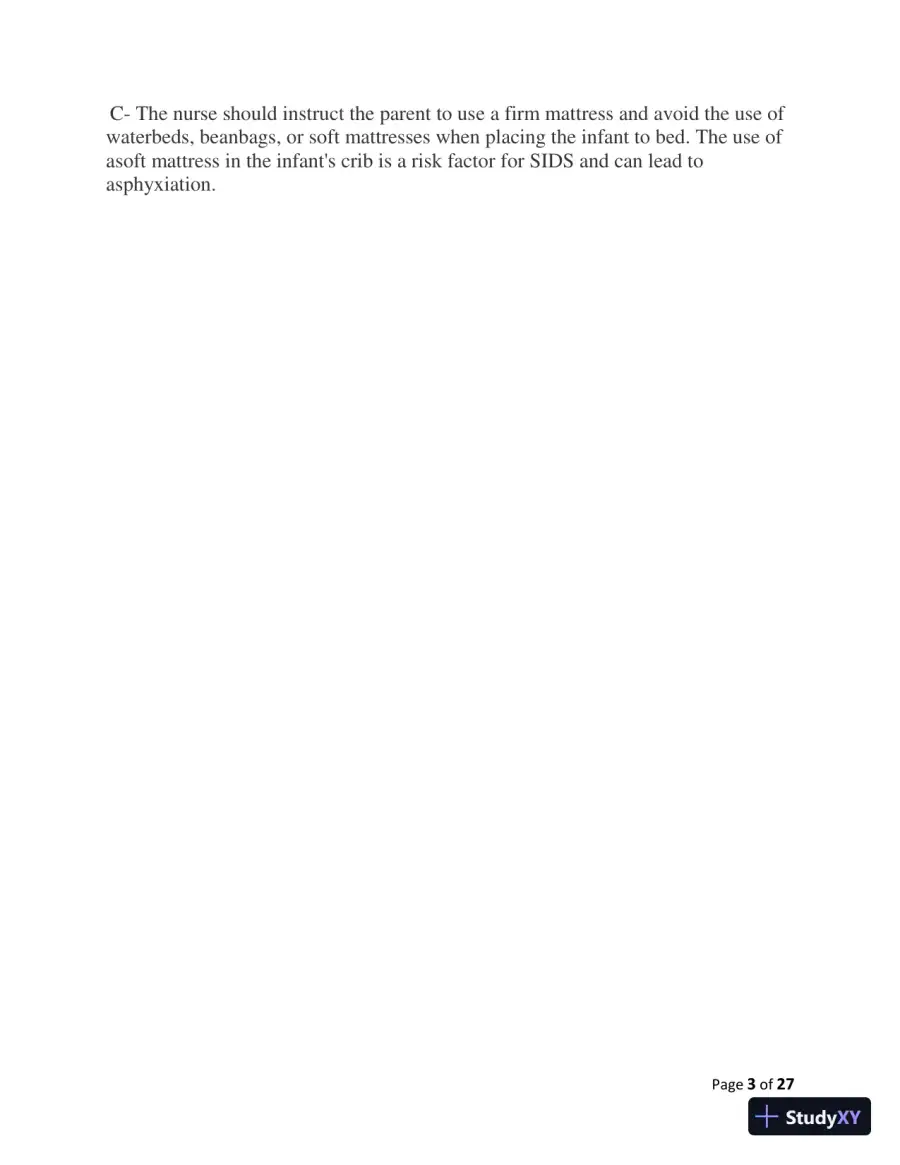 Page3of27C- The nurse should instruct the parent to use a firm mattress and avoid the use ofwaterbeds, beanbags, or soft mattresses when placing the infant to bed. The use ofasoft mattress in the infant's crib is a risk factor for SIDS and can lead toasphyxiation.lOMoARcPSD|13778330
Page 5
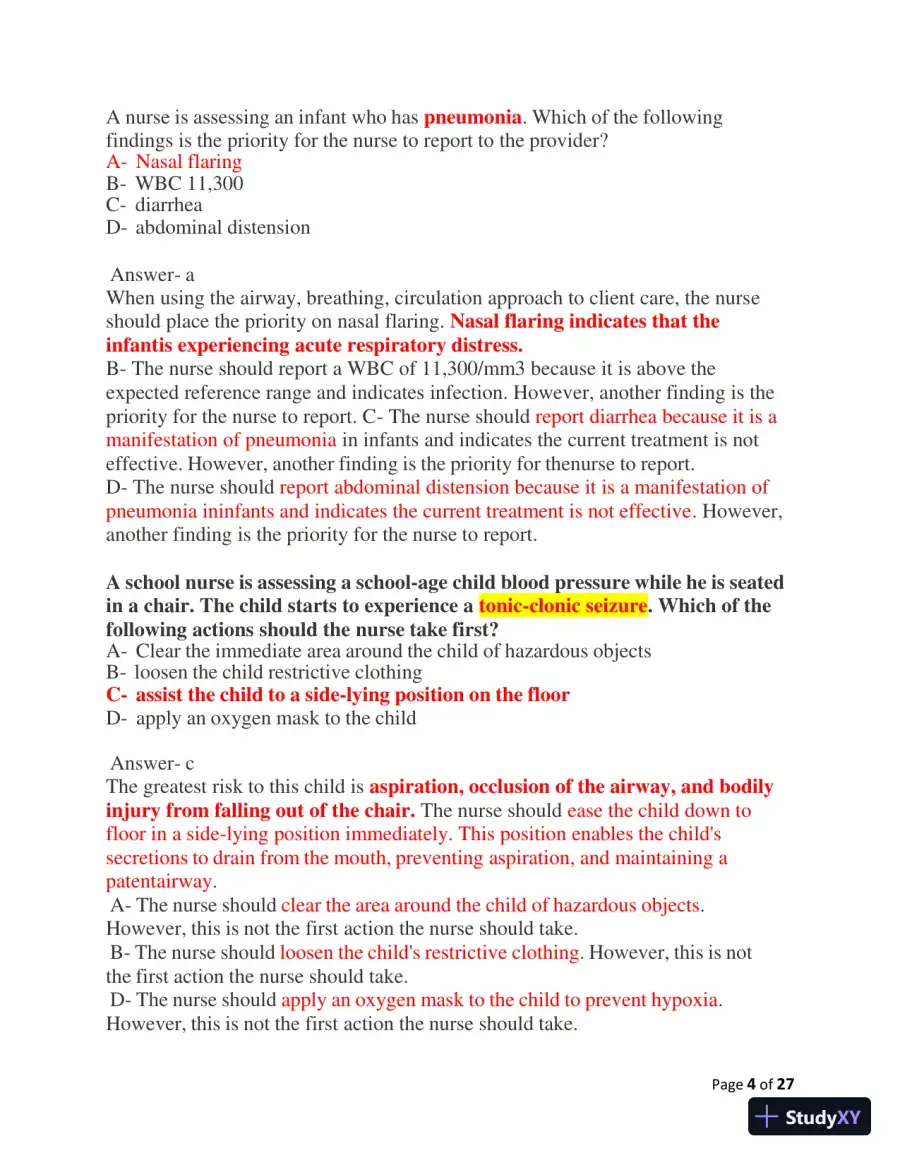 Page4of27A nurse is assessing an infant who haspneumonia. Which of the followingfindings is the priority for the nurse to report to the provider?A- Nasal flaringB- WBC 11,300C- diarrheaD- abdominal distensionAnswer- aWhen using the airway, breathing, circulation approach to client care, the nurseshould place the priority on nasal flaring.Nasal flaring indicates that theinfantis experiencing acute respiratory distress.B- The nurse should report a WBC of 11,300/mm3 because it is above theexpected reference range and indicates infection. However, another finding is thepriority for the nurse to report. C- The nurse should report diarrhea because it is amanifestation of pneumonia in infants and indicates the current treatment is noteffective. However, another finding is the priority for thenurse to report.D- The nurse should report abdominal distension because it is a manifestation ofpneumonia ininfants and indicates the current treatment is not effective. However,another finding is the priority for the nurse to report.A school nurse is assessing a school-age child blood pressure while he is seatedin a chair. The child starts to experience a tonic-clonic seizure. Which of thefollowing actions should the nurse take first?A- Clear the immediate area around the child of hazardous objectsB- loosen the child restrictive clothingC- assist the child to a side-lying position on the floorD- apply an oxygen mask to the childAnswer- cThe greatest risk to this child isaspiration, occlusion of the airway, and bodilyinjury from falling out of the chair.The nurse should ease the child down tofloor in a side-lying position immediately. This position enables the child'ssecretions to drain from the mouth, preventing aspiration, and maintaining apatentairway.A- The nurse should clear the area around the child of hazardous objects.However, this is not the first action the nurse should take.B- The nurse should loosen the child's restrictive clothing. However, this is notthe first action the nurse should take.D- The nurse should apply an oxygen mask to the child to prevent hypoxia.However, this is not the first action the nurse should take.lOMoARcPSD|13778330
Page 6
 Page5of27A nurse is preparing to administer ibuprofen 5 mg per kg every 6 hours PRNfor temperatures above 38.0 degrees Celsius or 100.5 degrees Fahrenheit toan infant who weighs 17.6 lb. The infant has a temperature of 38.4 degreesCelsius or 100 + 1.2 degrees Fahrenheit. Available islOMoARcPSD|13778330
Page 7
 Page6of27ibuprofen liquid 100mg/ 5 ml. how many milliliters should the nurseadminister to the infant per dose? Round the answer to the nearest wholenumber. Use a leading zero if it applies.Answer: 2 mLA nurse is receiving change-of-shift Report on for children. Which of thefollowing children should the nurse assesses first?A- A toddler who has a concussion and an episode of forceful vomitingB- an adolescent who has infective endocarditis and reports having a headacheC- an adolescent who was placed into Halo traction 1 hour ago and rates his painat a 6 on a 0-10 scaleD- school-age child who has acute glomerulonephritis and brown colored urineAnswer- aWhen using the urgent vs. no urgent approach to client care, the nurse should assessthis child first. An episode of forceful vomiting is an indication of increasedintracranial pressure in a toddler who has a concussion.B- A report of a headache is no urgent because it is an expected finding for a childwho has infective endocarditis; therefore, the nurse should assess another childfirst.C- A report of moderate pain is no urgent because it is an expected finding fora child who has a new halo traction device; therefore, the nurse should assessanother child first.D- Brown-colored urine is no urgent because it is an expected finding for aschool-age child who has acute glomerulonephritis; therefore, the nurseshouldassess another child first.A nurse in the emergency department is caring for an adolescent who hassevere abdominal pain due to appendicitis. Which of the followinglocationsshould the nurse identify as mcburney's point?lOMoARcPSD|13778330
Page 8
 Page7of27Answer: aA is correct. The nurse should identify the lower right quadrant of the abdomenbetween the umbilicus and the anterior iliac crest as the location ofBurney’spoint.lOMoARcPSD|13778330
Page 9
 Page8of27B is incorrect. The nurse should not identify the left lower quadrant as thelocation ofMcBurney's point.C is incorrect.The nurse should not identify the right upper quadrant as the locationofMcBurney's point.A nurse is providing teaching to the family of a school-age child who hasjuvenile idiopathic arthritis. Which of the following instructions shouldthenurse include in the teaching?A- Limit the movement of the child large joints.B- Encourage the child to perform independent self-care.C- Provide the child with a soft mattress for sleeping.D- Schedule a 2-hour daily nap for the child in the afternoon.Answer- bThe nurse should teach the family the importance of encouraging the child toperform independent self-care. This will minimize the child's pain while maximizingmobility.Encouraging and praising the child's efforts for independence will also increase hisself-esteem.A- Large joints should be exercised regularly to maintain mobility and strengthenmuscles.C- Children who have juvenile idiopathic arthritis should sleep on a firm mattress toenhance comfort and rest. A soft mattress can increase pressure to the affected jointsand increasethe child’spain.D- Daytime naps are discouraged because stiffness can occur quickly and easilywith inactivity, and naps can interfere with nighttime sleeping.A nurse is assessing a client who has a new diagnosis of celiac disease. Whichof the following clinical manifestations should the nurse expect?A- SteatorrheaB- projectile vomitingC- sunken abdomenD- weight gainAnswer- aThe nurse should realize that clients who have celiac disease are unable to digestgluten. This will cause damage to the cells in the bowel, leading tomalabsorption,steatorrhea, and diarrhea.B- Clients who havepyloric stenosiswill exhibit projectile vomiting rather thanceliac disease.lOMoARcPSD|13778330
Page 10
 Page9of27C- A distended abdomen, rather than a sunken abdomen, is a manifestation of celiacdisease.D- Weight loss, rather than weight gain, is a manifestation of celiac disease.A nurse is providing teaching to an adolescent about how to manage tineapedis. Which of the following statements by the Adolescent indicates anunderstanding of the teaching?A- I should buy some plastic shoes to wear at the swimming poolB- I should wear sandals as much as possibleC- I should place the permethrin cream between my toes twice-dailylOMoARcPSD|13778330
Page 11
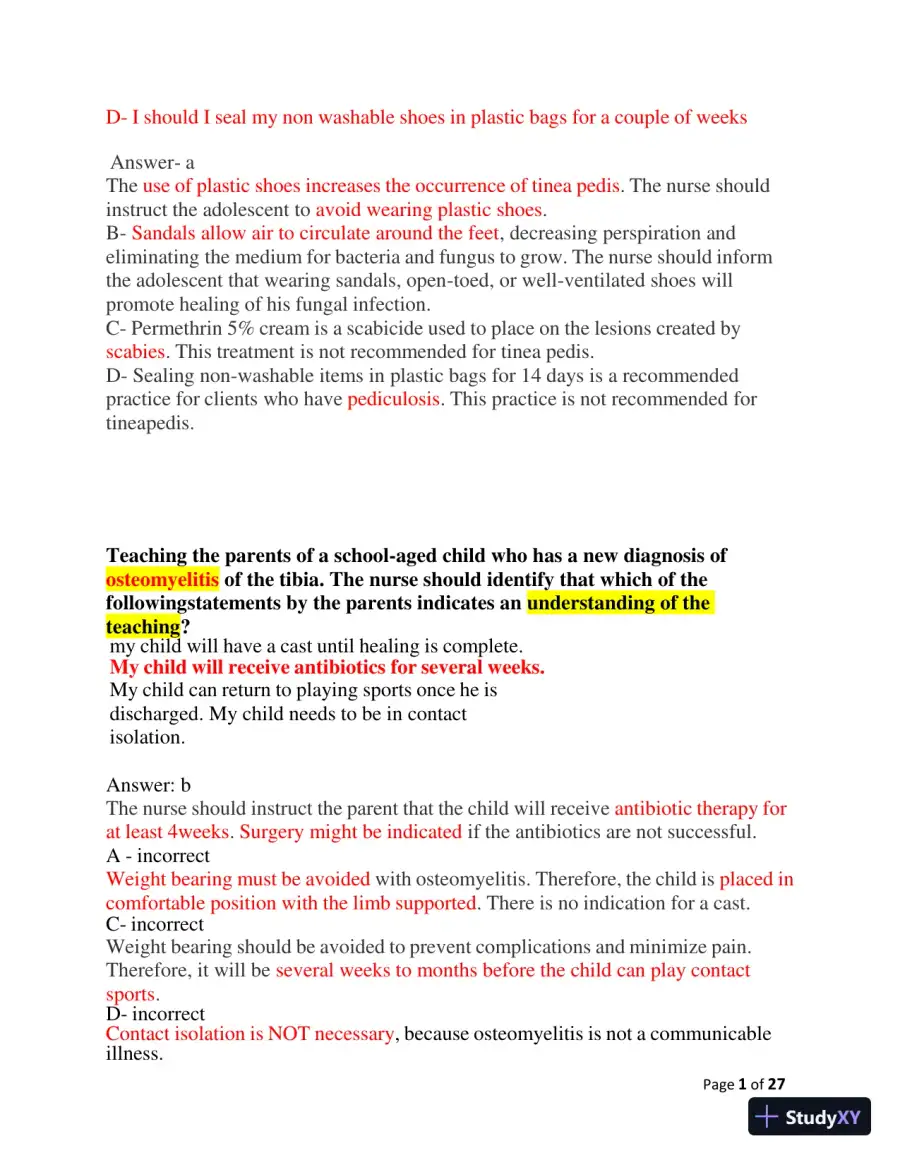 Page1of27D- I should I seal my non washable shoes in plastic bags for a couple of weeksAnswer- aThe use of plastic shoes increases the occurrence of tinea pedis. The nurse shouldinstruct the adolescent to avoid wearing plastic shoes.B- Sandals allow air to circulate around the feet, decreasing perspiration andeliminating the medium for bacteria and fungus to grow. The nurse should informthe adolescent that wearing sandals, open-toed, or well-ventilated shoes willpromote healing of his fungal infection.C- Permethrin 5% cream is a scabicide used to place on the lesions created byscabies. This treatment is not recommended for tinea pedis.D- Sealing non-washable items in plastic bags for 14 days is a recommendedpractice for clients who have pediculosis. This practice is not recommended fortineapedis.Teaching the parents of a school-aged child who has a new diagnosis ofosteomyelitis of the tibia. The nurse should identify that which of thefollowingstatements by the parents indicates an understanding of theteaching?my child will have a cast until healing is complete.My child will receive antibiotics for several weeks.My child can return to playing sports once he isdischarged. My child needs to be in contactisolation.Answer: bThe nurse should instruct the parent that the child will receive antibiotic therapy forat least 4weeks. Surgery might be indicated if the antibiotics are not successful.A - incorrectWeight bearing must be avoided with osteomyelitis. Therefore, the child is placed incomfortable position with the limb supported. There is no indication for a cast.C- incorrectWeight bearing should be avoided to prevent complications and minimize pain.Therefore, it will be several weeks to months before the child can play contactsports.D- incorrectContact isolation is NOT necessary, because osteomyelitis is not a communicableillness.lOMoARcPSD|13778330
Page 12
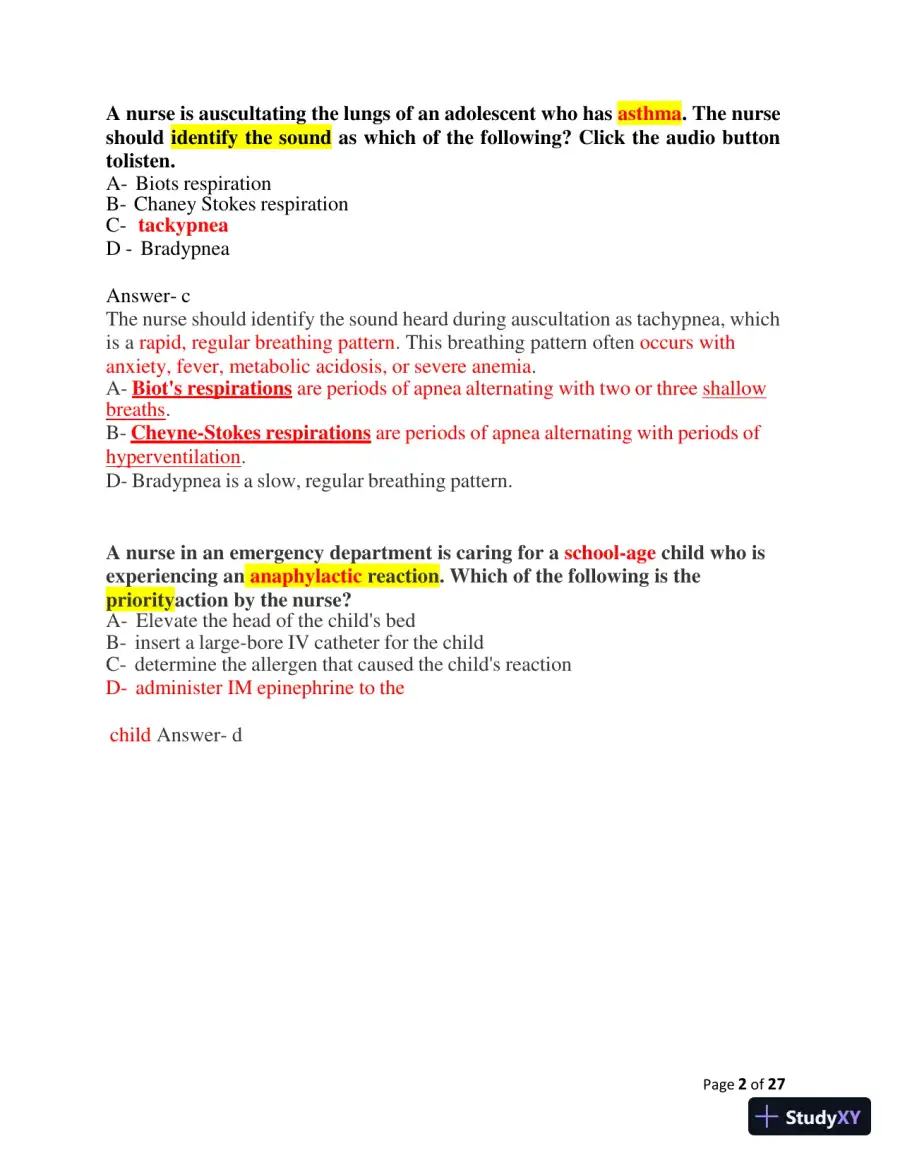 Page2of27A nurse is auscultating the lungs of an adolescent who has asthma. The nurseshould identify the sound as which of the following? Click the audio buttontolisten.A- Biots respirationB- Chaney Stokes respirationC-tackypneaD - BradypneaAnswer- cThe nurse should identify the sound heard during auscultation as tachypnea, whichis a rapid, regular breathing pattern. This breathing pattern often occurs withanxiety, fever, metabolic acidosis, or severe anemia.A-Biot's respirationsare periods of apnea alternating with two or three shallowbreaths.B-Cheyne-Stokes respirationsare periods of apnea alternating with periods ofhyperventilation.D- Bradypnea is a slow, regular breathing pattern.A nurse in an emergency department is caring for a school-age child who isexperiencing an anaphylactic reaction. Which of the following is thepriorityaction by the nurse?A- Elevate the head of the child's bedB- insert a large-bore IV catheter for the childC- determine the allergen that caused the child's reactionD- administer IM epinephrine to thechild Answer- dlOMoARcPSD|13778330
Page 13
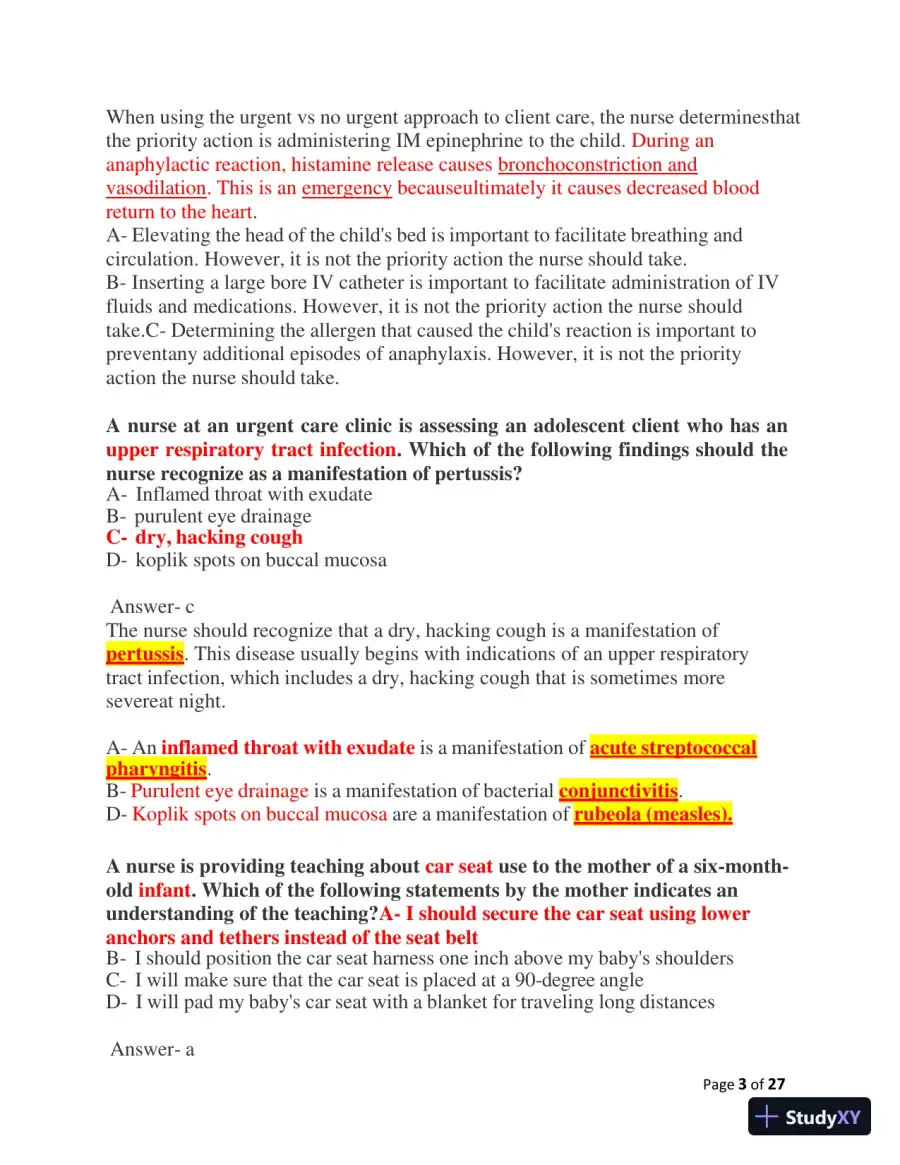 Page3of27When using the urgent vs no urgent approach to client care, the nurse determinesthatthe priority action is administering IM epinephrine to the child. During ananaphylactic reaction, histamine release causes bronchoconstriction andvasodilation. This is an emergency becauseultimately it causes decreased bloodreturn to the heart.A- Elevating the head of the child's bed is important to facilitate breathing andcirculation. However, it is not the priority action the nurse should take.B- Inserting a large bore IV catheter is important to facilitate administration of IVfluids and medications. However, it is not the priority action the nurse shouldtake.C- Determining the allergen that caused the child's reaction is important topreventany additional episodes of anaphylaxis. However, it is not the priorityaction the nurse should take.A nurse at an urgent care clinic is assessing an adolescent client who has anupper respiratory tract infection. Which of the following findings should thenurse recognize as a manifestation of pertussis?A- Inflamed throat with exudateB- purulent eye drainageC- dry, hacking coughD- koplik spots on buccal mucosaAnswer- cThe nurse should recognize that a dry, hacking cough is a manifestation ofpertussis. This disease usually begins with indications of an upper respiratorytract infection, which includes a dry, hacking cough that is sometimes moresevereat night.A- Aninflamed throat with exudateis a manifestation ofacute streptococcalpharyngitis.B- Purulent eye drainage is a manifestation of bacterialconjunctivitis.D- Koplik spots on buccal mucosa are a manifestation ofrubeola (measles).A nurse is providing teaching about car seat use to the mother of a six-month-old infant. Which of the following statements by the mother indicates anunderstanding of the teaching?A- I should secure the car seat using loweranchors and tethers instead of the seat beltB- I should position the car seat harness one inch above my baby's shouldersC- I will make sure that the car seat is placed at a 90-degree angleD- I will pad my baby's car seat with a blanket for traveling long distancesAnswer- alOMoARcPSD|13778330
Page 14
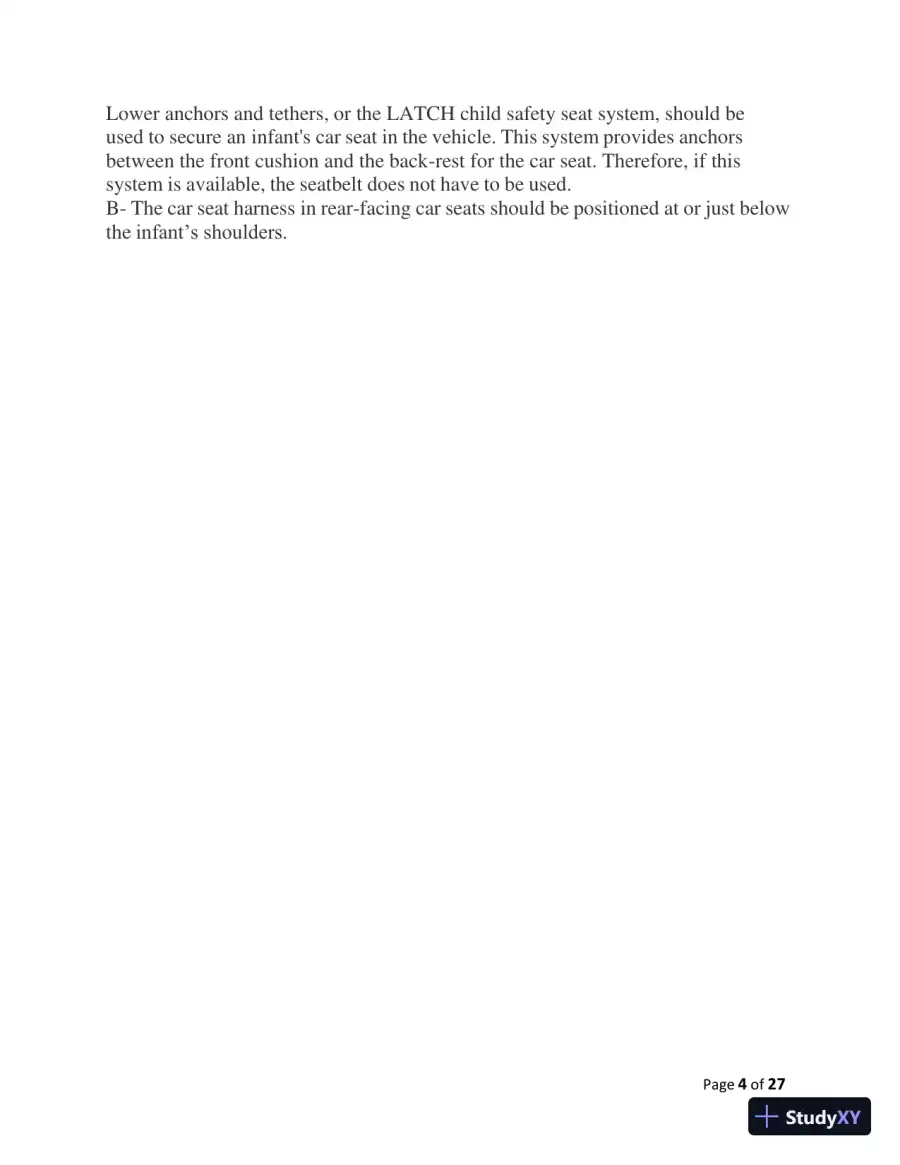 Page4of27Lower anchors and tethers, or the LATCH child safety seat system, should beused to secure an infant's car seat in the vehicle. This system provides anchorsbetween the front cushion and the back-rest for the car seat. Therefore, if thissystem is available, the seatbelt does not have to be used.B- The car seat harness in rear-facing car seats should be positioned at or just belowtheinfant’s shoulders.lOMoARcPSD|13778330
Page 15
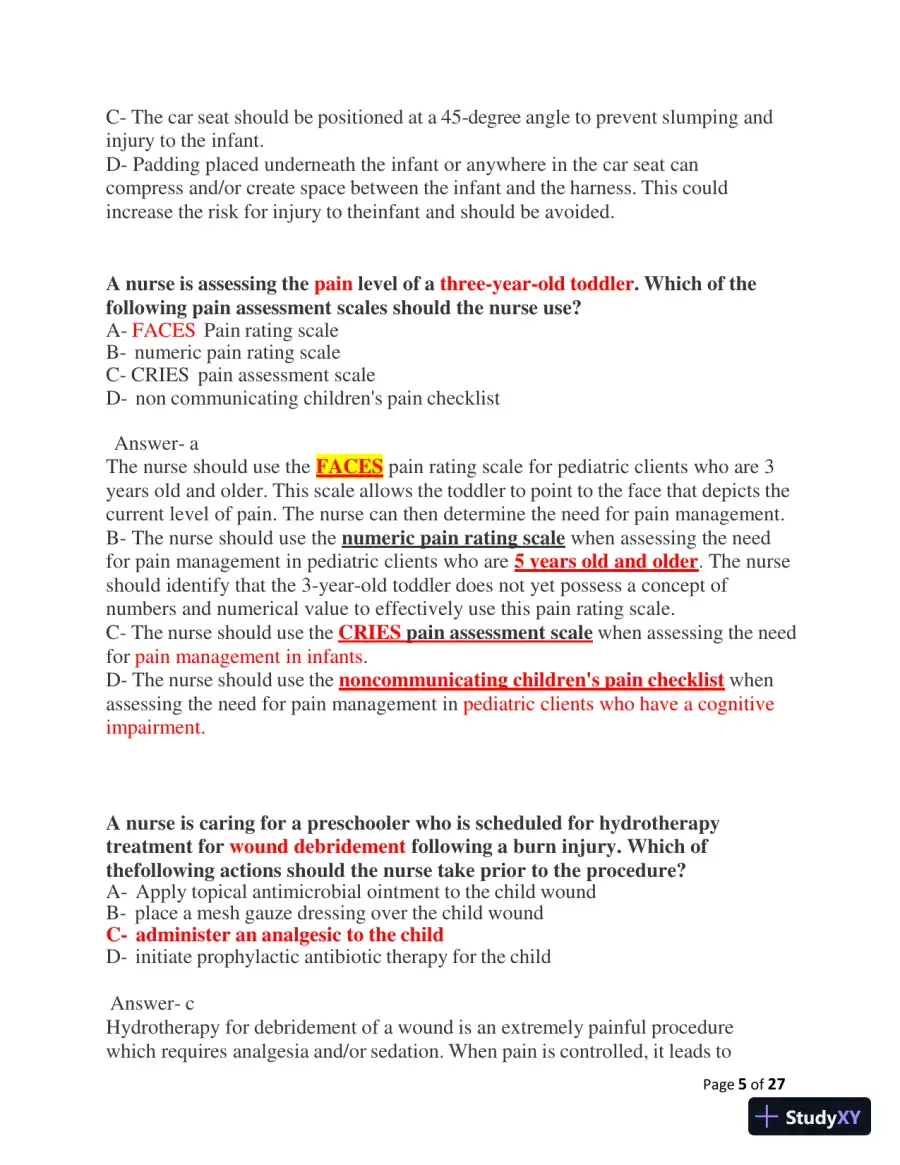 Page5of27C- The car seat should be positioned at a 45-degree angle to prevent slumping andinjury to the infant.D- Padding placed underneath the infant or anywhere in the car seat cancompress and/or create space between the infant and the harness. This couldincrease the risk for injury to theinfant and should be avoided.A nurse is assessing the pain level of a three-year-old toddler. Which of thefollowing pain assessment scales should the nurse use?A- FACES Pain rating scaleB- numeric pain rating scaleC- CRIES pain assessment scaleD- non communicating children's pain checklistAnswer- aThe nurse should use theFACESpain rating scale for pediatric clients who are 3years old and older. This scale allows the toddler to point to the face that depicts thecurrent level of pain. The nurse can then determine the need for pain management.B- The nurse should use thenumeric pain rating scalewhen assessing the needfor pain management in pediatric clients who are5 years old and older. The nurseshould identify that the 3-year-old toddler does not yet possess a concept ofnumbers and numerical value to effectively use this pain rating scale.C- The nurse should use theCRIES pain assessment scalewhen assessing the needfor pain management in infants.D- The nurse should use thenoncommunicating children's pain checklistwhenassessing the need for pain management in pediatric clients who have a cognitiveimpairment.A nurse is caring for a preschooler who is scheduled for hydrotherapytreatment for wound debridement following a burn injury. Which ofthefollowing actions should the nurse take prior to the procedure?A- Apply topical antimicrobial ointment to the child woundB- place a mesh gauze dressing over the child woundC- administer an analgesic to the childD- initiate prophylactic antibiotic therapy for the childAnswer- cHydrotherapy for debridement of a wound is an extremely painful procedurewhich requires analgesia and/or sedation. When pain is controlled, it leads tolOMoARcPSD|13778330
Page 16
 Page6of27reduced physiological demands on the body caused by stress and decreases thelikelihood of children developing depression and post-traumatic stress disorder.A- A nurse should apply topical antimicrobial ointment to the child's woundfollowing hydrotherapy to prevent infection.lOMoARcPSD|13778330
Page 17
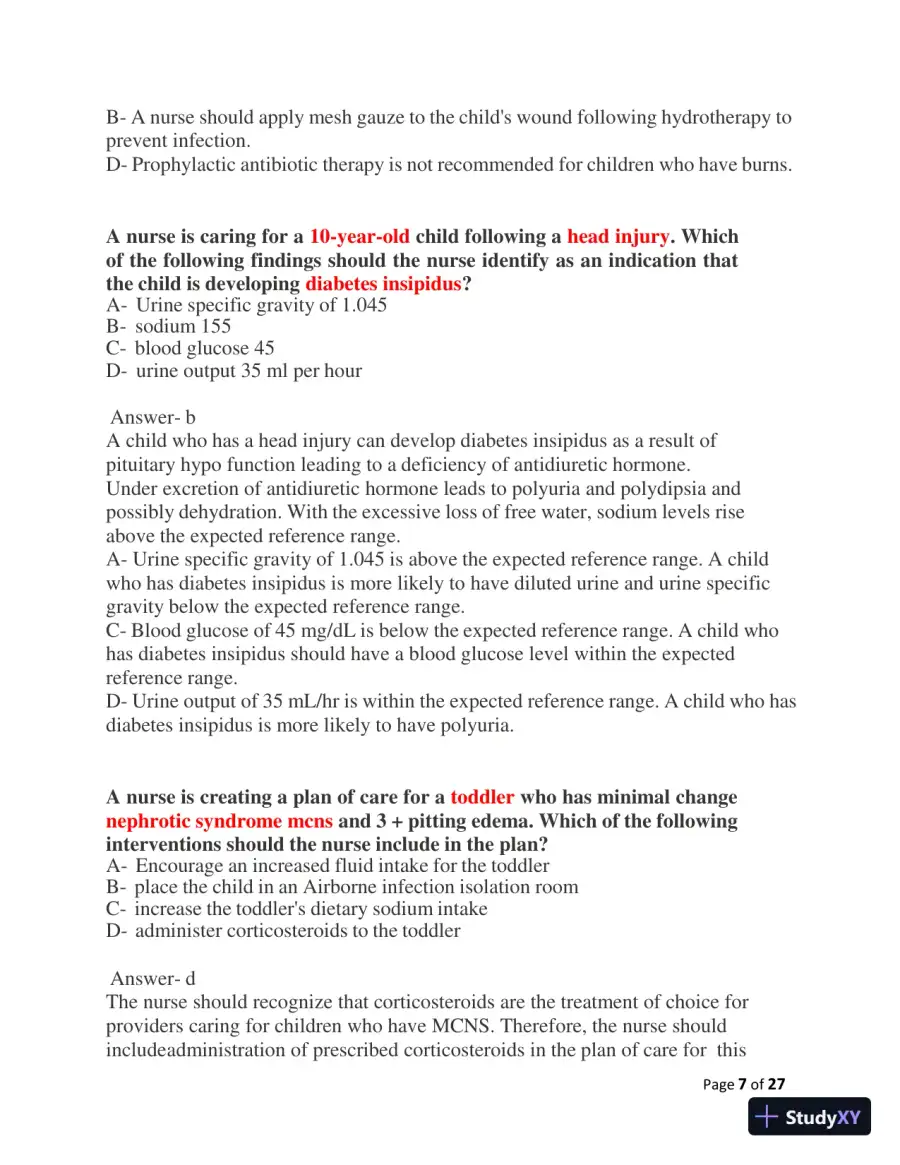 Page7of27B- A nurse should apply mesh gauze to the child's wound following hydrotherapy toprevent infection.D- Prophylactic antibiotic therapy is not recommended for children who have burns.A nurse is caring for a 10-year-old child following a head injury. Whichof the following findings should the nurse identify as an indication thatthe child is developing diabetes insipidus?A- Urine specific gravity of 1.045B- sodium 155C- blood glucose 45D- urine output 35 ml per hourAnswer- bA child who has a head injury can develop diabetes insipidus as a result ofpituitary hypo function leading to a deficiency of antidiuretic hormone.Under excretion of antidiuretic hormone leads to polyuria and polydipsia andpossibly dehydration. With the excessive loss of free water, sodium levels riseabove the expected reference range.A- Urine specific gravity of 1.045 is above the expected reference range. A childwho has diabetes insipidus is more likely to have diluted urine and urine specificgravity below the expected reference range.C- Blood glucose of 45 mg/dL is below the expected reference range. A child whohas diabetes insipidus should have a blood glucose level within the expectedreference range.D- Urine output of 35 mL/hr is within the expected reference range. A child who hasdiabetes insipidus is more likely to have polyuria.A nurse is creating a plan of care for a toddler who has minimal changenephrotic syndrome mcns and 3 + pitting edema. Which of the followinginterventions should the nurse include in the plan?A- Encourage an increased fluid intake for the toddlerB- place the child in an Airborne infection isolation roomC- increase the toddler's dietary sodium intakeD- administer corticosteroids to the toddlerAnswer- dThe nurse should recognize that corticosteroids are the treatment of choice forproviders caring for children who have MCNS. Therefore, the nurse shouldincludeadministration of prescribed corticosteroids in the plan of care for thislOMoARcPSD|13778330
38 more pages in the full document
Unlock it once and it stays in your library, ready to chat with or turn into flashcards.
Unlock the full documentMore Assessment Technologies Institute study materials
See all Past Exams
ATI Maternal Newborn Practice Exam with Answers (210 Solved Questions)
Assessment Technologies Institute
114 pages141downloadsFeb 2025 Past Exams
ATI PN Pediatrics Proctored Exam Version 8 with Answers (166 Solved Questions)
Assessment Technologies Institute
40 pages126downloadsFeb 2025 Past Exams
2023 ATI NGN Comprhensive Exit Exam with Answers (87 Solved Questions)
Assessment Technologies Institute
40 pages115downloadsFeb 2025 Past Exams
2021 ATI Medical/Surgical Neurosensory AH1 with Answers (80 Solved Questions)
Assessment Technologies Institute
19 pages106downloadsFeb 2025 Past Exams
2024-2025 ATI Leadership Proctored Focus Practice Exam with Answers (63 Solved Questions)
Assessment Technologies Institute
27 pages99downloadsFeb 2025 Past Exams
2024-2025 ATI Comprehensive Exit Exam with Answers (13 Solved Questions)
Assessment Technologies Institute
6 pages77downloadsFeb 2025 Past Exams
2023 ATI RN Adult Medical Surgical For NGN Form A, B, C with Answers (21 Solved Questions)
Assessment Technologies Institute
9 pages71downloadsFeb 2025 Past Exams
2022-2023 ATI Med Surg Proctored Exam Retake with Answers (111 Solved Questions)
Assessment Technologies Institute
37 pages68downloadsFeb 2025
Study this document with CramX
Once it is in your library, every tool can work from it.