
ATI Maternity Proctored Exam Version 5 With Answers (181 Solved Questions)

ATI Maternity Proctored Exam Version 5 With Answers helps you develop exam strategies with past test materials.

Sebastian Lopez
Contributor
4.4
33
10 months ago
Preview (14 of 45 Pages)
100%
Log in to unlock

Page 1

ATI Maternity Proctored Exam Version 5 With Answers (181 Solved Questions) - Page 1 preview image

Loading page ...

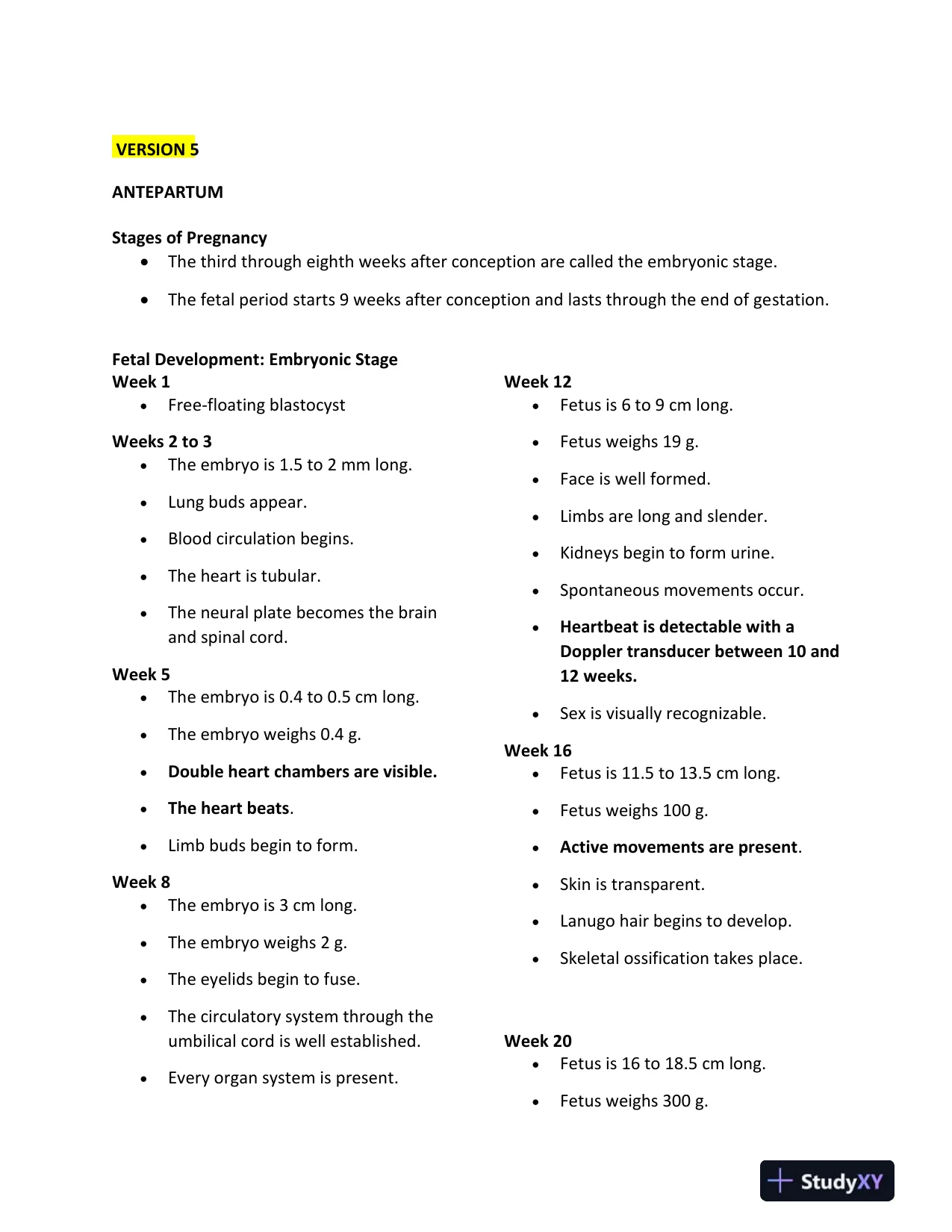
ANTEPARTUMStages of PregnancyThe third through eighth weeks after conception are called the embryonic stage.The fetal period starts 9 weeks after conception and lasts through the end of gestation.Fetal Development: Embryonic StageWeek 1Free-floating blastocystWeeks 2 to 3The embryo is 1.5 to 2 mm long.Lung buds appear.Blood circulation begins.The heart is tubular.The neural plate becomes the brainand spinal cord.Week 5The embryo is 0.4 to 0.5 cm long.The embryo weighs 0.4 g.Double heart chambers are visible.The heart beats.Limb buds begin to form.Week 8The embryo is 3 cm long.The embryo weighs 2 g.The eyelids begin to fuse.The circulatory system throughtheumbilical cord is well established.Every organ system is present.Week 12Fetus is 6 to 9 cm long.Fetus weighs 19 g.Face is well formed.Limbs are long and slender.Kidneys begin to form urine.Spontaneous movements occur.Heartbeat is detectable with aDoppler transducer between 10 and12 weeks.Sex is visually recognizable.Week 16Fetus is 11.5 to 13.5 cm long.Fetus weighs 100 g.Active movements are present.Skin is transparent.Lanugo hair begins to develop.Skeletal ossification takesplace.Week 20Fetus is 16 to 18.5 cm long.Fetus weighs 300 g.VERSION 5

Page 2

ATI Maternity Proctored Exam Version 5 With Answers (181 Solved Questions) - Page 2 preview image

Loading page ...

Page 3

ATI Maternity Proctored Exam Version 5 With Answers (181 Solved Questions) - Page 3 preview image

Loading page ...

Lanugo covers the entire body.Fetus has fingernails and toenails.Muscles are developed.Enamel and dentin are beingdeposited.Heartbeat is detectable with aregular (nonelectronic) fetoscope.Week 24Fetus is 23 cm long.Fetus weighs 600 g.Hair on head is well formed.Skin is reddish and wrinkled.Reflex hand grasp is functioning.Vernix caseosa covers the entirebody.Fetus can hear.Week 28Fetus is 27 cm long.Fetus weighs 1100 g.Limbs are well flexed.Brain is developing rapidly.Eyelids open and close.Lungs are developed sufficiently toprovide gas exchange (lecithinforming).If born at this time, neonate canbreathe.Week 32Fetus is 31 cm long.Fetus weighs 1800 to 2100 g.Bones are fully developed.Subcutaneous fat has accumulated.Lecithin-to-sphingomyelin (L/S) ratiois 2:1.Week 36Fetus is 35 cm long.Fetus weighs 2200 to 2900 g.Skin is pink and the body rounded.Skin is less wrinkled.Lanugo is disappearing.L/S ratio is higher than 2:1.Week 40Fetus is 40 cmlong.Fetus weighs 3200 g or more. 3KgSkin is pinkish and smooth.Lanugo remains on the upper arms and shoulders.Vernix caseosa coverage decreases.Fingernails extend beyond fingertips.Sole (plantar) creases run down to the heels.

Page 4

ATI Maternity Proctored Exam Version 5 With Answers (181 Solved Questions) - Page 4 preview image

Loading page ...

Testes are in the scrotum.Labia majora are well developed.Fetal CirculationPresent because of the fetus’nonfunctioning lungs,bypasses must close afterbirth to allowblood to flow through the lungs and the liver.

Page 5

ATI Maternity Proctored Exam Version 5 With Answers (181 Solved Questions) - Page 5 preview image

Loading page ...

Umbilical CordCord contains two arteries and one vein.Arteries carry deoxygenated blood and waste products from the fetus.Vein carries oxygenated blood and provides oxygen and nutrients to the fetus.Remember AVA: two arteries and one vein.The arteries carry deoxygenated blood and waste products away from the fetus to theplacenta, where these substances are transferred to the mother's circulation.The umbilical vein carries freshly oxygenated and nutrient-laden blood from theplacenta backto the fetus.Nagele's rule :Used to determine the estimated date of delivery/confinement.Subtract 3 months from the first day of the last menstrual period (LMP), add 7days, and then adjust the year as necessary.The ductus arteriosus connectsthe pulmonary artery to theaorta, bypassing the lungs.The ductus venosus connects theumbilical vein and the inferiorvena cava, bypassing the liver.The foramen ovale is the openingbetween the right and the leftatria of the heart, bypassing thelungsFetal HR: 160 to 170 beats/min in the firsttrimester butslowing with fetal growth to120 to 160 beats/min near or at term.

Page 6

ATI Maternity Proctored Exam Version 5 With Answers (181 Solved Questions) - Page 6 preview image

Loading page ...

Signs of PregnancyPresumptive SignsAmenorrheaNausea and vomitingIncreased size and feeling of fullness in breastsPronounced nipplesUrinary frequencyQuickeningFatigueDiscoloration andthickening of the vaginal mucosaProbable signsUterine enlargementHegar signGoodell sign: Softening of the cervixChadwick sign: Violet coloration of the mucous membranesBallottement: Rebounding of the fetus against the examiner's finger on palpation.Positive result on pregnancy test for human chorionic gonadotropin (hCG)Positive signsGstands for gravidity, or the number of pregnancies, including the current one.Trepresents term births, the number of children born at term (longer than 37 weeks’gestation).Pis preterm births, the number of children born before 37 weeks’ gestation.Arepresents abortions and miscarriages, the number of abortions and/or miscarriages(included in gravida if before 20 weeks’ gestation; included inparityif past 20 weeks’gestation). Note that the termination of a pregnancy after 20 weeks is referred to astherapeutic termination.Lstands for the number of current living children.

Page 7

ATI Maternity Proctored Exam Version 5 With Answers (181 Solved Questions) - Page 7 preview image

Loading page ...

Fetal heart rate, detectable with an electronic device (Doppler transducer) at 10 to 12weeks and with a nonelectronic device (fetoscope) at 20 weeks of gestationActive fetal movements palpable by examinerOutline of fetus on ultrasoundFundal Height:The fundal height is measured to help gauge the fetus' gestational age.**fundal height in centimeters approximately equals the fetus's age in weeks, plus or minus 2cm.**In the early weeks of pregnancy, the cervix softens as a result of pelvic congestion (Goodellsign). Cervical softening is noted on physical examination. The presence of the Goodell sign is aprobable indication of pregnancy. Anotherprobable indication of pregnancy is the Chadwicksign, in which the cervix changes from pink to a violet color. Presumptive indications ofpregnancy are also termed subjective changes because they are experienced and reported bythe woman. Positive indications of pregnancy include auscultation of fetal heart sounds, fetalmovement felt by the examiner, and visualization of the fetus on ultrasonography.When a pregnant woman is in the supine position, particularly during the second and thirdtrimesters, theweight of the gravid uterus partially occludes the vena cava and descendingaorta. The occlusion impedes return of blood from the lower extremities and consequentlyreduces cardiac return, cardiac output, and blood pressure. This is known as supine hypotensivesyndrome. Symptoms include faintness, lightheadedness, dizziness, and agitation. A lateralrecumbent position alleviates the pressure on the blood vessels and quickly corrects supinehypotension. Although the nurse may take the woman's blood pressure, this is not the action totake immediately. It is not necessary to call the obstetrician to the examining room. Placing acool cloth on the woman's forehead will not alleviate the problem.Urinalysis and Urine CultureA urine specimen for glucose and protein determinations should be obtained at everyprenatal visit.Glycosuria is a common result of the decreased renal threshold that occurs duringpregnancy.

Page 8

ATI Maternity Proctored Exam Version 5 With Answers (181 Solved Questions) - Page 8 preview image

Loading page ...

Persistent glycosuria may indicate diabetes.White blood cells in the urine may indicate infection.Ketonuria may result from insufficient food intake or vomiting.Levels of 2+ to 4+ protein in the urine may indicate infection or preeclampsia.If the client is Rh negative and the result of an antibody screen is negative, she will need repeatantibodyscreens and should receive Rh immune globulin around 28 weeks' gestation toprevent the formation of anti-Rh antibodies. An Rh-negative woman should also receive Rhimmune globulin within 72 hours of delivery if her newborn is Rh-positive. On the basis ofthedata provided in the question, the other options are incorrect.Amniocentesis is a relatively simple and safe procedure that permits the diagnosis of many fetalanomalies and confirms fetal maturity. It is a relatively painless procedure that takes only ashort amount of time. Ultrasonography is used to locate the fetus and placenta and identify thelargest pockets of amniotic fluid that can safely be sampled. A small amount of local anestheticmay be injected into the skin. The woman may feel pressure as the needle is inserted and mildcramping as the needle enters the myometrium. Informed consent will need to be provided bythe client before the procedure. Although risks are associated with the procedure, the need forseveral informed consents to besigned is not warranted.MaternityNursing 214A nurse is caring for a client who is pregnant and states that her last menstrual periodwas April 1, 2013. Which of the following is the client’s estimated date of delivery?A. Jan. 8, 2014B. Jan. 15,2014C. Feb. 8, 2014D. Feb. 15, 2014A.Jan. 8, 2014A nurse in a prenatal clinic is caring for a client who is in the first trimester of pregnancy.The client's health record includes this data: G3 T1 P0 A1 L1. How should the nurseinterpret this information? (Select all that apply)A. Client has delivered one newborn at terms.B. Client has experienced no preterm labor.C. Client has been through active labor.D. Client has had two prior pregnancies.E. Client has one living child.A. Client has delivered one newborn at terms.D. Client has had two prior pregnancies.

Page 9

ATI Maternity Proctored Exam Version 5 With Answers (181 Solved Questions) - Page 9 preview image

Loading page ...

E. Client has one living child.A nurse is reviewing the health record of a client who is pregnant. The providerindicated the client exhibits probable signs of pregnancy. Which of the following wouldbe included? (Select all that apply)A. Montgomery's glandsB. Goodall's signC. BallottementD. Chadwick's signE. QuickeningB. Goodall's signC. BallottementD. Chadwick's signA nurse in a prenatal clinic is caring for client who ispregnant and experiencing episodesof maternal hypotension. The client asks the nurse what causes these episodes. Whichof the following is an appropriate response by the nurse?A. "This is due to an increase in blood volume."B. "This is due to pressure from the uterus on the diaphragm"C. "This is due to the weight of the uterus on the vena cava."D. "This is due to increased cardiac output."C. "This is due to the weight of the uterus on the vena cava."A nurse in a clinic receives a phone call from a client who believes she is pregnant andwould like to be tested in the clinic to confirm her pregnancy. Which of the followinginformation should the nurse provide to the client?A. "You should wait until 4 weeks after conception to be tested."B. "You should be off any medication for 24 hours prior to the test."C. "You should be NPO for at least 8 hours prior to the test."D. "You should collect urine from the first morning void."D. "You should collect urine from the first morning void."A nurse is teaching a group of women who are pregnant about measures to relievebackache during pregnancy. The nurse should should teach the women which of thefollowing? (Select all that apply)A. Avoid any liftingB. Perform Kegel exercises twice a day.C. Perform the pelvic rock exercise every day.D. Use proper body mechanics.E. Avoid constrictive clothing.C. Perform the pelvic rock exercise every day.D. Use proper body mechanics.

Page 10

ATI Maternity Proctored Exam Version 5 With Answers (181 Solved Questions) - Page 10 preview image

Loading page ...

A client who is at 8 weeks of gestation tells the nurse that she isn't sure she is happyabout being pregnant. Which of the following is an appropriate response by the nurse tothe client's statement?A. "I will inform the provider that you are having these feelings."B. "It is normal to have these feelings during the first few months of pregnancy."C. "You should be happy that you are going to bring new life into the world."D. "I am going to make an appointment with the counselor for you to discuss these thoughts."B. "It is normal to have these feelings duringthe first few months of pregnancy."A nurse is caring for a client who is pregnant and reviewing signs of complications thatshould be promptly reported to the provider. Which of the following should beincluded?A. Vaginal bleedingB. SwellingC.Heartburn after eatingD. Lightheadedness when lying on backA. Vaginal bleedingA client who is at 7 weeks of gestation is experiencing nausea and vomiting in themorning. The nurse in the prenatal clinic provides teaching that should include which ofthefollowing?A. Eat crackers or plain toast before getting out of bed.B. Awaken during the night to eat a snackC. Skip breakfast and eat lunch after nausea has subsidedD. Eat a large evening meal.A. Eat crackers or plain toast before getting out of bed.A nurse is teaching a group of clients who are pregnant about behaviors to avoid duringpregnancy. Which of the following statements by a client indicates a need for furtherinstruction?A. "I can have a glass of wine with dinner."B. "Smoking is a causeof low birth weight in babies."C. "Signs of infection should be reported to my doctor."D. "I should not take over-the-counter medications without checking with my obstetrician."A. "I can have a glass of wine with dinner."A nurse in a prenatalclinic is providing education to a client who is in the 8th week ofgestation, The client states that she does not like milk. What is a good source of calciumthat the nurse can recommend to the client?A. Dark green, leafy vegetablesB. Deep red or orangevegetablesC. White bread and riceD. Meat, poultry, and fishA. Dark green, leafy vegetables

Page 11

ATI Maternity Proctored Exam Version 5 With Answers (181 Solved Questions) - Page 11 preview image

Loading page ...

A nurse in a prenatal clinic is caring for a group of clients. Which of the following clientsshould the nurse be concerned about regarding weight gain?A. 1.8kg(4lb) weight gain and is in her first trimesterB. 3.6kg (8lb) weight gain and is in her first trimesterC. 6.8kg (15lb) weight gain and is in her second trimesterD. 11.3kg (25lb) weight gain and is in her third trimesterB. 3.6kg (8lb) weight gain and is in her first trimesterA nurse in clinic is teaching a client of childbearing age about recommended folic acidsupplements. Which of the following defects can occur in the fetus or neonate as aresult of folic acid deficiency?A. Irondeficiency anemiaB. Poor bone formationC. Macrosomic fetusD. Neural tube defectsD. Neural tube defectsA nurse is reviewing a new prescription for iron supplements with a client who is in the8th week of gestation and has iron deficiency anemia. The nurse should advise the clientto take the iron supplements with which of the following?A. Ice waterB. Low-fat or whole milkC. Tea or coffeeD. Orange juiceD. Orange juiceA nurse is reviewing postpartum nutrition needs with a group of new mothers who arebreastfeeding their newborns. Which of the following statements by a member of thegroup requires clarification?A. "I am glad I can have my morning coffee."B. "I know that certain foods that I eat will affect my baby."C. "I will continue adding 330 calories per day to my diet."D. "I will continue my calcium supplements because I don't like milk."A. "I am glad I can have my morning coffee."A nurse is caring for a client and reviewing the findings of the client's biophysical profile(BPP). Which of the following variables are included in this test? (Select all that apply)A. Fetal weightB. Fetal breathing movementC. Fetal toneD. Reactive FHRE. Amniotic fluid volumeB. Fetal breathing movementC. Fetal tone

Page 12

ATI Maternity Proctored Exam Version 5 With Answers (181 Solved Questions) - Page 12 preview image

Loading page ...

D. Reactive FHRE. Amniotic fluidvolumeA nurse is caring for a client who is in preterm labor and is scheduled to undergo anamniocentesis to assess fetal lung maturity. Which of the following is a test for fetal lungmaturity?A. Alpha-fetoprotein (AFP)B. Lecithin/sphingomyelin (L/S) ratioC. Kleihauer-Betke testD. Indirect Coomb's testB. Lecithin/sphingomyelin (L/S) ratioA nurse is caring for a client who is pregnant and undergoing a nonusers test. The clientasks why the nurse is using an acoustic vibration device. Which offollowing is anappropriate response by the nurse?A. "It is used to stimulate uterine contractions."B. "It will decrease the incidence of uterine contractions."C. "It lulls the fetus to sleep."D. "It awaken a sleeping fetus."D. "It awaken a sleeping fetus."A nurse is teaching a client who is pregnant about the amniocentesis procedure. Whichof the following statements by the client requires clarification?A. "I will report cramping or signs of infection to the physician."B. "I should drink lots of fluids during the 24 hours following the procedure."C. "I need to have a full bladder at the time of the procedure."D. "The test is done to detect genetic abnormalities."C. "I need to have a full bladder at the time of the procedure."A nurse is caring for a client who is pregnant and is to undergo a contraction stress test(CST). Which of the following findings are indications for the procedure? (Select all thatapply)A. Decreased fetal movementB. Intrauterine growth restriction (IUGR)C. PostmaturityD. Advanced maternal ageE. Amniotic fluid emboliA. Decreased fetal movementB. Intrauterine growth restriction (IUGR)C. PostmaturityD. Advanced materal ageA nurse in L&D receives a phone call from a client who reports that her contractionsstarted about 2 hrs ago, did not go away when she had 2 glasses of water and rested,and became stronger since she started walking. Her contractions occur every 10 mins

Page 13

ATI Maternity Proctored Exam Version 5 With Answers (181 Solved Questions) - Page 13 preview image

Loading page ...

and last about 30 seconds. She hasn't had much fluid leak from her vagina. However,she saw some blood when she wiped after voiding. Based on this report the nurseshould recognize that the client is experiencingA. Braxton Hicks contractionsB. rupture of membranesC. fetal decentD. true contractionsD. True contractionsA nurse in L&D is caring for a client in labor and applies an external fetal monitor andtocotranducer. The FHR is around 140/min. Contractions are every 8 min and 30-40seconds in duration. The nurse performs a vaginal exam and finds the cervix is 2cmdilated, 50% effaced, and the fetus is at-2 station. Which of the following stages andphases of labor is this client experiencing?A. The 1st stage, latent phaseB. The 1st stage, active phaseC. The 1st stage, transition phaseD. The 2nd stage of laborA. The 1st stage, latent phaseA client experiences a large gush of fluid from her vagina while walking in the hallway ofthe birthing unit. The nurse's first action after establishing that the fluid is amniotic fluidshould be toA. Asses the amniotic fluid for meconiumB. Monitor the FHR for distressC. Dry the client and make her comfortableD. Monitor the client's uterine contractions.B. Monitor the FHR for distressA nurse in L&D is completing an admission history for a client who is at 39 weeks ofgestation. The client reports that she has been leaking fluid from her vagina for 2 days.The nurse knows that this client is at risk forA. Cord ProlapseB. InfectionC, Postpartum hemorrhageD. HydramniosB. InfectionA nurse is caring for a client who is in active labor and becomes nauseous and vomits.The client is very irritable and feels the urge to have a bowel movement. She states,"I've had enough. I can't do this anymore. I want to gohome right now." the nurseknows that these signs indication the client is in theA. 2nd stage of laborB. 4th stage of labor

Page 14

ATI Maternity Proctored Exam Version 5 With Answers (181 Solved Questions) - Page 14 preview image

Loading page ...

C. transition phase of laborD. latent phase of laborC. transition phase of laborA nurse is caring for a client at 40weeks of gestation who is experiencing contractionevery 3 to 5 min and becoming stronger. A vaginal exam reveals that the client's cervix is3 cm dilated, 80% effaced and-1 station. The client asks for pain medication. Which ofthe following actions should the nurse take at the time? (Select all that apply)A. Encourage the use of patterned breathing techniquesB. Insert an indwelling urinary catheterC. Administer opioid analgestic medication as prescribedD. Suggest application of coldE. Provide ice chips.A. Encourage the use of patterned breathing techniquesC. Administer opioid analgestic medication as prescribedD. Suggest application of coldA nurse is caring for a client who is in active labor. The client reports lower back pain.The nurse suspects that this pain is related to a persistent occiput posterior fetalposition. Which of the following nonpharmocological nursing interventions isappropriate?A. abdominal effleurageB. sacral counterpressureC. showing if not contraindicatedD. back rub and massageB. sacral counterpressureA nurse is caring for a client following the administration of an epidural block and ispreparing to administer a prescribed IV fluid bolus. The client's partner asks about thepurpose of the IV fluids. Which of the following is an appropriate response by the nurse?A. "It is needed to promote increased urine output."B. "It is needed to counteract respiratory depression."C "It is needed to counteract hypotension."D. "It is needed to prevent olihohyramnios"C "It is needed to counteract hypotension."A nurse in L&D is caring for a client who is in the 2nd stage of labor. The client's laborhas been progressing and she is expected to deliver vaginally in 20 mins. The provider ispreparing to administer lidocaine (Xylocaine) for pain relief and perform an episiotomy.The nurse should know that the type of regional anesthetic block that is to beadministered is which of the following?A. Pudendal blockB. Epidural blockC. Spinal block
Preview Mode

This document has 45 pages. Sign in to access the full document!