

ATI RN Fundamental Practice Exam With Answers (65 Solved Questions)
- Assessment Technologies Institute
- 28 pages
- Shared May 2025
ATI RN Fundamental Practice Exam With Answers helps you prepare effectively by reviewing actual exam questions from previous years.
Preview 9 of 28 pages
See the first 9 pages exactly as they appear in the document.
Page 1 Read page 1 as text
Ati rn fundamentals complete structured exam with correct qns&answs Rated A++ latest. 65 QUESTIONS WITH 100% CORRECT ANSWERS A nurse is giving change - of - shift report about a patient they admitted earlier that day who has pneumonia. Which of the following pieces of information is the priority for the nurse to provide? • Admitting diagnosis • Breath sounds • Body Temperature • Diagnostic test results - B. Breath sounds When using the airway, breathing, circulation approach to patient care, the nurse should determine that the priority information to provide is the current status of the patient's breath sounds. A nurse is caring for a patient who has an NG tube and is receiving intermittent feedings through an open system. Which of the following actions should the nurse take first? • Rinse the feeding bag with water between feedings. • Tell the patient to keep the head of the bed elevated at least 30º. • Make sure the enteral formula is at room temperature. • Wipe the top of the formula can with alcohol. - B. Tell the patient to keep the head of the bed elevated at least 30º. The first action the nurse should take when using the airway, breathing, circulation approach to patient care is to prevent aspiration of the enteral formula; therefore, the priority intervention is to keep the head of the bed elevated at least 30° to prevent reflux of the formula into the esophagus. A nurse is caring for a patient who has tuberculosis. Which of the following actions should the nurse take? (Select all that apply.)
Page 2 Page 3 Read page 3 as text
• Place the patient in a room with negative pressure airflow. • Wear gloves when assisting the patient with oral care. • Limit each visitor to 2 - hr increments. • Wear a surgical mask when providing patient care. • Use antimicrobial sanitizer for hand hygiene. - A, B, E • Place the patient in a room with negative - pressure airflow is correct. The nurse should place the patient in a room with negative - pressure airflow to meet the requirements of airborne precautions. • Wear gloves when assisting the patient with oral care is correct. The nurse should wear gloves when assisting the patient with oral care to meet the requirements of standard precautions, which the nurse must adhere to for all patients regardless of their d iagnosis. The nurse should wear gloves whenever their hands might come in contact with a patient's bodily fluids, such as saliva, and the mucous membranes in the mouth. • Limit each visitor to 2 - hr increments is incorrect. The nurse does not need to limit the patient's visitors. However, the nurse should limit the patient's presence outside the room and the patient should wear a surgical mask when outside of the room. • Wear a surgical mask when providing patient care is incorrect. The nurse should wear an N95 respirator during patient care to meet the requirements of airborne precautions. • Use antimicrobial sanitizer for hand hygiene is correct. The nurse should use antimicrobial sanitizer for routine hand hygiene when caring for a patient who has tuberculosis. Nurses should also wash their hands with soap and water when their hands are visibly soiled. A nurse is performing a Romberg test during the physical assessment of a patient. Which of the following techniques should the nurse use? • Touch the face with a cotton ball. • Apply a vibrating tuning fork to the patient's forehead. • Have the patient stand with their arms at their sides and their feet together.
Page 4 Read page 4 as text
• Perform direct percussion over the area of the kidneys. - C. Have the patient stand with their arms at their sides and their feet together. A Romberg test helps identify alterations in balance. The nurse should have the patient stand with their arms at their sides and their feet together to observe for swaying and a loss of balance. A nurse is preparing to obtain a lower extremity blood pressure from a patient and no longer palpates the popliteal pulse after 92 mm Hg. Which of the following images displays the measurement in mm Hg to which the nurse should inflate the cuff when obtaining the blood pressure? • 92 mm Hg • 102 mm Hg • 112 mm Hg • 122 mm Hg - D. 122 mm Hg To obtain an accurate blood pressure measurement, the nurse should inflate the cuff 30 mm Hg beyond the point at which the nurse was last able to palpate the pulse. If the nurse last palpated the pulse at 92 mm Hg, then this would be the correct pressure to which the nurse should inflate the cuff. A nurse has accepted a verbal prescription "for three tenths of a milligram of levothyroxine stat" for a patient who has myxedema coma. How should the nurse transcribe the dosage of this medication in the patient's medical record? • .3 mg • 0.3 mg • 0.30 mg D. 3/10 mg - B. 0.3 mg
Page 5 Read page 5 as text
The use and placement of a decimal point can potentially cause a medication error if documented incorrectly. A zero should precede a decimal point, as in 0.3 mg, but should not follow a decimal point unless a whole number follows the zero, as in 2.05 mg. A nurse is discussing the use of herbal supplements for health promotion with a patient. Which of the following patient statements indicates an understanding of herbal supplement use? • "I can take echinacea to improve my immune system." • "I can take feverfew to reduce my level of anxiety." • "I can take ginger to improve my memory." • "I can take ginkgo biloba to relieve nausea." - A. "I can take echinacea to improve my immune system." Echinacea is taken to promote immunity and reduce the risk of infection. A nurse is caring for a patient who has decreased mobility. Which of the following actions should the nurse take to decrease the patient's risk of developing plantar flexion contractures? • Place a pillow under the patient's knees. • Position a trochanter roll under each of the patient's hips. • Advise the patient to wear rubber - soled slippers. • Apply an ankle - foot orthotic device to the patient's feet . - D. Apply an ankle - foot orthotic device to the patient's feet. The nurse should use a device to maintain dorsiflexion, such as an ankle - foot orthotic device or a foot board placed perpendicular to the mattress. A nurse is reviewing practice guidelines with a group of newly licensed nurses. Which of the following interventions should the nurse include that is within the RN scope of practice? • Insert an implanted port. • Close a laceration with sutures.
Page 6 Read page 6 as text
• Place an endotracheal tube. • Initiate an enteral feeding through a gastrostomy tube. - D. Initiate an enteral feeding through a gastrostomy tube. It is within the RN scope of practice for nurses to initiate enteral feedings through nasoenteric, gastrostomy, and jejunostomy tubes. A nurse is planning care for a patient who has vision loss. Which of the following interventions should the nurse include in the plan of care to assist the patient with feeding? • Assign a staff member to feed the patient. • Provide small - handled utensils for the patient. • Thicken liquids on the patient's tray. • Arrange food in a consistent pattern on the patient's plate. - D. Arrange food in a consistent pattern on the patient's plate. Consistency in preparing the patient's plate helps to facilitate self - feeding for patients who have vision loss. Staff can describe the location of the food on the plate by using a clock pattern, allowing the patient to have greater independence during mea ls. A charge nurse is observing a newly licensed nurse prepare a sterile field for a dressing change. Which of the following actions by the newly licensed nurse requires intervention by the charge nurse? • The newly licensed nurse places the cap of a bottle of sterile saline solution on the sterile field. • The newly licensed nurse places sterile objects 2.5 cm (1 inch) within the border of the field. • The newly licensed nurse holds the bottle of sterile saline outside the edge of the field when pouring. • The sterile field is positioned at the level of the newly licensed nurse's waist. - A. The newly licensed nurse places the cap of a bottle of sterile saline solution on the sterile field. The newly licensed nurse should place the cap with the sterile side up on a clean surface because the outer edges are unsterile and will contaminate the sterile field.
Page 7 Read page 7 as text
A nurse is reviewing protocol in preparation for suctioning secretions from a patient who has a new tracheostomy. Which of the following actions should the nurse plan to take? • Use a resuscitation bag with 80% oxygen prior to the procedure. • Select a suction catheter that is half the size of the lumen. • Place the end of the suction catheter in water - soluble lubricant. • Adjust the wall suction apparatus to a pressure of 170 mm Hg. - B. Select a suction catheter that is half the size of the lumen. The nurse should select a suction catheter that is half the size of the lumen to prevent hypoxemia and trauma to the mucosa. A nurse in a clinic is caring for a middle adult patient who states, "The doctor says that, since I am at an average risk for colon cancer, I should have a routine screening. What does that involve?" Which of the following responses should the nurse make? • "I'll get a blood sample from you and send it for a screening test." • "Beginning at age 60, you should have a colonoscopy." • "You should have a fecal occult blood test every year." • "The recommendation is to have a sigmoidoscopy every 10 years." - C. "You should have a fecal occult blood test every year." Colorectal cancer screening for patients who are at average risk begins at age 50. One option for screening is a fecal occult blood test annually. A nurse has just inserted an NG tube for a patient. Which of the following findings should the nurse expect to confirm correct tube placement? • The tube aspirate has a pH of 7. • An x - ray shows the end of the tube above the pylorus.
Page 8 Read page 8 as text
• Bowel sounds are present on auscultation. • The patient reports relief of nausea. - B. An x - ray shows the end of the tube above the pylorus. An abdominal x - ray showing the end of the tube above the pylorus indicates gastric placement. A nurse is preparing to administer 0.5 mL of oral single - dose liquid medication to a patient. Which of the following actions should the nurse take? • Gently shake the container of medication prior to administration. • Transfer the medication to a medicine cup. • Place the patient in a semi - Fowler's position prior to medication administration. • Verify the dosage by measuring the liquid before administering it. - A. Gently shake the container of medication prior to administration. The nurse should gently shake the liquid medication to ensure that the medication is mixed. A nurse is admitting a patient who has rubella. Which of the following types of transmission - based precautions should the nurse initiate? • Droplet • Airborne • Contact • Protective environment - A. Droplet Droplet precautions are a requirement for patients who have infections that spread via droplet nuclei that are larger than 5 microns in diameter, including influenza, rubella, meningococcal pneumonia, and streptococcal pharyngitis. A nurse is reviewing a patient's medication prescription that reads, "digoxin 0.25 by mouth every day." Which of the following components of the prescription should the nurse verify with the provider?
Page 9 Read page 9 as text
• Medication name • Route of administration • Medication dose • Frequency of administration - C. Medication dose In the prescription, the medication dose is not complete. The number 0.25 should be followed by a unit of measurement, such as mg, to clarify the amount the nurse should administer. A nurse manager is overseeing the care activities on a unit. For which ofthe following situations should the nurse manager intervene due to a violation of HIPAA guidelines? • A nurse who is caring for a patient reviews the patient's medical chart with a nursing student who is working with the nurse. • A nurse asks a nurse from another unit to assist with documentation for a patient. • A nurse who is caring for a patient returns a call to the person appointed in the health care proxy to discuss the patient's care. • A nurse discusses a patient's status with the physical therapist who is caring for the patient. - B. A nurse asks a nurse from another unit to assist with documentation for a patient. Only health care professionals directly caring for a patient should have access to the patient's medical information; therefore, this is a violation of HIPAA guidelines. A nurse is teaching an older adult patient who is at risk for osteoporosis about beginning a program of regular physical activity. Which of the following types of activity should the nurse recommend? • Walking briskly • Riding a bicycle • Performing isometric exercises • Engaging in high - impact aerobics - A. Walking briskly
19 more pages in the full document
Unlock it once and it stays in your library, ready to chat with or turn into flashcards.
Unlock the full documentMore Assessment Technologies Institute study materials
See all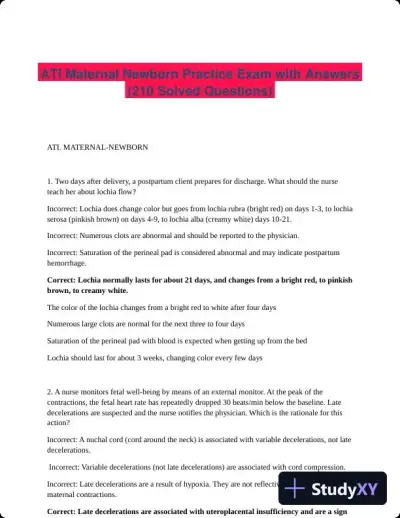 Past Exams
ATI Maternal Newborn Practice Exam with Answers (210 Solved Questions)
Assessment Technologies Institute
114 pages141downloadsFeb 2025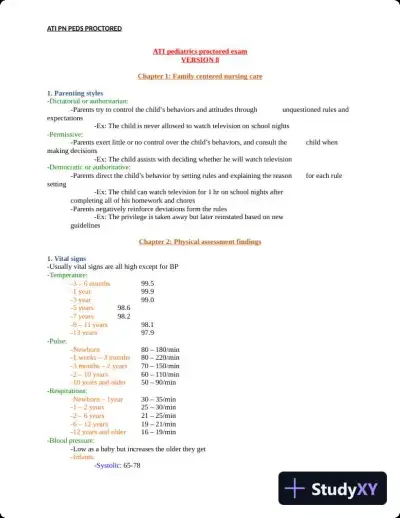 Past Exams
ATI PN Pediatrics Proctored Exam Version 8 with Answers (166 Solved Questions)
Assessment Technologies Institute
40 pages126downloadsFeb 2025 Past Exams
2023 ATI NGN Comprhensive Exit Exam with Answers (87 Solved Questions)
Assessment Technologies Institute
40 pages115downloadsFeb 2025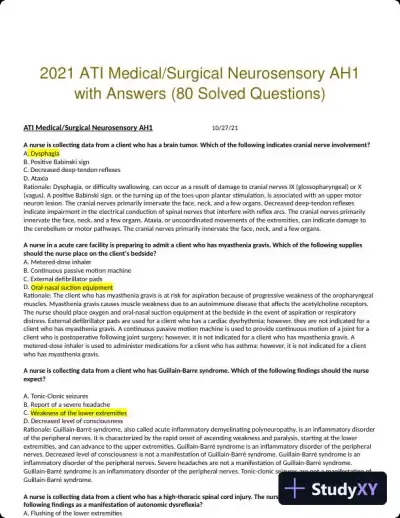 Past Exams
2021 ATI Medical/Surgical Neurosensory AH1 with Answers (80 Solved Questions)
Assessment Technologies Institute
19 pages106downloadsFeb 2025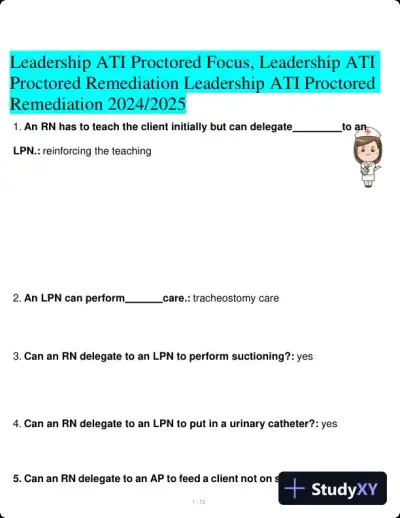 Past Exams
2024-2025 ATI Leadership Proctored Focus Practice Exam with Answers (63 Solved Questions)
Assessment Technologies Institute
27 pages99downloadsFeb 2025 Past Exams
2024-2025 ATI Comprehensive Exit Exam with Answers (13 Solved Questions)
Assessment Technologies Institute
6 pages77downloadsFeb 2025 Past Exams
2023 ATI RN Adult Medical Surgical For NGN Form A, B, C with Answers (21 Solved Questions)
Assessment Technologies Institute
9 pages71downloadsFeb 2025 Past Exams
2022-2023 ATI Med Surg Proctored Exam Retake with Answers (111 Solved Questions)
Assessment Technologies Institute
37 pages68downloadsFeb 2025
Study this document with CramX
Once it is in your library, every tool can work from it.