

ATI RN Fundamental Proctored Exam With Answers (103 Solved Questions)
- Assessment Technologies Institute
- 29 pages
- Shared May 2025
With ATI RN Fundamental Proctored Exam With Answers, you get access to a valuable archive of past exam papers to enhance your study sessions.
Preview 9 of 29 pages
See the first 9 pages exactly as they appear in the document.
Page 1 Read page 1 as text
1/29 ATI fundamentals, ATI RN Fundamentals Proctored Focus STUDY PLAY Flashcards Learn Write Spell Test Match Terms in this set (106) Always correct You've answered all of these correctly! +1 Home safety: Teaching an older adult client about home safety -remove items that could cause the client to trip (rugs, cords, carpets) -place electrical/extension cords
Page 2 Page 3 Read page 3 as text
No Answers Yet You still haven't studied these! against a wall behind furniture -monitor gait/balance, provide aids PRN -make sure steps/sidewalks are in good condition -grab bars near toilet, tub, shower -stool riser, toilet cushion -nonskid bath mats/shower mats -shower chair or bedside commode PRN -ensure adequate lighting -water heater 120 -no smoking if on oxygen, cotton stuff only, no heating oil or nail polish remover -cook meat and fish fully, handle properly +1 Safe Medication Administration & Error Reduction: Appropriate Actions Following a Medication Error -assess client -inform charge nurse -complete incident report Normal level for WBC's 4,500 - 11,000 Normal lab values for Hbg male 13.5-17.5 g/dL
Page 4 Read page 4 as text
Normal lab values for Hbg female 12-16 g/dL Normal lab values for Na 135-145 mEq/L Normal lab values for K 3.5-5 mEq/L Normal lab values for Cl 95-105 mEq/L Normal lab values for HCO3 22-29 mEq/L Normal BUN lab values 7-18 mg/dL Normal Creatine lab values 0.6- 1.2 mg/dL Normal Glucose lab values 70-110 mg/dL Normal Calcium lab values 8.5-10.5 mg/dL Normal total protein lab values 6-8 g/dL
Page 5 Read page 5 as text
Normal Alb lab values 3.5-6 g/dL Normal total Bili 0-1 mg/dL How many grams are in 1 oz 28.35 How many mL are in 1 oz 29.57 How many oz are in 1 cup? 8 oz How many liters are in 1 gallon? 3.8 What are normal values of pH for ABG 7.35-7.45 What are normal values of PaCO2? 35-45 mmHg What are normal values of PaO2? 80-100 mmHg
Page 6 Read page 6 as text
What are normal values of HCO3 24-30 mEq/L What are the steps in removing an artificial eye? pull down the lower lip with index finger & exert slight pressure, allowing to slide over lower lid and grab with free hand -store artificial eye in labeled container filled with tap water or saline What are the steps in inserting an artificial eye? lift upper and lower lid to insert and blink until sets How do you wash an artificial eye? Wash with warm, normal saline, with soft gauze or clean tap water How do you properly irrigate an ear -Have pt sit or lie on side with the affected ear UP. -Using a bulb-irrigating syringe or Walter Pik set on No 2, gently wash ear with warm solution, directing flow toward the superior aspect of the ear canal. Nonblanchable erythema indicates the skin has been damaged by what? Pressure
Page 7 Read page 7 as text
Explain what is happening in the S1 sound "Lub" sound- tricuspid and mitral valves snap shut @ beginning of systole. It is loudest at the apex of the heart. Explain what is happening in the S2 sound "Dub" sound- Aortic and Pulmonic valves shut at beginning of diastole. This is heard best at the base of the <3 What does a split S2 mean? Electrical conduction may be delayed on one side so ventricles might not close at the same time - may sound like a "stutter" S3 is heard in pt's with what? CHF. It follows S2 S4 is heard in pt's with what? HTN, CAD, MI. What is a murmur? occurs between S1 and S2. It should be silent there, but with a murmur there is a whooshing sound.....this typically happens if a valve isn't open wide enough (Stenotic) or if a valve doesn't close tightly enough and blood leaks back Grade 1 murmurs difficult
Page 8 Read page 8 as text
are typically ____to hear Grade 6 murmurs are typically ___ to hear easy to hear Grade 4 and above murmurs are considered____ and are accompanied by a _____ loud murmurs. palpable thrill Pericardial friction rub pericardium (membrane around the heart) becomes inflamed. It causes high pitched, scratchy sound. It is loaded at apex What is the Valsalva maneuver? holding breath and bearing down. Usually done to check for hernia's When suctioning a trach, do you apply suction before or after insertion?Do you use a rotation method? After insertion. Yes
Page 9 Read page 9 as text
Do not insert ____ ___ into artificial airway because it increases the risk of infection normal saline. insert artificial airway until ____ feel resistance or patient starts coughing. If pt needs more suctioning, repeat procedure only ______ more times & wait at least ____ minute 1-2. 1 To rinse catheter, use ________ mL of ________ 5-10 mL. Normal saline Elderly people and children need a _____ gauge for IV's larger # Every time access port you should _____ clean it NEVER infuse _______ potassium chloride
20 more pages in the full document
Unlock it once and it stays in your library, ready to chat with or turn into flashcards.
Unlock the full documentMore Assessment Technologies Institute study materials
See all Past Exams
ATI Maternal Newborn Practice Exam with Answers (210 Solved Questions)
Assessment Technologies Institute
114 pages141downloadsFeb 2025 Past Exams
ATI PN Pediatrics Proctored Exam Version 8 with Answers (166 Solved Questions)
Assessment Technologies Institute
40 pages126downloadsFeb 2025 Past Exams
2023 ATI NGN Comprhensive Exit Exam with Answers (87 Solved Questions)
Assessment Technologies Institute
40 pages115downloadsFeb 2025 Past Exams
2021 ATI Medical/Surgical Neurosensory AH1 with Answers (80 Solved Questions)
Assessment Technologies Institute
19 pages106downloadsFeb 2025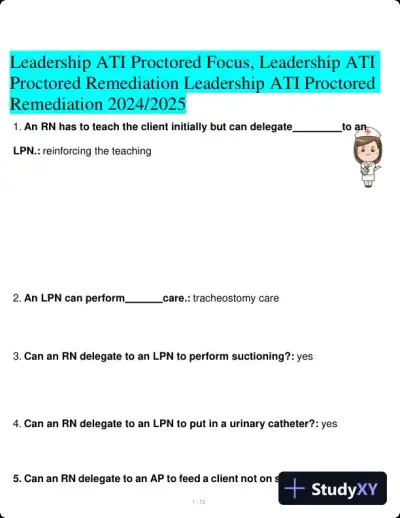 Past Exams
2024-2025 ATI Leadership Proctored Focus Practice Exam with Answers (63 Solved Questions)
Assessment Technologies Institute
27 pages99downloadsFeb 2025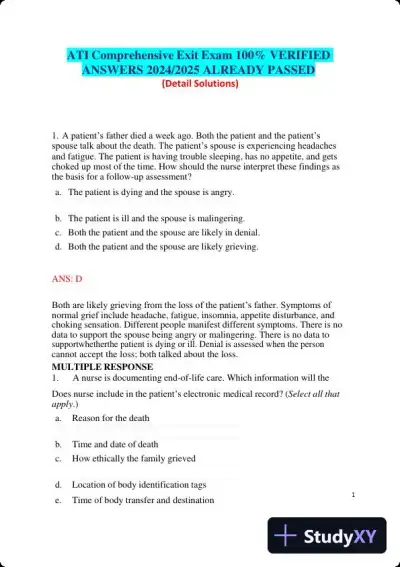 Past Exams
2024-2025 ATI Comprehensive Exit Exam with Answers (13 Solved Questions)
Assessment Technologies Institute
6 pages77downloadsFeb 2025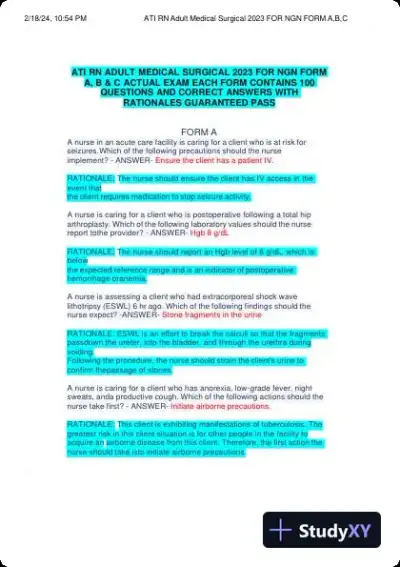 Past Exams
2023 ATI RN Adult Medical Surgical For NGN Form A, B, C with Answers (21 Solved Questions)
Assessment Technologies Institute
9 pages71downloadsFeb 2025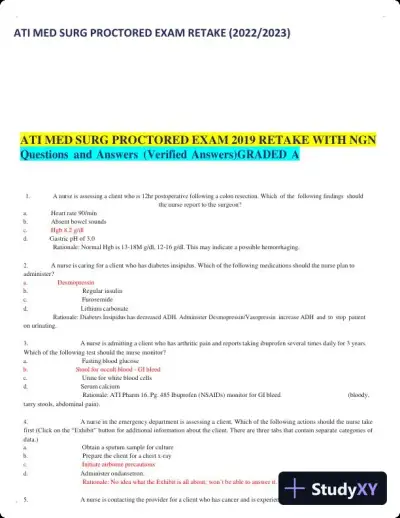 Past Exams
2022-2023 ATI Med Surg Proctored Exam Retake with Answers (111 Solved Questions)
Assessment Technologies Institute
37 pages68downloadsFeb 2025
Study this document with CramX
Once it is in your library, every tool can work from it.