
ATI RN Maternal Newborn Proctored Exam Version 4 With Answers (33 Solved Questions)

Track your progress with ATI RN Maternal Newborn Proctored Exam Version 4 With Answers, featuring real past exams and performance analysis tips.

Nathan Bell
Contributor
4.6
55
10 months ago
Preview (13 of 41 Pages)
100%
Log in to unlock

Page 1

ATI RN Maternal Newborn Proctored Exam Version 4 With Answers (33 Solved Questions) - Page 1 preview image

Loading page ...

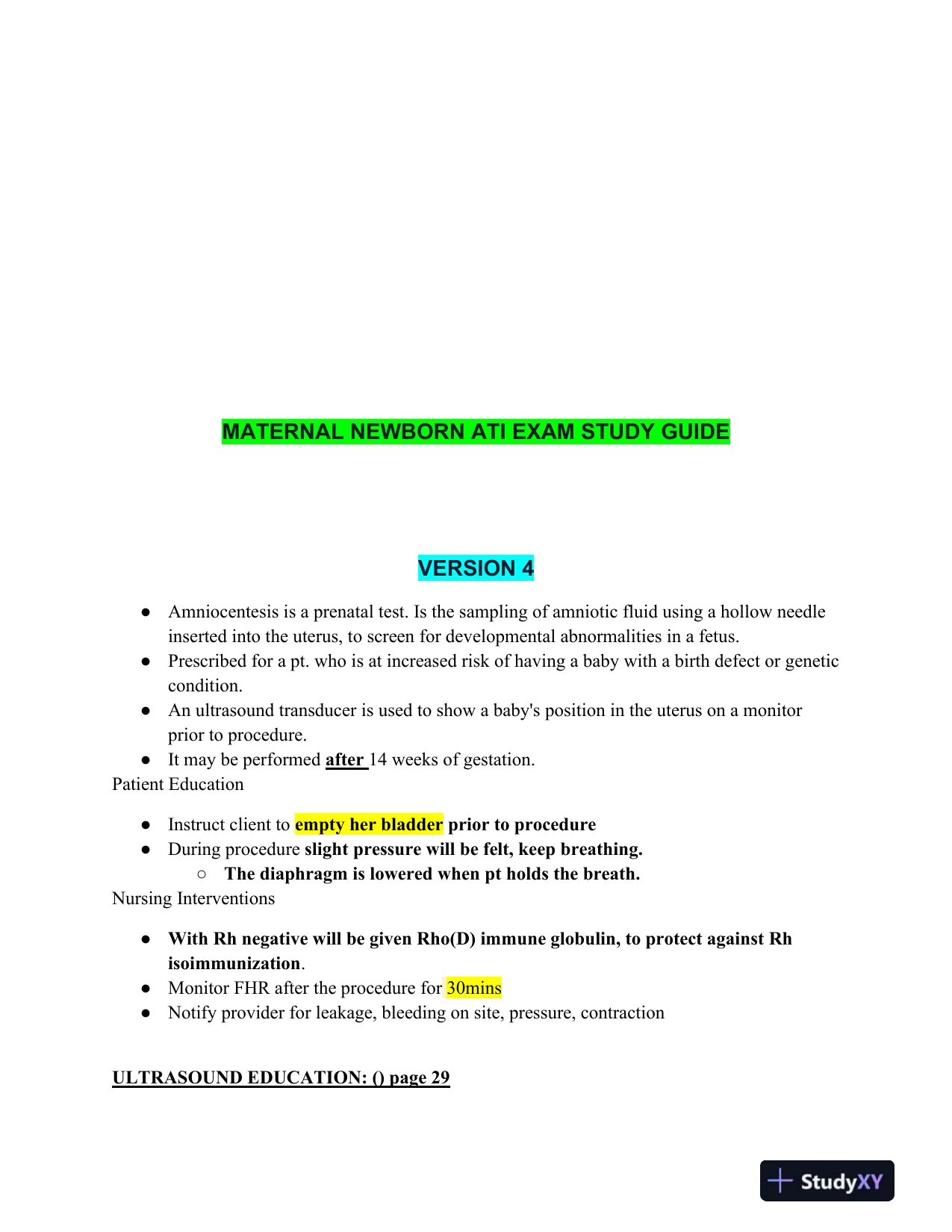
MATERNAL NEWBORN ATI EXAM STUDY GUIDEVERSION 4Amniocentesis is a prenatal test. Is the sampling of amniotic fluid using a hollow needleinserted into the uterus, to screen for developmental abnormalities in a fetus.Prescribed for a pt. who is at increased risk of having a baby with a birth defect orgeneticcondition.An ultrasound transducer is used to show a baby's position in the uterus on a monitorprior to procedure.It may be performedafter14 weeks of gestation.Patient EducationInstruct client toempty her bladderprior to procedureDuring procedureslight pressure will be felt, keep breathing.The diaphragm is lowered when pt holds the breath.Nursing InterventionsWith Rh negative will be given Rho(D) immune globulin, to protect against Rhisoimmunization.Monitor FHR after the procedure for30minsNotify provider for leakage, bleeding on site, pressure, contractionULTRASOUND EDUCATION: () page 29

Page 2

ATI RN Maternal Newborn Proctored Exam Version 4 With Answers (33 Solved Questions) - Page 2 preview image

Loading page ...

Page 3

ATI RN Maternal Newborn Proctored Exam Version 4 With Answers (33 Solved Questions) - Page 3 preview image

Loading page ...

instruct patient to havefull bladder.“Drink 1 quart of waterprior to the procedureput the Wedge UNDER the right buttuck to prevent supine hypotention.NONSTRESS TEST: NURSING INTERVENTIONS: page 31“What are you looking at while you monitor my baby?”“This test monitors the response of your baby’s FHR to fetal movement.”Which trimester can this noninvasive test be performed? 3rd, 32 weeksLet's look at 2 strips to determine reactive vs. non reactive.Let’s go over the reactive definition AGAIN!Nonreactive, baby is sleeping, Opioid and nicotine(smoking) can cause baby torelax which can cause a false nonreactive NSTWhy do we ALSO need to connect the client to the Toco transducer during this test?If an acceleration occurs at the same time as a contraction it does not countBest Maternal Position during this exam?High fowler’s orleft sideSupine with wedge under hipWhat is the ‘normal’ range for the FHR? (page 86)110-160 bpmAfter birth: 100-160 bpmNONSTRESS TEST: RESULTS:)-third trimesterDone twice a week at 28-32 weeks gestation, IF HIGH RISK PREGNANCY (PAGE 31,BOTTOM LEFT under Client Presentation.)Reactive (good): FHR normal baseline with moderate variability. Accelerates at least 15beats for 15 sec and it occurs twice during 20 minsRemember, it’s not counted as an acceleration IF it occurs DURING a contraction!!!Non-reactive: no demonstration of 2 qualifying accelerations in 20 minsSome medications, like Opioids & Nicotine can cause non-reactive results.Stimulate baby for 3 sec, give food ordrink OJReffered to get BPP or CSTFalse non-reactive NST whenbaby is asleep (sleep periods 20-30 mins), if Pt is onopioids (dilaudid) or is a smoker (page 31)Moderate variability with a minimum of2 accelerationsWhat is the definition of a acceleration?15 bpm above the fetal baseline and lasts for 15 secondsduring a 20 minuteperiod. (I say, “it’s a 15 by 15”)

Page 4

ATI RN Maternal Newborn Proctored Exam Version 4 With Answers (33 Solved Questions) - Page 4 preview image

Loading page ...

Less than 32 weeks = 10 bpm, lasts 10 secondsIdentification of Prolonged Decelerations:Decrease in FHR is 15 beats/min or more BELOW THE BASELINE and lasts forat least2 min but less than 10 if sustained for10 min its a baseline change.Nursing interventions for Prolonged Decelerations: )Notify providerStay with patient’Reposition pt. (Turn on side)--always least invasive action first!!!MaternalOxygen--facemask at 8-10L/minIV fluid bolusAssessing Fetal Lung maturity (prior to birth):)--PAGE 34Preterm baby lungs are not mature no surfactant.Amnio for L/S RATIO AND PG presence.--page 34L/S Ratio-2:1 ratio indicates fetal lung maturity (2.5:1 or 3:1 for a client withdiabetes) Its ration should be higher than standard.Absence of PG (phosphatidylglycerol) = respiratory distress :WANT PG forlung maturityObtained via amniocentesisMom at risk of preterm deliverywill receive 2 doses of betamethasone (corticosteroid)Enhance fetal lung maturityDoses 24 hrs apartProlong labor so you can to give both dosesExpected Lab findings:BUNFirst trimester: 7-12mg/dLSecond trimester: 3-13 mg/dLThird trimester: 3-11 mg/dLHematocrit: 30-40 %Hemoglobin: 11-15 g/dLPlatelets: 150,000-400,000Liver enzymes (ALT 8-20 and AST 5-40)

Page 5

ATI RN Maternal Newborn Proctored Exam Version 4 With Answers (33 Solved Questions) - Page 5 preview image

Loading page ...

Protein is NEVER normal in urineDescribe fetal Late deceleration:Fetal heart rate slowsaftercontraction has started and returns to baseline wellaftercontraction has ended.Causes of late decel.Uteroplacental insufficiency causing inadequate fetal oxygenation.InterventionsSide lying positionfirst actionIncrease rate of IV fluidDiscontinue oxytocinAdminister oxygen 8-10 L via nonrebreather face maskElevate legsPrepare for assisted vaginal birth or cesareanPitocin (Oxytocin)No more than 5 contractions in 10 minutesNo more than 7 contractions in 15 minutesContraction longer than 90 seconds is hyper-contraction and leads to fetal distressD/c or lower the doseA prolonged contraction duration(greater than 90 seconds) or too frequentcontractions (more than five in a 10-min period) without sufficient time foruterinerelaxation (less than 30 seconds)in between can reduce blood flow tothe placenta. This can result in fetal hypoxia and decreased FHRGBBS: patient education regarding screening:screen at 35 weeks to 37 weeks, and if it has positive, antibiotic treatment willbe givenduring labor/after SROMHOW DO YOU EXPLAIN THIS TO YOUR CLIENT

Page 6

ATI RN Maternal Newborn Proctored Exam Version 4 With Answers (33 Solved Questions) - Page 6 preview image

Loading page ...

Natural bacteria, sometimes leaks out and baby can be exposed during vaginal birth.Can cause neurological issues (cerebral palsy)Give antibiotic q4hrs IV while in labor; stopantibiotics once baby is born.Client does NOT need antibiotics if she’s going to have a c-section.Teach client about hysterosalpingography:outpatient radiological procedure in which dye is used to assess the patency of fallopiantubes for imaging.Assess for history of iodine and seafood allergies prior to procedure (because of thecontrast dye)If allergic to shellfish and needs procedure done, pt will premedicated withDiphenhydramine(Benadryl)Evaluating lab values for a client with Preeclampsia:pg 60UA= protein 1-2 is mild, +3 is chronicAt risk for HELLPHemolysis: results in anemia and jaundiceElevatedLiver enzymesLowPlatelets : less than 100,000 results in bleedingLabs:1.albumin : 3.5-52.Ammonia: 15-453.bilirubin : 0.1-1,04.protein :0.85.Elevated ALT and AST (liver enzymes6.CBC-platelets 150,000-400,000under 100,000Hyperemesis Gravidarum:Signs and symptomsExcessive vomiting, nausea, increased pulse, decreased BP

Page 7

ATI RN Maternal Newborn Proctored Exam Version 4 With Answers (33 Solved Questions) - Page 7 preview image

Loading page ...

Results in5%weight loss, electrolyte imbalances, acetonuria, ketosisNursing InterventionsMonitor I&O.Assess skin turgor and mucous membranes.Monitor vital signs.Monitor weight.Monitor lab for ketone and acetone in urinalysis, electrolytes andhemoconcentrationin CBCAdminister IV LR, supplements, antiemetics as orderedAdvance the diet as toleratedEducationSmall frequent mealsFluids between mealsCrackers at bedside in the morningEncourage gatoradeNotify ProviderCan’t hold anything down for 12 hrs (@ riskfor dehydration-uterus tocontract)Expected vital sign changes during pregnancy:1st trimester: B/P measurements arewithin the prepregnancy rangeSystolic slight or no increase from pre pregnancy levelsDiastolic: slight decreases around 24-32weeksWill gradually return to prepregnancy level by the end of pregnancyPulseIncreases 10-15/min around 32 weeks of gestation and remain elevated throughout theremainder of the pregnancyRespirationsUnchanged or slightly increasedShortness of breathmay occur due to expanding uterusCircumcision site care:client educationApply gauze lightly to penis if there’s bleeding,water-based lubricantFan fold diapers to prevent pressure on areaChange diapers at least every 4 hours and clean penis with warmwater each changeAvoid tub baths until healed; trickle warm water on penis(DO NOT WIPE)Film of yellowish mucus may appear-do not wash it off

Page 8

ATI RN Maternal Newborn Proctored Exam Version 4 With Answers (33 Solved Questions) - Page 8 preview image

Loading page ...

Avoid pre moistened towelettes to clean the penis becauseit may contain alcoholClamp procedure: applypetroleum jelly each diaper change for at least 24 hours aftercircumcisionPlastibell circumcision: client educationProvider will tie a suture tightly around the foreskin & with pressure the excess foreskinis removed. ~5-7 days the plastibell drops offleaving clean circumcision.NO bottle feeding for 2-3 hours prior to procedure to prevent vomiting/aspiration. (Thosewho are breastfed can nurse up until the procedure)AVOID alcohol towelettes.DO NOT use petroleum jelly.DO NOT give tub bathuntil circumcision is healed.Change diaper ~4 hours & clean with WARM water.Notify of S/S of infection. A film of yellow mucus can form over glans (it is part of thehealing process)Give acetaminophen as prescribedEDUCATE MOM TO CALL PROVIDERColorof penis changes reddish, bluishExcess amount of bleedingIf plastibell falls off before 5 daysUnresolvable pain (grimacing and excessive crying)Any discharge, swelling, strong odor, tenderness,decrease in urination,Fever 100.4 F (38 C) and aboveYour c-section client begins to hemorrhage when you arrive in the recovery room, describethe top 3 nursing actions and why those are the top 3:(L1.Call provider2.Firm massage fundus, monitor v/s, assess for source of bleeding.3.Assess fundus height , firmness and psn. If uterus is boggy, massage fundus to increasemuscle contraction.4.Assess lochia and other clinical findings of bleeding such as lacerations, episiotomy orhematoma.5.Maintain or initiate isotonic fluids, ( LR or 0.9 Sodium Chloride) Colloid volumeexpanders such as albumin and blood products (packed RBC’s and fresh, frozen plasma)6.Provide O2, 2-3 L min per nasal cannula and monitor O2 sat. Elevate pt legs 20-30degrees to promote venous return.VS changes: HR increased, BP decreased, Urinary output decrease, SPO2 decreased

Page 9

ATI RN Maternal Newborn Proctored Exam Version 4 With Answers (33 Solved Questions) - Page 9 preview image

Loading page ...

Priority nursing assessment (top 3) after Epidural placement:1.Maternal VS’s: B/P-at risk for B/P to drop and HR (fyi: nausea = Low BP)2.FHR3.Pain-was epidural successful ?4.Temp at risk for infection (CLE & Foley)-maternal fever 100.4 F5.FALL RISKSpecific labs drawn during prenatal care and : ): (Rubella, ABO, RH factor, etc.)During prenatal care, Obtain initial laboratory tests, including hemoglobin, hematocrit,WBC, blood type and Rh (rhogam) , rubella titer, urinalysis(protein, ketones, WBC) renalfunction test, Pap test, cervical cultures, HIV antibody, hepatitis B surface antigen,toxoplasmosis, andRPR (syphilis) or VDRL.Rh-negative and not sensitized, the indirect Coombs’ test is repeated between 24 and 28weeks of gestationGroup B Streptococcus (GBS): Obtain a vaginal/anal culture at 35 to 37 weeks ofgestation to assess for GBS infection.One-hour glucose tolerance (oral ingestion or IV administration of concentrated glucosewith venous sample taken 1 hr later [fasting not necessary]): Identifies hyperglycemia;done at initial visit for at-risk clients and at 24 to 28 weeks of gestation for all pregnantwomen (greater than 140 mg/dL requires follow up).Glucose Testing: prenatal (Crystal)1hr initial visit24-28 wks gestationfasting is not necessary50 grams oral glucose loaded, followed by plasma glucose analysis 1 hour laterPositive glucose screening is 130-140 or greater additional testing with a 3 houroral glucose tolerance test is indicatedOral glucose tolerance test (3 hour);Following overnight fasting , no caffeine, and abstinence of smoking for 12 hr prior totesting; afasting glucose is obtained, a 100 g glucose load is given and serum glucoselevels are determined at 1,2,3 hr following glucose ingestionTotal of 4 blood draws (fasting and one every hr for 3 hrs)

Page 10

ATI RN Maternal Newborn Proctored Exam Version 4 With Answers (33 Solved Questions) - Page 10 preview image

Loading page ...

Two elevations are required to be diagnosed with gestational diabetesPrenatal Screening: client education:(Nitza)Done w/in the first 12 weeks. Determine estimated due date. Obtain medical and nursing historyto include social supports. Perform physical assessment to include pt baseline weight, v/s andpelvic exam.LABS-Blood type, RH factor, and presence of irregular antibodies.Indirect Coombs to identify pt sensitized to RH + blood.CBC to detect anemia,Hgb electrophoresis ( identifies sickle cell and thalassemia) Rubella titer, Hep B,Urinalysis to check pregnancy, HCG, DM, HTN, renal disease, infection. Pap test andvag/cervical culture.PPD (tuberculosis screen)VDLR ( test for syphilis, HIV, screen for TORCH, and Maternal Serum alpha-fetoprotein(MSAFP)What is abstinence Syndrome(drug withdrawal)? Assessment of a newborn with this issue.Nursing interventions/management:(Jaleya)Withdraw from physically dependent substance use; mother use during pregnancy orbefore knowingAssessment:Opiate withdrawal: Abstinence scoringHeroin withdrawal: low birth weight, SGA, increased risk of SIDS, abstinence syndromeMethadone withdrawal: Abstinence syndrome, increased incidence of seizures, sleeppattern disturbances, higher birth weight thanheroin useMarijuana withdrawal: Preterm birth, meconium staining(sgas and lgas too), long termeffects of deficits in attention, cognition, memory, and motor skillsAmphetamine withdrawal: Preterm or SGA, drowsiness, jitteriness, sleep patterndisturbances, respiratory distress, frequent infections, poor weight gain, emotionaldisturbances, and delayed growth and developmentAlcohol withdrawal: Jitteriness, irritability, increased tone and reflex responses, andseizuresTobacco: prematurity, low birth weight, increased risk for SIDS, increased for bronchitis,pneumonia, and developmental delaysInterventions:

Page 11

ATI RN Maternal Newborn Proctored Exam Version 4 With Answers (33 Solved Questions) - Page 11 preview image

Loading page ...

Perform ongoing assessment of the newborn using neonatal abstinence scoring systemassessmentElicit and assess newborn’s reflexesMonitor thenewborn ability to feed and digest intakeSwaddle baby with legs flexedOffernon-nutritive sucking(Pacifier)Cluster care nursingMonitor newborns fluids and electrolytes with skin turgor, mucous membranes,fontanels, daily weights, and I&OReduce environmental stimuli (dim light Gastrointestinal:poor feeding, regurgitation,diarrhea, excessive, uncoordinated suckings, lower noise level)Neonatal Abstinence scoring(Jaleya)CNS:high pitched, shrill cry; incessant crying, irritability, tremors, hyperactivity withincreased moro reflex, increased deep tendon reflexes, increased muscle tone, disturbedsleep pattern, hypertonicity, convulsionsMetabolic, vasomotor, and respiratory:Nasal congestion with flaring, frequentyawning, skin mottling, retractions, sneezing, tachypnea <60, sweating, temp greater than99Newborn born to anHIV positive mother:(Destinee)Mom cannot breastfeed. HIV can be transmitted through milk. Formula feed.Medications for babyHEP B shot: 6-12 hrs after birth → because of compromised immunesystembath immediatelyZidovudine/Retrovir(protects baby from infection): liquid in mouth for 4-6 wksBactrim (prevent PCP) after 4-6 weeksBathed immediately after birth, does not go to mom (Same for Hep B +moms)If parents refuse vitamin k they baby has to come back for circumcisionVirologic test done 14days, 21days, 1-2 months and 4-6 months2 must be positive for baby to be diagnosed

Page 12

ATI RN Maternal Newborn Proctored Exam Version 4 With Answers (33 Solved Questions) - Page 12 preview image

Loading page ...

Indications for a cesarean birth:(Kayleigh)Infections, ex.Active herpesComplete placenta previa(nothing in vagina penis fingers)Prolapsed cord(finger and push baby's head up)Pattern of late decelerationBreech positionMultifetal gestation (twin A position is transverse or breech)Previous cesarean section (vertical incision on uterus) (only down low tranny)Newborn is born to a Hepatitis B positive mother. Describe the interventions used toprevent the baby from contracting Hepatitis B: (Joseph) P 122 in ATIVaccine: the hepatitis B vaccine and the hepatitis B immunoglobulin (HBIG)within 12hr of birth.Immediate bath after birthRecommended to be administered to all newborns. ●Informed consentmust beobtained. ● For newborns born to healthy women, recommended dosage schedule is atbirth, 1 month, and 6 months. The hepatitis B vaccine is given alone at 1 month, 2months, and 12 months. !it is important NOT to give the vitamin K and the hepatitisb injections in the same thigh. sites should be alternated in case of allergic reaction.Gonorrhea treatment during pregnancy(Karla)Administererythromycinto all infantsTreat with ceftriaxone IM/Azithromycin PO: broad spectrum abxInstruct client to: take all meds as prescribed, repeat culture to assess for medeffectiveness. There is a possibility of decreasing effectiveness of oral contraceptives*****REPORT THIS DISEASE to CDCCar Seat Safety: client education; term and premature newborn(Bukola)Use an approved rear-facing car seat in the back seat, preferably in the middle (awayfrom airbags and side impact), to transfer the newborn.Keep infants in rear-facing car seats until age 2 or until the child reaches the maximumheight and weight for the seat.You as the nurseCAN NOTput baby in carseat, may demonstrate but then take baby out25 to 45 degrees

Page 13

ATI RN Maternal Newborn Proctored Exam Version 4 With Answers (33 Solved Questions) - Page 13 preview image

Loading page ...

List your top 5 (priority) nursing actions following delivery of a normal newborn: (Crystal)Throw baby on mom's chest and dry to prevent coldExternal assessment:skin color, peeling (term), birthmarks(notify MD), foot creases(none in premature), breast tissue, nasal patency, and meconium staining (can indicatefetal hypoxia), Muscle Tone (preterm floppy, term flexed)Chest:point of maximal impulse location; ease of breathing ; auscultation for heart rateand quality of tone; respirations for crackles, wheezes, and equality of bilateral breathsoundsAbdomen:rounded, umbilical cordone vein 2 arteries(“AVA”)Neuro:muscle tone and reflex reaction, palpation for the presence and size of fontanelsand sutures , assessment of fontanels for fullness or bulgeReflex irritability:grimace, cryExstrophy of the bladder: (nursing assessment and management): (Joseph)avoid abduction of the infant’s legs,monitor peripheral circulation, provide meticulouswound & skin care( do not cover with any clothes on the part of exstrophy of the bladder). prevent infection and trauma to bladder(pre-op nursing care)Care of the surgical site, monitor renal function ( post care)Avoid moisten gauze,use a mist tent6-8 wet diapers in one dayPlanning patient care: Cholecystitis &Cholelithiasis:(Kayleigh)Cholecystitis : inflammation of gallbladderCholelithiasis : hardeneddeposits within gallbladderCommon during pregnancydue to decreased gallbladder motility and increasedcholesterol saturation of bileAssociated with increased risk of preterm birth, maternal morbidity and readmission
Preview Mode

This document has 41 pages. Sign in to access the full document!