

Past Exams
ATI RN Mental Health Proctored Exam NGN Version 11 With Answers (24 Solved Questions)
- Assessment Technologies Institute
- 7 pages
- Shared May 2025
ATI RN Mental Health Proctored Exam NGN Version 11 With Answers provides you with past test papers to analyze and improve your exam technique.
Preview · 3 of 7 pages
100%
Page 1
 VERSION 11Psychotic Disorders: Initial Plan of Care for a Client Who Has Schizophrenia (RN QSEN-Patient-centered Care, Active Learning Template-System Disorder, RM MH RN 10.0 Chp 15)•Provide a structured, safe environment (milieu) for the client to decrease anxiety and todistract the client from constant thinking about hallucinations
Page 2

Page 3
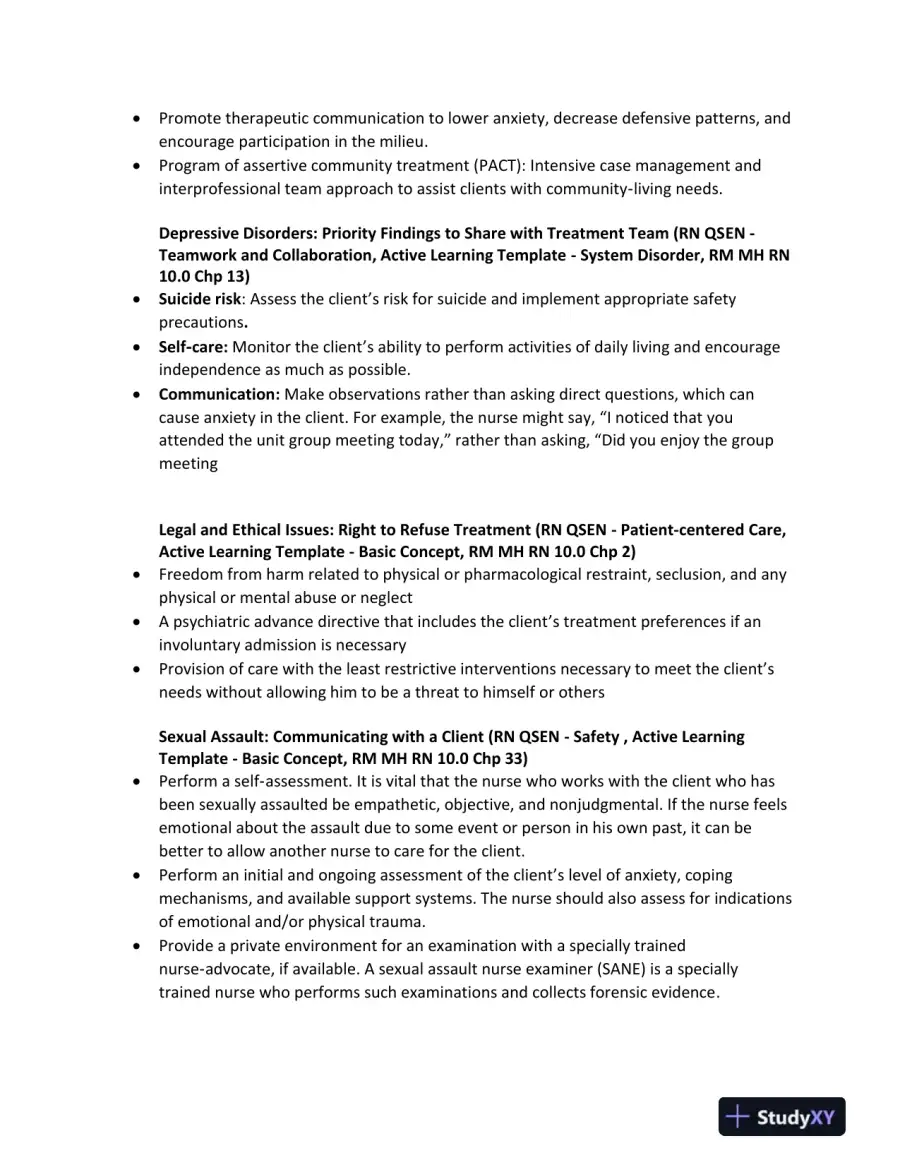 •Promote therapeutic communication to lower anxiety, decrease defensive patterns, andencourage participation in the milieu.•Program of assertive community treatment (PACT): Intensive case management andinterprofessional team approach to assist clients with community‑living needs.Depressive Disorders: Priority Findings to Share with Treatment Team (RN QSEN-Teamwork and Collaboration, Active Learning Template-System Disorder, RM MH RN10.0 Chp 13)•Suicide risk: Assess the client’s risk for suicide and implement appropriate safetyprecautions.•Self‑care:Monitor the client’s ability to perform activities of daily living and encourageindependence as much aspossible.•Communication:Make observations rather than asking direct questions, which cancause anxiety in the client. For example, the nurse might say, “I noticed that youattended the unit group meeting today,” rather than asking, “Did you enjoy the groupmeetingLegal and Ethical Issues: Right to Refuse Treatment (RN QSEN-Patient-centered Care,Active Learning Template-Basic Concept, RM MH RN 10.0 Chp 2)•Freedom from harm related to physical or pharmacological restraint, seclusion, and anyphysical or mental abuse or neglect•A psychiatric advance directive that includes the client’s treatment preferences if aninvoluntary admission is necessary•Provision of care with the least restrictive interventions necessary to meet the client’sneeds without allowing him to be a threat to himself or othersSexual Assault: Communicating with a Client (RN QSEN-Safety , Active LearningTemplate-Basic Concept, RM MH RN 10.0 Chp 33)•Perform a self‑assessment. It is vital that the nurse who works with the client who hasbeen sexually assaulted be empathetic, objective, and nonjudgmental. If the nurse feelsemotional about the assault due to some event or person in his own past, it can bebetter to allow another nurse to care for the client.•Perform an initial and ongoing assessment of the client’s level of anxiety, copingmechanisms, and available support systems. The nurse should also assess for indicationsof emotional and/or physical trauma.•Provide a private environment for an examination with a specially trainednurse‑advocate, if available. A sexual assault nurse examiner (SANE) is a speciallytrained nurse who performs such examinations and collects forensic evidence.
4 more pages in the full document
Unlock it once and it stays in your library, ready to chat with or turn into flashcards.
Unlock the full documentMore Assessment Technologies Institute study materials
See all Past Exams
ATI Maternal Newborn Practice Exam with Answers (210 Solved Questions)
Assessment Technologies Institute
114 pages141downloadsFeb 2025 Past Exams
ATI PN Pediatrics Proctored Exam Version 8 with Answers (166 Solved Questions)
Assessment Technologies Institute
40 pages126downloadsFeb 2025 Past Exams
2023 ATI NGN Comprhensive Exit Exam with Answers (87 Solved Questions)
Assessment Technologies Institute
40 pages115downloadsFeb 2025 Past Exams
2021 ATI Medical/Surgical Neurosensory AH1 with Answers (80 Solved Questions)
Assessment Technologies Institute
19 pages106downloadsFeb 2025 Past Exams
2024-2025 ATI Leadership Proctored Focus Practice Exam with Answers (63 Solved Questions)
Assessment Technologies Institute
27 pages99downloadsFeb 2025 Past Exams
2024-2025 ATI Comprehensive Exit Exam with Answers (13 Solved Questions)
Assessment Technologies Institute
6 pages77downloadsFeb 2025 Past Exams
2023 ATI RN Adult Medical Surgical For NGN Form A, B, C with Answers (21 Solved Questions)
Assessment Technologies Institute
9 pages71downloadsFeb 2025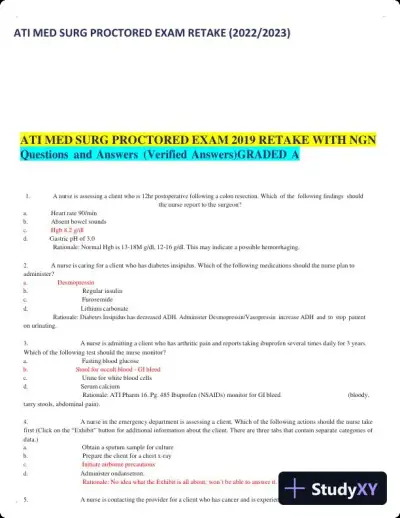 Past Exams
2022-2023 ATI Med Surg Proctored Exam Retake with Answers (111 Solved Questions)
Assessment Technologies Institute
37 pages68downloadsFeb 2025
Study this document with CramX
Once it is in your library, every tool can work from it.