

Introduction To General, Organic And Biochemistry, 11th Edition Solution Manual
- Biochemistry
- 250 pages
- Shared May 2025
Simplify your studies with Introduction To General, Organic And Biochemistry, 11th Edition Solution Manual, an essential guide to mastering your course material.
Preview 16 of 250 pages
See the first 16 pages exactly as they appear in the document.
Page 1 Read page 1 as text
Chapter 1: Matter, Energy, and Measurement 1.1 Multiplication: (a) 4.69 10 5 (b) 2.8 10 - 15 Division: (a) 1.94 10 18 (b) 1.37 10 5 1.2 (a) o F = 9 5 o C + 32 = 9 5 64.0 o C + 32 = 147 o F (b) o C = 5 9 ( o F - 32) = 5 9 (47 o F - 32) = 8.3 o C 1.3 8.55 mi 1.609 km 1 mi = 13.8 km 1.4 332 m s 1 km 1000 m 1 mi 1.609 km 60 s 1 min 60 min 1 hr = 743 mi/hr 1.5 1.6 1.7 d = m/V = 56.8 g 23.4 mL = 2.43 g/mL 1.8 The specific gravity of a substance is the density of this substance divided by the density of water, which is 1.000 g/mL. 1.9 Amount of heat = SH m (T 2 -T 1 ) = 1.0 cal g g o C 731 g ( ) 74 − 8 ( ) o C = 4.8 10 4 cal
Page 2 Page 3 Read page 3 as text
Chapter 1: Matter, Energy, and Measurement 1.10 100 g of iron may have been measured to one, two, or three significant figures (the zeros at the end of a number without a decimal point are called trailing zeros, are ambiguous and may or may not be significant). If 100 g implied two or three significant figures, T 2 will be 46 o C (the number of significant figures is determined by the specific heat of iron, which is reported to two significant figures). One common way to show that trailing zeros are significant is to place a decimal point after the zeros, for example 100. g (three significant figures). Zeros between a decimal and a non - zero digit are significant figures. This method is used often in the textbook problems. The context of the problem suggests 100. g, therefore the solution will assume 100 g of iron was measured to three significant figures (100. g of iron) . (T 2 -T 1 ) o C = 21 o C T 2 = 21 o C + 25 o C = 46 o C 1.11 SH = Amount of heat m (T 2 -T 1 ) = 88.2 cal (13.4 g)(176-23) o C = 0.0430 cal / g o C 1.12 A major reason for the increase of the average life expectancy of humans in the last 80 years has been great progresses in medical science. Diseases that were once fatal have either been eradicated or cures developed. The causes and cures for many major diseases are now better understood and treatments more effective. 1.14 Metals have low specific heats and organic compounds have higher specific heats. 1.16 (a) Chemical change: burning gasoline is converted to carbon dioxide and water. (b) Physical change: ice forming from liquid water is still H 2 O, just a different state of matter. (c) Physical change: boiling oil is still oil, just a different state of matter. (d) Physical change: melting lead remains lead, just a different state of matter. (e) Chemical change: elemental Fe has been converted to rust, Fe 2 O 3 . (f) Chemical change: nitrogen and hydrogen converted ammonia, NH 3 , involves a change in chemical composition. (g) Chemical change: the chemical components in food are converted to energy, carbon dioxide, and water thus changing chemical composition. 1.18 (a) 403,000 (b) 3,200 (c) 0.0000713 (d) 0.000000000555 1.20 (a) 2.10 10 13 (b) 1.07 10 4 (c) 2.93 10 - 12 (d) 8.4 10 1 (e) 1.36 10 - 26 1.22 (a) 7.74 10 3 (b) 8.808 10 - 2 (c) 1.3022 10 2
Page 4 Read page 4 as text
Chapter 1: Matter, Energy, and Measurement 1.24 3.25 10 - 10 1.26 (a) 3 (b) 2 (c) 1 (d) 4 (e) 5 1.28 (a) 2.5 10 4 (b) 4.1 (c) 15.5 1.30 (a) 10963.1 (b) 244 (c) 172.34 1.32 (a) 1 kg = 1000 g (b) 1 mg = 0.001 g 1.34 (a) 100 cm (b) 230 mL (c) 75 kg (d) 15 mL (e) 50 mg (f) 100 mm (g) 40 g 1.36 Temperature conversions: o C = 5 9 ( o F - 32) and K = 273 + o C (a) 5 9 (320 o F - 32) = 160 o C and 273 + 160 o C = 433 K (b) 5 9 (212 o F - 32) = 100 o C and 273 + 100 o C = 373 K (c) 5 9 (0 o F - 32) = -18 o C and 273 + (-18) o C = 255 K (d) 5 9 (-250 o F - 32) = -157 o C and 273 + (-157) o C = 116 K 1.38 Unit conversions: (a) 42.6 kg 2.205 lb 1 kg = 93.9 lb (b) 1.62 lb 453.6 g 1 lb = 735 g (c) 34 in 2.54 cm 1 in = 86 cm (d) 37.2 km 1 mi 1.609 km = 23.1 mi (e) 2.73 gal 3.785 L 1 gal = 10.3 L (f) 62 g 1 oz 28.35 g = 2.2 oz (g) 33.61 qt 1 L 1.057 qt = 31.80 L (h) 43.7 L 1 gal 3.785 L = 11.5 gal (i) 1.1 mi 1.609 km 1 mi = 1.8 km (j) 34.9 mL 1 fl oz 29.57 mL = 1.18 fl oz 1.40 First, convert one of the bottle's units to the other.
Page 5 Read page 5 as text
Chapter 1: Matter, Energy, and Measurement , which is less than 300. cc bottle 1.42 The key here is to first convert speed from mph to kph. Yes, you would reach Ottawa within an hour. 1.44 1.46 1.48 1.50 1.52 combined volumes of IV solutions = 4 10 2 mL (rounded to one significant figure) 1.54 At low temperatures, most substances exist as solids.
Page 6 Read page 6 as text
Chapter 1: Matter, Energy, and Measurement 1.56 1.58 1.60 Answer rounded to two significant figures: 1.62 (a) The densities of O 2 and CO 2 can be calculated as follows: d O2 = 10.00 g O 2 6702 mL O 2 1000 mL O 2 1 L O 2 = 1.492 g/L d CO2 = 10.00 g CO 2 5058 mL CO 2 1000 mL CO 2 1 L CO 2 = 1.977 g/L (b) Carbon dioxide (a gas that does not support combustion), being denser than oxygen, will sink to the level of the fire and temporarily displace the oxygen above it. By cutting off the supply of oxygen (a fuel for the fire), the fire will be extinguished. 1.64 Matter - energy can neither be created nor destroyed (law of conservation of energy), solar panels work by converting light energy into electrical energy. 1.66
Page 7 Read page 7 as text
Chapter 1: Matter, Energy, and Measurement 1.68 1.70 Assuming that the 200 lb man is measured to three significant figures: 1.72 Shivering generates heat for the body through muscular action. 1.74 (a) Volume (b) Volume (c) Mass (d) Energy (e) Density (f) Energy (g) Temperature (h) Velocity 1.76 V room = length x height x width = (5.3 m)(2.0 m)(4.2 m) = 45 m 3 m air = d air V air = 1.25 10 -3 g cm 3 (45 m 3 ) 100 cm 1 m 3 1 kg 1000 g = 56 kg air 1.78 KE = 1/2(mv 2 ) 1.80 Convert dollars/L into dollars/gal, then compare: Gasoline is less expensive in Potsdam ($3.93/gal) than in Montreal ($4.62/gal).
Page 8 Read page 8 as text
Chapter 1: Matter, Energy, and Measurement 1.82 (a) Astronauts weigh less on the moon because of the moon’s reduced gravity will cause the astronaut to exert less force (weight) on the moon’s surface. (b) No, their masses were not different. Mass is independent of gravity, whereas weight is the force that an object’s mass exerts on a surface under the influence of gravity. 1.84 Convert each quantity to a common unit, then compare: 1.86 In this problem, it is reasonable to assume that 100 g is measured to three significant figures and that temperature is measured to two significant figures. (a) The heat required to raise the temperature of a substance is directly proportional to the specific heat of that substance. Mercury, having the lowest specific heat, will require the least amount of energy to heat 100 g by 10 o C. (b) If the heats and masses are equal, the combined equations can be expressed as: (c) If the heats and T are equal, the combined equations can be expressed as: SH unk m unk = SH Fe m Fe identify element by solving for SH unk SH unk = SH Fe m Fe m unk = 0.107 cal/g o C ( ) 1.6 g ( ) 1 g = 0.17 cal/g o C The unknown element is gra phite 1.88 Compare products using common units.
Page 9 Read page 9 as text
Chapter 1: Matter, Energy, and Measurement Milk purchased by the quart ($0.80/qt) is a better buy than milk bought by the liter ($0.81/qt). 1.90 Convert the quantities to common units (miles/hour) and then compare. The velocity expressed in choice (c) is the fastest. (a) 70 miles/hr (b) 140 km hr 1 mi 1.609 km = 87 mi/hr (c) 4.5 km s 1 mi 1.609 km 60 s 1min 60 min hr = 1.0 10 4 mi/hr (d) 48 mi min 60 min hr = 2.9 10 3 mi/hr 1.92 No, the solar cell cannot produce enough energy. First solve the problem quantitatively by converting the solar cell energy production to kcal/hour for easy comparison. This reveals that the solar cell only produces 1.20 x 10 2 kcal/hr of energy, which is not enough to maintain a temperature of 4 o C in the refrigerator (250. kcal/hr required). 1.94 All of the substances in coffee are chemicals, including the water, caffeine, and the trace chemicals responsible for the coffee’s flavor. 1.96 You should purchase the 200. grams of cheese. Qualitatively, we can compare the masses of cheese with the masses of common items. The average mass of a human is about 70 kg; therefore, 200. kg of cheese is a lot of cheese. A single aspirin tablet contains 325 mg of acetylsalicylic acid active ingredient; therefore, 200. mg of cheese would not even cover a slice of bread. A loaf of bread has a mass of about 500 - 600 grams, therefore, 200. grams of cheese is a reasonable amount to compliment a loaf of bread. 1.98 Hydrometers measure the specific gravity of liquids. By comparing the hydrometer reading of an unknown concentration of antifreeze solution and comparing it with hydrometer readings from antifreeze solutions of standard concentrations, the unknown antifreeze concentration can be determined.
Page 10 Read page 10 as text
Chapter 1: Matter, Energy, and Measurement 1.100 Aspirin tablets that contain 325 mg of aspirin contain more aspirin than 81 mg tablets. The 325 mg dose of aspirin is usually taken for pain, while the 81 mg daily dose of aspirin is usually taken to help prevent heart attacks. 1.102 Water reaches its maximum density at 4 o C, therefore freshwater lakes freeze from the top on down. 1.104 First, it is important to know exactly what the treatment involves and the mechanism of action. Also, did the study compare the treatment group with a control group consisting of ear infection patients that didn’t receive the treatment? Finally, did the scientist test the treatment for safety? 1.106 The quantity of a solid is most easily measured by its mass; therefore, the mass of urea is measured using a balance. The quantity of a liquid is easily measured by its volume or mass. The volume of pure ethanol can be measured using a volumetric pipette or a graduated cylinder. The advantage of measuring the volume of ethanol is that the mass of ethanol can be calculated using its volume and density. 1.108 The molecular structure and arrangement of atoms in chemical substances are important to their reactivity and biological activity. New medications are going to mimic natural molecules involved in biochemical processes, therefore, the new medicines would be expected to have similar characteristics to the natural biomolecules that are comparable in molecular structure and atomic arrangement. 1.110 1.112 (a) Dose (in milligrams) of Tylenol calculated to two significant figures: (b) Dose in milliliters of Tylenol solution calculated to two significant figures:
Page 11 Read page 11 as text
Chapter 2: Atoms 2.1 (a) NaClO 3 (b) AlF 3 2.2 (a) The mass number is 15 + 16 = 31. (b) The mass number is 86 + 136 = 222. 2.3 (a) The element has 15 protons, making it phosphorus (P); its symbol is . (b) The element has 86 protons, making it radon (Rn); its symbol is . 2.4 (a) The atomic number of mercury (Hg) is 80; that of lead (Pb) is 82. (b) An atom of Hg has 80 protons; an atom of Pb has 82 protons. (c) The mass number of this isotope of Hg is 80 + 120 = 200; the mass number for this isotope of Pb is 82 + 120 = 202. (d) The symbols of these isotopes are and . 2.5 The atomic number of iodine (I) is 53. The number of neutrons in each isotope is 125 - 53 = 72 for iodine - 125 and 131 - 53 = 78 for iodine - 131. The symbols for these two isotopes are and . 2.6 The atomic weight is 6.941 amu, which is nearer to 7 amu than 6 amu. Therefore, lithium - 7 is the more abundant isotope. The relative abundances for these two isotopes are 92.50 percent for lithium - 7 and 7.50 percent for lithium - 6. 2.7 This element has 13 electrons and, therefore, 13 protons. The element with atomic number 13 is Aluminum (Al). 2.8 Both Democritus and Dalton believed that matter was composed of tiny indivisible particles referred to as atoms. The major difference between Democritus and Dalton is that Dalton based his theory on evidence rather than belief. 2.10 (a) Oxygen - an element (b) Table salt - a compound (c) Sea water - a mixture (d) Wine - a mixture (e) Air - a mixture (f) Silver - an element (g) Diamond - an element (h) A pebble - a mixture (i) Gasoline - a mixture (j) Milk - a mixture (k) Carbon dioxide - a compound (l) Bronze - a mixture
Page 12 Read page 12 as text
Chapter 2: Atoms 2.12 Given here is the element, its symbol, and its atomic number: (a) Bohrium (Bh, 107) (b) Curium (Cm, 96) (c) Einsteinium (Es, 99) (d) Fermium (Fm, 100) (e) Lawrencium (Lr, 103) (f) Meitnerium (Mt, 109) (g) Mendelevium (Md, 101) (h) Nobelium (No, 102) (i) Rutherfordium (Rf, 104) (j) Seaborgium (Sg, 106) 2.14 The three elements named for planets are mercury (Hg, 80), uranium (U, 92), and neptunium (Np, 93). 2.16 (a) NaHCO 3 (b) C 2 H 6 O (c) KMnO 4 2.18 The law of conservation of mass 2.20 Mass percent of H and O in: H 2 O: 18.015 g/mol H: 11.2% O: 88.8% H 2 O 2 : 34.014 g/mol H: 5.9% O: 94.1% 2.22 (a) Protons are located in the nucleus. (b) Electrons are outside the nucleus. (c) Neutrons are in the nucleus. 2.24 (a) Mass number = 22 protons + 26 neutrons = 48 (b) Mass number = 76 protons + 114 neutrons = 190 (c) Mass number = 34 protons + 45 neutrons = 79 (d) Mass number = 94 protons + 150 neutrons = 244 2.26 An element is identified by its atomic number, which is mass number - number of neutrons. (a) 45 - 24 = 21 protons. The element is scandium (Sc), and its symbol is . (b) 48 - 26 = 22 protons. The element is titanium (Ti), and its symbol is . (c) 107 - 60 = 47 protons. The element is silver (Ag), and its symbol is . (d) 246 - 156 = 90 protons. The element is thorium (Th) and its symbol is . (e) 36 - 18 = 18 protons. The element is argon (Ar) and its symbol is . 2.28 The number of neutrons is equal to the mass number - atomic number (number of protons). (a) 13 - 6 = 7 neutrons (b) 73 - 32 = 41 neutrons (c) 188 - 76 = 112 neutrons (d) 195 - 78 = 117 neutrons
Page 13 Read page 13 as text
Chapter 2: Atoms 2.30 (a) Neon - 22 has 10 protons and 22 - 10 = 12 neutrons (b) Palladium - 104 has 46 protons and 104 - 46 = 58 neutrons (c) Chlorine - 35 has 17 protons and 35 - 17 = 18 neutrons (d) Tellurium - 128 has 52 protons and 128 - 52 = 76 neutrons (e) Lithium - 7 has 3 protons and 7 - 3 = 4 neutrons (f) Uranium - 238 has 92 protons and 238 - 92 = 146 neutrons 2.32 The atomic number is the number of protons in the nucleus of an element. The mass number is the number of protons and neutrons in the nucleus. 2.34 The atomic weight (121.75 amu) is nearer to that of antimony - 121 (120.90 amu) than it is to antimony - 123 (122.90 amu). Therefore, antimony - 121 has the greater natural abundance. The observed abundances are 57.3 percent antimony - 121, and 42.7 percent antimony - 123. 2.36 Carbon - 14 has 6 protons, 6 electrons, and 8 neutrons. 2.38 Fluorine - 18 has 9 protons, 9 electrons, and 9 neutrons. Nitrogen - 13 has 7 protons, 7 electrons, and 6 neutrons. Oxygen - 15 has 8 protons, 8 electrons, and 7 neutrons. 2.40 Rubidium - 87 has 37 protons, 37 electrons, and 50 neutrons. Strontium - 87 has 38 protons, 38 electrons, and 49 neutrons. 2.42 In period 3, there are three metals (Na, Mg, and Al), one metalloid (Si) and four nonmetals (P, S, Cl, and Ar). 2.44 Periods 1 - 3 contain more nonmetals than metals. Periods 4 - 7 contain more metals than nonmetals. 2.46 Palladium (Pd), cobalt (Co), and chromium (Cr) are transition elements. Cerium (Ce) is an inner transition element; K and Br are main group elements. 2.48 (a) Argon is a nonmetal (b) Boron is a metalloid (c) Lead is a metal (d) Arsenic is a metalloid (e) Potassium is a metal (f) Silicon is a metalloid (g) Iodine is a nonmetal (h) Antimony is a metalloid (i) Vanadium is a metal (j) Sulfur is a nonmetal (k) Nitrogen is a nonmetal
Page 14 Read page 14 as text
Chapter 2: Atoms 2.50 Only Period 1 has two elements. Periods 2 and 3 have eight elements. Periods 4 and 5 have 18 elements and Period 6 has 32 elements. Period 7 is filling with recently discovered elements, and upon confirmation, will contain its full capacity of 32 elements. 2.52 The group number tells the number of Lewis dots to be placed around the symbol of the element. (a) (b) (c) (d) (e) (f) C Si O S Al Br : : : : : : : : : . . : . . . . . . . . 2.54 Following are Lewis dot structures for each element in Problem 2.49: (a) (b) (c) (d) (e) Li N e C . . : : Be : . Mg : : : : 2.56 Following are Lewis dot structures for each element in Problem 2.55: (a) (b) (c) (d) (e) N a P . Cl : . : . H e : . : : . H . 2.58 In the ground state, 3 s and 3 p orbitals are occupied by four valence electrons. 2.60 (a) Rb(37): 1 s 2 2 s 2 2 p 6 3 s 2 3 p 6 4 s 2 3 d 10 4 p 6 5 s 1 (b) Sr(38): 1 s 2 2 s 2 2 p 6 3 s 2 3 p 6 4 s 2 3 d 10 4 p 6 5 s 2 (c) Br(35): 1 s 2 2 s 2 2 p 6 3 s 2 3 p 6 4 s 2 3 d 10 4 p 5 2.62 The properties are similar because all of them have the same outer - shell electron configuration. They are not identical because each has a different number of filled inner shells. 2.64 Going from left to right within a period, increasing positive charge holds onto the outer electrons more tightly, thus decreasing the atomic radius and increasing the ionization energy. So, for the following atoms B, C, and N: (a) Boron has the largest atomic radius. (b) Nitrogen has the smallest atomic radius. (c) Nitrogen has the largest ionization energy. (d) Boron has the lowest ionization energy. 2.66 Ionization energy generally increases from left to right within a period in the Periodic Table and from bottom to top within a column: (a) K < Na < Li (b) C < N < Ne (c) C < O < F (d) Br < Cl < F
Page 15 Read page 15 as text
Chapter 2: Atoms 2.68 Following are the ground - state electron configurations of Mg atom, Mg + , Mg 2+ , and Mg 3+ . The first electron is removed from the 3s orbital. The removal of each subsequent electron requires more energy because, after the first electron is removed, each subsequent electron is removed from a positive ion, which strongly attracts the remaining electrons. The third ionization energy is especially large because the electron is removed from the filled second principal energy level, meaning that it is removed from an ion that has the same electron configuration as neon. 2.70 The most abundant elements by weight (a) in the Earth's crust are oxygen and silicon, and (b) in the human body they are oxygen and carbon. 2.72 Bronze is an alloy of copper and tin. 2.74 (a) 1 s (b) 2 s , 2 p (c) 3 s , 3 p , 3 d (d) 4 s , 4 p , 4 d , 4 f 2.76 (a) The atomic radius decreases going from left to right across a period in the Periodic Table. Although the principal quantum number of the outermost orbital remains the same, as each successive electron is added, the nuclear charge also increases by the addition of one proton. The resulting increased attraction between nucleus and electrons is somewhat stronger than the increasing repulsion between electrons, which causes the atomic radius to decrease. (b) To pull a valence electron from an atom, energy is required to overcome the attractive forces on the electron from the positively charged nucleus. 2.78 (a) s 2 p 1 (b) s 2 p 5 (c) s 2 p 3
Page 16 Read page 16 as text
Chapter 2: Atoms 2.80 (a) Carbon - 12 has 6 protons and 6 neutrons. Neutrons contribute 50% of its mass. (b) Calcium - 40 has 20 protons and 20 neutrons. Neutrons contribute 50% of its mass. (c) Iron - 55 has 26 protons and 29 neutrons. Neutrons contribute 53% of its mass. (d) Bromine - 79 has 35 protons and 44 neutrons. Neutrons contribute 56% of its mass. (e) Platinum - 195 has 78 protons and 117 neutrons. Neutrons contribute 60% of its mass. (f) Uranium - 238 has 92 protons and 146 neutrons. Neutrons contribute 61% of its mass. 2.82 (a) P (b) K (c) Na (d) N (e) Br (f) Ag (g) Ca (h) C (i) Sn (j) Zn 2.84 (a) Silicon is in Group 4A. It has four outer - shell electrons. (b) Bromine is in Group 7A. It has seven outer - shell electrons. (c) Phosphorus is in Group 5A. It has five outer - shell electrons. (d) Potassium is in Group 1A. It has one outer - shell electron. (e) Helium is in Group 8A. It has two outer - shell electrons. (f) Calcium is in Group 2A. It has two outer - shell electrons. (g) Krypton is in Group 8A. It has eight outer - shell electrons. (h) Lead is in Group 4A. It has four outer - shell electrons. (i) Selenium is in Group 6A. It has six outer - shell electrons. (j) Oxygen is in Group 6A. It has six outer - shell electrons. 2.86 (a) An electron has a charge of - 1, a proton a charge of +1, and a neutron has no charge. (b) An electron has a mass of 0.0005 amu; both protons and neutrons have masses of 1 amu. 2.88 Xenon (Xe) will have the highest ionization energy. Ionization energy increases from left to right going across the periodic table. 2.90 Going from left to right across a period in the Periodic Table, protons are being added to the nucleus and electrons are added to the valence shell. For elements in the same period, the principal energy level remains the same (for example, the valence electrons of all second period elements occupy the second principal energy level). But in going from one element to the next across a period, one more proton is added to the nucleus, thus increasing the nuclear charge by one unit for each step from left to right. The result is that the nucleus exerts an increasingly stronger pull on the valence electrons and atomic radius decreases. 2.92 The O 2 - has a larger radius than F and F - for several reasons. The most important being that O 2 - has two ( - ) charged electrons in excess of the positively charged nucleus. This increases the amount of electron - electron repulsions, expanding the electron cloud relative to F and F - . Another factor is that oxygen is less electronegative than fluorine, therefore, oxygen holds on to its electrons less tightly.
234 more pages in the full document
Unlock it once and it stays in your library, ready to chat with or turn into flashcards.
Unlock the full documentMore Biochemistry study materials
See all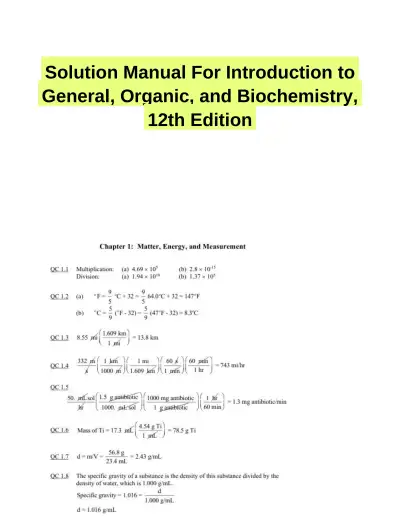 Textbook Guides
Solution Manual For Introduction to General, Organic, and Biochemistry, 12th Edition
Biochemistry
251 pagesMay 2025 Exam Guides
Test Bank For Introduction To General, Organic And Biochemistry, 10th Edition
Biochemistry
631 pagesMay 2025 Exam Guides
Test Bank For Advanced Nutrition and Human Metabolism 7th Edition Test Bank
Biochemistry
266 pages145downloadsFeb 2025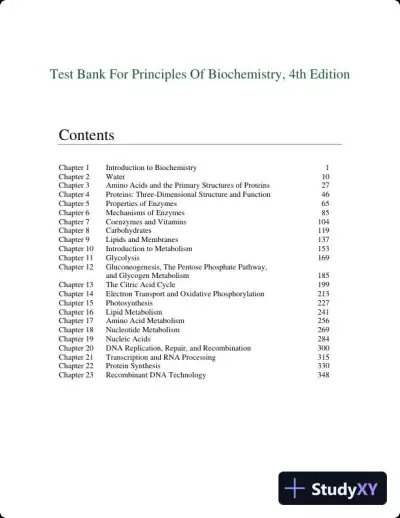 Exam Guides
Test Bank For Principles Of Biochemistry, 4th Edition
Biochemistry
362 pages61downloadsFeb 2025 Quick Guides
Biochemistry-II - RNA and Transcription
Biochemistry
37 pagesMar 2026 Quick Guides
Biochemistry I - Carbohydrate Metabolism II
Biochemistry
25 pagesMar 2026 Past Exams
BIOD171 Biochemistry Final Exam With Answers (29 Solved Questions)
Biochemistry
7 pagesMay 2025 Quick Guides
Biochemistry-II - DNA Structure, Replication, and Repair
Biochemistry
36 pagesMar 2026
Study this document with CramX
Once it is in your library, every tool can work from it.