

Solution Manual For Introduction to General, Organic, and Biochemistry, 12th Edition
- Biochemistry
- 251 pages
- Shared May 2025
Solution Manual For Introduction to General, Organic, and Biochemistry, 12th Edition condenses textbook information into an easy-to-follow study resource.
Preview 16 of 251 pages
See the first 16 pages exactly as they appear in the document.
Page 1 Read page 1 as text
1 Chapter 1: Matter, Energy, and Measurement QC 1.1 Multiplication: (a) 4.69 10 5 (b) 2.8 10 - 15 Division: (a) 1.94 10 18 (b) 1.37 10 5 QC 1.2 (a) o F = 9 5 o C + 32 = 9 5 64.0 o C + 32 = 147 o F (b) o C = 5 9 ( o F - 32) = 5 9 (47 o F - 32) = 8.3 o C QC 1.3 8.55 mi 1.609 km 1 mi = 13.8 km QC 1.4 332 m s 1 km 1000 m 1 mi 1.609 km 60 s 1 min 60 min 1 hr = 743 mi/hr QC 1.5 50. mLsol hr 1.5 g antibiotic 1000. mL sol 1000 mg antibiotic 1 g antibiotic 1 hr 60 min = 1.3 mg antibiotic/min QC 1.6 Mass of Ti = 17.3 mL 4.54 g Ti 1 mL = 78.5 g Ti QC 1.7 d = m/V = 56.8 g 23.4 mL = 2.43 g/mL QC 1.8 The specific gravity of a substance is the density of this substance divided by the density of water, which is 1.000 g/mL. Specific gravity = 1.016 = d 1.000 g/mL d = 1.016 g/mL 1. 2 A major reason for the increase of the average life expectancy of humans in the last 80 years has been great progresses in medical science. Diseases that were once fatal have either been eradicated or cures developed. The causes and cures for many major diseases are now better understood and treatments more effective.
Page 2 Page 3 Read page 3 as text
Chapter 1: Matter, Energy, and Measurement 2 1. 4 (a) Chemical change: burning gasoline is converted to carbon dioxide and water. (b) Physical change: ice forming from liquid water is still H 2 O, just a different state of matter. (c) Physical change: boiling oil is still oil, just a different state of matter. (d) Physical change: melting lead remains lead, just a different state of matter. (e) Chemical change: elemental Fe has been converted to rust, Fe 2 O 3 . (f) Chemical change: nitrogen and hydrogen converted ammonia, NH 3 , involves a change in chemical composition. (g) Chemical change: the chemical components in food are converted to energy, carbon dioxide, and water thus changing chemical composition. 1. 6 (a) 403,000 (b) 3,200 (c) 0.0000713 (d) 0.000000000555 1. 8 (a) 2.10 10 13 (b) 1.07 10 4 (c) 2.93 10 - 12 (d) 8.4 10 1 (e) 1.36 10 - 26 1.1 0 (a) 7.74 10 3 (b) 8.808 10 - 2 (c) 1.3022 10 2 1. 1 2 3.25 10 - 10 1. 1 4 (a) 3 (b) 2 (c) 1 (d) 4 (e) 5 1. 1 6 (a) 2.5 10 4 (b) 4.1 (c) 15.5 1. 1 8 (a) 10963.1 (b) 244 (c) 172.34 1.2 0 (a) 1 kg = 1000 g (b) 1 mg = 0.001 g 1. 2 2 (a) 100 cm (b) 230 mL (c) 75 kg (d) 15 mL (e) 50 mg (f) 100 mm (g) 8 g 1. 2 4 Temperature conversions: o C = 5 9 ( o F - 32) and K = 273 + o C (a) 5 9 (320 o F - 32) = 160 o C and 273 + 160 o C = 433 K (b) 5 9 (212 o F - 32) = 100 o C and 273 + 100 o C = 373 K (c) 5 9 (0 o F - 32) = -18 o C and 273 + (-18) o C = 255 K (d) 5 9 (-250 o F - 32) = -157 o C and 273 + (-157) o C = 116 K
Page 4 Read page 4 as text
Chapter 1: Matter, Energy, and Measurement 3 1. 2 6 Unit conversions: (a) 42.6 kg 2.205 lb 1 kg = 93.9 lb (b) 1.62 lb 453.6 g 1 lb = 735 g (c) 34 in 2.54 cm 1 in = 86 cm (d) 37.2 km 1 mi 1.609 km = 23.1 mi (e) 2.73 gal 3.785 L 1 gal = 10.3 L (f) 62 g 1 oz 28.35 g = 2.2 oz (g) 33.61 qt 1 L 1.057 qt = 31.80 L (h) 43.7 L 1 gal 3.785 L = 11.5 gal (i) 1.1 mi 1.609 km 1 mi = 1.8 km (j) 34.9 mL 1 fl oz 29.57 mL = 1.18 fl oz 1. 2 8 First, convert one of the bottle's units to the other. 9.5 fl. oz . 29.57 mL 1 fl. oz. 1 cc 1 mL = 2.8 10 2 cc , which is less than 300. cc bottle 1. 3 0 The key here is to first convert speed from mph to kph. Yes, you would reach Ottawa within an hour. Speed = 75 mi 1 hr 1.609 km 1 mi = 120 kph Time to reach Ottawa = 80 km 1 hr 120 km = 0.7 hr (rounded to one significant figure) 1. 3 2 Car efficiency = 25.00 mi gal 1.609 km 1 mi 1 gal 3.785 L = 10.63 km/L 1. 3 4 186 lb 1 kg 2.205 lb 2.0 mg drug 1 kg 1 cc IV sol 10. mg drug 1 mL IV sol 1 cc IV sol = 17 mL IV sol 1. 3 6 36 lb child 1 kg 2.205 lb 20. mg Velosef/day 1 kg = 3.3 10 2 mg/day 36 lb child 1 kg 2.205 lb 20. mg Velosef /day 1 kg 1 mL sol 208 mg Velosf = 1.6 mL sol day
Page 5 Read page 5 as text
Chapter 1: Matter, Energy, and Measurement 4 1. 3 8 750 mg lidocaine 150 mL IV sol 500. mg lidocaine 1 min 5 mL IV sol = 5 10 1 min The answer is rounded to one significant figure because both 1 min and 5 mL only contain one significant figure. 1. 4 0 Vol of pantoprazole IV = 40. mg PAN 1 mL IV sol 0.4 mg PAN = 1 10 2 mL PAN IV solution Vol of MgSO 4 IV = 5 g MgSO 4 1 mL IV sol 0.02 g MgSO 4 = 3 10 2 mL MgSO 4 IV solution C ombined volumes of IV solutions = 4 10 2 mL (rounded to one significant figure) 1. 4 2 At low temperatures, most substances exist as solids. 1. 4 4 d rock sample = mass/volume = 1.075 kg 334.5 mL 1000 g 1 kg = 3.214 g/mL 1. 4 6 Volume of Ti = 163 g Ti 1 mL Ti 4.54 g Ti = 35.9 mL Ti 1. 4 8 Answer rounded to two significant figures: Mass methanol = 280 mL methanol 0.791 g methanol 1 mL methanol = 2.2 10 2 g methanol 1.5 0 (a) The densities of O 2 and CO 2 can be calculated as follows: d O2 10.00 g O 2 6702 mL O 2 1000 mL O 2 1 L O 2 = 1.492 g/L d CO2 10.00 g CO 2 5058 mL CO 2 1000 mL CO 2 1 L CO 2 = 1.977 g/L (b) Carbon dioxide (a gas th at does not support combustion) being denser than oxygen will sink to the level of the fire and temporar ily displace the oxygen . By cutting off the supply of oxygen (a fuel for the fire), the fire will be extinguished.
Page 6 Read page 6 as text
Chapter 1: Matter, Energy, and Measurement 5 1. 5 2 Matter - energy can neither be created nor destroyed (law of conservation of energy), solar panels work by converting light energy into electrical energy. 1. 5 4 Assuming that the 180 lb man is measured to three significant figures: 135lb Drug dose = 135 lb man 445 mg drug 180 lb man = 334 mg drug 1. 5 6 (a) Volume (b) Volume (c) Mass (d) D ensity (e) T emperature ( f ) Velocity 1. 5 8 V room = length x height x width = (5.3 m)(2.0 m)(4.2 m) = 45 m 3 m air = d air V air = 1.25 10 -3 g cm 3 (45 m 3 ) 100 cm 1 m 3 1 kg 1000 g = 56 kg air 1. 6 0 KE = 1/2(mv 2 ) m = 127 lb 453.6 g 1 lb = 5.76 10 4 g v = 14.7 mi hr 1.609 km 1 mi 1000 m 1 km 100 cm 1 m 1 hr 60 min 1 min 60 sec = 657 cm/s KE = 1/2(5.76 10 4 g)(657 cm/s) 2 = 1.24 10 10 g cm 2 s -2 = 1.24 10 10 ergs 1. 6 2 Convert dollars/L into dollars/gal, then compare: Gasoline price Montreal = $1.22 L 3.785 L gal = $4.62/gal Gasoline is less expensive in Potsdam ($3.93/gal) than in Montreal ($4.62/gal). 1.64 75 mL 1 hr 10. gtts 1 mL 1 hr 60 min = 13 gtts/min flow rate 1.66 dose = 14 lb cat 2.5 mg 1 lb cat = 35 mg per 12 hours total drug to be delivered = 7 days 24 hr day 1 dose 12 hr 35 mg dose = 4.9 10 2 mg
Page 7 Read page 7 as text
Chapter 1: Matter, Energy, and Measurement 6 1.68 51.4 lbs 1 kg 2.205 lbs 1.3 mg drug 1 kg 1 mL stock 15 mg drug = 2.02 mL of stock solution 1. 70 Convert each quantity into a common unit (grams): (a) is the largest and (d) is the smallest. (a) 41 g 3 (b) 3 10 mg 1 g 1000 mg = 3 g 6 (c) 8.2 10 g 6 1 g 10 g = 8.2 g -8 (d) 4.1310 10 kg 1000 g 1 kg -5 = 4.1310 10 g 1. 72 Travel time = 1490. mi 1.609 km 1 mi 1 hr 220. km = 10.9 hr 1. 7 4 1.00 mL of butter = 0.860 g and 1.00 mL of sand = 2.28 g (a) mixture 3.14 g mixture d = 1.57 g/mL 2.00 mL (b) First calculate the volumes of sand and butter, which totals 1.60 mL sand V 1.00 g sand 1.00 mL sand 2.28 g sand butter = 0.439 mL V 1.00 g butter 1.00 mL butter 0.860 g butter = 1.16 mL mixture 2.00 g d = = 1.25 g/mL 1.60 mL 1. 7 6 60. mg meperidine 1 mL sol 75 mg meperidine = 0.8 mL solution injected 1. 7 8 Aspirin tablets that contain 325 mg of aspirin contain more aspirin than 81 mg tablets. The 325 mg dose of aspirin is usually taken for pain, while the 81 mg daily dose of aspirin is usually taken to help prevent heart attacks. 1. 80 First, it is important to know exactly what the treatment involves and the mechanism of action. Also, did the study compare the treatment group with a control group consisting of ear infection patients that didn’t receive the treatment? Finally, did the scientist test the treatment for safety?
Page 8 Read page 8 as text
Chapter 1: Matter, Energy, and Measurement 7 1.8 2 The folk medicine will be extracted and separated into pure materials. Each pure material will be tested for biological activity. The pure materials that are identified as biologically active will have their chemical structures determined, and often, a chemical synthesis developed for mass production. 1. 8 4 flow rate = 1 L sol 12 hr 1000 mL 1 L sol 1 hr 60 min 15 gtts mL = 21 gtts/min 1. 8 6 (a) Dose (in milligrams) of Tylenol calculated to two significant figures: Dose = 42 lb child 1 kg child 2.205 lb child 15 mg Tylenol 1 kg child = 2.9 10 2 mg Tylenol (b) Dose in milliliters of Tylenol solution calculated to two significant figures: Dose = 42 lb child 1 kg child 2.205 lb child 15 mg Tyl 1 kg child 5.0 mL sol 160 mg Tyl = 8.9 mL sol
Page 9 Read page 9 as text
8 Chapter 2: Atoms QC 2.1 (a) NaClO 3 (b) AlF 3 QC 2.2 (a) The mass number is 15 + 16 = 31. (b) The mass number is 86 + 136 = 222. QC 2.3 (a) The element has 15 protons, making it phosphorus (P); its symbol is 15 31 P . (b) The element has 86 protons, making it radon (Rn); its symbol is 86 222 Rn . QC 2.4 (a) The atomic number of mercury (Hg) is 80; that of lead (Pb) is 82. (b) An atom of Hg has 80 protons; an atom of Pb has 82 protons. (c) The mass number of this isotope of Hg is 80 + 120 = 200; the mass number for this isotope of Pb is 82 + 120 = 202. (d) The symbols of these isotopes are 80 200 Hg and 82 202 Pb . QC 2.5 The atomic number of iodine (I) is 53. The number of neutrons in each isotope is 125 - 53 = 72 for iodine - 125 and 131 - 53 = 78 for iodine - 131. The symbols for these two isotopes are 53 125 I and 53 131 I . QC 2.6 The atomic weight is 6.941 amu, which is nearer to 7 amu than 6 amu. Therefore, lithium - 7 is the more abundant isotope. The relative abundances for these two isotopes are 92.50 percent for lithium - 7 and 7.50 percent for lithium - 6. QC 2.7 This element has 13 electrons and, therefore, 13 protons. The element with atomic number 13 is Aluminum (Al). 2. 2 (b), (c), (d), (f), (g), (h), and (k): True (a) False: matter is divided into pure substances and mixtures. (e) False: mixtures can be separated into their component pure substances. (i) False: technetium, promethium, and all of the elements beyond uranium are artificial . (j) False: H, O, C, N, Ca, and P are the six most important elements in the human body. (l) False: t he combining ratio is based on a ratio of atoms, not a ratio of masses. Al
Page 10 Read page 10 as text
Chapter 2: Atoms 9 2. 4 (a) Oxygen (b) Lead (c) Calcium (d) Sodium (e) Carbon (f) Titanium (g) Sulfur (h) Iron (i) Hydrogen (j) Potassium (k) Silver (l) Gold 2. 6 Given here is the element, its symbol, and its atomic number: (a) Americium (Am, 95) (b) Berkelium (Bk, 97) (c) Californium (Cf, 98) (d) Dubnium (Db, 105) (e) Europium (Eu, 63) (f) Francium (Fr, 87) (g) Gallium (Ga, 31) (h) Germanium (Ge, 32) (i) Hafnium (Hf, 72) (j) Hassium (Hs, 108) (k) Holmium (Ho, 67) (l) Lutetium (Lu, 71) (m) Magnesium (Mg, 12) (n) Polonium (Po, 84) (o) Rhenium Re, 75) (p) Ruthenium (Ru, 44) (q) Scandium (Sc, 21) (r) Strontium (Sr, 38) (s) Ytterbium (Yb, 70), Terbium (Tb, 65), and Yttrium (Y, 39) (t) Thulium (Tm, 69) 2. 8 (a) K 2 O (b) Na 3 PO 4 (c) LiNO 3 2.1 0 (a) The law of conservation of mass states that matter can be neither created nor destroyed. Dalton's theory explains this because if all matter is made up of indestructible atoms, then any chemical reaction just changes the attachments between atoms and does not destroy the atoms themselves. (b) The law of constant composition states that any compound is always made up of elements in the same proportion by mass. Dalton's theory explains this because molecules consist of tightly bound groups of atoms, each of which has a particular mass. Therefore, each element in a compound always constitutes a fixed proportion of the total mass. 2.1 2 No. CO and CO 2 are different compounds, and each obeys the law of constant composition for that particular compound. 2. 14 (b), (c), (e), (f), (g), (h), (k), (m), (o), (p), (q), and (s): True (a) False: electrons and protons have equal, but opposi te charges. Electrons are much lighter in mass than protons. (d) False: 1 amu = 1.6605 10 - 24 grams. (i) False: opposite charges attract each other. (j) False: the size of the atom includes the space occupied by the electrons. The nucleus is a small fraction of the size of the atom. (l) False: t he mass number is the number of protons and neutrons. (n) False: 1 H has no neutrons, 2 H has one neutron, and 3 H has two neutrons. (r) False: atomic weights are weighted averages of the known isotopes and their abundances . (t) False: d ensity is mass/volume. 2. 16 The statement is true. T he element is determined by the number of protons (the atomic number).
Page 11 Read page 11 as text
Chapter 2: Atoms 10 2. 18 (a) The element with 22 protons is titanium (Ti). (b) The element with 76 protons is osmium (Os). (c) The element with 34 protons is selenium (Se). (d) The element with 94 protons is plutonium (Pu). 2.20 Each would still be the same element because the number of protons has not changed. (a) The element is scandium (Sc), and its symbol is 21 47 Sc . (b) The element is titanium (Ti), and its symbol is 22 50 Ti . (c) The element is silver (Ag), and its symbol is 47 109 Ag . (d) The element is thorium (Th) and its symbol is 90 248 Th . (e) The element is argon (Ar) and its symbol is 18 38 Ar . 2.2 2 Radon (Rn) has an atomic number of 86, so each isotope has 86 protons. The number of neutrons is mass number - atomic number. (a) Radon - 210 has 210 - 86 = 124 neutrons (b) Radon - 218 has 218 - 86 = 132 neutrons (c) Radon - 222 has 222 - 86 = 136 neutrons 2. 24 Two more neutrons: tin - 120 Three more neutrons: tin - 121 Six more neutrons: tin - 124 2. 26 (a) An ion is an atom or group of bonded atoms with an unequal number of protons and electrons. (b) Isotopes are atoms with the same number of protons in their nuclei but a different number of neutrons. 2. 28 Rounded to four significant figures, the calculated value is 12.01 amu. The value given in the Periodic Table is 12.011 amu. 98.90 100 ´ 12.000 amu æ è ç ö ø ÷ + 1.10 100 ´ 13.003 amu æ è ç ö ø ÷ = 12.01 amu 2.3 0 Carbon - 11 has 6 protons, 6 electrons, and 5 neutrons. 2.3 2 Americium - 241 (Am) has atomic number 95. This isotope has 95 protons, 95 electrons and 241 - 95 = 146 neutrons.
Page 12 Read page 12 as text
Chapter 2: Atoms 11 2. 34 (a), (f), (g), (h), and (i): True (b) False: main group elements go from groups 1A through 8A (c) False: very roughly, the metalloids exist in a diagonal, starting in the lower right corner, moving up to upper middle of the Periodic Table. Nonmetals exist above the diagonal, metals below it. (d) False: there are more metals than nonmetals (e) False: horizontal rows are called periods. 2. 36 (a) Groups 2A (2) , 3B (3) , 4B (4) , 5B (5) , 6B (6) , 7B (7) , 8B (8,9, and 10) , 1B (11) , and 2B (12) contain only metals. Note that Group 1A contains one nonmetal, hydrogen. (b) No group contains only metalloids. (c) Only Groups 7A (17) and 8A (18) contain only nonmetals. 2. 38 In the Periodic Table, elements of the same group should have similar properties: As, N, and P; I and F; Ne and He; Mg, Ca, and Ba; K and Li. 2.4 0 (a) a luminum > silicon (b) a rsenic > phosphorus (c) g allium > germanium (d) g allium > aluminum 2.4 2 (a), (b), (c), (e), (g), (h), (j), (k), (l), (m), (n), (q), (r), and (s): True (d) False: principal energy level 1 contains a maximum of two electrons, the principal energy level 2 contains a maximum of eight electrons, the principal energy level 3 contains a maximum of 18 electrons, and the principal energy level 4 contains a maximum of 32 electrons. (f) False: a 2 s electron is easier to remove than a 1 s electron because it is further away from the influence of the positively charged nucleus. (i) False: The three 2 p orbitals are arranged perpendicular to each other. (o) False: paired electrons have spins in the opposite direction. (p) False: each box represents an orbital and each orbital can accommodate two electrons. When an orbital is completely filled, the electrons must be paired with spins in the opposite direction. (t) False: group 6A elements have two unpaired electrons. 2. 44 The group number indicates the number of electrons in the valence shell of the element. 2. 46 (a) Li(3): 1 s 2 2 s 1 (b) Ne(10): 1 s 2 2 s 2 2 p 6 (c) Be(4): 1 s 2 2 s 2 (d) C(6): 1 s 2 2 s 2 2 p 2 (e) Mg(12): 1 s 2 2 s 2 2 p 6 3 s 2 2. 48 (a) He(2): 1 s 2 (b) Na(11): 1 s 2 2 s 2 2 p 6 3 s 1 (c) Cl(17): 1 s 2 2 s 2 2 p 6 3 s 2 3 p 5 (d) P(15): 1 s 2 2 s 2 2 p 6 3 s 2 3 p 3 (e) H(1): 1 s 1 2.5 0 In (a), (b), and (c); the outer - shell electron configurations are the same. The only difference is the principal energy level of the valence shell being filled.
Page 13 Read page 13 as text
Chapter 2: Atoms 12 2.5 2 The element X might be in Group 2A, all of which have two valence electrons. It might also be helium. 2. 54 (a), (b), (c), (f), and (h): True (d) False: helium is a group 8A element and has two valence electrons. (e) False: the period number has nothing to do with the number of elements . (g) False: period 3 has eight elements. 2. 56 (a), (b), (c), (d), and (f): True (e) False: ionization energy decreases going from top to bottom within a column of the Periodic Table. 2. 58 (a) The additional electron in the valence shell exceeds the positive charge in the nucleus causing the electrons in the valence shell to be held less tightly, thus increasing the atomic radius. Also, the additional electron in the valence shell introduces new repulsions causing the electron cloud to expand. (b) With the loss of a valence electron, the positive charge in the nucleus exceeds the collective negative charge of the electrons, causing the valence electrons to be held more tightly, thus decreasing the atomic radius. Also, one less electron in the valence shell reduces the electron - electron repulsions causing the electron cloud to contract. 2.6 0 Ionization energies generally increase going from left to right in a period of the Periodic Table due to the increasing positive charge in the nucleus. As the nucleus becomes more positively charge within a period, the valence electrons become more difficult to remove in an ionization. 2.6 2 Sulfur and iron are essential components of proteins, and calcium is a major component of bones and teeth. 2. 64 Calcium is an essential element in human bones and teeth. Because strontium behaves chemically much like calcium, strontium - 90 gets into our bones and teeth and gives off radioactivity for many years directly into our bodies. 2.66 Copper can be made harder by hammering it. 2. 68 (a) Metals (b) Nonmetals (c) Metals (d) Nonmetals (e) Metals (f) Metals 2.7 0 The atomic radius decreases going from left to right across a period in the Period ic Table. Atomic radius increases going down a group (column) in the Periodic Table. (a) Radium (Ra) (d) Neon (Ne) (b) Beryllium (Be) (e) Fluorine (F) (c) Lithium (Li) (f) Astatine (At)
Page 14 Read page 14 as text
Chapter 2: Atoms 13 2.7 2 (a) Phosporous - 32 has 15 protons, 15 electrons, and 32 - 15 = 17 neutrons. (b) Molybdenum - 98 has 42 protons, 42 electrons, and 98 - 42 = 56 neutrons. (c) Calcium - 44 has 20 protons, 20 electrons, and 44 - 20 = 24 neutrons. (d) Hydrogen - 3 has 1 proton, 1 electron, and 3 - 1 = 2 neutrons. (e) Gadolinium - 158 has 64 protons, 64 electrons, and 158 - 64 = 94 neutrons. (f) Bismuth - 212 has 83 protons, 83 electrons, and 212 - 83 = 129 neutrons. 2. 74 For elements with atomic numbers less than that of iron (Fe), the number of neutrons is close to the number of protons. Elements with atomic numbers greater than that of iron have more neutrons than protons. Therefore, heavy elements typically have more neutrons than protons. 2. 76 Rounded to four significant figures, the atomic weight of naturally occurring boron is 10.81 amu . The value given in the Periodic Table is 10.811 amu . 19.9 100 ´ 10.013 amu æ è ç ö ø ÷ + 80.1 100 ´ 11.009 amu æ è ç ö ø ÷ = 10.8 amu 2. 78 It would take 6.0 x 10 21 protons to equal the mass of a grain of salt. 2.8 0 The atomic number of this element is 54, which means that it is xenon (Xe). This isotope of xenon has 54 protons, 54 electrons, and 131 - 54 = 77 neutrons. 2.8 2 (a) Ionization energy generally decreases down a column in the Periodic Table, so the ionization energy of Tennessine should be less than that of At(85). (b) Ionization energy generally increases from left to right across a row in the Periodic Table, so ionization energy of Tennessine should be greater than Ra(88). 2. 84 (a) The first electron is removed from the 2 s orbital. The removal of each subsequent electron requires more energy because, after the first electron is removed, each subsequent electron is removed from a positive ion, which strongly attracts the remaining electrons. The second ionization energy is especially large because the electron is removed from the filled first principal energy level, meaning that it is removed from an ion that has the same electron configuration as helium. (b) Li + ion has a smaller radius than Li because with the loss of a valence electron from Li, the positive charge in the nucleus exceeds the collective negative charge of the electrons, causing the valence electrons to be held more tightly, thus decreasing the atomic radius. Also, one less electron in the valence shell of Li + reduces the electron - electron repulsions causing the electron cloud to contract. 1.0 x 10 -2 g NaCl 1.67 x 10 -2 4 g/ proton = 6.0 x 10 21 protons
Page 15 Read page 15 as text
Chapter 2: Atoms 14 2. 86 Increasing size: C < B < Al < Na There are relatively small decreases in atomic radii going from left to right in the Periodic Table due to the increasingly stronger pull on the electrons because of the additional protons, therefore, the size of the atomic radii can be compared as C < B and Al < Na. Going to a higher numbered period in the Period ic Table results in a much larger increase in atomic radii, therefore, both Na and Al are larger than C and B. 2. 88 Going down Group 3A, we have boron, aluminum, gallium, indium, and thallium. The electron configuration of each 3A element tells us that the valence shell s orbitals are completely filled and that the valence shell p orbital has one electron. 2.9 0 The Ca 3+ ion is not found in chemical compounds because calcium only needs to lose two electrons to achieve a stable n oble gas electronic configuration. Losing three electrons brings the electronic configuration away from a stable noble gas electronic configuration. 2.9 2 If the bromine is all used up, it is assumed that it is the limiting reagent. The reaction of magnesium and bromine is as follows: M g + Br 2 ® MgBr 2 Mg reacted = 1.80 g Br 2 1 mol Br 2 159.8 g Br 2 æ è ç ç ö ø ÷ ÷ 1 mol Mg 1 mol Br 2 æ è ç ç ö ø ÷ ÷ 24.305 g Mg 1 mol Mg æ è ç ö ø ÷ = 0.274 g Mg remaining = 7.12 g (Mg initial mass) - 0.274 g (Mg reacted) = 6.85 g 2. 94 Answers in bold. The mass numbers derived reflect the most abundant isotope. Symbol Atomic number Atomic weight Mass number # of protons # of neutrons # of electrons H 1 1.0079 1 1 0 1 Li 3 6.941 7 3 4 3 Al 13 26.9815 27 13 14 13 Fe 26 55.845 58 26 32 26 Pt 78 195.084 195 78 117 78 Ca 20 40.078 37 20 17 20 S 16 32.066 32 16 16 16 2. 96 0.4818 109 Ag atomic mass ( ) + 0.5182(106.905 amu) = 107.868 amu 109 Ag atomic mass = 52.47 amu 0.4818 109 Ag atomic mass = 108.9 amu
Page 16 Read page 16 as text
Chapter 2: Atoms 15 2.98 If 30 Si has an isotopic abundance of 3.09%, then 28 Si + 29 Si = 96.91% of the mix. Therefore, if 28 Si = x and 29 Si = y , then (x + y) = 0.9691 and y = (0.9691 – x ) . (1) 27.977(x) amu + 28.086 (y) amu + 29.974 ´ (0.0309) amu = 28.086 amu (2) replace y with (0.9691 – x) and then solve for x (3) 27.977(x) amu + 28.086 (0.9691 – x) amu + 29.974 ´ (0.0309) amu = 28.086 amu x = 0.9217 The isotopic abundance is : 28 Si = 92.17%, 29 Si = 4.74%, and 30 Si = 3.09 % (given) 2.10 0 (a) Ar (b) Al (c) Si (d) Cl (e) Mg (f) P (g) Ar (h) S
235 more pages in the full document
Unlock it once and it stays in your library, ready to chat with or turn into flashcards.
Unlock the full documentMore Biochemistry study materials
See all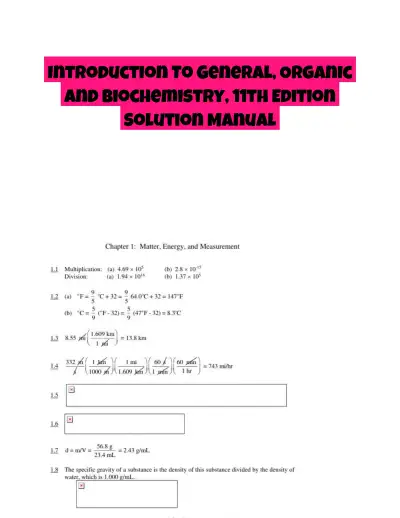 Textbook Guides
Introduction To General, Organic And Biochemistry, 11th Edition Solution Manual
Biochemistry
250 pagesMay 2025 Exam Guides
Test Bank For Introduction To General, Organic And Biochemistry, 10th Edition
Biochemistry
631 pagesMay 2025 Exam Guides
Test Bank For Advanced Nutrition and Human Metabolism 7th Edition Test Bank
Biochemistry
266 pages145downloadsFeb 2025 Exam Guides
Test Bank For Principles Of Biochemistry, 4th Edition
Biochemistry
362 pages61downloadsFeb 2025 Quick Guides
Biochemistry-II - RNA and Transcription
Biochemistry
37 pagesMar 2026 Quick Guides
Biochemistry I - Carbohydrate Metabolism II
Biochemistry
25 pagesMar 2026 Past Exams
BIOD171 Biochemistry Final Exam With Answers (29 Solved Questions)
Biochemistry
7 pagesMay 2025 Quick Guides
Biochemistry-II - DNA Structure, Replication, and Repair
Biochemistry
36 pagesMar 2026
Study this document with CramX
Once it is in your library, every tool can work from it.