

Test Bank For Introduction To General, Organic And Biochemistry, 10th Edition
- Biochemistry
- 631 pages
- Shared May 2025
Test Bank For Introduction To General, Organic And Biochemistry, 10th Edition ensures you�re well-prepared with detailed content, expert insights, and practice exercises.
Preview 16 of 631 pages
See the first 16 pages exactly as they appear in the document.
Page 1 Read page 1 as text
CHAPTER 1 — MATTER, ENERGY, AND MEASUREMENT MULTIPLE CHOICE 1. Which of the following is an example of matter? a. the light of a flame c. the air you breathe b. the sound of thunder d. None of these is matter. ANS: C PTS: 1 TOP: 1.1 - WHY DO WE CALL CHEMISTRY THE STUDY OF MATTER? 2. Which of the following is not an example of matter? a. the air in your lungs b. the blood in your arteries c. the sunlight coming through the window d. None, all of these are matter. ANS: C PTS: 1 TOP: 1.1 - WHY DO WE CALL CHEMISTRY THE STUDY OF MATTER? 3. Which of the following is a chemical property of water? a. Ice floats. c. Water reacts violently with sodium. b. Wa ter boils at 100°C. d. All of these are chemical properties. ANS: C PTS: 1 TOP: 1.1 - WHY DO WE CALL CHEMISTRY THE STUDY OF MATTER? 4. Which of the following is a chemical property of gold? a. characteristic color b. electrical conductivity c. lack of reactivity d. None, they are all physical properties. ANS: C PTS: 1 TOP: 1.1 - WHY DO WE CALL CHEMISTRY THE STUDY OF MATTER? 5. Which of the following is not a physical property of gold? a. characteristic color b. density c. electrical conductivity d. None, they are all physical properties. ANS: D PTS: 1 TOP: 1.1 - WHY DO WE CALL CHEMISTRY THE STUDY OF MATTER? 6. Which of the following is not a chemical change? a. rusting of a car body b. ripening of fruit c. souring of milk d. None, all of these are chemical changes. ANS: D PTS: 1 TOP: 1.1 - WHY DO WE CALL CHEMISTRY THE STUDY OF MATTER?
Page 2 Page 3 Read page 3 as text
7. Which of the following represents a physical change? a. stretching a silver wire c. both a and b b. tarnishing of silver d. neither a nor b ANS: A PTS: 1 TOP: 1.1 - WHY DO WE CALL CHEMISTRY THE STUDY OF MATTER? 8. Which of the following represents a physical change? a. boiling water c. both a and b b. decomposition of a dead organism d. neither a nor b ANS: A PTS: 1 TOP: 1.1 - WHY DO WE CALL CHEMISTRY THE STUDY OF MATTER? 9. Which of the following represents a physical change? a. burning of fuel oil c. both a and b b. melting of ice d. neither a nor b ANS: B PTS: 1 TOP: 1.1 - WHY DO WE CALL CHEMISTRY THE STUDY OF MATTER? 10. Which of the following is synonymous with “fact”? a. a hypothesis b. an observation which is reproducible c. an observation which is not reproducible d. none of these ANS: B PTS: 1 TOP: 1.2 - WHAT IS THE SCIENTIFIC METHOD? 11. Which of the following is true of a hypothesis? a. It is a tentative idea or explanation which can be disproved by an experiment. b. It is a tentative idea or explanation which can be proven by an experiment. c. It is a tentative idea which can either be proven or disproved by an experiment. d. It is a belief which is asserted without proof. ANS: A PTS: 1 TOP: 1.2 - WHAT IS THE SCIENTIFIC METHOD? 12. Which of the following best describes a scientific theory? a. It is just one of many ways of looking at things. b. It is a point of view which cannot be challenged. c. It is a widely accepted explanation of some phenomena supported by a large amoun t of experimental data and is therefore definitely correct. d. It is a widely accepted explanation of some phenomena supported by a large amount of experimental data, but it can be shown to be incorrect by a single experiment which yields results which contradict it. ANS: D PTS: 1 TOP: 1.2 - WHAT IS THE SCIENTIFIC METHOD? 13. The quotation, “Chance favors the prepared mind,” is attributed to the great French scientist Louis Pasteur. This most closely means which of the following? a. A careful experimenter will obtain reliable results. b. A careful experimenter will sometimes make an unexpected but significant observation. c. Intense study is required to obtain good examination grades. d. Nothing can be accomplished without appropriate preparation. ANS: B PTS: 1 TOP: 1.2 - WHAT IS THE SCIENTIFIC METHOD?
Page 4 Read page 4 as text
14. The area of Africa is approximately 11.7 million square miles. Which of the following is the correct way to express this number in scientific notation? a. 1.17 10 5 c. 1.17 10 7 b. 1.17 10 6 d. none of these ANS: C PTS: 1 TOP: 1.3 - HOW DO SCIENTISTS REPORT NUMBERS? 15. During its orbit the earth’ s maximum distance from the sun is approximately 152 million kilometers. Which of the following is the correct way to express this number in scientific notation? a. 1.52 10 5 c. 1.52 10 7 b. 1.52 10 6 d. 1.52 10 8 ANS: D PTS: 1 TOP: 1.3 - HOW DO SCIENTISTS REPORT NUMBERS? 16. In one second light travels 2.998 10 8 meters. Which of the following is the correct way to write this in conventional notation? a. 0.00000002998 m/s c. 299,800,000 m/s b. 2,998,000 m/s d. none of these ANS: C PTS: 1 TOP: 1.3 - HOW DO SCIENTISTS REPORT NUMBERS? 17. The population of the earth at the end of 2008 was approximately 6.7 10 9 people. Which of the following is correct way to represent this number? a. 6,700,000,000 people c. 67,000,000,000,000 people b. 67,000,000,000 people d. none of these ANS: A PTS: 1 TOP: 1.3 - HOW DO SCIENTISTS REPORT NUMBERS? 18. The land surface area of the earth is approximately 1.49 10 8 km 2 . Which of the following is the correct way to write this in conventional notation? a. 0.00000000149 km 2 c. 14,900,000,000 km 2 b. 149,000,000 km 2 d. none of these ANS: B PTS: 1 TOP: 1.3 - HOW DO SCIENTISTS REPORT NUMBERS? 19. Sometimes the same word can have different meanings. In the United States the word billion means “a thousand million” but in Britain the word billion means “a million million.” Which of the following corresponds to the “British Billion”? a. 1 10 – 9 c. 1 10 9 b. 1 10 – 6 d. 1 10 12 ANS: D PTS: 1 TOP: 1.3 - HOW DO SCIENTISTS REPORT NUMBERS? 20. Nanoparticles which have a length of approximately 1 10 - 9 meters. Which of the following is the correct way to write this in conventional notation? a. 0.0000000001 m c. 10,000,000 m b. 0.000000001 m d. 1,000,000,000 m
Page 5 Read page 5 as text
ANS: B PTS: 1 TOP: 1.3 - HOW DO SCIENTISTS REPORT NUMBERS? 21. Which of the following is the largest number? a. 2 10 – 1 c. 3 10 4 b. 5 10 3 d. 7 10 – 6 ANS: C PTS: 1 TOP: 1.3 - HOW DO SCIENTISTS REPORT NUMBERS? 22. Which of the following is the smallest number? a. 5 10 3 c. 2 10 – 5 b. 3 10 4 d. 7 10 – 6 ANS: D PTS: 1 TOP: 1.3 - HOW DO SCIENTISTS REPORT NUMBERS? 23. Given the calculation: 4.238 + 12.72 + 9.1 = ? What is the answer reported to the correct number of significant figures? a. 26.058 c. 26.0 b. 26.06 d. 26.1 ANS: D PTS: 1 TOP: 1.3 - HOW DO SCIENTISTS REPORT NUMBERS? 24. Given the calculation: 4.877 + 12.87 + 9.19 = ? What is the answer reported to the correct number of significant figures? a. 26.937 c. 26.94 b. 26.93 d. 26.9 ANS: C PTS: 1 TOP: 1.3 - HOW DO SCIENTISTS REPORT NUMBERS? 25. Given the calculation: 4.238 + 12.72 - 9.1 = ? What is the answer reported to the correct number of significant figures? a. 7.858 c. 7.8 b. 7.86 d. 7.9 ANS: D PTS: 1 TOP: 1.3 - HOW DO SCIENTISTS REPORT NUMBERS? 26. Given the calculation: 17.72 – 4.232 – 9.1 = ? What is the answer reported to the correct number of significant figures? a. 4.388 c. 4.39 b. 4.38 d. 4.4 ANS: D PTS: 1 TOP: 1.3 - HOW DO SCIENTISTS REPORT NUMBERS? 27. Given the calculation: 4.238 9.1 = ? What is the answer reported to the correct number of significant figures? a. 38.5658 c. 38.6 b. 38.57 d. 39 ANS: D PTS: 1 TOP: 1.3 - HOW DO SCIENTISTS REPORT NUMBERS?
Page 6 Read page 6 as text
28. Given the calculation: 1.987 6.02 = ? What is the answer reported to the correct number of significant figures? a. 11.96174 c. 12.0 b. 11.96 d. 12 ANS: C PTS: 1 TOP: 1.3 - HOW DO SCIENTISTS REPORT NUMBERS? 29. Given the calculation: 15.72/9.16 = ? What is the answer reported to the correct number of significant figures? a. 1.71616 c. 1.716 b. 1.7162 d. 1.72 ANS: D PTS: 1 TOP: 1.3 - HOW DO SCIENTISTS REPORT NUMBERS? 30. Given the calculation: 17.712/7.610 = ? What is the answer reported to the correct number of significant figures? a. 2.32746 c. 2.327 b. 2.3275 d. 2.33 ANS: C PTS: 1 TOP: 1.3 - HOW DO SCIENTISTS REPORT NUMBERS? 31. Given the calculation: (6.49 10 7 ) (7.1 10 5 ) = ? What is the answer reported to the correct number of significant figures? a. 4.6079 10 13 c. 4.6 10 2 b. 4.6 10 13 d. 4.6079 10 2 ANS: B PTS: 1 TOP: 1.3 - HOW DO SCIENTISTS REPORT NUMBERS? 32. Given the calculation: (7.22 10 - 3 ) (6.4 10 7 ) = ? What is the answer reported to the correct number of significant figures? a. 4.6 10 5 c. 4.620 10 5 b. 4.62 10 5 d. 4.6208 10 5 ANS: A PTS: 1 TOP: 1.3 - HOW DO SCIENTISTS REPORT NUMBERS? 33. Given the calculation: (6.02 10 23 )/12.00 = ? What is the answer reported to the correct number of significant figures? a. 1.993 10 – 23 c. 5.017 10 22 b. 1.99 10 – 23 d. 5.02 10 22 ANS: D PTS: 1 TOP: 1.3 - HOW DO SCIENTISTS REPORT NUMBERS? 34. Given the calculation: (6.626 x 10 - 34 )/(9.63 x 10 7 ) = ? What is the answer reported to the correct number of significant figures? a. 1.453 10 41 c. 6.88 10 – 42 b. 1.45 10 41 d. 6.882 10 – 42 ANS: C PTS: 1
Page 7 Read page 7 as text
TOP: 1.3 - HOW DO SCIENTISTS REPORT NUMBERS? 35. Which metric prefix is commonly abbreviated using a Greek letter? a. mega c. milli b. micro d. nano ANS: B PTS: 1 TOP: 1.4 - HOW DO WE MAKE MEASUREMENTS? 36. In which of the following are the lengths given in the correct order? a. cm > mm > m > km c. km > m > cm > mm b. cm > m > km > mm d. mm > cm > m > km ANS: C PTS: 1 TOP: 1.4 - HOW DO WE MAKE MEASUREMENTS? 37. In which of the following are the lengths given in the correct order? a. cm < mm < m < m c. m < mm < cm < m b. cm < m < m < mm d. m < m < cm < mm ANS: C PTS: 1 TOP: 1.4 - HOW DO WE MAKE MEASUREMENTS? 38. How many millimeters (mm) are there in 1 kilometer (km)? a. 1 10 – 12 c. 1 10 6 b. 1 10 – 6 d. 1 10 12 ANS: C PTS: 1 TOP: 1.4 - HOW DO WE MAKE MEASUREMENTS? 39. How many kilometers (km) are there in 1 millimeter (mm)? a. 1 10 – 12 c. 1 10 6 b. 1 10 – 6 d. 1 10 12 ANS: B PTS: 1 TOP: 1.4 - HOW DO WE MAKE MEASUREMENTS? 40. How many microliters ( L) are there in 1 liter (L)? a. 1 10 – 12 c. 1 10 6 b. 1 10 – 6 d. 1 10 12 ANS: C PTS: 1 TOP: 1.4 - HOW DO WE MAKE MEASUREMENTS? 41. How many liters (L) are there in 1 microliter ( L)? a. 1 10 – 12 c. 1 10 6 b. 1 10 – 6 d. 1 10 1 ANS: B PTS: 1 TOP: 1.4 - HOW DO WE MAKE MEASUREMENTS? 42. How many microliters ( L) are there in 1 milliliter (mL)? a. 1 10 – 6 c. 1 10 3 b. 1 10 – 3 d. 1 10 6 ANS: C PTS: 1 TOP: 1.4 - HOW DO WE MAKE MEASUREMENTS? 43. How many milliliters (mL) are there in 1 microliter ( L)? a. 1 10 – 6 c. 1 10 3 b. 1 10 – 3 d. 1 10 6 ANS: B PTS: 1 TOP: 1.4 - HOW DO WE MAKE MEASUREMENTS?
Page 8 Read page 8 as text
44. In the SI system of units the basic unit of volume is the cubic meter (m 3 ). A volume of 1 m 3 is equal to which of the following? a. 1 L c. 100 L b. 10 L d. 1000 L ANS: D PTS: 1 TOP: 1.4 - HOW DO WE MAKE MEASUREMENTS? 45. The decimeter (dm) is 0.1 m. Sometimes the volume of a liquid is specified in units of cubic decimeters. Which of the following volumes equals 1 cubic decimeter? a. 10 L c. 100 mL b. 10 mL d. 1000 mL ANS: D PTS: 1 TOP: 1.4 - HOW DO WE MAKE MEASUREMENTS? 46. In the SI system of units the basic unit of volume is the cubic meter (m 3 ). The cubic meter is equal to which of the following? a. 10 3 mL c. 10 9 mL b. 10 6 mL d. 10 12 mL ANS: C PTS: 1 TOP: 1.4 - HOW DO WE MAKE MEASUREMENTS? 47. The standard metric unit of volume, the liter, is equal to which of the following? a. 1 cm 3 c. 100 cm 3 b. 10 cm 3 d. 1000 cm 3 ANS: D PTS: 1 TOP: 1.4 - HOW DO WE MAKE MEASUREMENTS? 48. In which of the following are the masses given in the correct order? a. cg > mg > g >kg c. kg > g > cg > mg b. cg > g > kg > mg d. mg > cg > g > kg ANS: C PTS: 1 TOP: 1.4 - HOW DO WE MAKE MEASUREMENTS? 49. In which of the following are the masses given in the correct order? a. cg < mg < g < g c. g < mg < cg < g b. cg < g < g < mg d. g < g < cg < mg ANS: C PTS: 1 TOP: 1.4 - HOW DO WE MAKE MEASUREMENTS? 50. How many kilograms (kg) are there in 1 milligram (mg)? a. 1 10 – 12 c. 1 10 6 b. 1 10 – 6 d. 1 10 12 ANS: B PTS: 1 TOP: 1.4 - HOW DO WE MAKE MEASUREMENTS? 51. How many milligrams (mg) are there is 1 kilogram (kg)? a. 1 10 – 12 c. 1 10 6 b. 1 10 – 6 d. 1 10 1 ANS: C PTS: 1 TOP: 1.4 - HOW DO WE MAKE MEASUREMENTS? 52. How many millgrams (mg) are there in 1 microgram ( g)? a. 1 10 – 6 c. 1 10 3 b. 1 10 – 3 d. 1 10 6 ANS: B PTS: 1 TOP: 1.4 - HOW DO WE MAKE MEASUREMENTS?
Page 9 Read page 9 as text
53. How many micrograms ( g) are there in 1 milligram ( g)? a. 1 10 – 6 c. 1 10 3 b. 1 10 – 3 d. 1 10 6 ANS: C PTS: 1 TOP: 1.4 - HOW DO WE MAKE MEASUREMENTS? 54. An intern made an error and gave a patient a dose of 500 mg rather than 500 g of a drug. Which of the following is true? a. the patient received an overdose by a factor of 1000 b. the patient received an overdose by a factor of 100 c. the patient received an underdose by a factor of 1000 d. the patient received an underdose by a factor of 100 ANS: A PTS: 1 TOP: 1.4 - HOW DO WE MAKE MEASUREMENTS? 55. An intern made an error and gave a patient a dose of 500 g rather than 500 mg of a drug. Which of the following is true? a. The patient received an overdose by a factor of 1000. b. The patient received an overdose by a factor of 100. c. The patient received an underdose by a factor of 1000. d. The patient received an underdose by a factor of 100. ANS: C PTS: 1 TOP: 1.4 - HOW DO WE MAKE MEASUREMENTS? 56. How many seconds are in a 24 hour day? [Assume exactly 24 hours in a day] a. 60 c. 3.60 10 3 b. 1.44 10 3 d. 8.64 10 4 ANS: D PTS: 1 TOP: 1.4 - HOW DO WE MAKE MEASUREMENTS? 57. How many minutes are in a 30 day month? [Assume exactly 24 hours in a day] a. 7.20 10 2 c. 2.59 10 6 b. 4.32 10 4 d. 3.11 10 7 ANS: B PTS: 1 TOP: 1.4 - HOW DO WE MAKE MEASUREMENTS? 58. How many minutes are in a 365 day year? [Assume exactly 24 hours in a day] a. 8.760 10 3 c. 5.256 10 5 b. 2.190 10 4 d. 3.154 10 7 ANS: C PTS: 1 TOP: 1.4 - HOW DO WE MAKE MEASUREMENTS? 59. What temperature on the Celsius is the same as normal body temperature 98.6 F? a. 34.3 C c. 119.9 C b. 37.0 C d. none of these ANS: B PTS: 1 TOP: 1.4 - HOW DO WE MAKE MEASUREMENTS? 60. Daytime temperatures in a desert can reach 45.0 C. What is this temperature on the Fahrenheit temperature scale? a. 90.0 F c. 121.0 F b. 113.0 F d. none of these ANS: B PTS: 1 TOP: 1.4 - HOW DO WE MAKE MEASUREMENTS?
Page 10 Read page 10 as text
61. The lowest temperature ever recorded on earth was - 128.6 F. What is this temperature on the Celsius temperature scale? a. - 57.3 C c. - 173.8 C b. - 89.2 C d. - 289.1 C ANS: B PTS: 1 TOP: 1.4 - HOW DO WE MAKE MEASUREMENTS? 62. At what temperature do the temperatures on the Celsius and Fahrenheit scales have the same numerical value? a. – 40. c. 32 b. 0 d. at no value ANS: A PTS: 1 TOP: 1.4 - HOW DO WE MAKE MEASUREMENTS? 63. At what temperature do the temperatures on the Celsius and Kelvin scales have the same numerical value? a. – 40 c. 32 b. 0 d. at no value ANS: D PTS: 1 TOP: 1.4 - HOW DO WE MAKE MEASUREMENTS? 64. What Celsius temperature is the same as 77.0 F? a. 25.0 C c. 106.6 C b. 74.8 C d. none of these ANS: A PTS: 1 TOP: 1.4 - HOW DO WE MAKE MEASUREMENTS? 65. The boiling point of octane is 126 C. What is this temperature on the Fahrenheit scale? a. 52 F c. 259 F b. 102 F d. 284 F ANS: C PTS: 1 TOP: 1.4 - HOW DO WE MAKE MEASUREMENTS? 66. The boiling point of liquid nitrogen is 77 K. What is this temperature on the Celsius scale? a. 350 C c. 25 C b. 171 C d. – 196 C ANS: D PTS: 1 TOP: 1.4 - HOW DO WE MAKE MEASUREMENTS? 67. Wha t is the metric length of the 100. yard dash? [1 inch = 2.54 cm (exactly)] a. 9.14 cm c. 91.4 m b. 25.4 cm d. 254 m ANS: C PTS: 1 TOP: 1.5 - WHAT IS A HANDY WAY TO CONVERT FROM ONE UNIT TO ANOTHER? 68. One long distance Olympic race is the 10,000 meter run. Which of the following is most nearly the length of this run to three significant figures in feet? [1 meter is slightly longer than 39 inches] a. 6.09 10 3 ft c. 1.00 10 4 ft b. 6.22 10 3 ft d. 3.28 10 4 ft ANS: D PTS: 1 TOP: 1.5 - WHAT IS A HANDY WAY TO CONVERT FROM ONE UNIT TO ANOTHER?
Page 11 Read page 11 as text
69. The length of an American football field is 100. yards. Which of the following most nearly approximates the length of this run in meters? [1 meter is slightly longer than 39 inches] a. 9.14 m c. 91.4 m b. 10.9 m d. 109 m ANS: C PTS: 1 TOP: 1.5 - WHAT IS A HANDY WAY TO CONVERT FROM ONE UNIT TO ANOTHER? 70. A common piece of laboratory glassware is a 125 mL beaker. What is this volume in the English system of units? [1 quart = 0.946 liter = 32 fl oz] a. 0.423 fl oz c. 4.23 fl oz b. 0.423 qt d. 4.23 qt ANS: C PTS: 1 TOP: 1.5 - WHAT IS A HANDY WAY TO CONVERT FROM ONE UNIT TO ANOTHER? 71. A certain automobile has an 18 gallon gas tank. What is the volume of this tank in liters? [1 gallon = 4 quarts, 1 quart = 0.946 liter] a. 4.3 L c. 68 L b. 4.8 L d. 76 L ANS: C PTS: 1 TOP: 1.5 - WHAT IS A HANDY WAY TO CONVERT FROM ONE UNIT TO ANOTHER? 72. If you went into a cheese shop in Edam, Holland and wanted to buy approximately 1 pound of Edam cheese which of the following would you ask for? a. 0.25 kg c. 2 kg b. 0.5 kg d. 4 kg ANS: B PTS: 1 TOP: 1.5 - WHAT IS A HANDY WAY TO CONVERT FROM ONE UNIT TO ANOTHER? 73. A Frenchman in New York wants to buy approximately a kilo (1 kg) of cheese. How much cheese should he ask for? [1 pound = 453.6 grams] a. 1/4 lb. c. 2 lb. b. 1/2 lb. d. 4 lb ANS: C PTS: 1 TOP: 1.5 - WHAT IS A HANDY WAY TO CONVERT FROM ONE UNIT TO ANOTHER? 74. What is the mass of a quarter pound hamburger, expressed in the metric system? [1 pound = 453.6 grams] a. 113 mg c. 1814 g b. 113 g d. 0.1814 kg ANS: B PTS: 1 TOP: 1.5 - WHAT IS A HANDY WAY TO CONVERT FROM ONE UNIT TO ANOTHER? 75. An object weighs 75.7 kg. What is the weight of this object expressed in the English system? [1 pound = 453.6 grams] a. 16.7 pounds c. 343 pounds b. 167 pounds d. 34.3 pounds ANS: B PTS: 1 TOP: 1.5 - WHAT IS A HANDY WAY TO CONVERT FROM ONE UNIT TO ANOTHER?
Page 12 Read page 12 as text
76. If gasoline costs $1.95 per gallon is its cost per liter? [1 quart = 0.946 liter] a. 5.15 cents c. 73.9 cents b. 51.5 cents d. 7.39 cents ANS: B PTS: 1 TOP: 1.5 - WHAT IS A HANDY WAY TO CONVERT FROM ONE UNIT TO ANOTHER? 77. A particular model of hybrid car can travel 53.0 miles/gallon of gas. What is t his fuel efficiency expressed in the metric system? [1 quart = 0.946 liter; 1 mile = 1.609 km] a. 8.71 km/liter c. 22.5 km/liter b. 20.2 km/liter d. 90 km/liter ANS: C PTS: 1 TOP: 1.5 - WHAT IS A HANDY WAY TO CONVERT FROM ONE UNIT TO ANOTHER? 78. A studio apartment in Paris has an area of 75.0 square meters. A New York apartment with which of the following areas most closely has the same area as the Paris apartment? [1 meter = 1.094 yards] a. 90.0 square feet c. 675 square feet b. 270. square feet d. 810. square feet ANS: D PTS: 1 TOP: 1.5 - WHAT IS A HANDY WAY TO CONVERT FROM ONE UNIT TO ANOTHER? 79. If a 1.000 L bottle of champagne cost 134 Euros and the exchange rate is 1 Euro = $1.33 (US), what is the cost in dollars for 8.000 fluid ounces of this champagne? [1 fluid ounce = 29.57 mL] a. $5.26 c. $47.09 b. $42.15 d. $81.31 ANS: B PTS: 1 TOP: 1.5 - WHAT IS A HANDY WAY TO CONVERT FROM ONE UNIT TO ANOTHER? 80. In Europe the area of apartments are typically given in square meters (m 2 ). If the area of an American apartment is 9.0 10 2 ft 2 , a Paris apartment with which of the following areas most closely has the same area as the New York apartment? [1 meter = 1.094 yards] a. 27 m 2 c. 84 m 2 b. 30 m 2 d. 90 m 2 ANS: C PTS: 1 TOP: 1.5 - WHAT IS A HANDY WAY TO CONVERT FROM ONE UNIT TO ANOTHER? 81. The area of Europe is 1.05 10 7 km 2 . Which of the following shapes has an area most nearly equal to the area of Europe? [1 mile = 1.609 km] a. a rectangle 2000 miles by 1000 miles c. a square 2000 miles on a side b. a rectangle 2000 miles by 1500 miles d. none of these ANS: C PTS: 1 TOP: 1.5 - WHAT IS A HANDY WAY TO CONVERT FROM ONE UNIT TO ANOTHER? 82. The unit of weight used for precious stones is the carat (1 carat = 200 mg, exactly). If a particular 1.25 carat diamond cost $7000.00, what is the cost of a collection of identical diamonds which weighs 1.00 ounce? [1 ounce = 28.35 grams] a. $28,000 c. $16,000 b. $35,000 d. $790,000 ANS: D PTS: 1 TOP: 1.5 - WHAT IS A HANDY WAY TO CONVERT FROM ONE UNIT TO ANOTHER?
Page 13 Read page 13 as text
83. At the 2008 Olympics the Jamaican runner Usain Bolt ran the 100. meter dash in w orld record time of 9.69 seconds. What is this speed in miles per hour? [1 mile = 1.609 km] a. 2.31 mph c. 23.1 mph b. 4.33 mph d. 43.3 mph ANS: C PTS: 1 TOP: 1.5 - WHAT IS A HANDY WAY TO CONVERT FROM ONE UNIT TO ANOTHER? 84. At the 2008 Olympics the Jamaican runner Usain Bolt ran the 200. meter dash in world record time of 19.30 seconds. What is this speed in miles per hour? [1 mile = 1.609 km] a. 43.1 mph c. 4.31 mph b. 23.2 mph d. 2.32 mph ANS: B PTS: 1 TOP: 1.5 - WHAT IS A HANDY WAY TO CONVERT FROM ONE UNIT TO ANOTHER? 85. At the 2008 Olympics the Jamaican runner Shelly Ann Fraser ran the 100. meter dash in world record time of 10.78 seconds. What is this speed in miles per hour? [1 mile = 1.609 km] a. 2.08 mph c. 20.8 mph b. 4.81 mph d. 48.1 mph ANS: C PTS: 1 TOP: 1.5 - WHAT IS A HANDY WAY TO CONVERT FROM ONE UNIT TO ANOTHER? 86. At the 2008 Olympics the Ethiopian runner Kenisa Bekele won 1.00 10 4 meter run in 27 minutes, 1.17 seconds. What is this speed in miles per hour? [1 mile = 1.609 km] a. 1.38 mph c. 12.3 mph b. 2.30 mph d. 13.8 mph ANS: D PTS: 1 TOP: 1.5 - WHAT IS A HANDY WAY TO CONVERT FROM ONE UNIT TO ANOTHER? 87. The dimensions of a room are typically given in feet, but carpeting is sold by the square yard. How many square yards of carpet are required to cover the floor of a room which is 12 feet by 18 feet? a. 12 square yards c. 24 square yards b. 18 square yards d. 220 square yards ANS: C PTS: 1 TOP: 1.5 - WHAT IS A HANDY WAY TO CONVERT FROM ONE UNIT TO ANOTHER? 88. A can of soda has a volume of 355 mL. The area of a circle is given as A = r 2 , where r is the radius of the circle, so the volume of the can is given by V = ( r 2 ) h , where h is the height of the can. If a particular can has a height of 12.2 cm what is the radius of the can? a. 3.04 mm c. 9.26 mm b. 3.04 cm d. 9.26 cm ANS: B PTS: 1 TOP: 1.5 - WHAT IS A HANDY WAY TO CONVERT FROM ONE UNIT TO ANOTHER? 89. The dimensions of a piece of wood are 2.8 meters x 14 cm x 120 mm. What is the volume of this piece of wood? a. 4.7 10 3 mm 3 c. 4.7 10 4 cm 3 b. 4.7 10 3 cm 3 d. 4.7 10 3 m 3
Page 14 Read page 14 as text
ANS: C PTS: 1 TOP: 1.5 - WHAT IS A HANDY WAY TO CONVERT FROM ONE UNIT TO ANOTHER? 90. Which state of matter is highly compressible? a. solid c. gas b. liquid d. none of them ANS: C PTS: 1 TOP: 1.6 - WHAT ARE THE STATES OF MATTER? 91. Which state of matter retains its volume but adapts its shape to that of its container? a. solid c. gas b. liquid d. none of these ANS: B PTS: 1 TOP: 1.6 - WHAT ARE THE STATES OF MATTER? 92. Which state of matter is essentially incompressible? a. solid c. gas b. liquid d. none of them ANS: A PTS: 1 TOP: 1.6 - WHAT ARE THE STATES OF MATTER? 93. Which of the following describes the compressibility of liquids? a. They are highly compressible. b. They are slightly compressible. c. They are virtually incompressible. d. Any of these, depending on the liquid. ANS: B PTS: 1 TOP: 1.6 - WHAT ARE THE STATES OF MATTER? 94. Dry ice is called dry ice because it passes directly from the solid state to the gaseous state (sublimes) under normal atmospheric conditions.. Which of the following occurs during this transformation? a. The chemical composition of dry ice changes. b. The volume of the sample decreases. c. The volume of the sample remains the same. d. The volume of the sample increases. ANS: D PTS: 1 TOP: 1.6 - WHAT ARE THE STATES OF MATTER? 95. Which of the following is true of ice, water and steam? a. They are three different chemical substances. b. They are the same substance in different chemical states. c. They are the same substance in different physical states. d. They are the same substance in different chemical and physical states. ANS: C PTS: 1 TOP: 1.6 - WHAT ARE THE STATES OF MATTER? 96. Mercury is the only metal which is a liquid at room temperature. The density of mercury is 13.6 g/cm 3 . What is the mass, in pounds, of 1.00 quart of mercury? [1 liter = 1.057 quart; 1 pound = 453.6 grams] a. 0.0284 lb c. 31.7 lb b. 28.4 lb d. 35.3 lb ANS: B PTS: 1 TOP: 1.7 - WHAT ARE DENSITY AND SPECIFIC GRAVITY?
Page 15 Read page 15 as text
97. Xenon is a gas found in some automobile headlights. The density of xenon at room temperature and pressure is 5.37 g/L. What is the mass, in pounds of 1.00 quart of xenon? [1 liter = 1.057 quart; 1 pound = 453.6 grams] a. 0.0112 lb c. 79.9 lb b. 0.0125 lb d. 89.3 lb ANS: A PTS: 1 TOP: 1.7 - WHAT ARE DENSITY AND SPECIFIC GRAVITY? 98. Which of the following is true of the relationship between density expressed in g/mL and specific gravity? a. They have different numerical values and different units. b. They have the same numerical value and the same units. c. They have the same numerical value but specific gravity is dimensionless. d. They have the same units but different numerical values. ANS: C PTS: 1 TOP: 1.7 - WHAT ARE DENSITY AND SPECIFIC GRAVITY? 99. The densities of the coinage metals (copper, silver and gold) are as follows: copper = 8.95 g/cm 3 silver = 12.59 g/cm 3 gold = 19.32 g/cm 3 A sample of material is found to weigh 14.03 grams, and have a volume of 1.20 cm 3 . The sample could be which of the coinage metals? a. copper b. silver c. gold ANS: B PTS: 1 TOP: 1.7 - WHAT ARE DENSITY AND SPECIFIC GRAVITY? 100. An unknown substance has a mass of 56.8 g and a volume of 23.4 mL. What is the density of this unknown substance? a. 0.411 g/mL c. 2.43 g/mL b. 2.34 g/mL d. 2.50 g/mL ANS: C PTS: 1 TOP: 1.7 - WHAT ARE DE NSITY AND SPECIFIC GRAVITY? 101. Aluminum has a density of 2.70 g/ cm 3 . What volume is occupied by a block of aluminum which weighs 4.32 kg? a. 0.000625 cm 3 c. 1.60 cm 3 b. 0.625 cm 3 d. 1.60 L ANS: D PTS: 1 TOP: 1.7 - WHAT ARE DENSITY AND SPECIFIC GRAVITY? 102. Titanium has a density of 4.54 g/mL. What is the mass of 17.3 mL of titanium? a. 3.81 g c. 78.5 g b. 38.1 g d. 785 g ANS: C PTS: 1 TOP: 1.7 - WHAT ARE DENSITY AND SPECIFIC GRAVITY?
Page 16 Read page 16 as text
103. Iron has a density of 7.874 g/cm 3 . What is the mass of a rectangular block of iron with dimensions of 3.000 cm by 4.000 cm by 5.000 cm? a. 7.629 g c. 94.48 g b. 60.00 g d. 472.4 g ANS: D PTS: 1 TOP: 1.7 - WHAT ARE DENSITY AND SPECIFIC GRAVITY? 104. Iron has a density of 7.874 g/cm 3 . What is the volume of a block of iron which weighs 15.321 g? a. 0.008289 cm 3 c. 1.946 cm 3 b. 0.5139 cm 3 d. 120.6 cm 3 ANS: C PTS: 1 TOP: 1.7 - WHAT ARE DENSITY AND SPECIFIC GRAVITY? 105. Which of the following is true about specific gravity of a material? a. It has units of g/mL. b. It is defined as the density of the material divided by the density of water. c. both a and b d. neither a nor b ANS: B PTS: 1 TOP: 1.7 - WHAT ARE DENSITY AND SPECIFIC GRAVITY? 106. If specific gravities were defined by reference to oil (density = 0.89 g/mL) rather than water (density = 1.0 g/mL) which of the following would be true? a. The specific densities of all materials would be larger than those given in tables in handbooks. b. The specific densities of all materials would be smaller than those given in tables in handbooks. c. The specific densities of some objects would be larger and of other objects would be smaller than those given in tables in handbooks. d. The question is meaningless since water is the only permissible reference material. ANS: A PTS: 1 TOP: 1.7 - WHAT ARE DENSITY AND SPECIFIC GRAVITY? 107. A particular material has a specific gravity of 1.04 at 20°C. As this material is heated from 20°C to 30°C its volume increases faster than does the volume of water. Which of the following statements is true of the specific gravity of this material as it is heated to 30°C? a. Its specific gravity decreases. b. Its specific gravity increases. c. Its specific gravity remains the same. d. There is insufficient information to answer the question. ANS: A PTS: 1 TOP: 1.7 - WHAT ARE DENSITY AND SPECIFIC GRAVITY? 108. What is the name of the instrument used to measure specific gravity? a. densitometer c. hydrometer b. gravameter d. spectrometer ANS: C PTS: 1 TOP: 1.7 - WHAT ARE DENSITY AND SPECIFIC GRAVITY? 109. Which of the following is the formula used to calculate the kinetic energy of a moving object?
615 more pages in the full document
Unlock it once and it stays in your library, ready to chat with or turn into flashcards.
Unlock the full documentMore Biochemistry study materials
See all Textbook Guides
Solution Manual For Introduction to General, Organic, and Biochemistry, 12th Edition
Biochemistry
251 pagesMay 2025 Textbook Guides
Introduction To General, Organic And Biochemistry, 11th Edition Solution Manual
Biochemistry
250 pagesMay 2025 Exam Guides
Test Bank For Advanced Nutrition and Human Metabolism 7th Edition Test Bank
Biochemistry
266 pages145downloadsFeb 2025 Exam Guides
Test Bank For Principles Of Biochemistry, 4th Edition
Biochemistry
362 pages61downloadsFeb 2025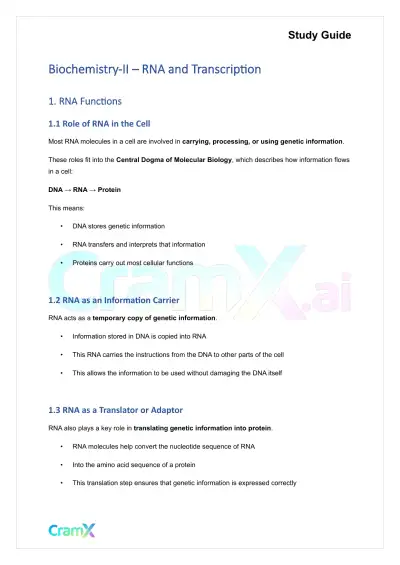 Quick Guides
Biochemistry-II - RNA and Transcription
Biochemistry
37 pagesMar 2026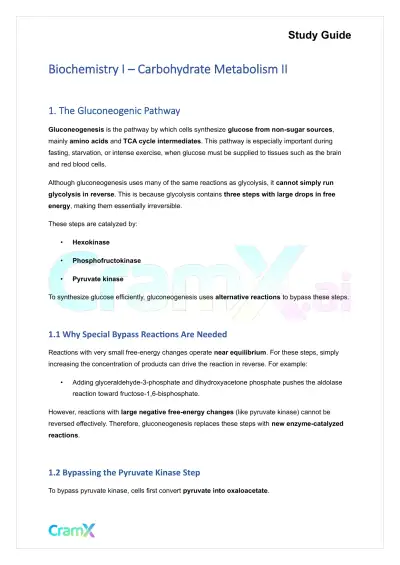 Quick Guides
Biochemistry I - Carbohydrate Metabolism II
Biochemistry
25 pagesMar 2026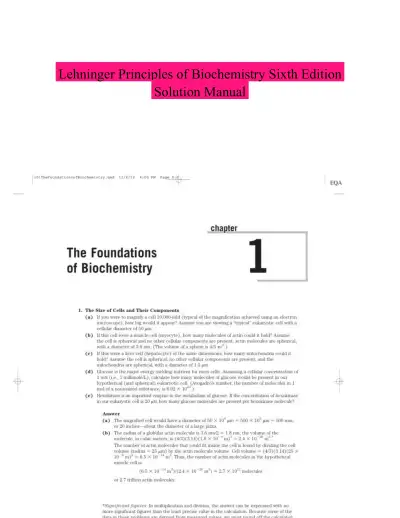 Textbook Guides
Lehninger Principles of Biochemistry Sixth Edition Solution Manual
Biochemistry
320 pagesMay 2025 Past Exams
BIOD171 Biochemistry Final Exam With Answers (29 Solved Questions)
Biochemistry
7 pagesMay 2025
Study this document with CramX
Once it is in your library, every tool can work from it.