

BUS 520 Final Exam Part 1: Team Dynamics, Decision-Making, and Conflict Resolution
- Business Management
- Strayer University
- 7 pages
- Shared May 2025
Exam focusing on team dynamics, decision-making, and conflict resolution in business.
Preview 3 of 7 pages
See the first 3 pages exactly as they appear in the document.
Page 1 Read page 1 as text
BUS 520 Final Exam Part 1: Team Dynamics, Decision - Making, and Conflict Resolution BUS 520 FINAL EXAM PART 1 Question 1 Members of __________ can solve problems with a positive combination of functional expertise and integrative or total systems thinking. Answer cross - functional teams self - directed teams cross - departmental teams virtual teams statutory teams Question 2 When teams accomplish more than the total of their individual members’ capabilities, __________ occurs. Answer exchange association synergy harmony union Question 3 Groups that form spontaneously through personal relationships or special interests, and not by any specific organizational endorsement, are called __________. Answer informal groups virtual groups temporary groups interim groups ad hoc groups Question 4 Members of teams that __________ must have good long - term working relationships with one another, solid operating systems, and the external support needed to achieve effectiveness over a sustained period of time. Answer plan things reengineer things recommend things
Page 2 Page 3 Read page 3 as text
make or do things review things Question 5 The __________ is another name for the functional silos problem. Answer individual unit problem. serviceable group problem functional chimney problem hyper - focused team problem exclusive over - assemblage problem Question 6 __________ refers to a person’s relative rank, prestige, and standing in a group. Answer Condition Standing Fullness Status Prominence Question 7 Tasks that are routine and easily subdivided lend themselves to: Answer hierarchical communicat ion networks. parallel communication networks. decentralized communication networks. restricted communication networks. centralized communication networks Question 8 _________ - role conflict occurs when a person’s values and needs come into conflict with role expectations. Answer Intrasender Intersender Person Inter Outer Question 9 __________is a “logically perfect” group decision making method because all team members agree totally on a course of action. Answer Consensus
4 more pages in the full document
Unlock it once and it stays in your library, ready to chat with or turn into flashcards.
Unlock the full documentMore Business Management study materials
See all Solved Assignments
Bus 520 The Culture of Innovation: A Study of Google�s Organizational Culture and Leadership
Business Management
7 pagesMay 2025 Solved Assignments
BUS 520 � Leadership and Organizational Training and Motivation
Business Management
9 pagesMay 2025 Solved Assignments
BUS 520 Leadership and Organizational Culture: The Success Story of Tony Hsieh and Zappos
Business Management
7 pagesMay 2025 Solved Assignments
Bus 520 Ethical Decision-Making in the Workplace: Personal Dilemmas and Organizational Impact
Civil Law
7 pagesMay 2025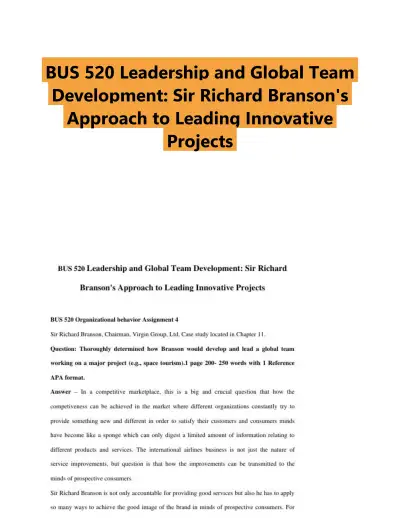 Solved Assignments
BUS 520 Leadership and Global Team Development: Sir Richard Branson's Approach to Leading Innovative Projects
Business Management
2 pagesMay 2025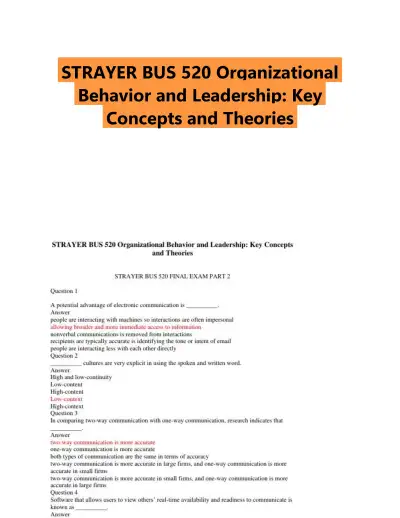 Solved Assignments
STRAYER BUS 520 Organizational Behavior and Leadership: Key Concepts and Theories
Business Management
6 pagesMay 2025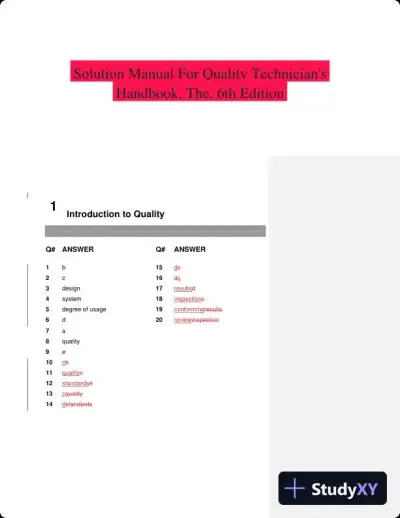 Textbook Guides
Solution Manual For Quality Technician's Handbook, The, 6th Edition
Business Management
22 pages173downloadsFeb 2025 Textbook Guides
Solution Manual for Business Essentials, 12th Edition
Business Management
421 pages147downloadsFeb 2025
Study this document with CramX
Once it is in your library, every tool can work from it.