

Chemistry - Acids and Bases
- Chemistry
- Texas A&M University
- 38 pages
- Shared March 2026
Preview 10 of 38 pages
See the first 10 pages exactly as they appear in the document.
Page 1 Read page 1 as text
Study Guide Chemistry - Acids and Bases 1. Quiz: The pH Scale 1. Question The neutral value on the pH scale is Answer Choices • less than 7 • greater than 7 • equal to 7 Correct Answer equal to 7 Why This Is Correct A neutral solution has equal concentrations of hydrogen ions (H ⁺ ) and hydroxide ions (OH ⁻ ). On the pH scale, this balance corresponds to a pH of 7. Pure water at 25°C is neutral and has a pH of 7. 2. Question Water dissociates into H ⁺ and OH ⁻ ions Answer Choices • to a large degree • to a small degree • not at all
Page 2 Read page 2 as text
Study Guide Correct Answer to a small degree Why This Is Correct Only a very small fraction of water molecules dissociate into ions at any given time. This limited dissociation is why pure water is a poor conductor of electricity. 3. Question The value of the ionization constant for water, Kw is Answer Choices • 1.0 × 10 ⁻ ⁷ • 1.0 × 10¹⁴ • 1.0 × 10 ⁻ ¹⁴ Correct Answer 1.0 × 10 ⁻ ¹⁴ Why This Is Correct Kw is defined as the product of the concentrations of H ⁺ and OH ⁻ ions in water. At 25°C, this constant value is always 1.0 × 10 ⁻ ¹⁴. 4. Question The pH scale is Answer Choices • a logarithmic scale • a linear scale • an exponential scale
Page 3 Read page 3 as text
Study Guide Correct Answer a logarithmic scale Why This Is Correct Each change of one pH unit represents a tenfold change in hydrogen ion concentration. Because it is based on powers of 10, the pH scale is logarithmic. 5. Question What is the [H ⁺ ] of a solution if the pH is 3.5? Answer Choices • 3.16 × 10⁴ • 3.16 × 10 ⁻ ⁴ • 3.5 × 10 ⁻ ⁴ Correct Answer 3.16 × 10 ⁻ ⁴ Why This Is Correct The hydrogen ion concentration is calculated using the formula: pH = −log[H ⁺ ] So, [H ⁺ ] = 10 ⁻ ³ ⋅ ⁵ = 3.16 × 10 ⁻ ⁴ M. 6. Question A solution has a [H ⁺ ] = 7.0 × 10 ⁻ ¹¹. What is its pH? Answer Choices • 10.15 • − 10.15 • 11.00
Page 4 Read page 4 as text
Study Guide Correct Answer 10.15 Why This Is Correct Using pH = −log[H ⁺ ]: pH = −log(7.0 × 10 ⁻ ¹¹) ≈ 10.15. A low hydrogen ion concentration corresponds to a high pH. 7. Question A solution has a [OH ⁻ ] = 1.3 × 10 ⁻ ³. This solution would be classified as Answer Choices • acidic • basic • neutral Correct Answer basic Why This Is Correct A high hydroxide ion concentration indicates a basic solution. Since [OH ⁻ ] is much greater than 1.0 × 10 ⁻ ⁷ , the pH will be above 7. 8. Question Bases have a pH Answer Choices • less than 7 • equal to 7 • greater than 7
Page 5 Read page 5 as text
Study Guide Correct Answer greater than 7 Why This Is Correct Basic solutions contain more hydroxide ions than hydrogen ions, resulting in a pH above 7 on the pH scale. 9. Question An acidic solution has Answer Choices • a greater concentration of hydroxide ions than hydrogen ions • a greater concentration of hydrogen ions than hydroxide ions • equal concentrations of hydrogen ions and hydroxide ions Correct Answer a greater concentration of hydrogen ions than hydroxide ions Why This Is Correct Acids release hydrogen ions in solution. A higher [H ⁺ ] compared to [OH ⁻ ] is the defining characteristic of an acidic solution. 10. Question A solution has a hydrogen ion concentration of 3.7 × 10 ⁻ ². What is its hydroxide ion concentration? Answer Choices • 2.7 × 10 ⁻ ¹³ • 3.7 × 10 ⁻ ¹⁶ • 3.7 × 10¹²
Page 6 Read page 6 as text
Study Guide Correct Answer 2.7 × 10 ⁻ ¹³ Why This Is Correct Using the equation Kw = [H ⁺ ][OH ⁻ ]: [OH ⁻ ] = (1.0 × 10 ⁻ ¹⁴) ÷ (3.7 × 10 ⁻ ²) ≈ 2.7 × 10 ⁻ ¹³ M. 2. Strong and Weak Acids 2.1 What Happens When Substances Dissolve in Water? When a substance is placed in water, it can behave in different ways: • Some substances break completely into ions . • Some do not break at all . • Others break only partially . Understanding this behavior helps us classify substances as strong electrolytes or weak electrolytes . 2. 2 Strong Electrolytes: Complete Dissociation Substances that completely separate into ions in water are called strong electrolytes . Because they produce many ions, their solutions can conduct electricity very well . • Most ionic compounds behave this way. • A common example is sodium chloride (NaCl) . 2. 3 Compounds with Both Ionic and Covalent Bonds Some compounds contain both ionic and covalent bonds . A good example is sodium carbonate (Na ₂ CO ₃ ) .
Page 7 Read page 7 as text
Study Guide Why is Na ₂ CO ₃ a strong electrolyte? • In water, each formula unit of Na ₂ CO ₃ completely dissociates into three ions: o Two sodium ions (Na ⁺ ) o One carbonate ion (CO ₃ ² ⁻ ) Dissociation equation: • The sodium ions are free in solution. • The carbonate ion stays intact internally because its atoms are held together by covalent bonds . Figure 1. Ionic and covalent bonding in Na 2 CO 3 . 2.4 Weak Electrolytes: Partial Dissociation Some substances contain polar covalent bonds and only partially dissociate in water. These are called weak electrolytes . An example is sulfurous acid (H ₂ SO ₃ ) . Equilibrium reaction: • Most of the solution remains as undissociated H ₂ SO ₃ molecules . • Only a small number of ions are formed.
Page 8 Read page 8 as text
Study Guide 2. 5 Strong vs Weak Electrolytes: Key Difference • Strong electrolytes → completely dissociate into ions. • Weak electrolytes → only partially dissociate. This difference becomes very important when studying acids and bases . 2. 6 Strong Acids and Weak Acids Acids are classified as strong or weak based on how much they ionize in water. The general dissociation of an acid is written as: • HA = acid molecule • H ⁺ = hydrogen ion • A ⁻ = conjugate base (anion) 2.7 Acid Ionization Constant (Ka) The extent to which an acid ionizes is measured by the acid ionization constant , called Ka . Ka expression: • Large Ka → strong acid (more ionization) • Small Ka → weak acid (less ionization) 2.8 Common Acids and Their Ka Values Different acids have very different Ka values.
Page 9 Read page 9 as text
Study Guide What the table shows: • Strong acids like HCl, HNO ₃ , and H ₂ SO ₄ have very large Ka values . • Weak acids like acetic acid and carbonic acid have small Ka values . • Every acid produces H ₃ O ⁺ (hydronium ions) in solution. 2. 9 Calculating Ion Concentrations: Example with Carbonic Acid Let’s look at a 1 M solution of carbonic acid (H ₂ CO ₃ ) . Equilibrium reaction: Let x = amount of H ₂ CO ₃ that dissociates. Ka expression: x² / (1 − x) = 4.3 × 10 ⁻ ⁷ Because carbonic acid is weak, x is very small , so:
Page 10 Read page 10 as text
Study Guide x² ≈ 4.3 × 10 ⁻ ⁷ x = 6.56 × 10 ⁻ ⁴ M • This is the hydronium ion concentration • pH = 3.18 2. 10 Organic Acids: Carboxylic Acids Carboxylic acids contain a – COOH functional group . • Only one hydrogen in this group can dissociate. • As a result, these acids are weak acids . Examples: • Acetic acid • Propionic acid Summary • Strong acids dissociate almost completely. o Example: 0.5 M HCl → [H ₃ O ⁺ ] ≈ 0.5 M • Weak acids dissociate only slightly. o Their ion concentrations must be calculated using Ka . • The smaller the Ka , the weaker the acid .
28 more pages in the full document
Unlock it once and it stays in your library, ready to chat with or turn into flashcards.
Unlock the full documentMore Chemistry study materials
See all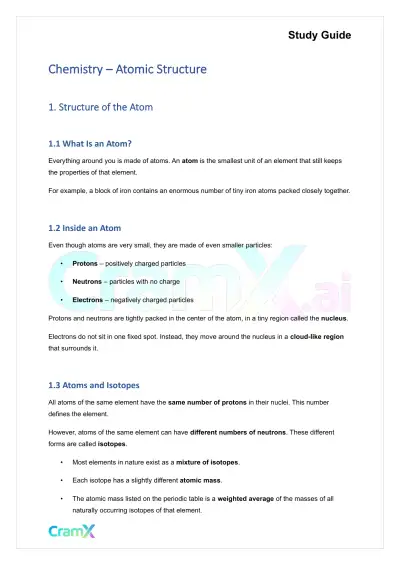 Quick Guides
Chemistry - Atomic Structure
Chemistry
42 pagesMar 2026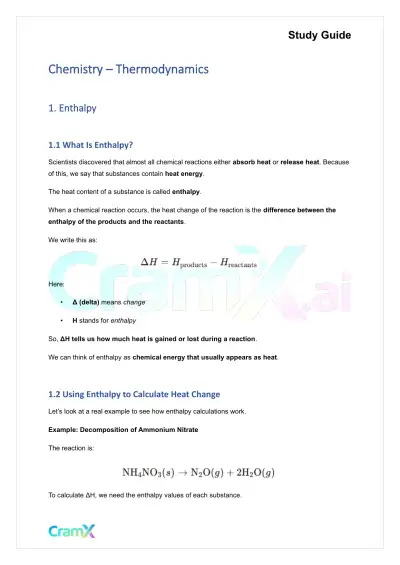 Quick Guides
Chemistry - Thermodynamics
Chemistry
38 pagesMar 2026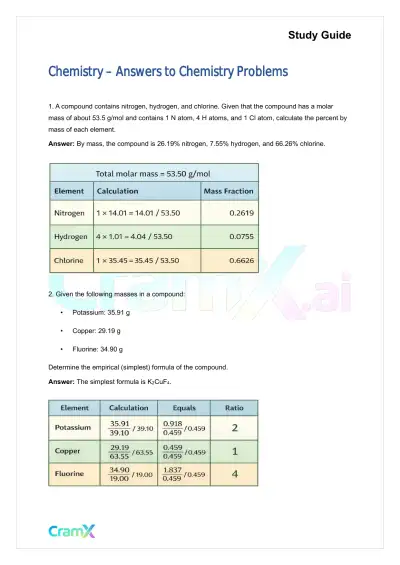 Quick Guides
Chemistry - Answers to Chemistry Problems
Chemistry
16 pagesMar 2026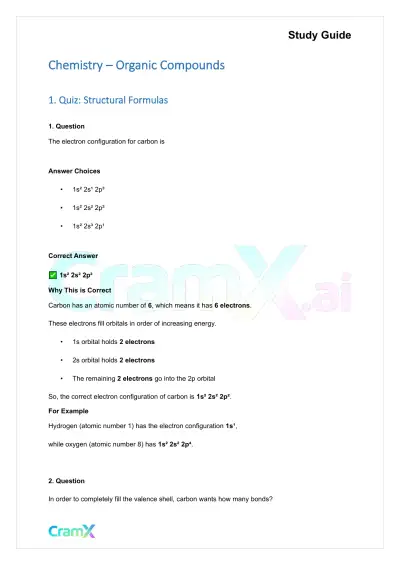 Quick Guides
Chemistry - Organic Compounds
Chemistry
41 pagesMar 2026 Quick Guides
Chemistry - Gases
Chemistry
39 pagesMar 2026 Quick Guides
Chemistry - Electrochemistry
Chemistry
35 pagesMar 2026 Quick Guides
Chemistry - Atoms
Chemistry
40 pagesMar 2026 Quick Guides
Chemistry - Elements
Chemistry
37 pagesMar 2026
Study this document with CramX
Once it is in your library, every tool can work from it.