

Chemistry - Answers to Chemistry Problems
- Chemistry
- Texas A&M University
- 16 pages
- Shared March 2026
Preview 5 of 16 pages
See the first 5 pages exactly as they appear in the document.
Page 1 Read page 1 as text
Study Guide Chemistry – Answers to Chemistry Problems 1. A compound contains nitrogen, hydrogen, and chlorine. Given that the compound has a molar mass of about 53.5 g/mol and contains 1 N atom, 4 H atoms, and 1 Cl atom, calculate the percent by mass of each element. Answer: By mass, the compound is 26.19% nitrogen, 7.55% hydrogen, and 66.26% chlorine. 2. Given the following masses in a compound: • Potassium: 35.91 g • Copper: 29.19 g • Fluorine: 34.90 g Determine the empirical (simplest) formula of the compound. Answer: The simplest formula is K 2 CuF 4 .
Page 2 Read page 2 as text
Study Guide 3. How many moles of C ₆ H ₅ Br are present in 1000 grams of the compound? Answer: There are 6.37 moles of C 6 H 5 Br. 4. What is the mass of neon gas in 5.0 liters at STP? Answer: The neon has a mass of 4.5 grams. 5. If 1.00 gram of methane (CH ₄ ) reacts completely with oxygen according to the balanced equation, how many liters of oxygen gas are required at STP? Answer: The reaction coefficients denote the relative volumes, so the volume of O 2 is twice that of 6. Three nuclei are shown. Two have mass numbers of about 24, and one has a different atomic number. Which nuclei are isotopes, and which element do they represent? Answer: Nuclei B and C are isotopes of magnesium, the element with atomic number 12. Nuclei A and B both have a mass of approximately 24 atomic mass units because their nucleons sum to 24.
Page 3 Read page 3 as text
Study Guide 7. Natural silver has an average atomic mass of 107.868 amu. Given the isotopes silver - 107 and silver - 109, determine the percent abundance of Ag - 109. Answer: Natural silver is 48.15% silver ‐ 109. 8. An alpha particle is emitted from a radioactive nucleus. The resulting nucleus has an atomic number of 88 and a mass number of 226. Identify the element, atomic number, and mass number of the daughter nucleus. Answer: The nucleus is radium ‐ 226, also written ²²⁶ ₈₈ Ra The atomic mass decreased by four, the mass of the alpha particle. The atomic number decreased by two because the alpha particle carried off two protons. The problem asks for the mass number “226,” the atomic number “88,” and the name of the element “r adium.” 9. How many valence electrons does aluminum have? How many does oxygen have? Answer: Aluminum has three valence electrons; whereas oxygen has six. Remember that you count columns from the left margin of the periodic table. 10. Draw the Lewis structure for hydrogen sulfide (H ₂ S). Answer: The Lewis diagram for H 2 S is 11. The electronegativity of chlorine is 3.0 and magnesium is 1.2. Calculate the electronegativity difference and classify the type of bond formed.
Page 4 Read page 4 as text
Study Guide Answer: The electronegativity difference of magnesium and chlorine is 1.8, which corresponds to a bond with 52% ionic character and 48% covalent character. Such an intermediate bond is called polar. 12. C ₅ H ₁₂ has three structural isomers. Draw and name the three isomers and explain how their carbon bonding differs. Answer: The three isomers of C 5 H 12 are shown in the following example. The essential feature is the bonding of carbons. In the first molecule, no carbon is bonded to more than two carbons, the second molecule has a carbon bonded to three carbons, and the third molecule has a carbon bonded to four carbons. 13. Acetylene reacts with hydrogen to form ethane. If 100 liters of acetylene react, how many liters of hydrogen gas are required at the same conditions? Answer: The addition of hydrogen converts acetylene to ethane: Because the number of moles of hydrogen is twice that of acetylene, the reaction requires 200 liters of hydrogen, double that of acetylene.
Page 5 Read page 5 as text
Study Guide 14. Identify the functional group and name the compound with the structural formula H – C(=O) – H. Answer: It is an aldehyde with the structural formula: 15. What is the minimum pressure required to liquefy carbon dioxide at its critical temperature? Answer: The minimum pressure for liquid CO 2 is 5.1 atmospheres. 16. At what temperature does solid carbon dioxide sublime at standard pressure? Answer: At – 64°C, the solid CO 2 sublimates to the gas state. 17. Calculate the total heat required to warm ice from −40°C to water at 20°C, including phase changes. Answer: The total heat needed is 49,831 joules. 18. Convert 611 mm Hg to atmospheres. Answer: The pressure equals 0.804 atmosphere.
11 more pages in the full document
Unlock it once and it stays in your library, ready to chat with or turn into flashcards.
Unlock the full documentMore Chemistry study materials
See all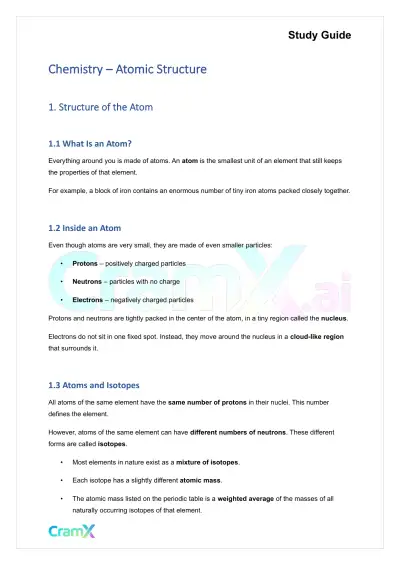 Quick Guides
Chemistry - Atomic Structure
Chemistry
42 pagesMar 2026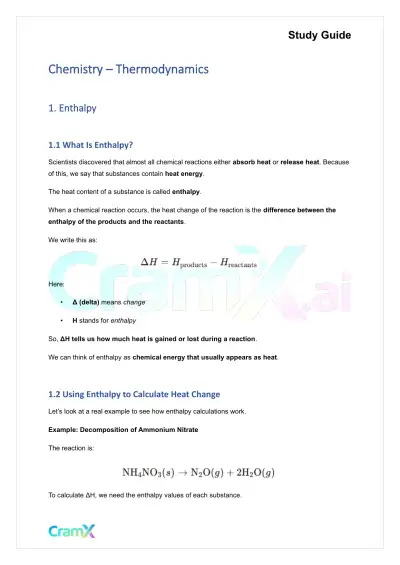 Quick Guides
Chemistry - Thermodynamics
Chemistry
38 pagesMar 2026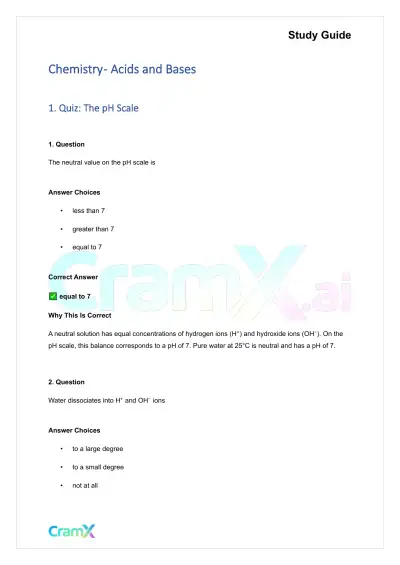 Quick Guides
Chemistry - Acids and Bases
Chemistry
38 pagesMar 2026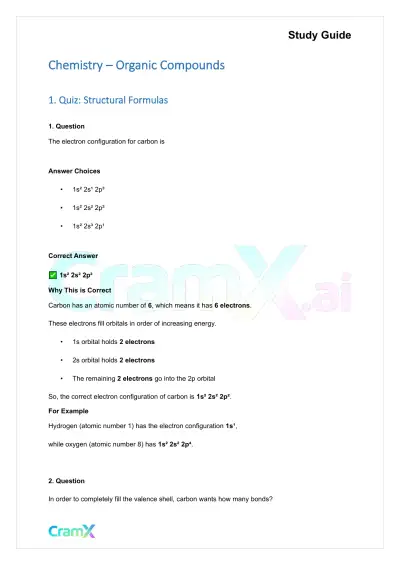 Quick Guides
Chemistry - Organic Compounds
Chemistry
41 pagesMar 2026 Quick Guides
Chemistry - Gases
Chemistry
39 pagesMar 2026 Quick Guides
Chemistry - Electrochemistry
Chemistry
35 pagesMar 2026 Quick Guides
Chemistry - Atoms
Chemistry
40 pagesMar 2026 Quick Guides
Chemistry - Elements
Chemistry
37 pagesMar 2026
Study this document with CramX
Once it is in your library, every tool can work from it.