

Organic Chemistry II - Summary of Preparations
- Chemistry
- Texas A&M University
- 30 pages
- Shared March 2026
Preview 9 of 30 pages
See the first 9 pages exactly as they appear in the document.
Page 1 Read page 1 as text
Study Guide Organic Chemistry II – Summary of Preparations 1. Preparations: Aryl Halides 1. Halogenation of Benzene • What happens? Benzene undergoes halogenation in the presence of a halogen (X ₂ ) and a Lewis acid catalyst (such as AlCl ₃ ). This leads to the substitution of a hydrogen atom on the benzene ring with a halogen atom. • What’s used? A halogen (X ₂ ) such as chlorine (Cl ₂ ) or bromine (Br ₂ ), and an AlCl ₃ catalyst. • Reaction:
Page 2 Read page 2 as text
Study Guide 2. Sandmeyer Reaction • What happens? In the Sandmeyer reaction, an amino group ( - NH ₂ ) on a benzene ring is converted to a halogen (usually bromine or chlorine) by first diazotizing the amine group with sodium nitrite (NaNO ₂ ) and hydrochloric acid (HCl), followed by treatment with a copper halide (CuX). • What’s used? Sodium nitrite (NaNO ₂ ), hydrochloric acid (HCl), copper(I) halide (CuX), and the appropriate halogen. • Reaction: (with CuBr as the catalyst for bromine substitution) 2. Preparations: Ethers 1. Sulfuric Acid Process • What happens? The sulfuric acid process involves the dehydration of alcohols to form ethers. Alcohol undergoes an acid - catalyzed elimination reaction with sulfuric acid (H ₂ SO ₄ ), resulting in the formation of an ether and water.
Page 3 Read page 3 as text
Study Guide • What’s used? Alcohol (R - OH) and concentrated sulfuric acid (H ₂ SO ₄ ). • Reaction: 2. Williamson Synthesis • What happens? The Williamson synthesis is an important method for forming ethers through an SN2 reaction. It involves the reaction of an alkoxide ion (RO ⁻ ) with a primary alkyl halide (RX), leading to the formation of an ether. • What’s used? An alkoxide ion (RO ⁻ ), an alkyl halide (RX), and heat ( Δ). • Reaction: 3. Preparations: Alcohols 1. Williamson Synthesis
Page 4 Read page 4 as text
Study Guide • What happens? The Williamson synthesis is used to prepare alcohols via the reaction of an alkoxide ion (RO ⁻ ) with a primary alkyl halide (RX) in a nucleophilic substitution reaction. This leads to the formation of an ether, which can be converted into an alcohol if water is added. • What’s used? Alkoxide ion (RO ⁻ ), alkyl halide (RX), and water (H ₂ O). • Reaction: 2. Hydroboration - Oxidation • What happens? In the hydroboration - oxidation reaction, an alkene reacts with borane (BH ₃ ) to form a trialkylborane intermediate, which is then oxidized using hydrogen peroxide (H ₂ O ₂ ) to form an alcohol. • What’s used? Borane (BH ₃ ), hydrogen peroxide (H ₂ O ₂ ). • Reaction:
Page 5 Read page 5 as text
Study Guide 3. Reduction of Aldehydes and Ketones • What happens? Aldehydes and ketones can be reduced to alcohols using lithium aluminum hydride (LiAlH ₄ ) as a reducing agent. • What’s used? Lithium aluminum hydride (LiAlH ₄ ) and water (H ₂ O). • Reaction: 4. Reduction of Carboxylic Acids
Page 6 Read page 6 as text
Study Guide • What happens? Carboxylic acids can be reduced to alcohols using lithium aluminum hydride (LiAlH ₄ ). • What’s used? Lithium aluminum hydride (LiAlH ₄ ) and water (H ₂ O). • Reaction: 5. Reduction of Esters • What happens? Esters can be reduced to alcohols using lithium aluminum hydride (LiAlH ₄ ), producing a primary alcohol and an alcohol derived from the ester group. • What’s used? Lithium aluminum hydride (LiAlH ₄ ) and water (H ₂ O). • Reaction:
Page 7 Read page 7 as text
Study Guide 6. Grignard Reagent with Aldehydes and Ketones • What happens? Grignard reagents (RMgBr) react with aldehydes or ketones to form alcohols through nucleophilic addition. The intermediate product is then treated with acid to form the alcohol. • What’s used? Grignard reagent (RMgBr), acid (H ⁺ ). • Reaction (Aldehyde): Key Takeaway • Williamson Synthesis: Alcohols can be synthesized by nucleophilic substitution between an alkoxide and an alkyl halide. • Hydroboration - Oxidation: Alkenes undergo hydroboration followed by oxidation to form alcohols. • Reduction of Aldehydes, Ketones, Carboxylic Acids, and Esters: LiAlH ₄ reduces carbonyl compounds to alcohols. • Grignard Reagent: Grignard reagents add to aldehydes and ketones, forming alcohols upon acid work - up.
Page 8 Read page 8 as text
Study Guide 4. Preparations: Aldehydes 1. Oxidation of Primary Alcohols • What happens? Primary alcohols can be oxidized to aldehydes using an oxidizing agent like pyridinium chlorochromate (PCC). The reaction occurs in the presence of a solvent like dichloromethane (CH ₂ Cl ₂ ). • What’s used? Pyridinium chlorochromate (C ₆ H ₅ N ⁺ HCrO ₃ Cl ⁻ ) and dichloromethane (CH ₂ Cl ₂ ). • Reaction: 2. Reduction of Acyl Halides • What happens? Acyl halides (R - CO - Cl) are reduced to aldehydes using lithium tri - tert - butoxyaluminum hydride (LATB - H) at low temperatures. • What’s used? Lithium tri - tert - butoxyaluminum hydride (LATB - H) and water (H ₂ O).
Page 9 Read page 9 as text
Study Guide • Reaction: 3. Reduction of Esters • What happens? Esters can be reduced to aldehydes using diisobutylaluminum hydride (DIBAL - H) at low temperatures followed by hydrolysis. • What’s used? Diisobutylaluminum hydride (DIBAL - H) and water (H ₂ O). • Reaction: 4. Reduction of Nitriles • What happens? Nitriles (R - C≡N) can be reduced to aldehydes using diisobutylaluminum hydride (DIBAL - H) followed by hydrolysis. • What’s used? Diisobutylaluminum hydride (DIBAL - H) and water (H ₂ O).
21 more pages in the full document
Unlock it once and it stays in your library, ready to chat with or turn into flashcards.
Unlock the full documentMore Chemistry study materials
See all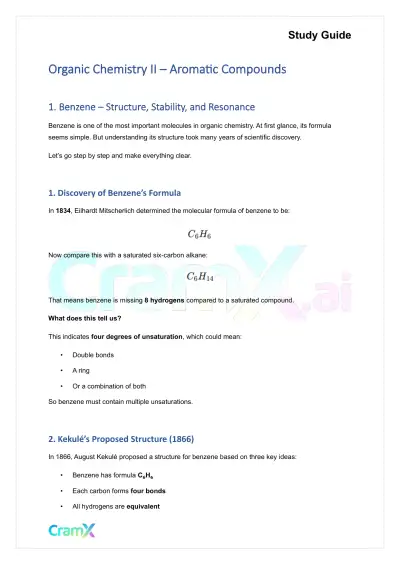 Quick Guides
Organic Chemistry II - Aromatic Compounds
Chemistry
24 pagesMar 2026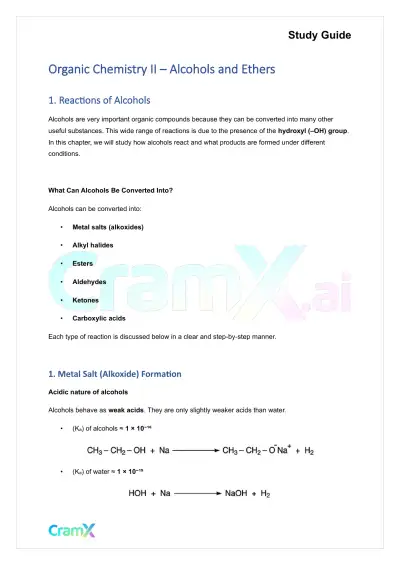 Quick Guides
Organic Chemistry II - Alcohols and Ethers
Chemistry
40 pagesMar 2026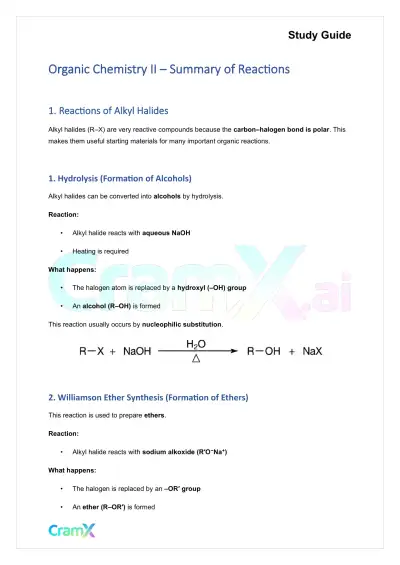 Quick Guides
Organic Chemistry II - Summary of Reactions
Chemistry
52 pagesMar 2026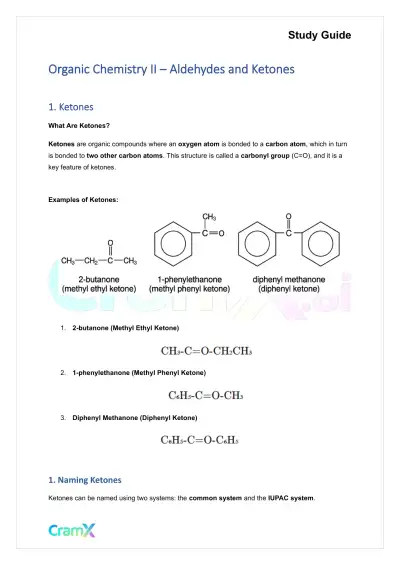 Quick Guides
Organic Chemistry II - Aldehydes and Ketones
Chemistry
35 pagesMar 2026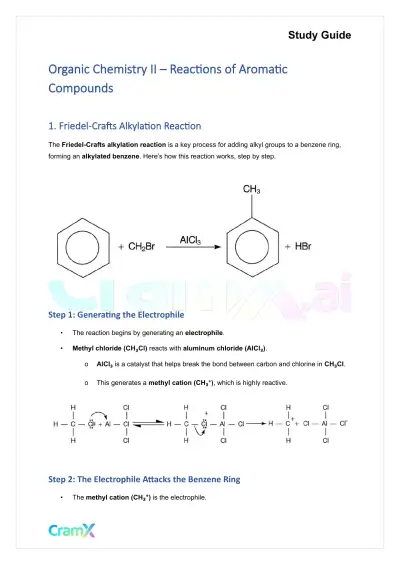 Quick Guides
Organic Chemistry II - Reactions of Aromatic Compounds
Chemistry
24 pagesMar 2026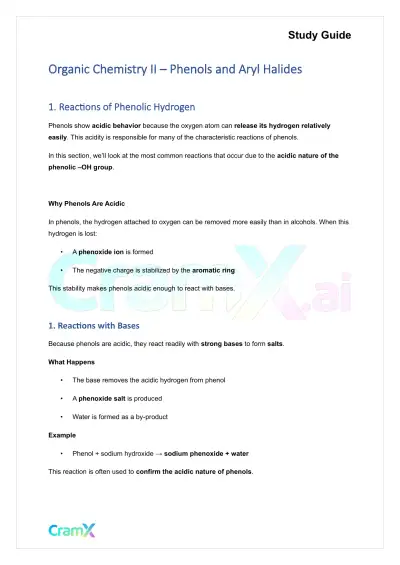 Quick Guides
Organic Chemistry II - Phenols and Aryl Halides
Chemistry
35 pagesMar 2026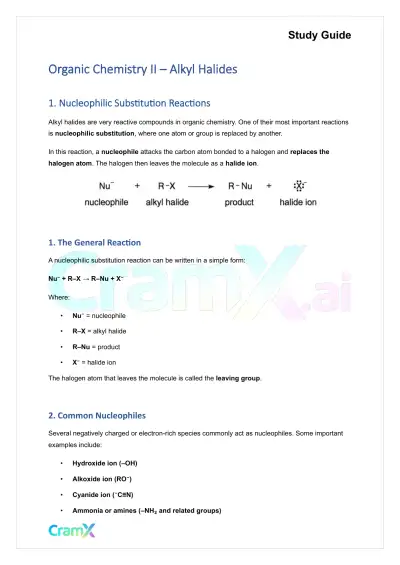 Quick Guides
Organic Chemistry II - Alkyl Halides
Chemistry
32 pagesMar 2026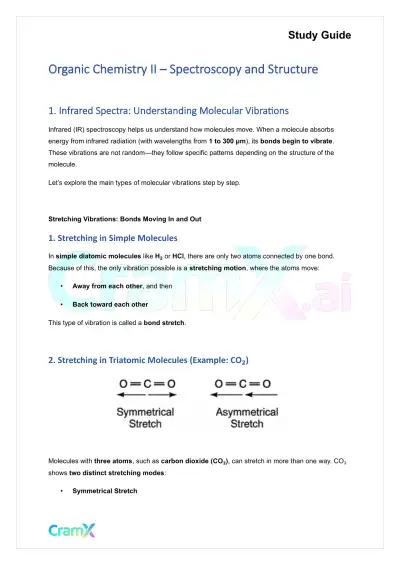 Quick Guides
Organic Chemistry II - Spectroscopy and Structure
Chemistry
16 pagesMar 2026
Study this document with CramX
Once it is in your library, every tool can work from it.