

Organic Chemistry II - Summary of Reactions
- Chemistry
- Texas A&M University
- 52 pages
- Shared March 2026
Preview 10 of 52 pages
See the first 10 pages exactly as they appear in the document.
Page 1 Read page 1 as text
Study Guide Organic Chemistry II – Summary of Reactions 1. Reactions of Alkyl Halides Alkyl halides (R – X) are very reactive compounds because the carbon – halogen bond is polar . This makes them useful starting materials for many important organic reactions. 1. Hydrolysis (Formation of Alcohols) Alkyl halides can be converted into alcohols by hydrolysis. Reaction: • Alkyl halide reacts with aqueous NaOH • Heating is required What happens: • The halogen atom is replaced by a hydroxyl ( – OH) group • An alcohol (R – OH) is formed This reaction usually occurs by nucleophilic substitution . 2. Williamson Ether Synthesis (Formation of Ethers) This reaction is used to prepare ethers . Reaction: • Alkyl halide reacts with sodium alkoxide (R′O ⁻ Na ⁺ ) What happens: • The halogen is replaced by an – OR′ group • An ether (R – OR′) is formed
Page 2 Read page 2 as text
Study Guide Important note: • This method works best with primary alkyl halides • It follows an SN2 mechanism 3. Formation of Nitriles Alkyl halides react with cyanide ion (CN ⁻ ) to form nitriles. Reaction conditions: • NaCN in aqueous medium • Heating What happens: • The halogen is replaced by a – CN group • A nitrile (R – C≡N) is formed Key advantage: • The carbon chain length increases by one carbon 4. Formation of Amines Alkyl halides can react with ammonia or amines to form different classes of amines. (a) With ammonia: • Forms primary amines (R – NH ₂ ) (b) With primary amines (R′NH ₂ ): • Forms secondary amines (R – NHR′) (c) With secondary amines (R′ ₂ NH):
Page 3 Read page 3 as text
Study Guide • Forms tertiary amines (R – NR′ ₂ ) Conditions: • Heating • Followed by treatment with base (OH ⁻ ) 5. Alkene Formation (Elimination Reaction) Alkyl halides can undergo elimination to form alkenes. Reaction conditions: • Alcoholic KOH or alkoxide (RO ⁻ K ⁺ ) • Heat What happens: • A hydrogen atom and halogen are eliminated • A double bond forms • An alkene is produced This reaction generally follows an E2 mechanism .
Page 4 Read page 4 as text
Study Guide 6. Formation of Grignard Reagents Alkyl halides react with magnesium to form Grignard reagents , which are very important in organic synthesis. Reaction conditions: • Magnesium metal • Dry ether (absence of moisture) Product: • R – Mg – X (Grignard reagent) These reagents are highly reactive and used to form new carbon – carbon bonds . Key Takeaway • Alkyl halides are reactive due to the polar C – X bond . • Hydrolysis converts alkyl halides into alcohols. • Williamson ether synthesis is used to prepare ethers. • Reaction with NaCN forms nitriles and increases chain length. • Alkyl halides react with ammonia and amines to form 1°, 2°, and 3° amines . • Elimination reactions produce alkenes under alcoholic conditions. • Reaction with magnesium forms Grignard reagents , essential for synthesis. • Alkyl halides undergo both substitution and elimination reactions . 2. Reactions of Phenols Phenols are aromatic compounds where a hydroxyl group ( – OH) is directly attached to a benzene ring.
Page 5 Read page 5 as text
Study Guide Because of this – OH group , phenols show reactions that are different from both alcohols and benzene. 1. Neutralization (Acidic Nature of Phenols) Phenols are weak acids . Reaction: • Phenol reacts with NaOH • Forms sodium phenoxide What this shows: • Phenols can lose a proton (H ⁺ ) • They are more acidic than alcohols • But less acidic than carboxylic acids Phenols do not react with NaHCO ₃ , confirming their weak acidity. 2. Ester Formation Phenols react with acid derivatives to form esters . (a) With acid anhydrides: • Produces phenyl esters • A carboxylic acid is formed as a by - product (b) With acid chlorides:
Page 6 Read page 6 as text
Study Guide • Produces phenyl esters • HX is released Key idea: • Phenols do not easily undergo esterification with carboxylic acids • More reactive reagents (acid chlorides or anhydrides) are needed 3. Ether Formation (Williamson - Type Reaction) Phenols can form ethers through their phenoxide ion . Steps: 1. Phenol reacts with NaOH → sodium phenoxide 2. Sodium phenoxide reacts with an alkyl halide (R – X) Result: • Aryl alkyl ether (Ar – O – R) is formed This reaction is similar to Williamson ether synthesis.
Page 7 Read page 7 as text
Study Guide 4. Halogenation The – OH group is a strong activating group and directs substitution to ortho and para positions . (a) In aqueous medium: • Reaction is very fast • Forms 2,4,6 - trihalophenol (b) In non - polar solvent (CS ₂ ) at low temperature: • Mainly mono - substitution • Ortho and para products are formed
Page 8 Read page 8 as text
Study Guide 5. Nitration Phenols undergo nitration easily due to ring activation. Reaction conditions: • Dilute HNO ₃ at room temperature Products: • Mixture of ortho - nitrophenol and para - nitrophenol Strong nitrating mixtures lead to polysubstitution. 6. Sulfonation Phenols react with concentrated H ₂ SO ₄ , and the product depends on temperature. At low temperature (≈25°C):
Page 9 Read page 9 as text
Study Guide • Ortho - phenol sulfonic acid is major At high temperature (≈100°C): • Para - phenol sulfonic acid is major This shows temperature control of orientation . 7. Kolbe Reaction (Kolbe – Schmitt Reaction) This reaction is used to prepare salicylic acid . Steps: 1. Sodium phenoxide reacts with CO ₂ 2. Acidification with H ₃ O ⁺ Result: • Formation of o - hydroxybenzoic acid (salicylic acid) This reaction is important in pharmaceutical chemistry.
Page 10 Read page 10 as text
Study Guide Key Takeaway • Phenols are weak acids and react with NaOH to form phenoxides. • Phenols form esters with acid chlorides and anhydrides. • Ether formation occurs via the phenoxide ion . • The – OH group strongly activates the benzene ring. • Phenols undergo ortho - and para - directed electrophilic substitution . • Halogenation in water gives 2,4,6 - trihalophenol . • Nitration gives o - and p - nitrophenols . • Sulfonation is temperature dependent . • The Kolbe reaction converts phenol into salicylic acid. 3. Reactions of Aryl Halides Aryl halides are compounds in which a halogen atom is directly attached to a benzene ring . Because the C – X bond is strengthened by resonance with the aromatic ring , aryl halides are much less reactive than alkyl halides in substitution reactions. 1. Grignard Reaction Aryl halides can react with magnesium to form Grignard reagents . Reaction conditions:
42 more pages in the full document
Unlock it once and it stays in your library, ready to chat with or turn into flashcards.
Unlock the full documentMore Chemistry study materials
See all Quick Guides
Organic Chemistry II - Aromatic Compounds
Chemistry
24 pagesMar 2026 Quick Guides
Organic Chemistry II - Alcohols and Ethers
Chemistry
40 pagesMar 2026 Quick Guides
Organic Chemistry II - Aldehydes and Ketones
Chemistry
35 pagesMar 2026 Quick Guides
Organic Chemistry II - Reactions of Aromatic Compounds
Chemistry
24 pagesMar 2026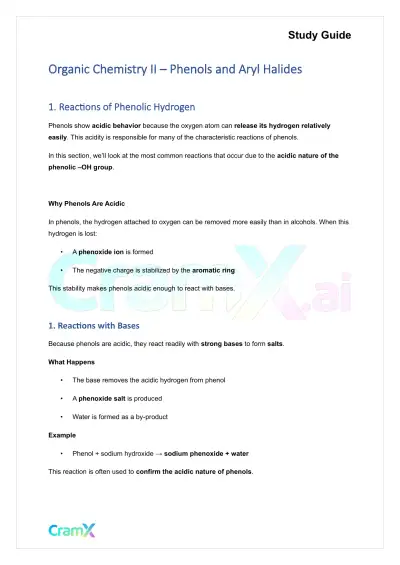 Quick Guides
Organic Chemistry II - Phenols and Aryl Halides
Chemistry
35 pagesMar 2026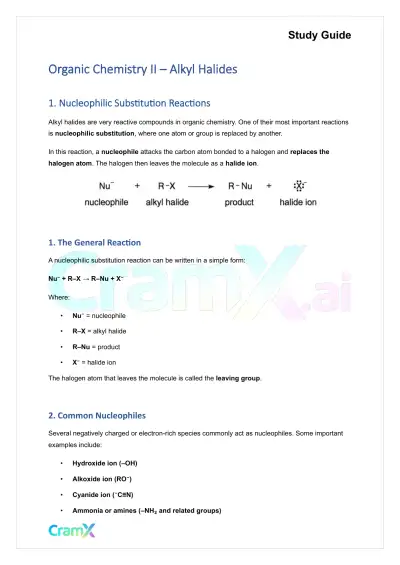 Quick Guides
Organic Chemistry II - Alkyl Halides
Chemistry
32 pagesMar 2026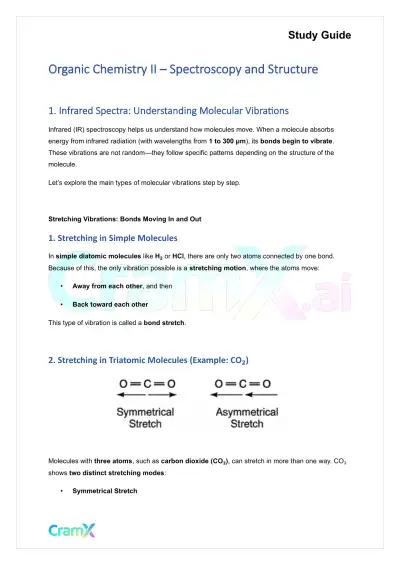 Quick Guides
Organic Chemistry II - Spectroscopy and Structure
Chemistry
16 pagesMar 2026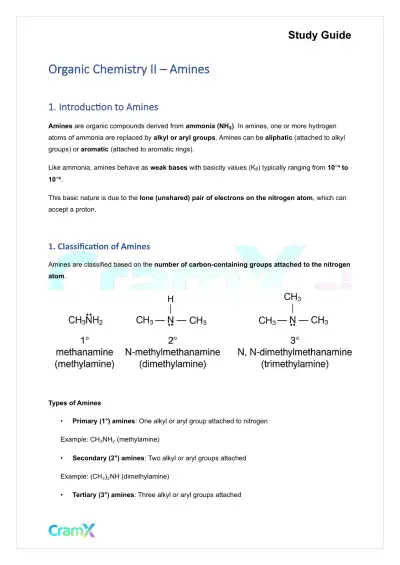 Quick Guides
Organic Chemistry II - Amines
Chemistry
19 pagesMar 2026
Study this document with CramX
Once it is in your library, every tool can work from it.