

Organic Chemistry II - Spectroscopy and Structure
- Chemistry
- Texas A&M University
- 16 pages
- Shared March 2026
Preview 5 of 16 pages
See the first 5 pages exactly as they appear in the document.
Page 1 Read page 1 as text
Study Guide Organic Chemistry II – Spectroscopy and Structure 1. Infrared Spectra: Understanding Molecular Vibrations Infrared (IR) spectroscopy helps us understand how molecules move. When a molecule absorbs energy from infrared radiation (with wavelengths from 1 to 300 μ m ), its bonds begin to vibrate . These vibrations are not random — they follow specific patterns depending on the structure of the molecule. Let’s explore the main types of molecular vibrations step by step. Stretching Vibrations: Bonds Moving In and Out 1. Stretching in Simple Molecules In simple diatomic molecules like H ₂ or HCl , there are only two atoms connected by one bond. Because of this, the only vibration possible is a stretching motion , where the atoms move: • Away from each other , and then • Back toward each other This type of vibration is called a bond stretch . 2. Stretching in Triatomic Molecules (Example: CO ₂ ) Molecules with three atoms , such as carbon dioxide (CO ₂ ) , can stretch in more than one way. CO ₂ shows two distinct stretching modes : • Symmetrical Stretch
Page 2 Read page 2 as text
Study Guide o Both oxygen atoms move away from the carbon atom at the same time , and then move back together. o The molecule stays balanced during this motion. • Asymmetrical Stretch o One oxygen atom moves toward the carbon atom while the other moves away . o This creates an uneven movement within the molecule. These different stretching motions absorb infrared energy at different frequencies. Figure 1 3. Bending Vibrations: Changing Bond Angles Molecules with three or more atoms don’t just stretch — they can also bend . Bending vibrations happen when bond angles change , meaning the bonds open and close like a hinge. These bending motions are grouped into different types.
Page 3 Read page 3 as text
Study Guide In - Plane Bending (Movement in the Same Plane) • Scissoring : Two atoms move toward and away from each other, like the blades of scissors. • Rocking : Atoms move together in the same direction within the plane of the molecule. Out - of - Plane Bending (Movement Above and Below the Plane) • Twisting : One atom moves forward while the other moves backward. • Wagging : Atoms move up and down together, like a wagging tail. These bending modes add more detail to an infrared spectrum and help identify molecular structure. Infrared Absorption and Molecular Identification Each bond and each group of three or more atoms absorbs infrared radiation at specific wavenumbers . When this happens, the molecule enters a quantized vibrational energy state . However, not all vibrations appear in an IR spectrum . Only vibrations that cause a change in dipole moment produce an absorption peak. This leads to two important ideas: • If a peak appears , it confirms the presence of a specific bond or group. • If a peak is missing , that bond or group is likely not present. The Fingerprint Region The region between 1400 and 800 cm ⁻ ¹ is called the fingerprint region . • This region contains many closely spaced peaks . • Individual peaks are difficult to assign to specific bonds. • However, the overall pattern is unique for each compound .
Page 4 Read page 4 as text
Study Guide Because of this: • If two compounds have identical spectra in the fingerprint region , they must be the same compound . Key Takeaway • Infrared radiation causes molecular vibrations , mainly stretching and bending. • Diatomic molecules can only show stretching vibrations . • Triatomic molecules like CO ₂ show symmetrical and asymmetrical stretching . • Bending modes involve changes in bond angles and include scissoring, rocking, twisting, and wagging. • Only vibrations that change the dipole moment produce IR absorption peaks. • The fingerprint region (1400 – 800 cm ⁻ ¹) is unique to each compound and is crucial for identification. • Matching fingerprint regions mean the compounds are identical . 2. Introduction: Spectroscopy and Structure In organic chemistry, scientists often need to figure out what a molecule looks like or confirm the identity of a known substance . To do this, they rely on information collected from scientific instruments. These instruments do not give answers directly. Instead, they produce data in the form of graphs , which are called spectra . Learning how to read and understand these spectra is a key skill for chemists. Why Spectroscopy Is Important Spectroscopy works by studying what happens when energy is added to a molecule . When a molecule absorbs energy, different parts of it respond in different ways. By observing these responses, chemists can: • Identify unknown molecules • Confirm molecular structures • Learn about bonds and functional groups
Page 5 Read page 5 as text
Study Guide To interpret spectra correctly, a chemist must understand how molecules behave when they interact with energy . Different Types of Energy Used in Spectroscopy Molecules can interact with energy from several sources. Each type of energy leads to a different kind of spectroscopy: • High - energy electrons → Mass Spectroscopy Helps determine molecular mass and fragmentation patterns. • Radio waves → Nuclear Magnetic Resonance (NMR) Spectroscopy Provides detailed information about the arrangement of atoms in a molecule. • Light energy (UV and visible light) → Ultraviolet – Visible (UV - Vis) Spectroscopy Useful for studying electronic transitions in molecules. • Heat energy (infrared radiation) → Infrared (IR) Spectroscopy Used to identify functional groups based on bond vibrations. Each technique gives different but complementary information , and together they help build a complete picture of molecular structure. Key Takeaway • Spectroscopy helps chemists identify molecules and determine their structures . • Instrument data is presented as graphs called spectra . • Understanding spectroscopy requires knowledge of how molecules respond to energy . • Different types of energy lead to different spectroscopic techniques. • Common methods include mass spectrometry, NMR, UV - Vis, and IR spectroscopy . • Using multiple spectroscopic techniques gives a more accurate and complete understanding of a molecule.
11 more pages in the full document
Unlock it once and it stays in your library, ready to chat with or turn into flashcards.
Unlock the full documentMore Chemistry study materials
See all Quick Guides
Organic Chemistry II - Aromatic Compounds
Chemistry
24 pagesMar 2026 Quick Guides
Organic Chemistry II - Alcohols and Ethers
Chemistry
40 pagesMar 2026 Quick Guides
Organic Chemistry II - Summary of Reactions
Chemistry
52 pagesMar 2026 Quick Guides
Organic Chemistry II - Aldehydes and Ketones
Chemistry
35 pagesMar 2026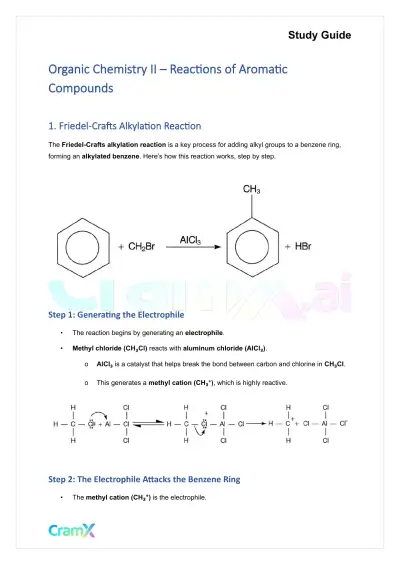 Quick Guides
Organic Chemistry II - Reactions of Aromatic Compounds
Chemistry
24 pagesMar 2026 Quick Guides
Organic Chemistry II - Phenols and Aryl Halides
Chemistry
35 pagesMar 2026 Quick Guides
Organic Chemistry II - Alkyl Halides
Chemistry
32 pagesMar 2026 Quick Guides
Organic Chemistry II - Amines
Chemistry
19 pagesMar 2026
Study this document with CramX
Once it is in your library, every tool can work from it.