

Organic Chemistry II - Aromatic Compounds
- Chemistry
- Texas A&M University
- 24 pages
- Shared March 2026
Preview 8 of 24 pages
See the first 8 pages exactly as they appear in the document.
Page 1 Read page 1 as text
Study Guide Organic Chemistry II – Aromatic Compounds 1. Benzene – Structure, Stability, and Resonance Benzene is one of the most important molecules in organic chemistry. At first glance, its formula seems simple. But understanding its structure took many years of scientific discovery. Let’s go step by step and make everything clear. 1. Discovery of Benzene’s Formula In 1834 , Eilhardt Mitscherlich determined the molecular formula of benzene to be: Now compare this with a saturated six - carbon alkane: That means benzene is missing 8 hydrogens compared to a saturated compound. What does this tell us? This indicates four degrees of unsaturation , which could mean: • Double bonds • A ring • Or a combination of both So benzene must contain multiple unsaturations. 2. Kekulé’s Proposed Structure (1866) In 1866, August Kekulé proposed a structure for benzene based on three key ideas: • Benzene has formula C ₆ H ₆ • Each carbon forms four bonds • All hydrogens are equivalent
Page 2 Read page 2 as text
Study Guide His Conclusion Kekulé suggested: • Six carbons arranged in a ring • Three double bonds alternating with three single bonds This structure explains: • Four degrees of unsaturation (1 ring + 3 double bonds) • Each carbon having four bonds At the time, this was a brilliant idea. 3. A Problem with Kekulé’s Structure Scientists noticed something strange. If benzene truly had alternating double bonds, then substituting groups at: • 1,2 positions • 1,6 positions should produce different compounds . But experimentally, these compounds were the same . This meant something was missing in Kekulé’s model.
Page 3 Read page 3 as text
Study Guide 4. Kekulé’s Modification – Rapid Interconversion To explain this, Kekulé suggested: There are two structures that differ only in the positions of the double bonds. These two structures: • Rapidly convert into each other • Interchange so fast that they appear identical This was an early hint of something deeper — what we now call resonance . Resonance in Benzene Modern chemistry explains benzene using resonance theory . What is Resonance? When more than one valid Lewis structure can be drawn for a molecule:
Page 4 Read page 4 as text
Study Guide • None of them alone is completely correct. • The real structure is a hybrid of all possible structures. • This hybrid is more stable than any single structure. The extra stability gained is called resonance energy . Resonance in Benzene The two Kekulé structures are actually resonance structures . Instead of three fixed double bonds: • The π electrons are delocalized • They move around the entire ring We represent this by drawing a circle inside the hexagon . That circle shows: • π electrons are shared equally over all six carbons • All carbon – carbon bonds are equivalent
Page 5 Read page 5 as text
Study Guide Evidence from Bond Lengths Experimental measurements show: • All C – C bonds in benzene are 1.40 pm • A single bond is 1.46 pm • A double bond is 1.34 pm Benzene’s bond length is exactly in between . This proves: • Bonds are neither purely single nor purely double. • All bonds are identical. Also: • All bond angles are 120° • The molecule is planar (flat) Resonance Energy Benzene is more stable than expected for a molecule with three double bonds. The extra stability is about: This extra stability is called its resonance energy . The greater the resonance energy, the more stable the compound. Orbital Picture of Benzene Now let’s look at the modern molecular explanation. Because: • Benzene is planar • All bond angles are 120°
Page 6 Read page 6 as text
Study Guide Each carbon is: What does this mean? Each carbon has: • Three sp² hybrid orbitals (forming σ bonds) • One unhybridized p orbital The sp² orbitals form: • C – C sigma bonds • C – H sigma bonds The p orbitals overlap sideways (above and below the ring). Figure 1 π Molecular Orbitals When six p orbitals overlap: They form six molecular orbitals : • 3 bonding orbitals (low energy) • 3 antibonding orbitals (high energy)
Page 7 Read page 7 as text
Study Guide The bonding orbitals are: π ₁ , π ₂ , π ₃ The antibonding orbitals are: π ₄ *, π ₅ *, π ₆ * Some orbitals have equal energy. These are called degenerate orbitals . Figure 2 Why Is Benzene So Stable? Benzene has: • Six π electrons • All electrons fill the bonding orbitals only • All electrons are paired • A completely filled set of bonding π orbitals This creates a closed shell of delocalized π electrons , which gives: • Exceptional stability • Large resonance energy Final Big Picture Here’s what you should remember:
Page 8 Read page 8 as text
Study Guide • Benzene has formula C ₆ H ₆ . • It contains four degrees of unsaturation. • Kekulé proposed alternating double bonds in a ring. • Modern theory explains benzene using resonance. • All C – C bonds are equal in length. • The molecule is planar and sp² hybridized. • Six π electrons are delocalized over the ring. • All bonding π orbitals are filled. • This gives benzene very high stability (36 kcal/mol resonance energy). 2. Hückel’s Rule, Nomenclature, and Reactions of Benzene Let’s now connect three important ideas about benzene: 1. Why benzene is aromatic (Hückel’s Rule) 2. How benzene compounds are named 3. How benzene reacts 1. Hückel’s Rule – Why Benzene Is Aromatic In 1931, Erich Hückel proposed a rule to predict whether a ring compound is aromatic . What kind of molecules does the rule apply to? The compound must be: • Cyclic (ring - shaped) • Planar (flat) • Fully conjugated (each atom has a p orbital) • Contain π electrons
16 more pages in the full document
Unlock it once and it stays in your library, ready to chat with or turn into flashcards.
Unlock the full documentMore Chemistry study materials
See all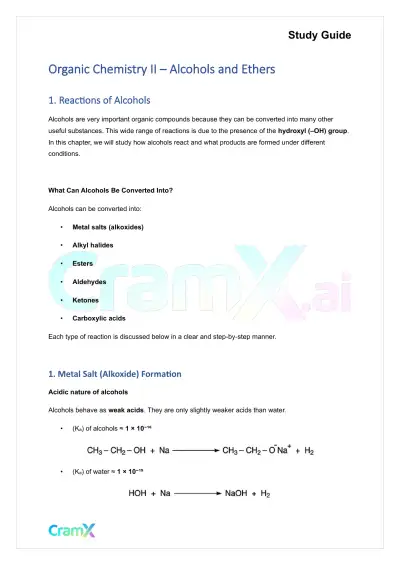 Quick Guides
Organic Chemistry II - Alcohols and Ethers
Chemistry
40 pagesMar 2026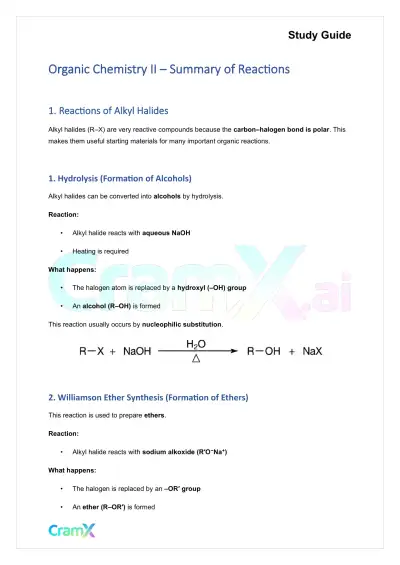 Quick Guides
Organic Chemistry II - Summary of Reactions
Chemistry
52 pagesMar 2026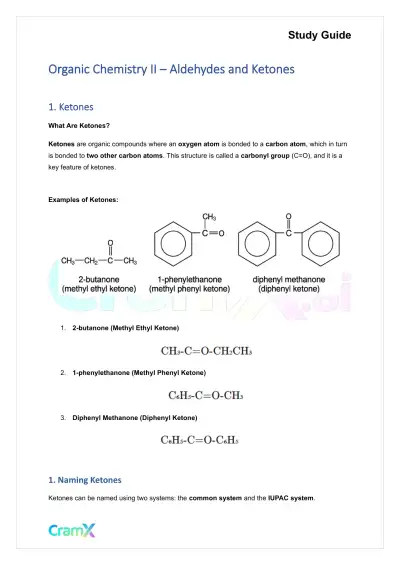 Quick Guides
Organic Chemistry II - Aldehydes and Ketones
Chemistry
35 pagesMar 2026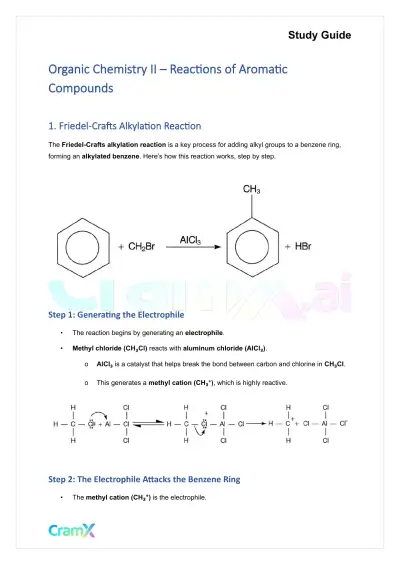 Quick Guides
Organic Chemistry II - Reactions of Aromatic Compounds
Chemistry
24 pagesMar 2026 Quick Guides
Organic Chemistry II - Phenols and Aryl Halides
Chemistry
35 pagesMar 2026 Quick Guides
Organic Chemistry II - Alkyl Halides
Chemistry
32 pagesMar 2026 Quick Guides
Organic Chemistry II - Spectroscopy and Structure
Chemistry
16 pagesMar 2026 Quick Guides
Organic Chemistry II - Amines
Chemistry
19 pagesMar 2026
Study this document with CramX
Once it is in your library, every tool can work from it.